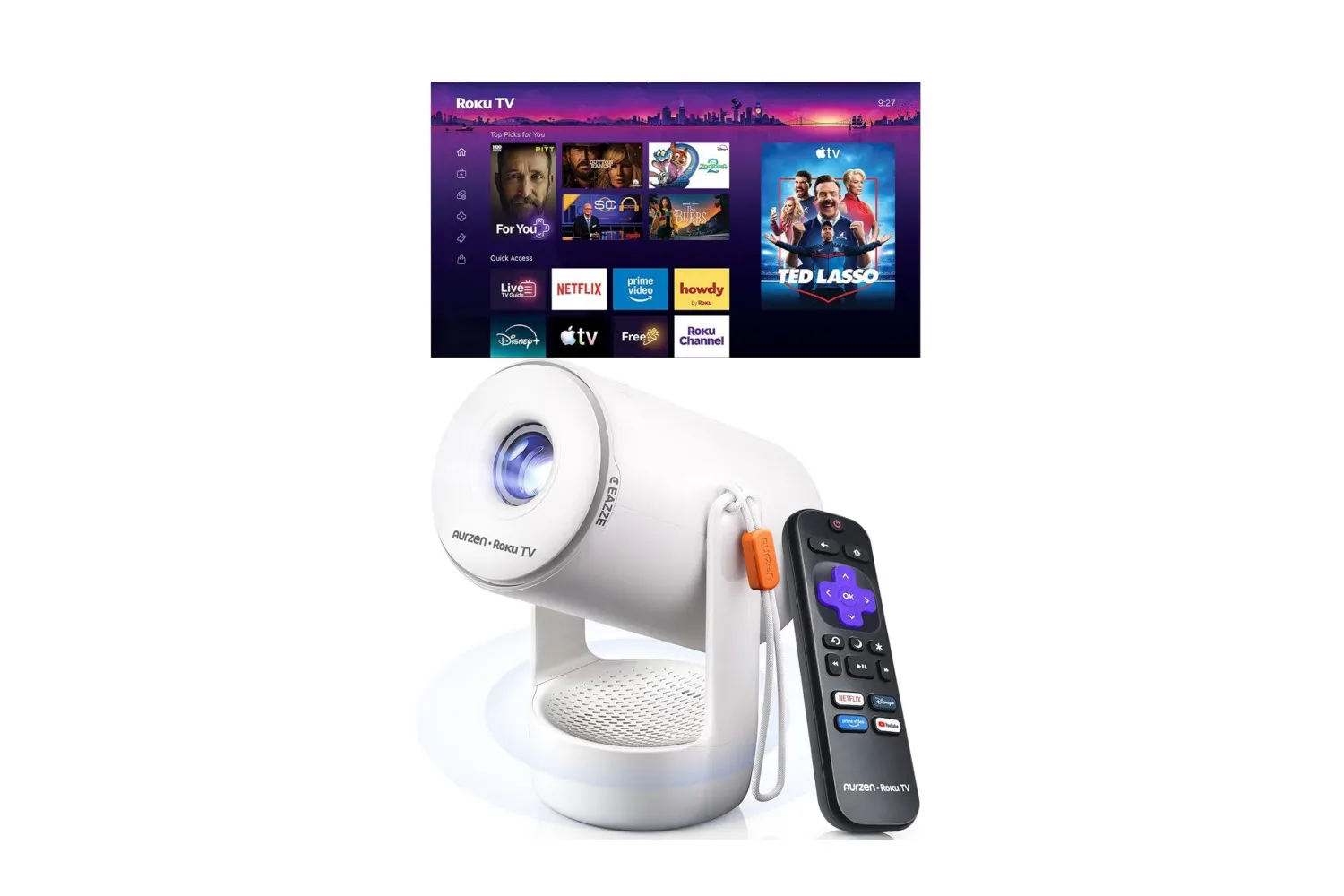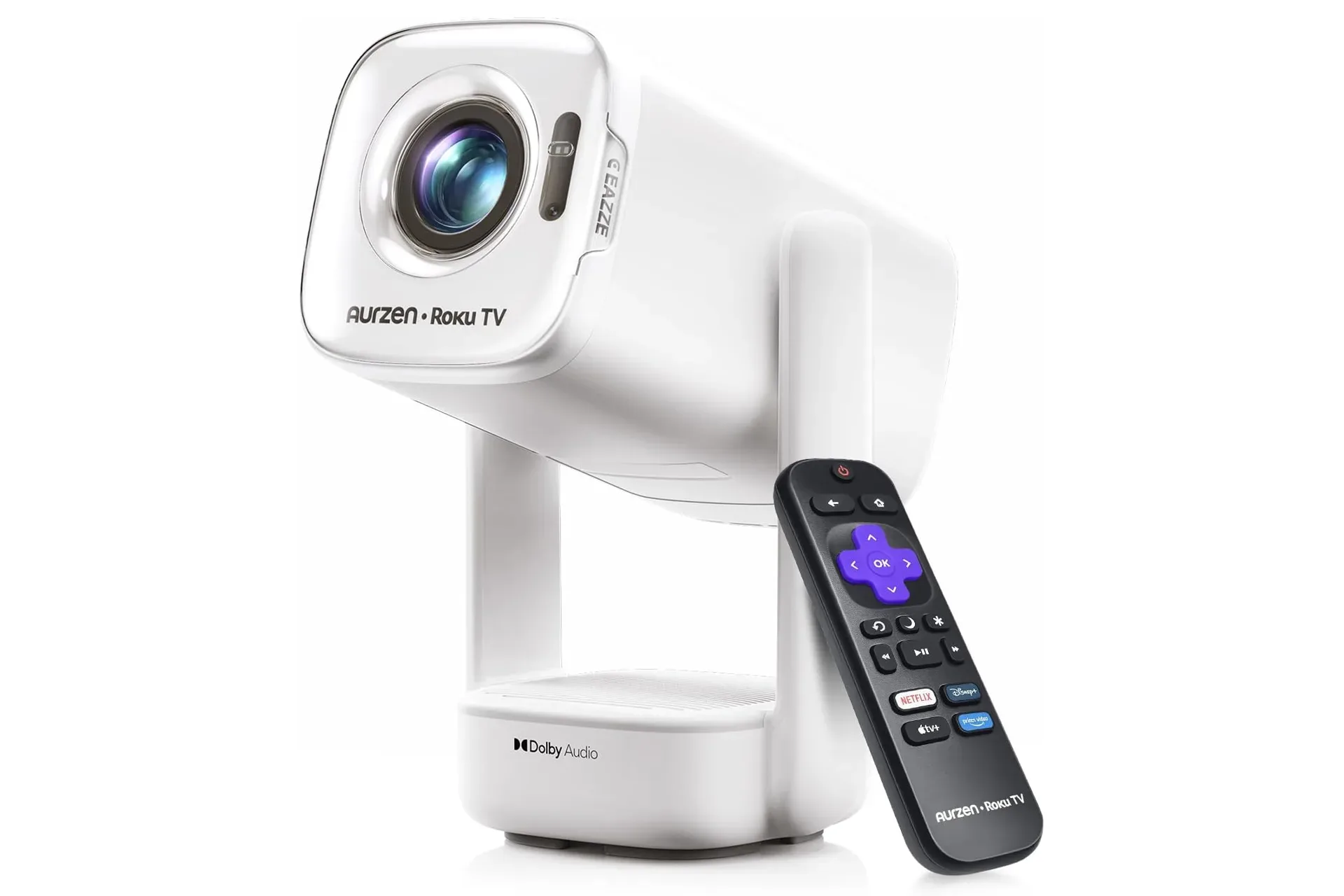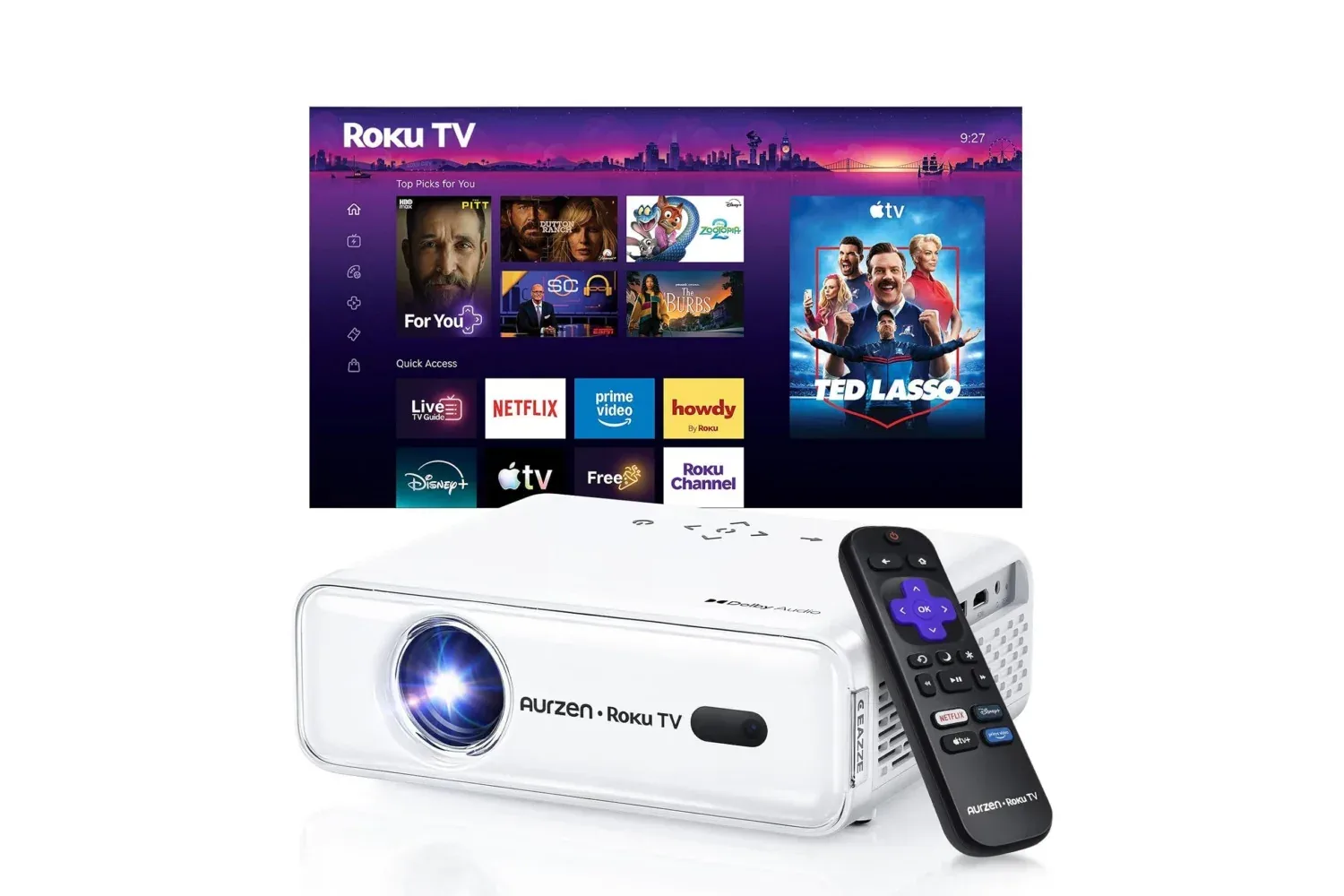
Aurzen’s Roku TV D1R smart portable projector is listed on Amazon for $130, a reduction of $70 from its stated $200 price. That is a 35% discount, and it puts the main proposition in straightforward terms: a portable 1080p projector with Roku TV already built in for considerably less than the cost of many conventional television upgrades.
For gaming and movie-night setups, the attraction is not that a projector is automatically better than a TV. It is that it can create a very large shared image without claiming permanent space on a wall or entertainment unit. The D1R is specified to project an image up to 150 inches, while its built-in Roku interface supplies a direct route to streaming apps and free channels. It also supports Bluetooth 5.2, device casting from Apple and Android hardware, and private headphone listening.
That package does not answer every question a buyer should ask about a projector. The supplied details do not state brightness, input options, gaming latency, contrast performance, or the projector’s ideal image size. Those omissions matter. Still, the D1R’s stated features outline a potentially useful, all-in-one option for someone whose priority is flexible, large-format viewing rather than replacing every function of a living-room display.
What the $130 deal includes
The D1R combines a projector with the Roku TV platform. In practical terms, that means streaming software is integrated into the device rather than requiring a separate streaming stick or box to access services. Netflix, Prime Video, Hulu, YouTube and The Roku Channel are among the named apps, while Roku TV also provides access to more than 500 TV channels.
Those channels broaden the projector’s potential use beyond a single film session. The intended experience can include on-demand shows, live sports, news, weather, and free content within the same interface. An included remote handles basic navigation and has dedicated buttons for Netflix, Disney+, Apple TV and Prime Video.
At its listed price, the D1R is therefore not merely a display device. It is positioned as a screen, streaming interface and basic audio solution in one compact category of product. That matters for a temporary setup in a bedroom, apartment, shared room, or a space where bringing in a full television and several connected devices would be inconvenient.
1080p and a claimed 150-inch image: what those figures mean
The projector’s native stated resolution is 1080p Full HD. “1080p” refers to a 1,920-by-1,080-pixel image. It remains a familiar resolution for streamed video and is a sensible baseline for a projector aimed at movies, television and casual big-screen use.
Resolution is only one component of perceived picture quality. On a projected image, the surface used, room lighting, projection distance, image size and the content itself can all affect how sharp and satisfying the result feels. The D1R’s 150-inch maximum is an upper limit, not a promise that every room will be suited to a 150-inch presentation. A projector needs room to throw a large image, and the wall or screen needs to accommodate it.
That said, a maximum size of 150 inches explains why projectors remain appealing for group viewing. A typical television becomes physically imposing and expensive long before reaching that scale. For a watch party or couch co-op session where the purpose is to let a room full of people follow the action, sheer image area can be more valuable than the compactness of a standard set.
Buyers should keep expectations aligned with the information available. There is no brightness rating in the provided product details, so there is no supported basis for judging how the D1R will handle daylight or strong room lighting. Anyone planning a purchase specifically for a bright living room should seek that specification before treating 150 inches as the usable everyday target.
Audio is built in, but expansion is part of the appeal
Aurzen specifies 5W built-in speakers with Dolby Audio support. Built-in sound has an obvious convenience advantage: it lets a viewer begin watching without routing cables through an AV receiver or attaching external speakers. That is especially relevant to a portable projector, where a quick setup is often more useful than a permanent installation.
“Dolby Audio” identifies audio processing or compatibility rather than a guarantee that a small integrated speaker system will match a dedicated soundbar or larger speakers. The more consequential flexibility here is Bluetooth 5.2. The projector can pair with headphones for private viewing, or with compatible speakers when a movie, match or game needs more substantial sound.
Private listening is a meaningful feature in a shared home. A large projection can be social; it can also be useful when someone wants the big image without filling the room with dialogue, soundtrack or game audio. Conversely, Bluetooth speaker support gives users a route to scale up the audio side later instead of requiring every part of the setup to be purchased immediately.
Casting makes it more useful than a fixed streaming menu
Roku TV provides the structured app experience, but the D1R also supports casting from Apple and Android devices. Casting is the process of sending media from a phone or tablet to another screen. It is useful when the desired material is already on a personal device rather than inside a television app.
Family videos are one clear example. Photos and clips can be easier to share on a wall-sized display than around a handset. The same flexibility can help with a web video, a specific piece of mobile content, or an app that a user prefers to access from their own device.
The details provided do not establish which casting standards are supported, nor do they describe casting performance. It is better to view Apple and Android casting support as a welcome convenience feature than assume it resolves every possible device-compatibility scenario.
Where it fits in a gaming setup
There is a strong case for a projector in local multiplayer, party-game, sports-game and retro-gaming settings. The large image gives multiple people a better view, and portability means the screen can be moved to where the gathering is happening. Roku TV also makes the jump from game session to show, film or highlights easy without introducing an additional media device.
But there is a key distinction between a large image and a gaming-optimized display. The information supplied does not mention HDMI ports, refresh rate, input lag, game mode, variable refresh rate, or console support. Input lag is the delay between pressing a controller button and seeing the result on screen. It is particularly important in fast competitive games, fighting games and rhythm games. Without a stated figure or a named low-latency mode, the D1R should not be represented as a projector designed for performance-focused competitive play.
For relaxed, shared gaming, those missing specifications may be less central than the room-friendly design, integrated streaming and projected size. For a player buying chiefly for twitch-sensitive console or PC games, they are questions to resolve before purchase. A big projected picture can be exciting, but technical suitability depends on more than image size and resolution.
Practical checks before choosing a projector over a TV
- Measure the room and wall: A 150-inch maximum image is only helpful if the space can accommodate it.
- Consider ambient light: The available details provide no brightness figure, so prospective buyers should verify whether their viewing room can be darkened and check the product listing for additional specifications.
- Plan the audio: The built-in 5W speakers offer a simple starting point; Bluetooth headphones or speakers provide alternatives for quieter or bigger-sounding sessions.
- Confirm the connections needed: Console and PC users should verify the available inputs and relevant gaming specifications instead of inferring them from the smart TV features.
- Think about the primary use: Roku TV and casting make the D1R especially straightforward for streaming and shared personal media, while dedicated competitive gaming demands information that has not been supplied.
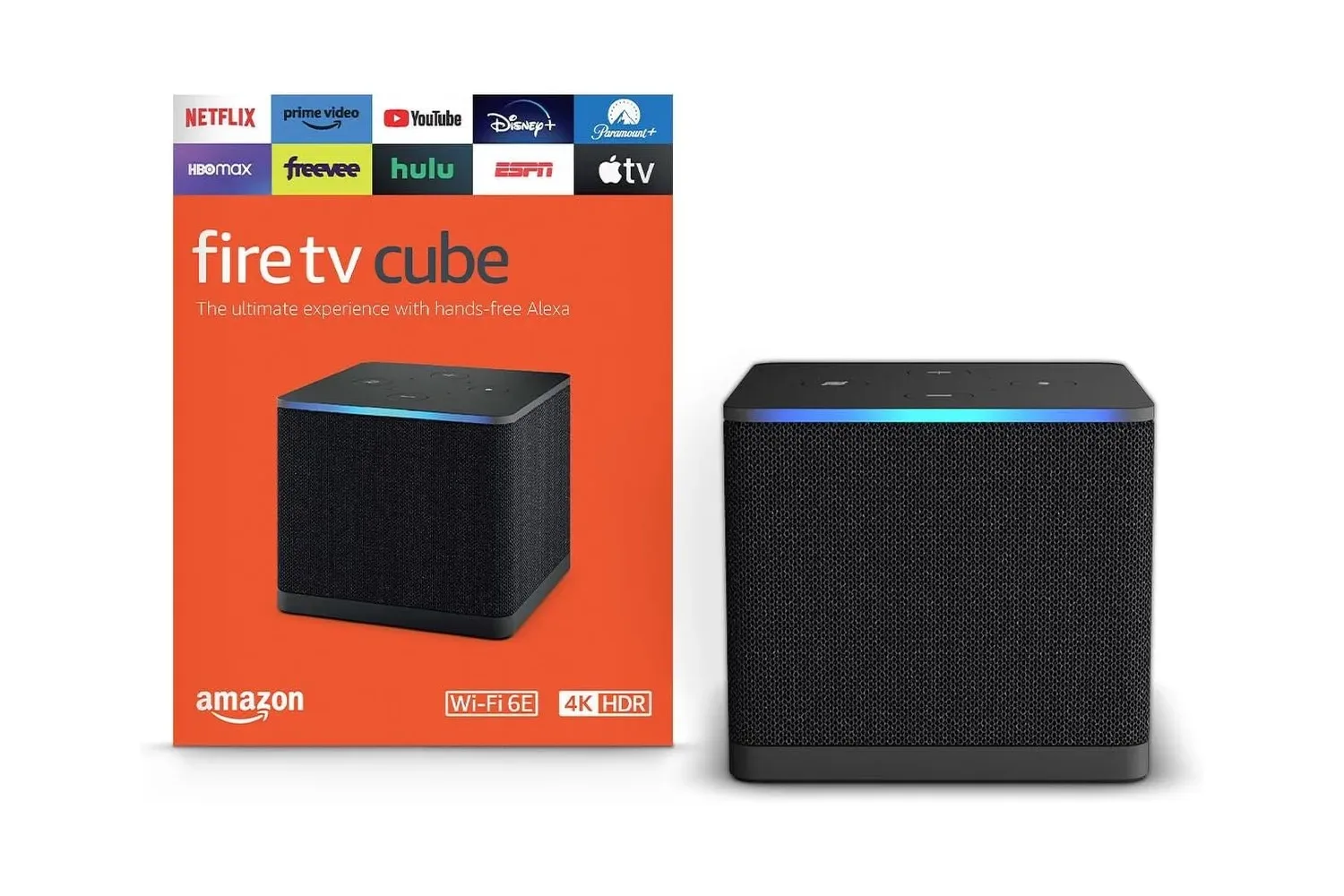
The same broader buying principle applies to streaming hardware generally: price cuts and feature labels are most useful when they are tied to the way a device will actually be used. For another example of breaking down what a streaming-device discount does and does not provide, see this look at the Fire TV Cube’s $110 listing.
The value proposition is convenience, not a universal TV replacement
At $130, the Aurzen Roku TV D1R’s clearest strength is how many basic pieces it brings together: 1080p projection, a claimed maximum 150-inch screen, Roku TV, streaming apps, free channels, onboard speakers, Bluetooth and mobile casting. The included shortcut remote further supports the idea of a low-friction entertainment device rather than a projector that needs a stack of accessories before it becomes enjoyable.
It should not be treated as proof that a smart TV no longer serves a purpose. TVs have different strengths, and the available D1R information leaves important picture and gaming-performance measurements unaddressed. But for buyers looking to add an occasional large-screen experience for films, streaming, family media or casual group play, the current listing turns an already approachable category into a notably lower-cost proposition.
The price, discount and delivery terms can change, so purchasers should confirm the live Amazon listing before checking out. The underlying choice is simpler: if integrated streaming and a flexible giant image matter more than permanent, high-spec display performance, this Roku-equipped projector has a compelling feature set at its stated $130 sale price.
Shop the products
Check current price, model and availability at the retailer.