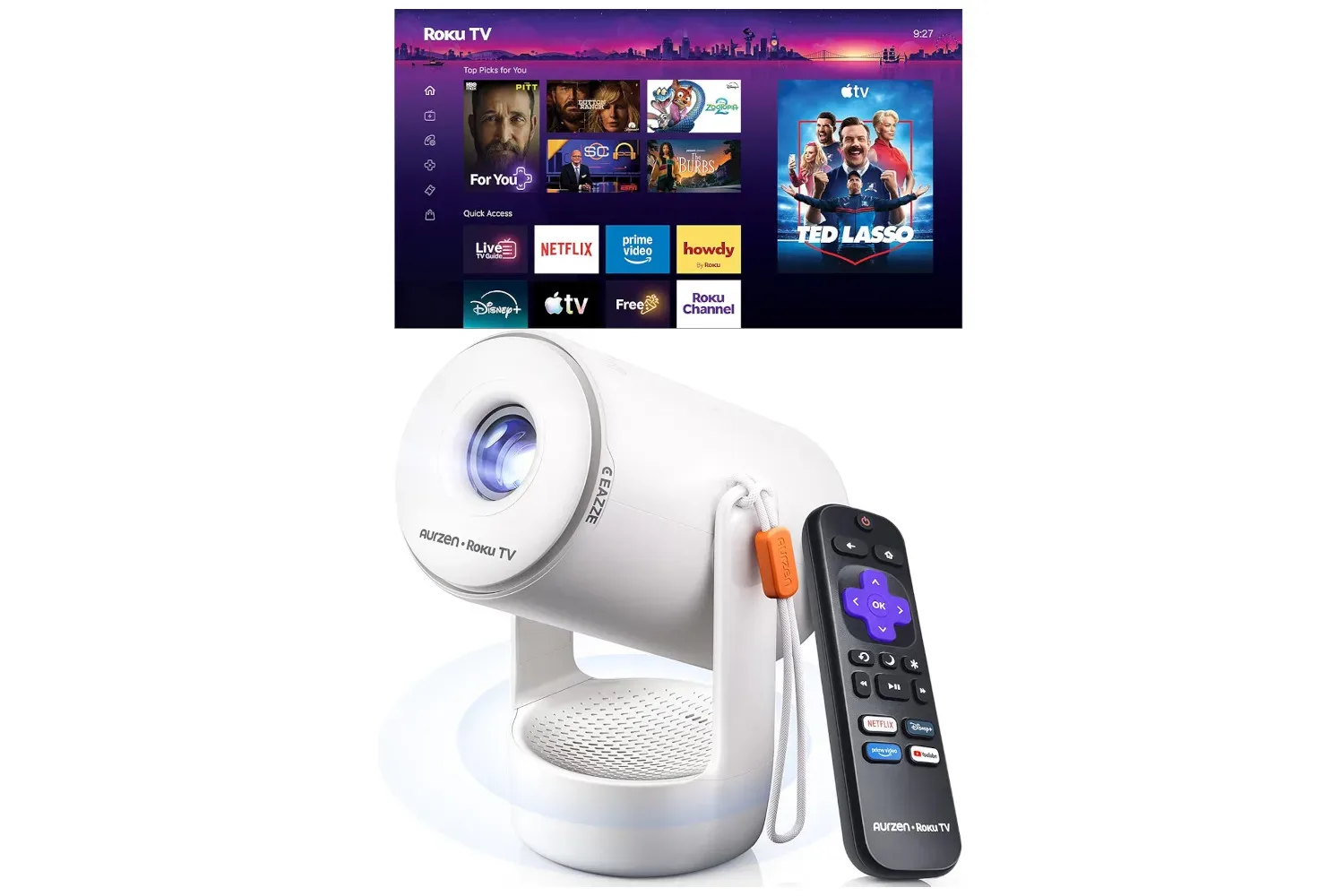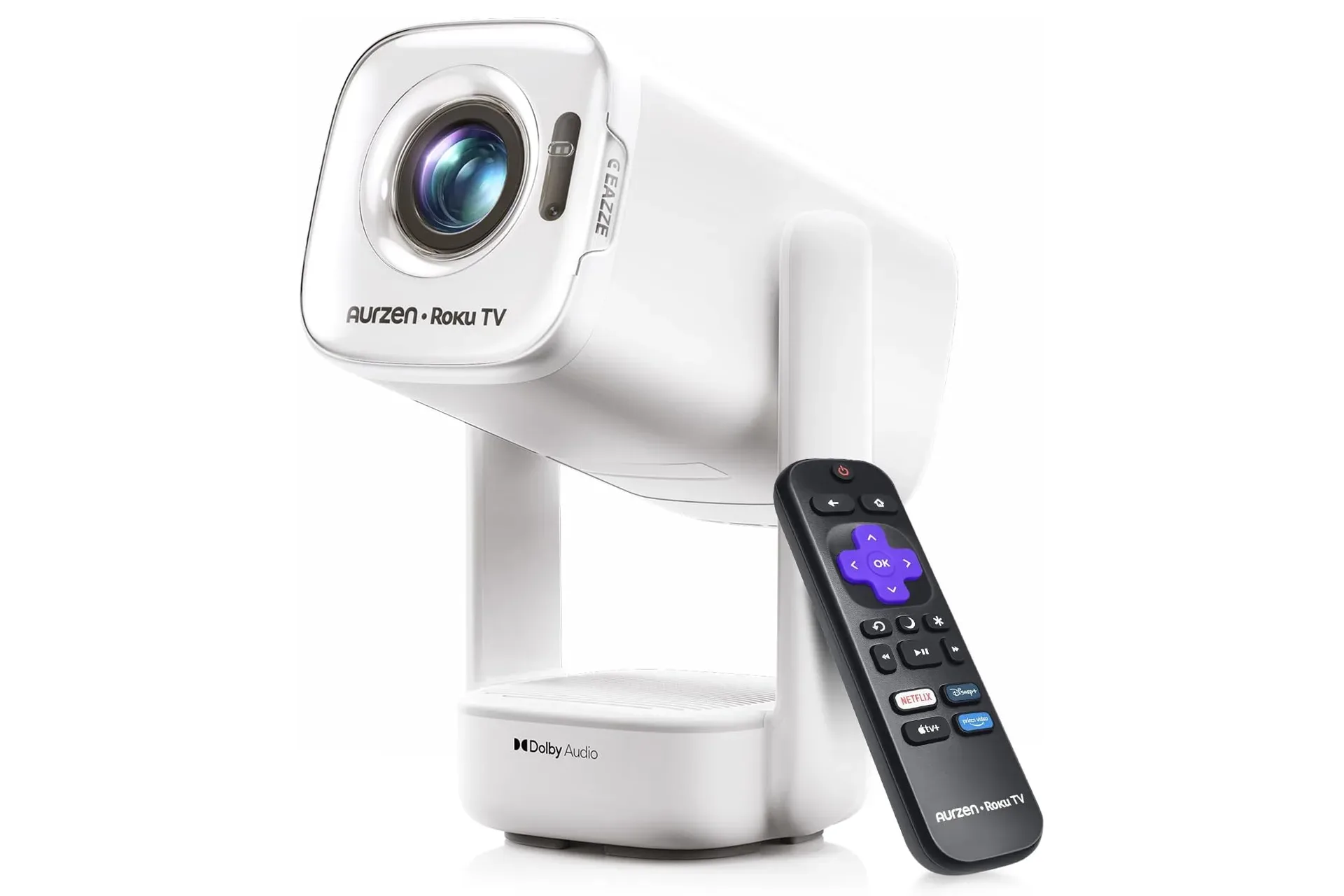
Aurzen’s Roku TV D1R Air portable smart projector is currently listed at $150, a $90 reduction from its stated $240 regular price. The limited-time price represents 38% off, and the appeal is straightforward: it puts a Roku TV interface, native 1080p projection and a relatively travel-friendly design into one device intended for quick movie or streaming setups.
For gaming households, a projector like this is less about replacing a main display and more about creating an occasional shared-screen setup. A backyard film night, a living-room co-op session, a dorm-room stream or an impromptu ceiling viewing arrangement all benefit from equipment that does not demand a permanent installation. The D1R Air’s supplied specifications suggest that portability and convenience, rather than an elaborate home-theater build, are its central pitch.
The deal, and what it actually covers
The D1R Air is a portable smart projector with Roku TV built in. At the advertised $150 price, buyers are getting the projector itself with its integrated streaming platform; the information provided does not establish what accessories beyond the projector are included. Aurzen’s PowerBase Stand, for example, is specifically described as sold separately.
That distinction matters because a portable setup can mean different things. The projector can be powered through USB-C using 65W Power Delivery input, but “USB-C powered” should not be read as a promise that it contains its own battery. The supplied details instead point to external power options: a nearby wall outlet, a laptop charger power bank, or the separate PowerBase Stand.
Power Delivery, often shortened to PD, is a USB-C power standard. In this case, the relevant claim is support for a 65W PD input. Practically, that gives the D1R Air a potentially simpler power arrangement than a projector that requires a more specialized cable or brick, provided the power source can supply the required PD input. Anyone planning an outdoor showing should still make power the first part of the plan, not the final detail.
A portable design built around placement flexibility
The projector weighs about two and a half pounds and sits on a smooth-damping gimbal that rotates for aiming at a wall or ceiling. A gimbal here means the adjustable support mechanism holding the projector: rather than stacking books, propping up the chassis or relying on a fixed-angle placement, the user can rotate the unit to direct the image where it needs to go.
That could be useful in a small apartment as much as outdoors. Ceiling projection is an option when wall space is unavailable, while the low weight makes carrying it to another room or a friend’s home less of a commitment. It also gives a group more latitude to arrange seating around the projected surface rather than forcing everyone to crowd around a conventional television.
There is a practical caveat, though: placement flexibility is not the same as a complete outdoor solution. The provided details do not claim weather resistance, a built-in battery, a bundled stand, or any particular projection distance and image-size range. Those omissions do not make the projector unsuitable for a casual event, but they do mean buyers should avoid assuming those capabilities from the portable label alone.
Related coverage includes Aurzen D1R Air Roku Projector Drops to $150 for Early Prime Day.
1080p and 300 ANSI lumens: reading the key display claims
Aurzen lists the D1R Air with native 1080p HD resolution and 300 ANSI lumens of brightness. Native 1080p means the projector’s underlying displayed image resolution is 1920 by 1080 pixels, rather than merely accepting a 1080p signal and scaling it to a lower-resolution panel. For films, streams and game footage, that is the more meaningful way to describe a projector’s resolution.
The brightness measurement is equally important, even if it is easy to overlook in a sale listing. ANSI lumens are the stated brightness metric here. In practical terms, brightness is one of the major factors that affects how much ambient light a projector image can tolerate. The supplied 300-ANSI-lumen specification should therefore prompt buyers to consider their intended viewing conditions, particularly if the attraction is a backyard gathering. Darker environments will naturally make a projected image easier to see than a brightly lit area.
The listing does not provide contrast, screen-size, throw-distance, input-lag or refresh-rate figures. Those are all specifications that may matter to different buyers, but they should not be guessed at. Most notably for players, nothing in the available information supports a claim about competitive gaming suitability or console responsiveness. The D1R Air may be useful for communal entertainment, but its listed attributes should not be confused with a performance certification for fast, reaction-sensitive play.
That does not diminish the social use case. A party-friendly display and a tournament-ready display can be very different products. For a laid-back evening where the focus is a shared movie, a stream or co-op chaos rather than leaderboard precision, easy setup, a movable image and integrated apps can matter more than the specifications that define a dedicated gaming monitor. That shared-screen spirit is also why co-op play can remain compelling even when perfection is not the point.
Roku TV is the convenience feature
The D1R Air runs Roku TV out of the box. That means the device is positioned to access streaming services directly rather than requiring a separate stick or box just to start watching. Netflix, HBO Max and Disney Plus are among the apps identified for the platform, alongside access to more than 500 free television channels with live news, weather and sports coverage.
For a host, integrated Roku TV reduces setup steps. There is no need to make a laptop the center of the evening merely to open a streaming app, and there is no separate streaming accessory to remember when packing the projector. The benefit is not that Roku TV changes the image hardware; it is that the content interface is already part of the device.
Of course, integrated streaming does not remove the need for an appropriate internet connection or access to whichever subscription service contains the desired title. It also does not turn a Roku projector into a game console. The available information focuses on streaming apps and free channels, not on gaming services, physical console connections or controller support. Buyers seeking those capabilities should confirm them independently before treating the D1R Air as a gaming-display purchase.
Sound and the compact-event question
The projector includes built-in speakers with Dolby Audio support. Built-in audio is especially helpful for a spontaneous setup because it means there is sound available without automatically adding a separate speaker to the packing list.
“Dolby Audio” describes support for Dolby audio technology; it should not be treated as a measurement of speaker volume, bass response or how well the system will fill a particular backyard. The details provided do not state output power, speaker size or any performance level. For a small, close-knit viewing group, integrated speakers may simplify the setup. For a larger or noisier gathering, buyers should plan expectations cautiously because no claim has been supplied about room- or yard-filling sound.
Who this sale best suits
The $150 listing appears most compelling for someone who wants one compact device for occasional streaming nights and values a low-friction setup. The native 1080p resolution, Roku TV software, USB-C PD input, built-in speakers and adjustable gimbal all support that picture. It is especially easy to see the appeal for a seasonal movie night, where a projector can turn a blank wall into the focal point without permanently reorganizing the room.
It is less clear-cut for shoppers who need detailed assurance around competitive console play, permanent theater installation, battery operation, large-scale audio, or bright-room projection. The facts available do not answer those questions, so the sensible approach is to judge the deal on what is confirmed rather than fill in the blanks.
Confirmed highlights
- Limited-time listed price of $150, down from $240.
- Native 1080p HD projection.
- 300 ANSI lumens of stated brightness.
- Roku TV built in, including major streaming apps and more than 500 free TV channels.
- USB-C power with 65W PD input support.
- About two and a half pounds in weight.
- Rotating smooth-damping gimbal for wall or ceiling aiming.
- Built-in speakers with Dolby Audio support.
Details not established by the available listing information
- Battery capacity or built-in battery operation.
- Whether the separate PowerBase Stand is necessary for a given setup.
- Input lag, refresh rate and competitive gaming performance.
- Projection-size and throw-distance specifications.
- Weather resistance or outdoor durability.
- Built-in speaker output and performance at larger gatherings.
At its current listed discount, the D1R Air’s strongest proposition is convenience: move it, point it, power it over USB-C and open Roku TV. For viewers who want that kind of flexible, occasional big-screen experience, the price cut makes the proposition substantially easier to consider. Just keep the event conditions realistic—especially light, power and sound—and avoid expecting unlisted home-theater or high-performance gaming features.
Shop the products
Check current price, model and availability at the retailer.