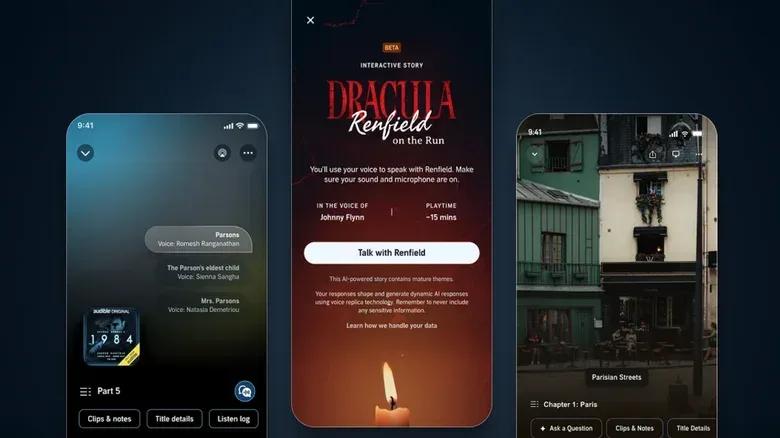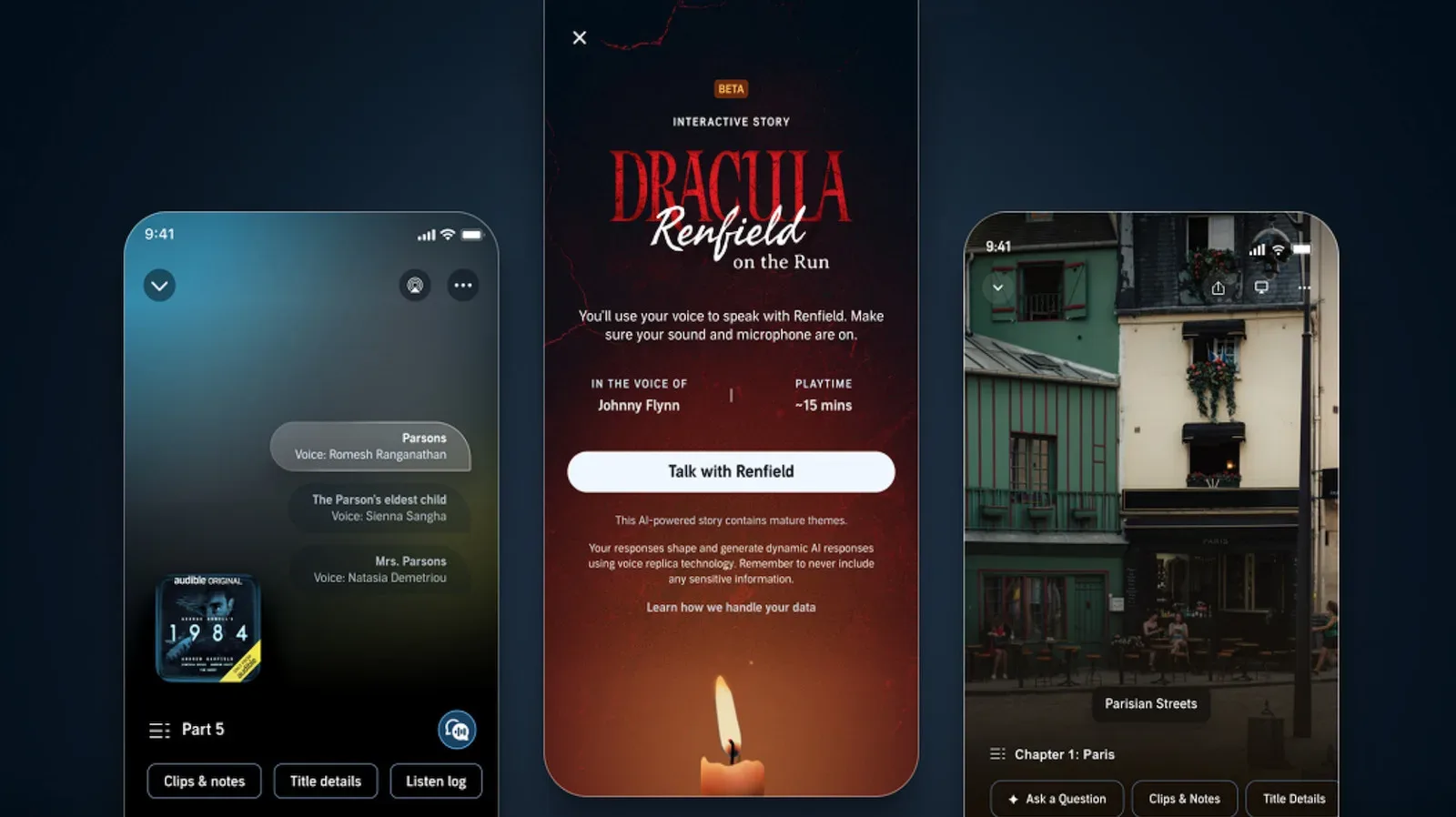
Audible is preparing a more participatory set of audio features, beginning with an AI-driven interaction set in the world of its forthcoming adaptation of Dracula. The first “Interactive Story” puts listeners in contact with Renfield, Dracula’s profoundly overworked servant and, apparently, the app’s first unwilling quest giver.
The premise is straightforward even if the technology is ambitious: Renfield assigns the listener a role, an objective and stakes, then the listener replies in their own words. The character is intended to respond in real time. Rather than selecting from a fixed set of dialogue options, the listener is meant to converse through generative AI.
It is a notable attempt to move an audiobook app a little closer to interactive fiction and role-playing. It is also an experiment that will live or die on execution. A spooky assignment from Renfield could be delightful; a confident but nonsensical AI response from Renfield could make the poor man seem even more beleaguered than usual.
What Audible means by an Interactive Story
An Interactive Story, as described so far, is not simply an adaptation with a few bonus recordings. It is a responsive encounter attached to an audio world. The listener is given a scenario and can answer naturally, while a character reacts immediately.
Generative AI refers to systems that produce new material—here, character responses—rather than merely retrieving a prewritten line from a database. That distinction matters. Traditional branching narrative design gives a player a finite number of authored paths. An AI conversation promises wider input: listeners can phrase an answer in their own way rather than hunt for the one dialogue button that most closely matches it.
The trade-off is control. A fixed dialogue tree may be limited, but writers can carefully establish every major response, safeguard story logic and ensure a character remains recognisable. A generative system has to balance open-ended conversation against those same needs. In a literary horror setting, maintaining tone is particularly important. Renfield should sound like Renfield, not like a chat assistant that has vaguely heard of bats.
No detailed mechanics have been specified beyond the assignment, response and real-time reaction structure. There is no stated information about how long exchanges can last, whether choices affect an ongoing story, what formats listeners will use to respond, or how much of the experience is prewritten versus generated. Those are practical questions worth keeping in mind when the beta arrives.
The company says Interactive Stories will launch in beta later in the fall, but has not supplied a firm date. Its new Dracula adaptation is dated October 1, so the feature is positioned around that release without a confirmed timetable.
Why the Dracula setting makes sense—and why it is a difficult test
Dracula is a sensible opening setting for this kind of feature. The story’s enduring cast and Gothic atmosphere give an interactive scene immediate texture. Renfield is also a useful point of contact: he belongs to Dracula’s orbit but is distinct from the Count himself, letting the listener enter the world without the feature needing to turn its central villain into a customer-service representative.
There is a structural advantage, too. Giving listeners a role, goal and stakes provides an interaction with a frame. That is important for a conversational feature. Without a clear purpose, a character chat can become a novelty with nowhere to go; with an assigned task, it has the outline of a small role-playing scenario.
But a good frame is only the beginning. The key questions are narrative ones: Does the listener have meaningful agency? Do their replies change the scene in a way that feels intelligible? Are the goal and consequences clear? And does the interaction have a satisfying stopping point instead of fading out after several exchanges?
Those concerns will be familiar to game audiences. Games have long used dialogue systems to make players feel acknowledged while keeping a narrative on course. This proposal approaches the same challenge from the other direction: instead of presenting a visible menu of authored responses, it invites listeners to speak freely. The appeal is obvious. So is the possibility that an open prompt may expose the limits of the underlying system.
For an audio service, there is another consideration: listening is often a hands-busy activity. People use audiobooks while walking, commuting or doing chores. A feature that expects a live response may be best suited to deliberate listening sessions rather than passive background playback. That does not make it a poor fit, but it means Interactive Stories may function more like an optional companion activity than a replacement for the usual audiobook experience.
The next planned experiment is Exoplanet
Audible has already identified a second Interactive Story. It will be set in Exoplanet, an original audio novel created with author Benjamin Percy, and is set for release on November 5.
That progression is revealing. Starting with Dracula connects the feature to a well-known literary world, while Exoplanet offers an original setting built alongside its author. The latter could be an especially useful environment for an interactive format because the world and its boundaries can be considered together from the beginning.
It should not be assumed, however, that author involvement means every AI response is personally written or approved. No such production details have been provided. What is known is that the Exoplanet experience was created alongside Percy and is the next announced use of the Interactive Stories concept.
For listeners, the distinction between an adaptation and an original audio world may affect expectations. With a familiar classic, people may arrive with firm ideas of who each character is. A new setting gives the format more room to establish its own rules, but it also has to earn the audience’s interest without the head start of a famous title.
Character Guide may be the most immediately practical addition
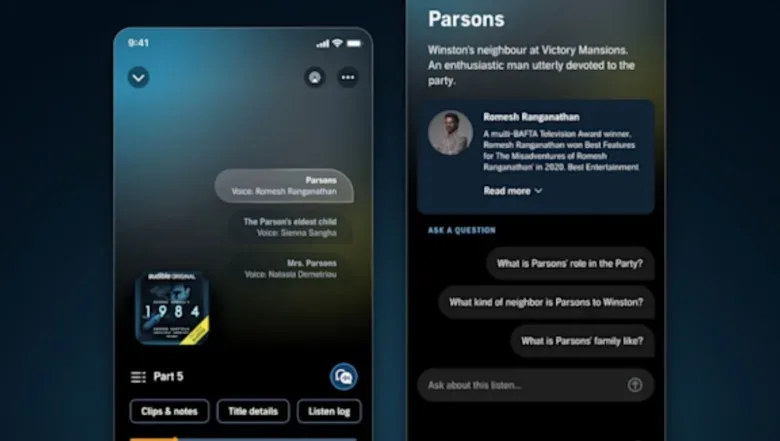
Alongside the conversational experiment, Audible is expanding a feature called Character Guide. It displays the current speaker visually in the app while an audiobook is playing and includes spoiler-free character cards.
This is a modest idea with a clear benefit. Full-cast audio and stories with large ensembles can make it difficult to keep every voice, name and relationship straight, especially after a pause between listening sessions. A visual cue showing who is speaking supplies context without asking users to leave the book and search for it elsewhere. Spoiler-free cards, if they remain genuinely spoiler-free, may help listeners refresh their memory without risking a major plot revelation.
Character Guide is already available with Audible’s adaptation of George Orwell’s 1984. It is also planned for Dracula and Exoplanet.
This tool does not turn an audiobook into something else. Instead, it addresses a practical weakness of an audio-only format: sound is excellent at performance and atmosphere, but less convenient for checking a name or untangling a crowded cast. For listeners who want that kind of support, the guide could be more valuable day to day than a headline-grabbing AI conversation.
Visual Explorer adds images without abandoning audio
Another planned feature, Visual Explorer, will show relevant imagery and visual context at selected moments during playback. The examples given include a map or an image connected to a pivotal event that listeners can explore.
That makes Visual Explorer different from Character Guide. Character Guide helps answer who is speaking? Visual Explorer is meant to answer questions of place, object or historical context. A map can be useful when a narrative moves through unfamiliar geography; an associated image can give a listener a reference point at a significant moment.
The first beta is planned alongside The Cultural Tutor’s Grand Tour: The Story of Europe in Six Cities, an audio tour through historical destinations in Europe. That is a particularly natural test case. Contextual imagery could help listeners orient themselves without demanding that the entire experience become a screen-first presentation.
The implementation will matter. Visual accompaniment is best treated as optional enrichment: useful for someone looking at their device, but not required for someone who is listening with the screen away. Audio has its own strengths, and a visual tool should support them rather than quietly make the experience incomplete without a display.
What this says about audio apps becoming interactive spaces
These three initiatives sit on a spectrum. Character Guide is a reference aid. Visual Explorer is contextual accompaniment. Interactive Stories is a bid for participation. Together, they suggest an effort to make listening more navigable and, in selected cases, more game-like.
That does not mean every audiobook needs a map, cast card or AI character. Plenty of listeners want narration, performance and nothing else. The sensible version of this strategy is one that keeps the core listening experience intact while making extra layers available to people who want them.
The interactive portion has the largest unanswered questions, including how reliably it handles freeform answers and whether it creates genuine narrative momentum. Still, the basic idea has a defensible appeal: a listener receiving a mission from Renfield is a more specific and potentially memorable proposition than a generic chatbot dressed in a cape.
It also reflects a broader interest in stories that let audiences participate rather than only observe. Game players already understand the appeal of occupying a role inside a fictional world, whether through dialogue, quests or emergent character moments. Recent experiments across games continue to explore how systems and authorship can share space; even debates around the balance of authored and reactive play remain central, as seen in this look at the evolving mix of turn-based and real-time design.
Audible’s version is not a game in the usual sense, based on the information available. It is a beta feature for a listening platform, with a character conversation at its center. But it is borrowing a recognisable game-design promise: your response is supposed to matter enough for the world to answer back.
For now, the most grounded expectation is a set of optional experiments arriving around selected titles. Dracula will be the first test of whether a generative-AI character exchange can add tension and playfulness to an audio adaptation. Exoplanet will follow on November 5, while Character Guide and Visual Explorer pursue a less flashy but potentially useful goal: helping listeners know who is talking, where they are and why a particular moment matters.