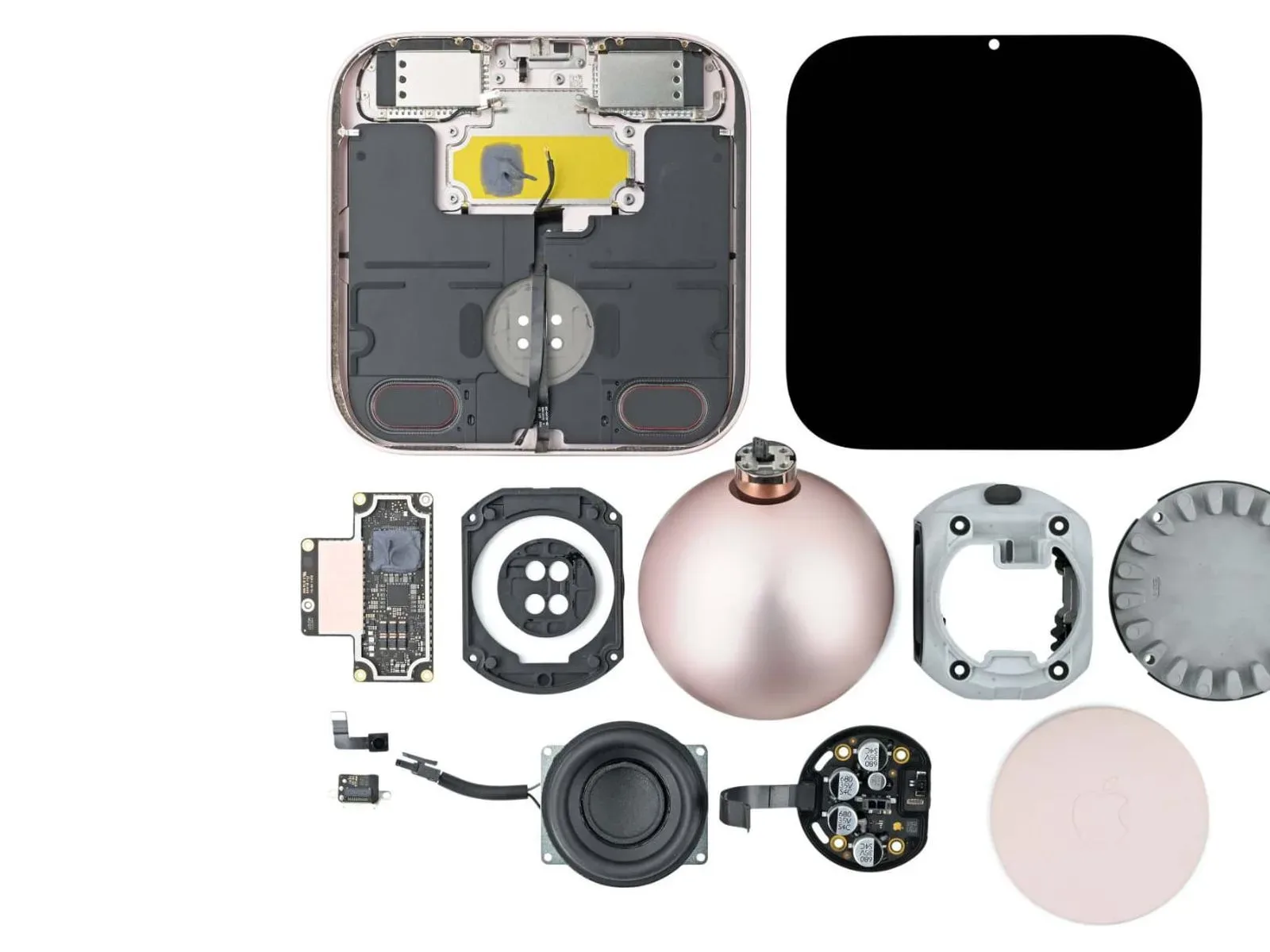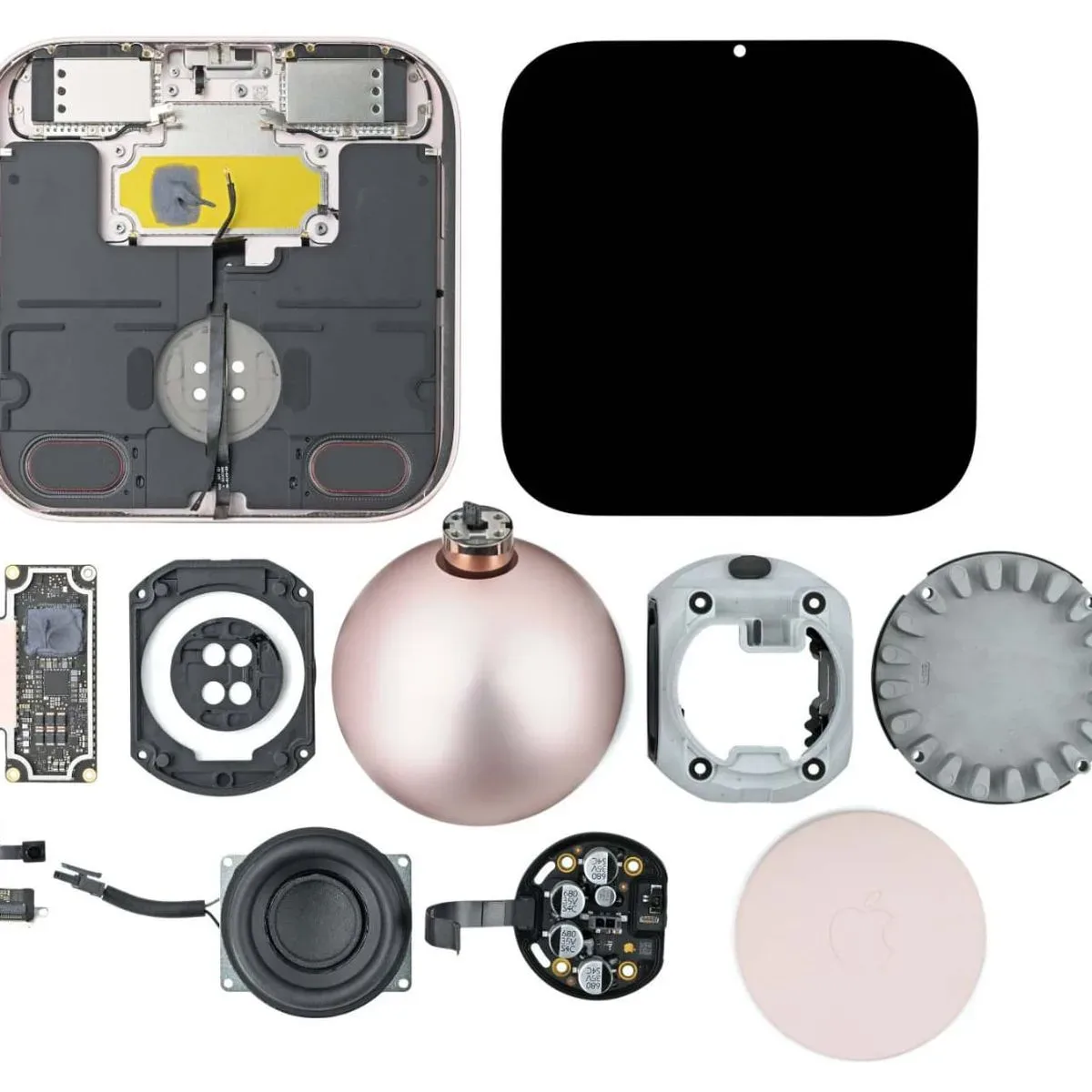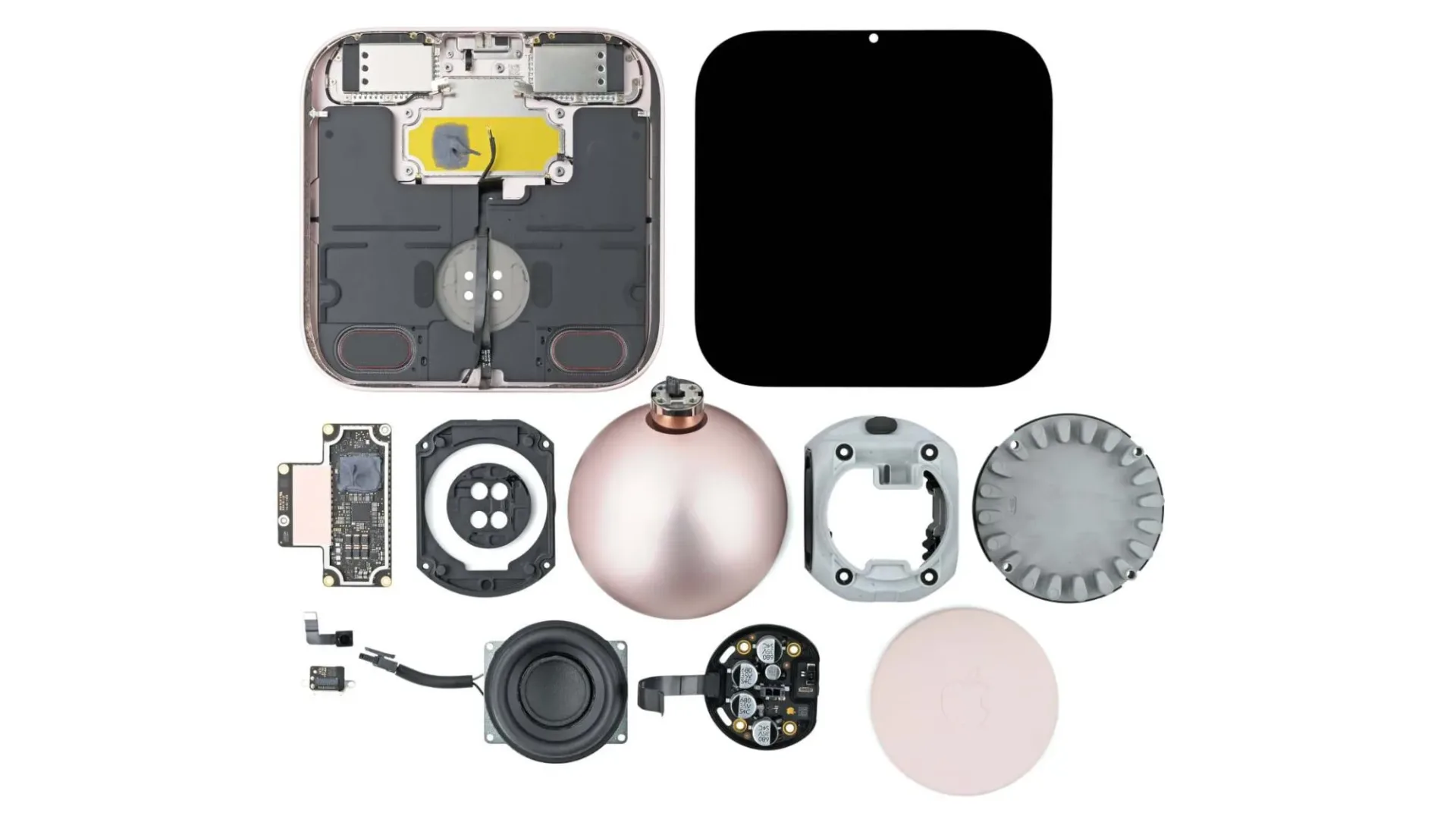
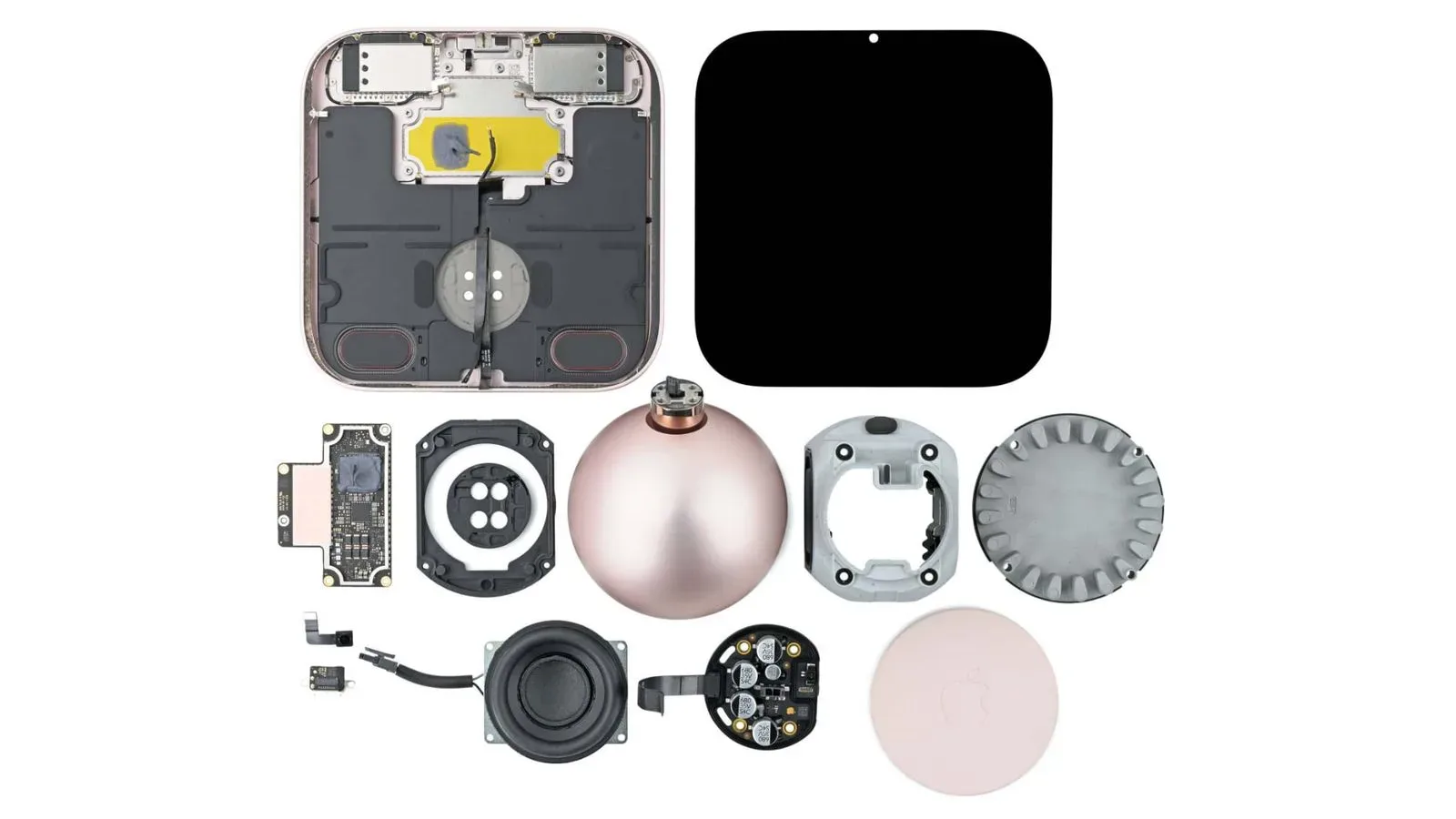
Apple’s HomeView is built around a familiar smart-display proposition: a screen joined to a speaker base. But a new teardown suggests that, beneath that straightforward exterior, the route to a repair is far less friendly than the form factor implies. The investigation found that opening the device and reaching its major internal parts can lead to component damage, with adhesive, thermal materials and a tightly layered layout creating obstacles well before a failed part can be replaced.
The central criticism is not that every piece of HomeView is permanently fixed in place. Some parts of its base can be replaced. Rather, it is that the parts most likely to require deeper access are arranged behind difficult-to-remove assemblies, and the process of getting to them may itself cause damage. The teardown characterizes that result as a backwards step compared with the HomePod’s repairability.
A display product with its internals behind the speakers
Inside HomeView, the speakers occupy most of the volume directly behind the display. The logic board sits behind those speakers, so access to the electronics depends on first working through the audio hardware. A logic board is the main circuit board that carries and links a device’s essential chips, connectors and controls. If it cannot be reached cleanly, diagnosing or replacing related components becomes substantially more involved.
This is not merely a case of removing a few ordinary fasteners. The logic board is covered by a shield that connects to the rear of the aluminum enclosure. Together, the shield and enclosure act as a heat sink: a structure that spreads and sheds heat away from electronics. Thermal control matters in a compact always-connected device, where chips and other components have limited space in which to disperse heat.
That thermal design comes with a repair trade-off. Thermal paste and adhesive attach the shield to the casing, making the board harder to remove. Thermal paste is a material used between surfaces to improve heat transfer; adhesive holds those surfaces or parts together. Both can serve legitimate design roles, but both also turn disassembly into a more delicate operation. In HomeView’s case, the teardown found the combination made extraction of the logic board difficult.
For owners, that distinction matters. A device may be physically possible to open without being practically repairable. A repairable layout provides a repeatable way to reach a component while minimizing the risk to surrounding hardware. When a board is trapped behind speakers and a heat-management assembly, the work becomes more dependent on careful separation of bonded components—an approach with a greater chance of collateral damage.
Adhesive is the major obstacle
The speaker arrangement appears to be the most consequential part of the design. The speakers are held with a thick adhesive pad, and an attempt to remove one during the teardown caused it to snap in half. That outcome illustrates the issue in unusually concrete terms: a component that needs to be moved to access another component may not survive the process.
Adhesive is common in compact electronics because it can secure components without consuming the room required by additional brackets or screws. It can also help a manufacturer achieve a rigid assembly. But from a repair perspective, an adhesive pad can be a single-use barrier. If a part breaks when separated, a repair that began with an unrelated fault may become a repair involving additional replacement parts.
HomeView also uses several cables between the display and the speaker base. Cables and connectors are not automatically a negative for repair, but they are another part of the disassembly sequence that must be handled correctly. More connections between two major modules can mean more opportunities for damage when the device is opened, particularly when the modules cannot be independently separated from the easiest side.
That last detail is important: the display cannot be separated from the base without approaching through the display side. The device’s apparent two-part structure therefore does not translate to a simple display module and a simple base module that can be detached from either direction. The assembly path determines the repair path.
Not every HomeView has the same inside
The wall-mounted and tabletop HomeView versions are not internally interchangeable. The teardown found distinct layouts in the two models: the wall-mounted version uses a larger logic board, while the tabletop model has larger speakers and a pivot mount.
That means the two variants should not be treated as the same device with a different external stand. Their internal architectures differ, and parts are not necessarily transferable between them. This has practical consequences for anyone considering repair planning or parts compatibility. A component from a tabletop unit cannot be assumed to fit a wall-mounted unit simply because both products carry the HomeView name.
The differing designs also show how mounting requirements influence a product’s internals. The tabletop model must accommodate both larger speakers and its pivot mechanism. The wall-mounted model instead makes room for a larger logic board. Neither approach is inherently better on its own, but the variations reinforce that HomeView repair procedures would need to be specific to the version being serviced.
There are a few replaceable pieces in the base
The teardown does identify meaningful bright spots in the speaker base, which is described as being designed similarly to a HomePod and easier to dismantle. The USB-C port is modular, meaning it is a separate replaceable component rather than necessarily being inseparable from the main board. The base’s two passive speakers can also be replaced.
Those are worthwhile design decisions. Ports endure repeated physical use, so a modular USB-C connector can limit the scope of a repair if that individual component is damaged. The ability to replace passive speakers likewise offers a more direct route when the fault is in that part of the audio system.
“Passive speakers” here refers to speaker units that do not contain their own separate amplification electronics. In this design, they are physical audio components within the enclosure rather than self-contained smart speakers. Their replaceability is especially notable because the teardown simultaneously found that at least one larger speaker assembly was difficult to remove without damage. Repairability within the same product can therefore be uneven: some parts may be designed for replacement, while access to others remains risky.
Modularity is often discussed as an all-or-nothing quality, but HomeView is a useful reminder that it exists at the component level. A replaceable port is helpful. Replaceable passive speakers are helpful. Neither benefit fully resolves the difficulty of reaching the logic board or separating the display from the base. An owner’s real repair outlook depends on which specific part has failed.
Why the teardown’s criticism goes beyond “hard to open”
The teardown argues that several of Apple’s decisions make HomeView repairs “unreasonably and unnecessarily difficult.” That conclusion rests on the combined effect of the layout rather than one screw, one cable or one adhesive strip. Speakers block access to the logic board; those speakers are aggressively bonded; the thermal shield is attached using paste and adhesive; and display removal has to begin from the display side.
Individually, each decision may be tied to product goals such as compact construction, audio hardware placement, thermal performance or structural stability. The criticism is that the finished assembly appears to leave too little consideration for a non-destructive repair route. The distinction is significant: a manufacturer can prioritize heat and packaging while still choosing access points and component retention methods that reduce the risk of damage during service. The teardown’s assessment is that HomeView does not strike that balance well.
For consumers, this affects more than do-it-yourself repair. Difficult access can complicate assessment of a fault, increase the work required for a technician, and make an otherwise limited repair more invasive. It can also make condition harder to judge in second-hand contexts, because an attempted opening may introduce new damage. None of that establishes what any particular service will cost or what support options Apple will provide; the teardown evidence speaks to construction and access, not pricing or warranty terms.
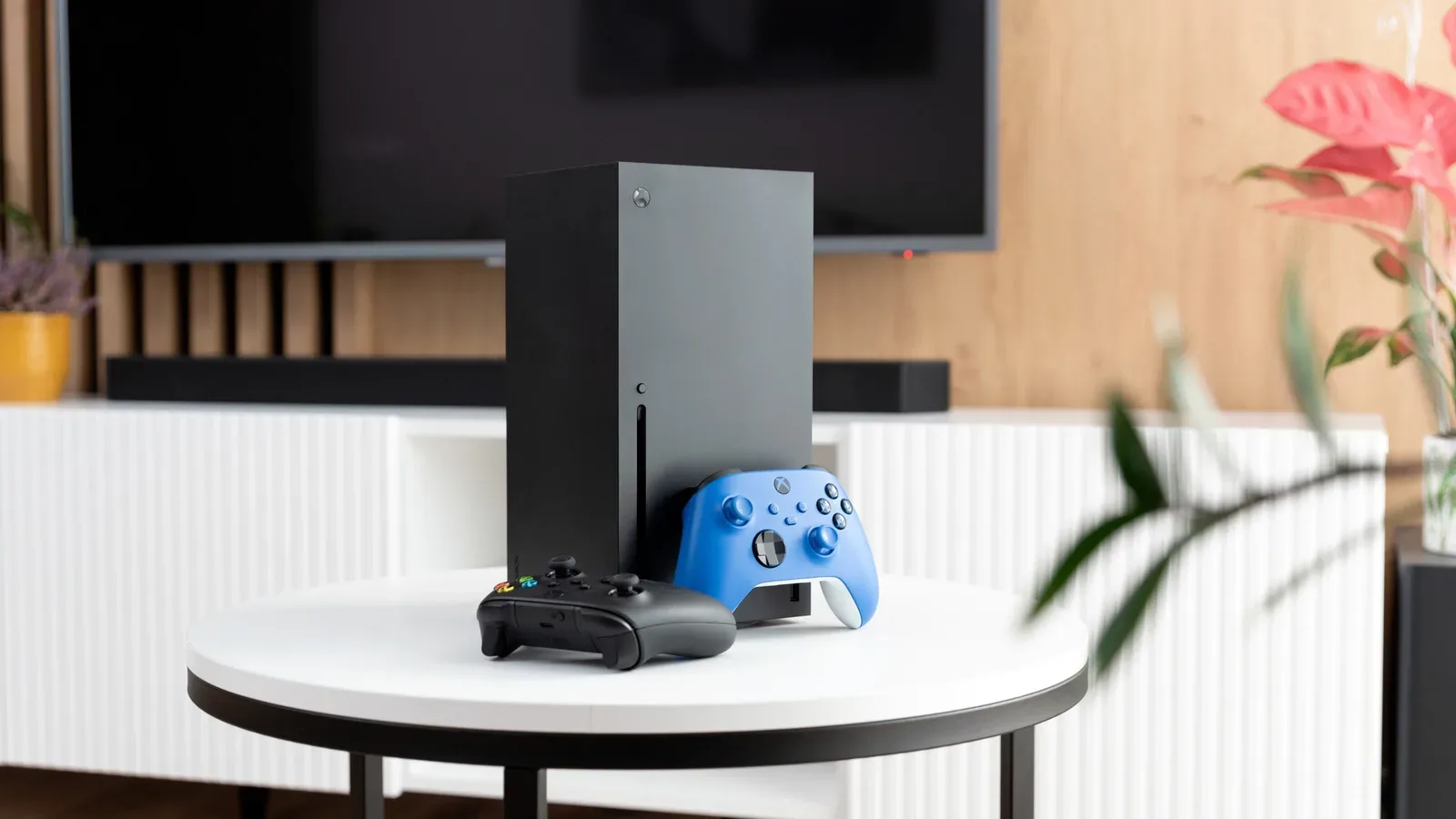
It is also useful to separate port repairability from port performance. HomeView’s USB-C connection is modular, while other home-tech questions can concern getting the right capability from a connector and display setup. For a separate example involving a console’s display connection, see this guide to checking whether an Xbox Series X is connected to the HDMI port suited to 120fps. The common lesson is that ports are only one part of a device’s practical experience; the surrounding design and configuration matter too.
What HomeView owners can reasonably take from this
- Do not assume the tabletop and wall-mounted models share parts. Their logic boards, speaker configurations and physical structures differ.
- The speaker base has the clearest repair positives. Its USB-C port and two passive speakers are replaceable, and the base is easier to open than the display-focused assembly.
- Deeper work has a higher risk profile. Access to the logic board is obstructed by the speaker arrangement and thermal shield, while adhesive can damage components during removal.
- A screen-and-base silhouette does not guarantee modular servicing. The display cannot be separated from the base without entering through the display side.
HomeView’s interior ultimately presents a mixed picture with a clear imbalance. Apple has made selected base components serviceable, including a modular USB-C port, but the broader construction puts critical electronics behind bonded speakers and a difficult thermal assembly. The result is a device where a repair may be technically conceivable yet unnecessarily hazardous to carry out—precisely the gap the teardown highlights.