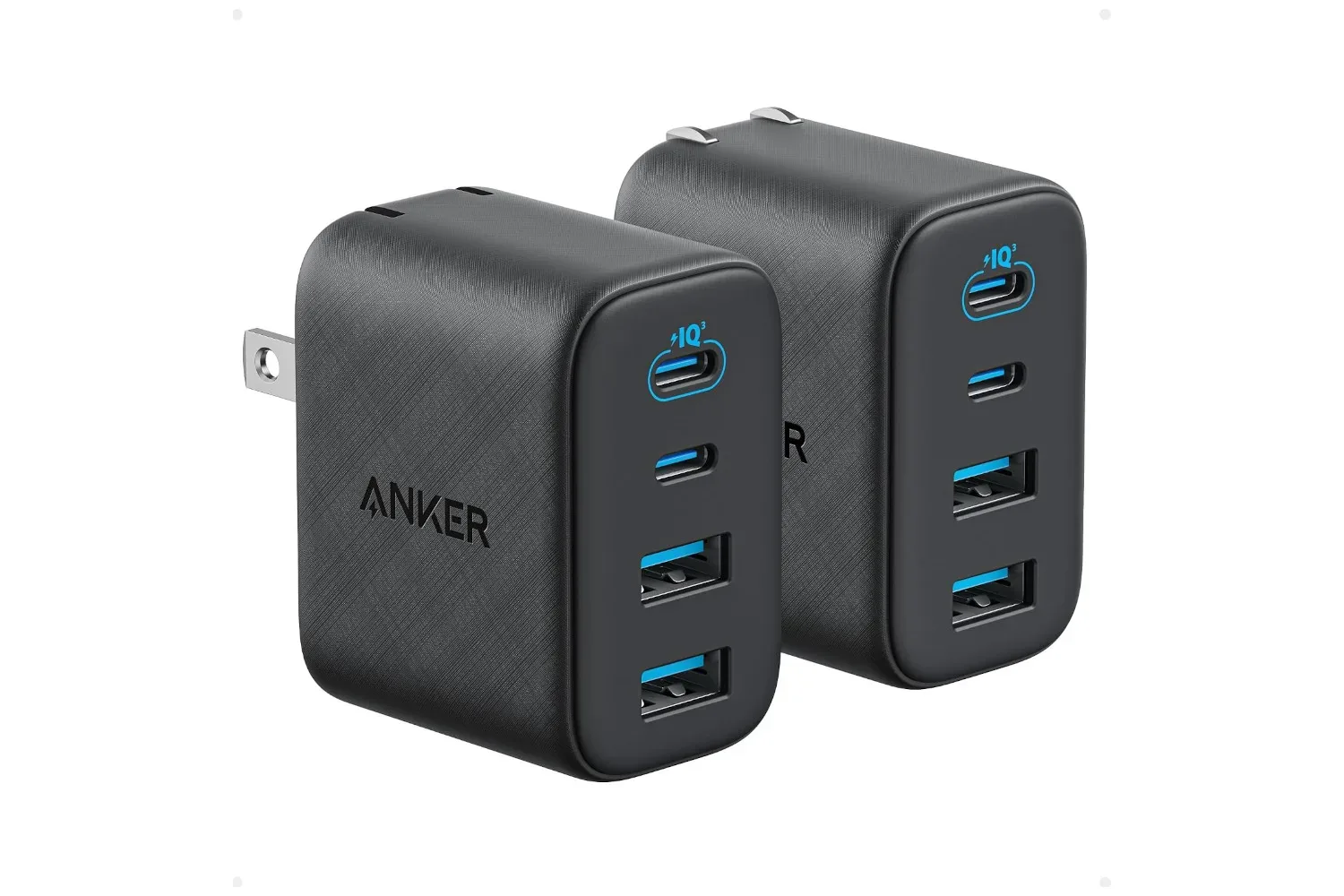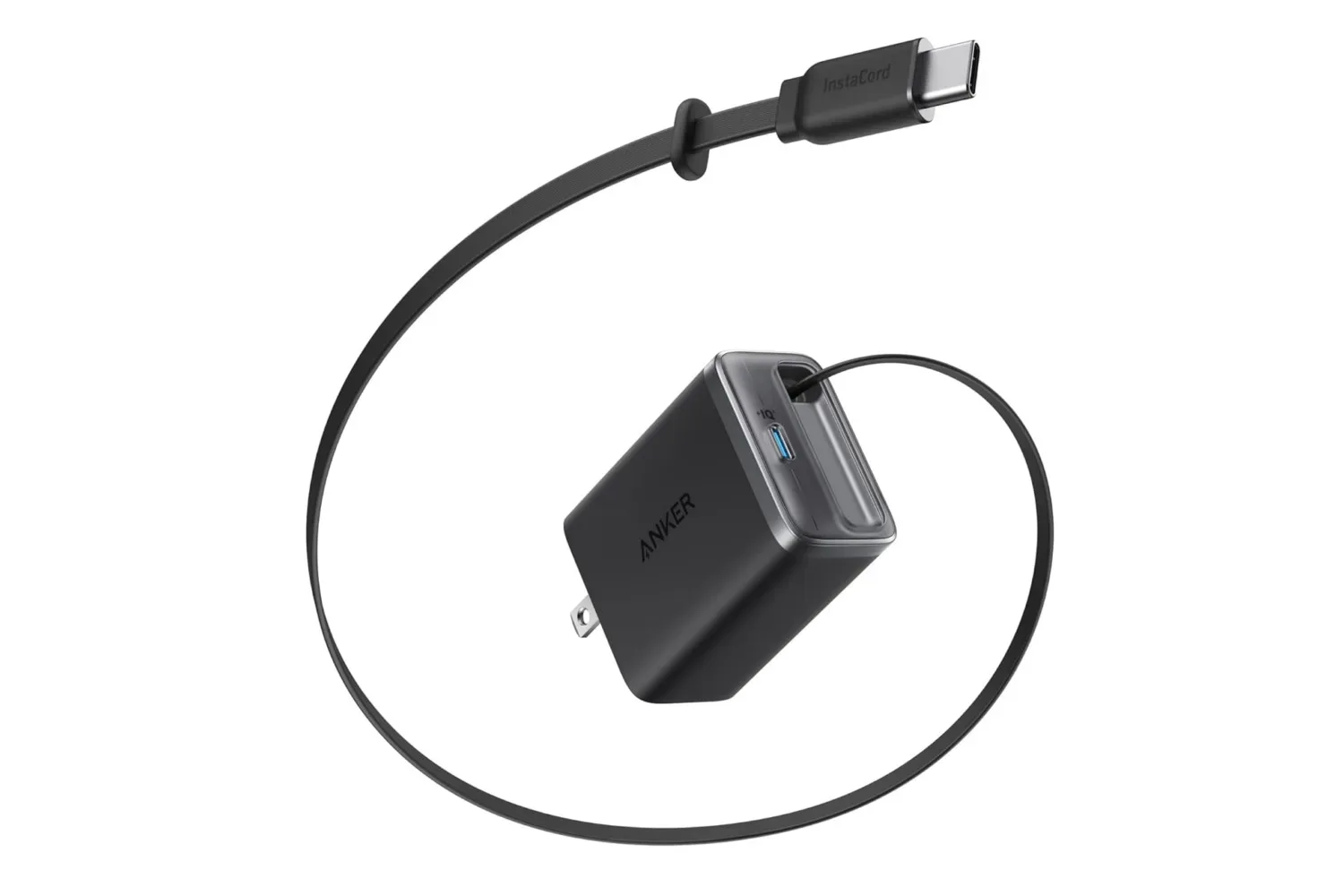
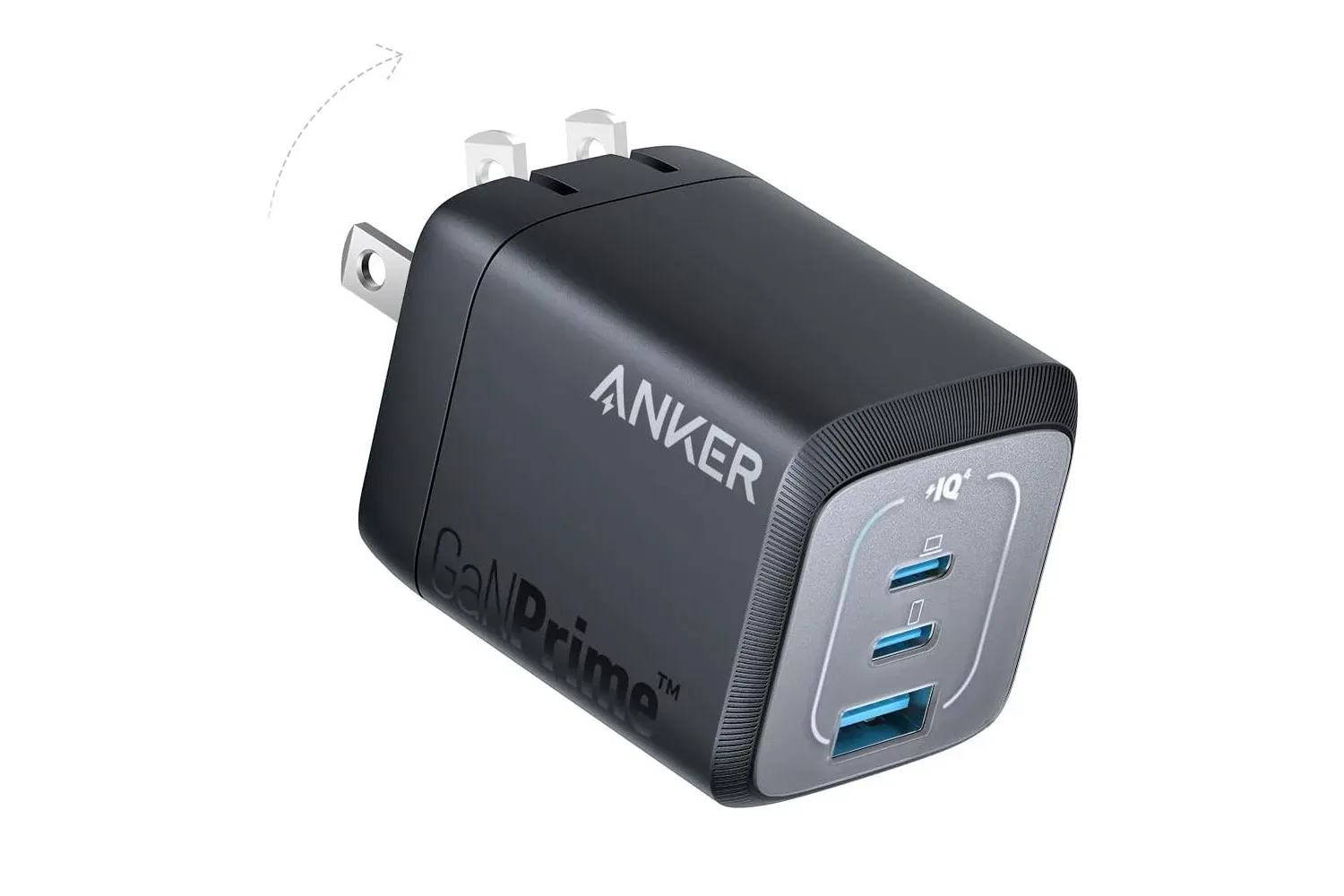
A single wall outlet can become a surprisingly contested resource when a phone, handheld, controller, headset, tablet, camera, or laptop accessory all need attention at once. Anker’s Prime 67W GaN wall charger is currently listed at $35, a $15 reduction from its stated $50 price. Its main appeal is straightforward: two USB-C ports and one USB-A port in one compact block, allowing up to three devices to charge simultaneously.
For players building a cleaner desk setup or trimming their travel kit, that is more useful than it may first sound. The charger replaces the familiar collection of single-device bricks with one outlet-based hub. It does not eliminate the need for cables—the package includes the charger, a welcome guide, and a 24-month warranty, but not charging cables—but it can reduce outlet clutter where compatible cables are already on hand.
What the $35 Anker Prime charger offers
The product is described as an Anker Prime 67W GaN wall charger, although the supplied specifications state a 65W total output. Prospective buyers should treat that distinction carefully: the 67W name identifies the model, while 65W is the stated shared-output figure in the available product details. Either way, the key practical limitation is not the headline alone, but how that available power is distributed when several devices are connected.
- Price listed: $35, reduced by $15 from $50.
- Ports: two USB-C and one USB-A.
- Simultaneous charging: up to three connected devices.
- Stated total output: 65W.
- Size claim: about 51% smaller than the original 67W MacBook charger.
- Included: charger, welcome guide, and 24-month warranty.
- Not included: charging cables.
The offer is described as available to both Prime and non-Prime shoppers, though pricing and stock can change. That matters with sale listings in particular: the $35 figure is useful only if it is still displayed when a buyer checks out.
Three ports are convenient, but shared power is the real rule
The two USB-C connections are the central feature for a modern gaming and work bag. USB-C is common across many current devices and accessories, while the USB-A port leaves room for an older cable or peripheral that still uses the rectangular connector. The stated compatibility spans Android and Apple devices, gaming consoles, cameras, tablets, and computer accessories.
However, “three ports” should not be read as three independent full-power chargers. The available details explicitly say that a single device connected through USB-C receives the best charging speed. Add more devices, and the charger divides its output between the active ports.
In plain terms, wattage is a measure of power delivery. A higher number can support faster charging for a compatible device, but it is a pool rather than a magical multiplier when multiple devices share one brick. If one USB-C device is connected, it can make use of the charger’s available capability subject to what the device and cable support. If two or three devices are connected, each receives a portion of the total instead.
That is not a flaw unique to this charger. It is the essential trade-off of compact multi-port charging: convenience and reduced outlet use in exchange for a shared power budget. For a setup in which several lower-demand items need a top-up at once, sharing can be exactly the point. For someone expecting every connected device to charge at its individual peak speed, it is important to connect fewer devices or recognize that charging rates may be lower.
A practical way to decide whether it fits
Think first about how devices are usually charged, rather than starting with the largest number printed on the box. A gamer who typically plugs in a phone, wireless headset case, and controller after a session may value the number and mix of ports most. A traveler may prefer one small charger over several bulky adapters. A desk user might use it to centralize routine charging for a phone, tablet, camera, or computer accessory.
On the other hand, someone who regularly needs to charge several power-hungry devices at maximum speed should pay particular attention to the shared-output behavior. The available information does not provide a port-by-port power-allocation table, so it does not support predicting the exact charging rate for every three-device combination. What can be said is that the USB-C ports offer the best speeds with one device connected, and that connecting more devices splits the available output.
Why GaN and the smaller footprint matter
“GaN” refers to gallium nitride, a material used in charging hardware. In practical product terms here, it is associated with fitting substantial charging capability into a compact wall charger. Anker says this unit is about 51% smaller than the original 67W MacBook charger and describes it as lightweight.
That compactness has a clear everyday benefit. A charger that takes less room in a bag is easier to treat as a permanent part of a handheld-console, laptop, or camera kit. At a workstation, one smaller brick can also make cable management less awkward than several separate power adapters occupying a power strip.
It is worth keeping the claim in context. “Smaller than” is a comparison to a specific original 67W MacBook charger, not a universal size ranking against every charger on the market. Still, the intended advantage is easy to understand: this is designed to be a portable multi-device charger rather than a large desktop power station.
For people whose longer trips require power away from a wall outlet, a charger and battery bank solve different problems. A wall charger needs an outlet; a power bank stores energy for later. The distinction is useful when weighing this compact block against products such as the Anker 737 140W power bank, which is aimed at portable reserve power rather than consolidating charging from a socket.
Safety monitoring is part of the package
Anker says the charger uses its ActiveShield 2.0 temperature-monitoring system, checking temperature up to 3,000,000 times per day. Temperature monitoring is relevant because chargers produce and manage electrical power while devices are connected, and keeping watch over heat is part of a charger’s broader safety approach.
The supplied information presents ActiveShield 2.0 as a safety feature, but it does not provide test results, temperature limits, or a detailed description of what actions the system takes in every condition. The useful takeaway is narrower: the charger includes a named system intended to monitor temperature frequently. It should not be treated as a reason to ignore ordinary care with charging gear.
- Use cables already known to work with the devices being charged, since none are included.
- Remember that connecting more devices means the charger divides its stated output.
- Use the USB-C ports when seeking the best stated charging speeds for a single connected device.
- Check the live listing before purchase, because sale price and stock are not permanent guarantees.
Who gets the most value from the deal
At the listed $35 price, the strongest case for this charger is not simply “more watts.” It is consolidation. Two USB-C ports and a USB-A port can cover a mixed collection of newer and older cables, while the compact design is positioned for bags, desks, and outlet-limited spaces. That makes sense for someone who regularly charges a few compatible devices but does not want to carry multiple wall adapters.
The 24-month warranty adds a defined period of coverage, while the lack of bundled cables is a small but important budgeting point for buyers who do not already have suitable leads. Reusing compatible cables at home can make the $35 price the full immediate cost; starting from scratch means adding cables to the plan.
Ultimately, this is a compact three-port charging block with a stated 65W total output, not three separate high-output chargers fused into one cube. Buyers who understand that shared-power arrangement can judge it on the things it appears built to do well: keep several everyday devices charging, use a single outlet more efficiently, and occupy less space than a larger laptop-oriented brick. With the listed discount bringing it from $50 to $35, that practical convenience is the part of the offer doing the real work.
Shop the products
Check current price, model and availability at the retailer.