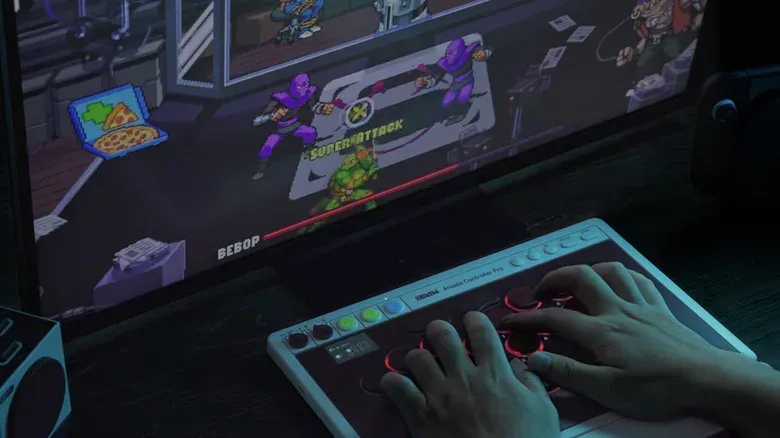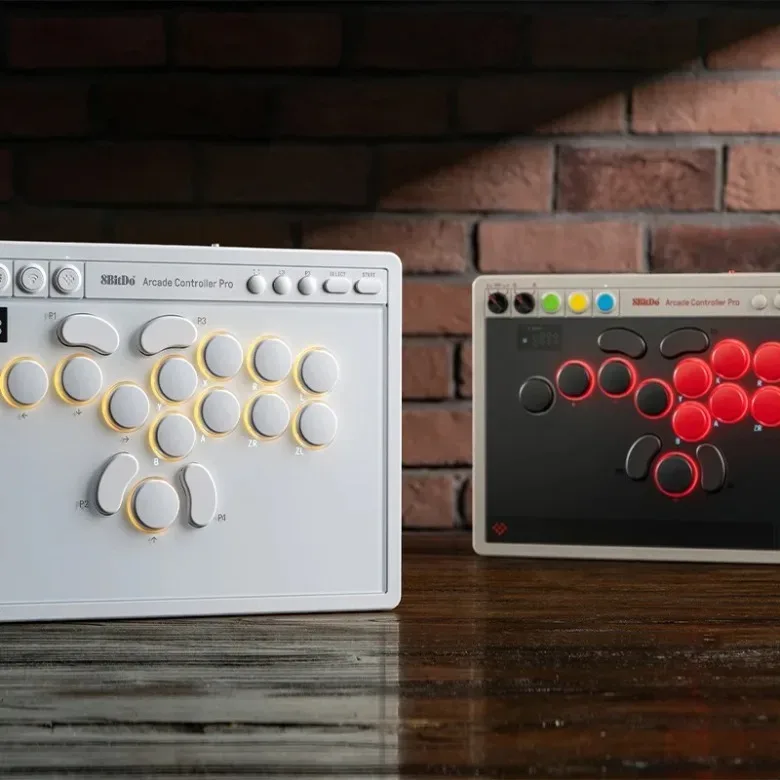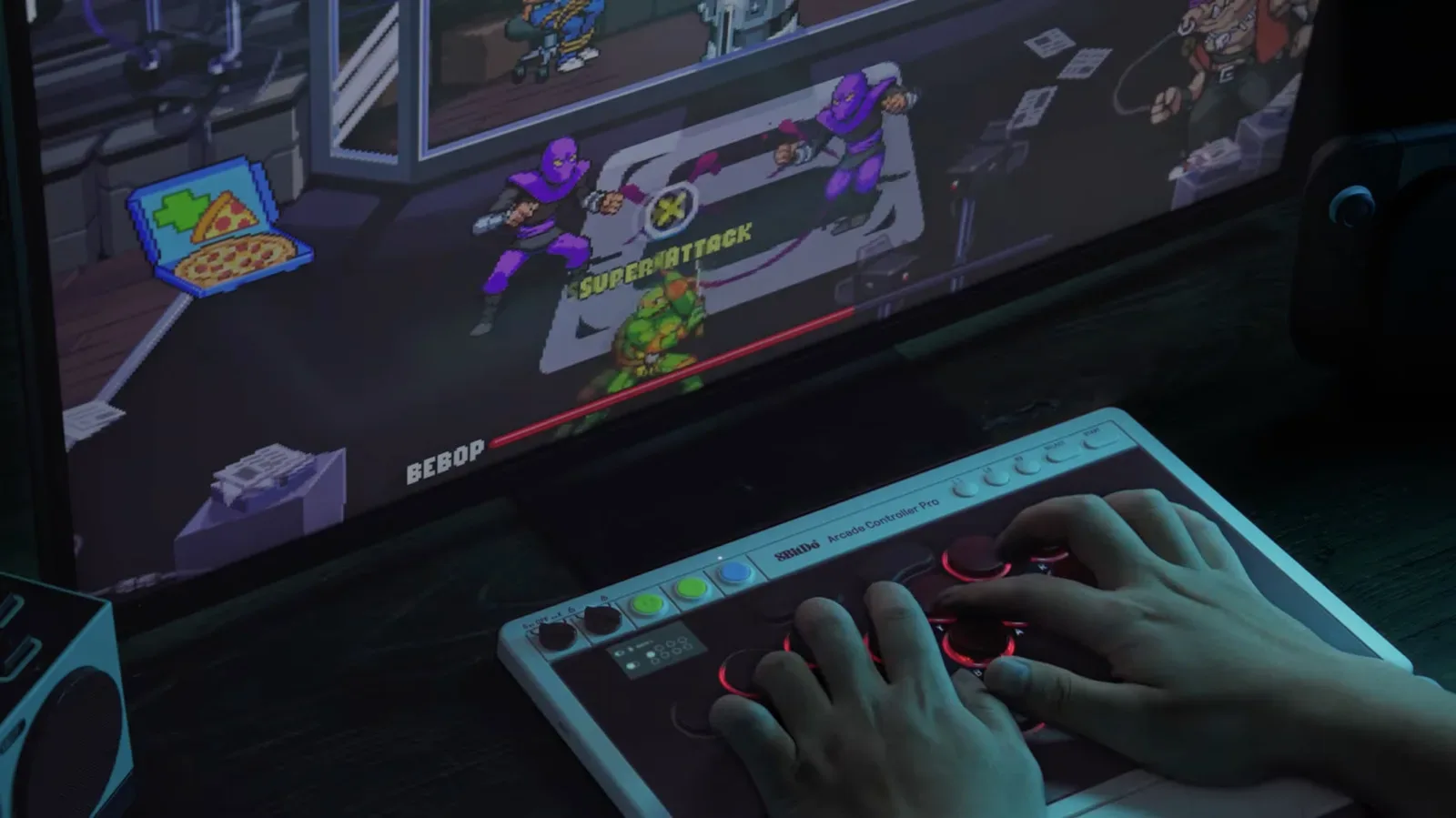
8BitDo’s next button-only fighting-game controller is now available to pre-order. The Arcade Controller Pro starts at $119.99 and is scheduled to begin shipping on November 30. It is the company’s second leverless arcade controller, following its earlier Arcade Controller, and it arrives with a notably more competition-minded list of refinements rather than a wholesale rethink of the format.
The most immediate distinction is in the name of the category itself: a leverless controller removes the traditional arcade stick. Directional movement and attack commands are entered with buttons instead. That design changes the physical language of play. Rather than moving a lever with one hand while pressing attack buttons with the other, players use separate buttons for every direction and action. 8BitDo’s Pro model builds on that layout with smaller buttons, tighter spacing, additional programmable inputs and onboard controls intended to make setup less dependent on external software.
A $30 step up from the earlier Arcade Controller
The Arcade Controller Pro’s $119.99 starting price places it $30 above the prior Arcade Controller, which starts at $89.99. That premium is attached to a cluster of changes aimed at players who care about layout, repeatable controls and the ability to adjust a device around their own preferences.
It is important to separate confirmed changes from assumptions about who should buy one. The available details establish that the Pro has a denser button arrangement, more programmable buttons, a display, a magnetic wrist rest, replacement caps and a larger battery. They do not establish that every fighting-game player will find the new layout preferable, or that it is necessarily a required upgrade for owners of the original. Hand size, comfort, game choice and personal muscle memory all matter with an input device this specialized.
Still, the direction is clear. The original controller represented 8BitDo’s move into arcade-style hardware without the usual joystick. The Pro narrows the presentation toward players who want more direct customization and a layout designed with serious fighting-game use in mind.
What “leverless” changes in practical terms
A conventional fight stick generally pairs a large directional lever with a set of face buttons. A leverless controller replaces that directional mechanism with buttons. The result is not simply an arcade controller with one piece removed; it changes where inputs come from and how the player’s hands rest on the surface.
For players considering the format for the first time, the useful question is not whether buttons are inherently better than a stick. It is whether a button-based directional layout suits the way they want to learn and execute commands. A traditional lever gives physical resistance and travel. Individual direction buttons instead ask the player to press a specific control for each direction, with the controller’s layout doing much of the organizational work.
That is why small alterations to button size and placement can matter. On the Arcade Controller Pro, 8BitDo has made the buttons smaller and placed them closer together than on the prior model. A compact layout can reduce the distance a finger needs to travel between controls, but it also makes the spacing itself more consequential. Someone comfortable with a roomier layout may need an adjustment period; someone who prefers a tighter grouping may see the revision as the main appeal of the Pro model.
Related coverage includes 8BitDo Arcade Controller Pro Pre-Orders Open at $119.99.
None of those trade-offs can be resolved from a specification sheet alone. They are personal ergonomic questions. The confirmed value of 8BitDo’s revision is that it gives the Pro a distinct physical identity rather than merely recoloring the existing controller.
More programmable controls and an onboard display
The Arcade Controller Pro also adds more programmable buttons. In controller terminology, programmable means a button can be assigned or remapped to a chosen function. That flexibility can be useful where players want their most-used inputs positioned where their hands naturally fall, or where they want a layout that better reflects their own preferences.
The device’s 1.47-inch display supports that customization. 8BitDo says the screen can show input monitoring, as well as facilitate custom button mapping and RGB lighting adjustments. Input monitoring is a display of the controls the device is registering. Its practical purpose is visibility: a player can check what the controller is reading while configuring inputs or verifying button presses.
The screen is therefore more than a decorative panel, although the RGB controls mean it also has a presentation role. Its more meaningful function is to keep core personalization on the controller itself. That does not tell us every detail of the mapping system, nor does it confirm how individual games or platforms handle every possible assignment. It does show that 8BitDo is treating on-device control as part of the Pro’s feature set.
For prospective buyers, that distinction is useful. Extra buttons alone do not guarantee a better setup; their value depends on whether the available assignments match the player’s needs. But an onboard display for mapping and monitoring gives the controller a more self-contained configuration approach than a unit limited to fixed controls.
A wrist rest that also carries spare caps
Long sessions are another stated focus. The Arcade Controller Pro includes a wrist rest that attaches magnetically to the bottom of the device. A wrist rest changes the point at which a player’s hands and forearms meet the controller, potentially making positioning more comfortable for people who want that additional support.
The accessory also doubles as storage. Opening the wrist rest reveals five extra button caps, which can be used to change the controller’s feel. A button cap is the piece a player physically presses, so swapping caps is a tactile customization option rather than a software setting. The supplied caps add a degree of experimentation without requiring buyers to source replacement parts immediately.
There is a sensible limit to what can be inferred here. The existence of a detachable wrist rest and alternate caps does not promise universal comfort, because comfort remains individual. What it does provide is an official, integrated way to alter the controller’s surface setup. Alongside the tighter layout, that reinforces the Pro’s focus on personal fit.
Battery capacity and charging details now confirmed
8BitDo has also confirmed a 3,000mAh battery for the Arcade Controller Pro. The mAh figure, short for milliampere-hours, is a measure of battery capacity. In broad terms, a larger number indicates the battery stores more charge, but it should not be treated as a direct promise of a particular number of play hours. Real runtime depends on factors such as how the controller is used and features such as lighting.
The battery can be fully recharged in four hours. The Pro’s battery is described as much larger than the one in the earlier Arcade Controller, giving the new device another concrete distinction beyond its revised button deck and display. Buyers who prioritize a larger onboard battery now have a confirmed specification and recharge estimate to weigh against the $30 increase over the original’s starting price.
As with the rest of the controller, the useful comparison is not only about one number. The Pro combines capacity with configuration features, extra caps and a comfort-oriented accessory. For someone who simply wants the least expensive route into 8BitDo’s leverless arcade-controller line, the $89.99 original remains the lower starting-price option. For someone looking for the newer layout and the bundled additions, the Pro is the more fully equipped version on paper.
Two color choices and a November shipping target
The Arcade Controller Pro will be offered in N Edition and White. Those two options are the confirmed color choices, with the $119.99 starting price and November 30 shipping date framing the pre-order window.
There are still boundaries around what is known. No additional compatibility details, performance claims or availability beyond the reported pre-order and shipping information are established here. Shoppers should avoid filling in those gaps from the product’s appearance or from assumptions based on other controllers. In hardware purchases, the details that seem routine—supported systems, connection methods and preferred layout—can be as important as the marquee features.
That broader caution applies to gaming gear generally: feature lists are most helpful when matched to the equipment someone already uses and the specific friction they are trying to solve. For another example of how ecosystem-specific features can affect a hardware decision, see our look at AirPods on Samsung Galaxy phones.
For 8BitDo, the Arcade Controller Pro is a targeted evolution of its first joystick-free arcade controller. Smaller, closer buttons; more remappable controls; a 1.47-inch configuration display; a magnetic wrist rest with five spare caps; and a 3,000mAh battery collectively explain why it sits above the original’s entry price. Whether those improvements justify the difference will depend less on the word “Pro” and more on a player’s preferred layout, need for onboard customization and appetite for a denser leverless design.