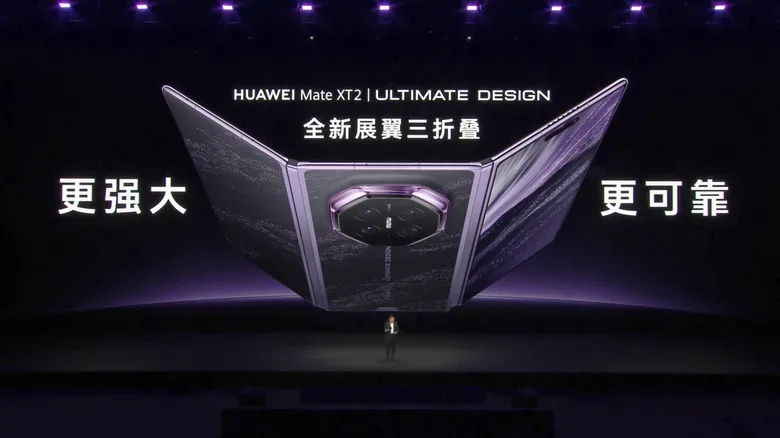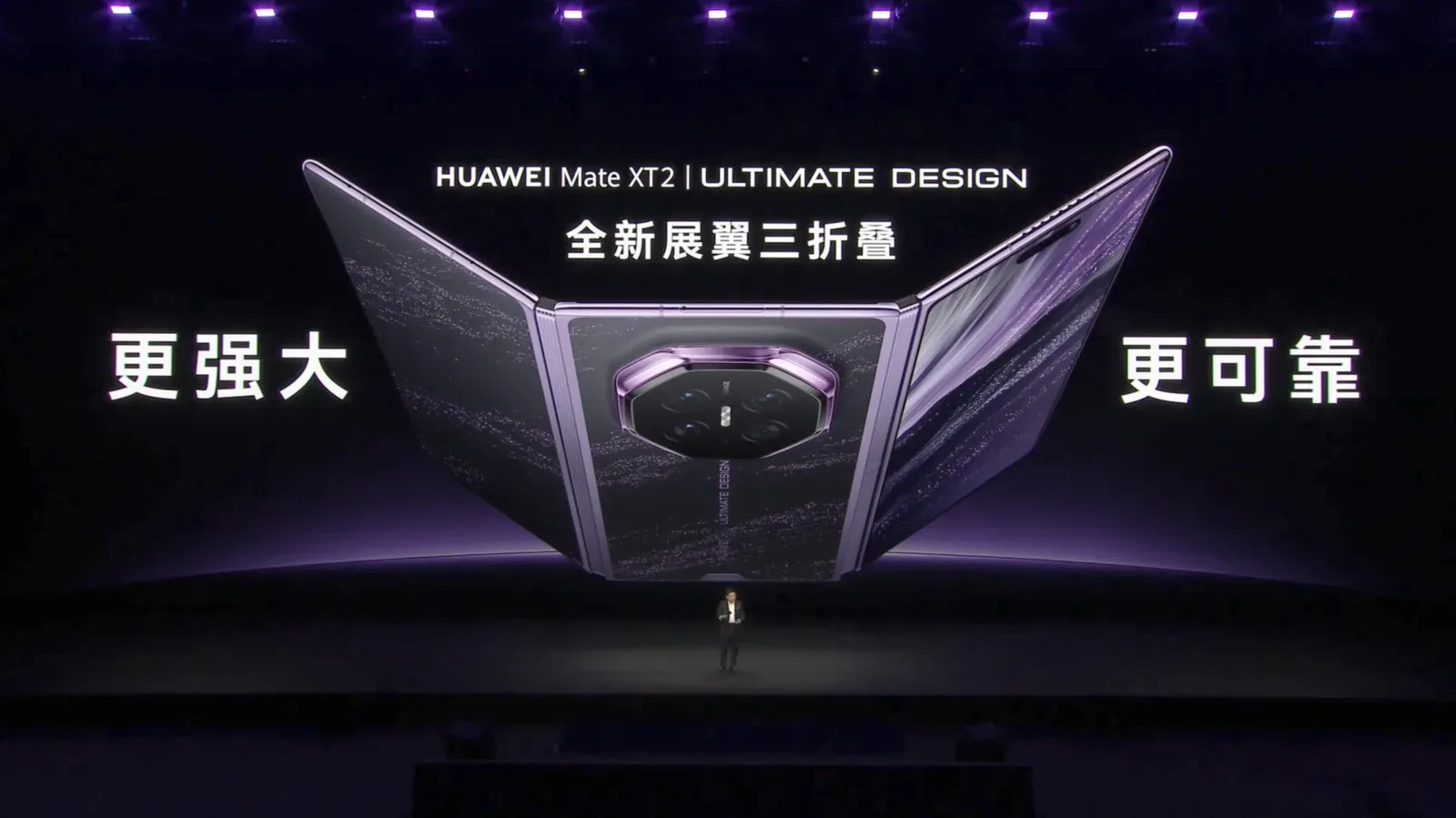
Huawei has introduced the Mate XT2, a tri-fold smartphone that combines a large folding display with an optional built-in privacy-display feature. The company is presenting the device as the first foldable phone to offer that particular combination, bringing a privacy-focused screen mode to a category already defined by complicated hinges, expansive panels and extremely high prices.
Scheduled to go on sale beginning September 12, the Mate XT2 succeeds Huawei’s 2024 Mate XT. Its headline change is not simply that it has three display sections; it is the revised mechanism used to close them. Where the previous model took a different approach, the new Mate XT2 uses an inward-folding hinge design. When shut, it operates around a 6.5-inch display. When fully unfolded, it becomes a 10.2-inch screen with 3K resolution.
It is a device built for the part of the market where a phone can attempt to act like several devices at once: compact handset when closed, larger reading and viewing screen when opened, and a premium technical showcase at every point in between. The Mate XT2’s price makes that positioning unmistakable. The base model starts at 19,999 yuan, approximately $2,980, while the privacy-display version with 1TB of storage starts at 24,999 yuan, or roughly $3,725. A 2TB collector’s edition starts at 29,999 yuan, around $4,470.
An inward-folding revision for Huawei’s tri-fold
Foldables always make their physical design part of the product story. Conventional handsets ask buyers to assess cameras, screen size, software and battery life. A tri-fold also asks them to consider how a device transitions between shapes and how many display surfaces are active in each state.
The Mate XT2 is designed around an inward fold, with its display panels folding inward rather than following the arrangement used by its predecessor. Huawei has not positioned the Mate XT2 as a minor specification refresh; the hinge change is central to the model’s identity. That matters because the hinge determines the practical relationship between the 6.5-inch folded display and the much larger 10.2-inch open screen.
At 10.2 inches, the Mate XT2 reaches beyond the screen space normally associated with a standard phone. Its 3K panel is intended to give that unfolded configuration a suitably high-resolution canvas. Huawei’s ultrawide Pura X foldable from the previous year used a 16:10 aspect ratio, but the Mate XT2 is not described as matching that same ultrawide format. Buyers should therefore avoid assuming the two devices share identical screen proportions simply because both are foldable Huawei products.
For people who follow the gadget market with the same fascination usually reserved for exotic game hardware, tri-fold phones are the kind of products that invite a specification-sheet double take. They make a familiar object mechanically unusual without abandoning the daily role of a smartphone. The Mate XT2’s display arrangement is the pitch: a 6.5-inch phone-like footprint when folded, then a 10.2-inch 3K display once all of the panels are open.
The privacy display is the distinctive option
Huawei’s biggest differentiator is the integrated privacy display offered on a higher-storage Mate XT2 configuration. The company is claiming a first for a foldable device that includes this feature. In simple terms, a privacy display is intended to make what appears on screen less easily visible to people looking from the side, a potentially attractive proposition in public spaces or crowded environments.
The important qualifier is that this is not stated as a standard feature across every Mate XT2. All models have 16GB of memory, but the 1TB model with the privacy-display feature begins at 24,999 yuan. The standard starting price is 19,999 yuan. That difference means the privacy feature is part of a distinctly more expensive tier, not a universal benefit of buying the tri-fold.
The category comparison is also worth handling carefully. Samsung has its own tri-folding smartphone, and its Galaxy S26 Ultra includes a Privacy Display. Huawei’s claim is about putting a privacy display and a tri-fold design in the same foldable product. It is a narrow but meaningful distinction in a market where individual features can exist elsewhere while the particular package remains unusual.
There is a straightforward reason that a privacy feature fits a large folding display. More screen space can be useful for viewing content, working across multiple windows or handling private information, but a larger visible surface can also draw more attention. Huawei is betting that privacy control belongs beside the spectacle of a 10.2-inch unfolding panel. Whether that is worth the substantial upgrade price will depend on how valuable the feature is to an individual buyer; the disclosed information establishes the configuration and pricing, rather than a measure of its effectiveness.
Kirin 9050 Pro performance claim
Inside the Mate XT2 is Huawei’s Kirin 9050 Pro processor. Huawei says the chip delivers performance that is 42 percent faster than the Mate XT. That is a manufacturer performance claim, so it should be read as a comparison supplied by Huawei rather than as an independently established benchmark result.
Still, the stated uplift helps explain why this second-generation model is being framed as more than a redesigned folding mechanism. A device with a screen that can expand to 10.2 inches has a strong reason to pursue additional performance headroom. More display area can encourage more demanding uses, and the Mate XT2’s processor upgrade is Huawei’s answer to that expectation.
The phone will run HarmonyOS, Huawei’s in-house operating system, continuing the software direction already associated with the company’s hardware. That detail has practical significance for anyone comparing phones across regions or ecosystems: the operating system is part of the product’s identity, not a background footnote. A device’s physical novelty may get the first headline, but its software platform ultimately shapes the applications and services surrounding it.
For a broader reminder that even ordinary phone settings can have outsized day-to-day consequences, see how to stop Apple CarPlay from auto-connecting to your iPhone. The Mate XT2 occupies a much more extravagant end of mobile hardware, but the basic lesson carries over: the experience of a phone is a mix of its physical design and the software behavior that accompanies it.
Four cameras, including a 3.5x periscope lens
Huawei lists four cameras for the Mate XT2. The rear system consists of a 50-megapixel main camera, a 40-megapixel ultra-wide camera and a 50-megapixel periscope camera with 3.5x optical zoom. An eight-megapixel selfie camera is located in the interior display.
Those numbers indicate that Huawei is treating the Mate XT2 as a flagship camera phone as well as a folding-display device. The periscope camera’s 3.5x optical zoom is especially notable because it adds a dedicated optical reach option instead of limiting the device to a main and ultra-wide pairing. But megapixel counts and zoom figures do not, by themselves, settle questions about image processing, low-light output, motion capture or the final quality of photographs. The available details establish the hardware configuration, not a complete camera assessment.
The interior placement of the eight-megapixel selfie camera also reflects the Mate XT2’s large-screen mode. Its inclusion makes the unfolded display more than a rear-camera viewfinder or reading surface; it retains a front-facing camera for that configuration. As with the screen itself, the device is constructed to shift roles as it changes shape.
Prices put the Mate XT2 in rarefied territory
The Mate XT2 is priced far beyond mainstream premium smartphones. Its entry point of 19,999 yuan includes 16GB of memory, as do the other listed models. The privacy-display edition pairs that feature with 1TB of storage and begins at 24,999 yuan. The collector’s edition raises storage to 2TB and begins at 29,999 yuan.
- Base Mate XT2: 19,999 yuan, about $2,980.
- 1TB Mate XT2 with privacy display: 24,999 yuan, about $3,725.
- 2TB collector’s edition: 29,999 yuan, about $4,470.
Currency conversions are approximate, and the yuan prices are the more concrete figures here. The progression is clear, however: Huawei is attaching a major premium to the privacy-display, high-storage configuration, then pushing further for the collector’s edition and its 2TB capacity.
The company is not expected to offer the Mate XT2 in the United States anytime soon. Huawei continues to be regarded as a national security risk there, making an immediate US release unlikely. That limitation is important context for American readers seeing the device’s converted dollar figures: those numbers help communicate scale, but they do not indicate a US sales plan.
Huawei’s Mate XT2 is therefore a highly specific kind of flagship: an inward-folding tri-panel phone, a 6.5-inch-to-10.2-inch display proposition, an optional built-in privacy display, a Kirin 9050 Pro upgrade and a price tier aimed squarely at the luxury edge of consumer electronics. Sales begin September 12, with its availability context remaining as consequential as its unusual hardware.