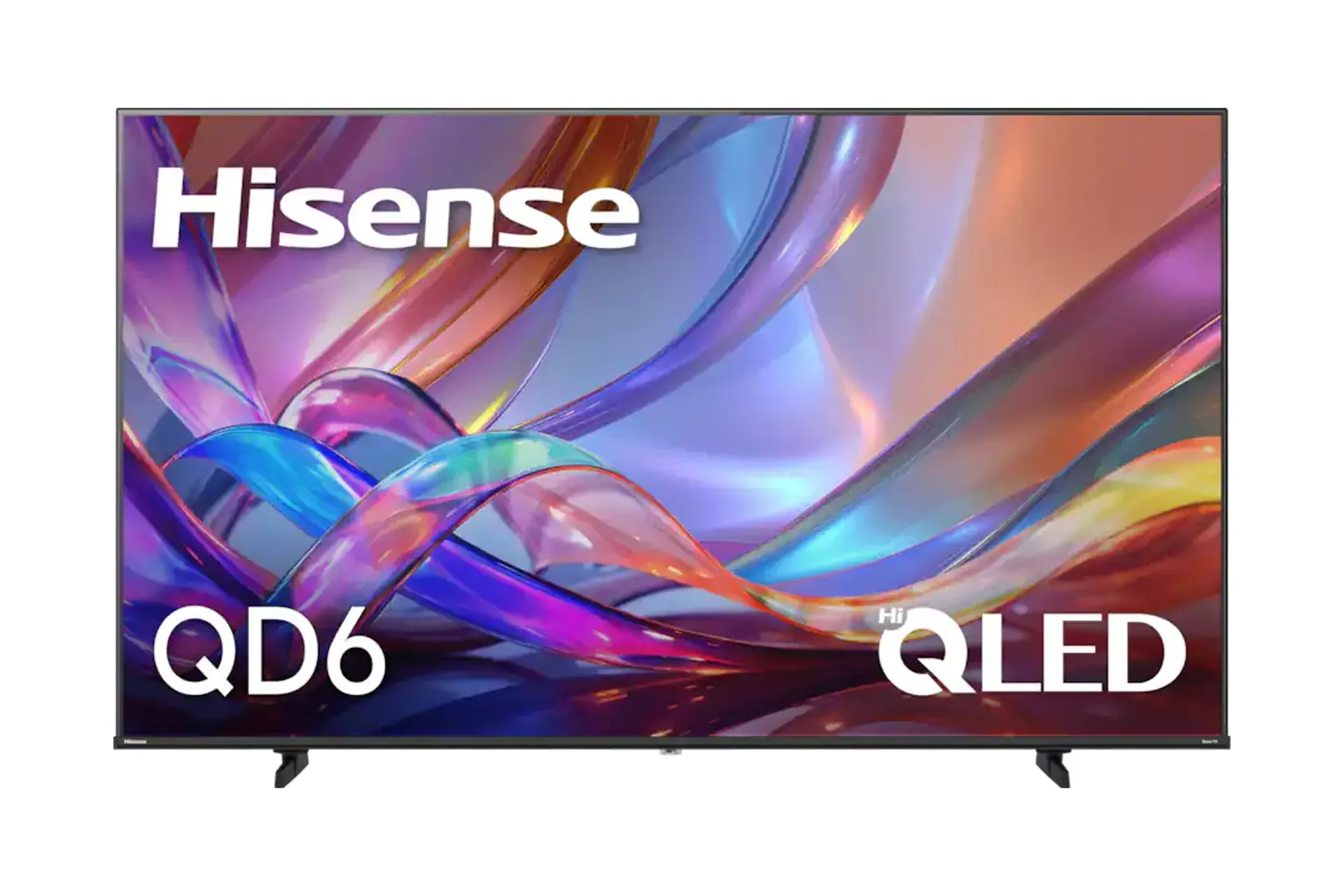
A bigger screen can be one of the most immediately noticeable upgrades for a game room, living-room setup or shared streaming space, but it does not automatically require premium-TV money. Hisense’s QD6 Hi-QLED Series 4K Roku TV range is currently discounted in several sizes, with the 65-inch Class model listed at $400 after a $100 reduction.
The sale spans from a 43-inch screen through a 75-inch option. The hardware is positioned as an accessible 4K smart-TV family rather than a specification race for enthusiasts, yet the supplied feature list includes several things that matter to people who switch between games, films and streaming apps: Game Mode Plus, Dolby Vision, HDR10, an AI 4K upscaler, the Roku TV interface, and Apple AirPlay and Apple Home support.
For a shopper whose first priority is screen size, the 65-inch model is the obvious headline. But the size lineup also gives buyers a reason to begin with the physical realities of their room, furniture and viewing distance—not simply the biggest diagonal that fits a budget. A lower-priced 43- or 50-inch screen may make more sense for a desk-adjacent setup or smaller room, while the 75-inch version puts the largest listed panel within a $550 sale price.
Hisense QD6 Hi-QLED Roku TV sale prices
- 43-inch Class QD6 Hi-QLED 4K UHD Smart Roku TV: $200, discounted by $100.
- 50-inch Class QD6 Hi-QLED 4K UHD Smart Roku TV: $250, discounted by $80.
- 55-inch Class QD6 Hi-QLED 4K UHD Smart Roku TV: $300, discounted by $80.
- 65-inch Class QD6 Hi-QLED 4K UHD Smart Roku TV: $400, discounted by $100.
- 75-inch Class QD6 Hi-QLED 4K UHD Smart Roku TV: $550, discounted by $150.
Those figures describe listed sale pricing and discounts at the time provided, rather than a promise that every size will remain available at the same price. Retail promotions can change, so the useful takeaway is the spread: moving from 55 inches to 65 inches is listed as a $100 step, and moving again to 75 inches adds $150.
What the picture terms mean in everyday use
The QD6 name uses Hi-QLED, which the product description associates with vivid, authentic color. QLED is a display-marketing term commonly centered on color performance; in this case, it is part of the advertised picture package rather than a standalone guarantee about how any particular game or movie will look in every room. Ambient light, the material being watched and settings selected by the viewer all still influence the final image.
The set also supports Dolby Vision and HDR10. HDR, or high dynamic range, refers to video designed to present a wider range between bright and dark portions of an image. The practical aim is more pronounced highlights and deeper shadows. The supplied description specifically identifies HDR10 as helping contrast, while Dolby Vision support broadens the range of compatible material the television can accept.
That matters most when the content itself supports these formats. It is not a retroactive makeover switch for every video source, but it gives compatible films, series and games an appropriate display path. For a household that jumps from an older show to a new release to a console session, format support is useful precisely because it reduces the chance that one kind of content feels like an awkward fit for the screen.
Hisense also lists an AI 4K upscaler. Upscaling is the process of adapting lower-resolution material for display on a 4K panel. A 4K television has far more pixels than older content was originally made to fill, so the TV must create a presentation suited to its screen. The advertised goal here is to add detail to older material. It is important, though, to read that sensibly: upscaling can improve how lower-resolution video is presented, but it cannot turn an older source into native 4K material. Its value is in making a mixed library—from legacy video to current streaming—more comfortable to watch on a modern display.
The gaming point: responsiveness, not a claimed miracle mode
The gaming-specific feature named in the listing is Game Mode Plus. Its stated purpose is to prioritize the elements of picture performance that matter to games and reduce input lag.
Input lag is the delay between a button press or controller action and the corresponding change appearing on the display. It is distinct from an internet connection issue: a poor network can affect online play, while display input lag concerns the time between the device sending an image and the TV showing it. Lowering that delay can make movement and menu navigation feel more immediate.
That is especially relevant for action games, sports games, fighting games and any experience where a player is reacting to what is on screen. It can also be a straightforward quality-of-life benefit in slower-paced games: even if timing is not the entire challenge, a prompt response feels more natural.
The available information does not provide measured latency figures, refresh-rate specifications, HDMI details or a list of console-specific capabilities. Prospective buyers should therefore avoid treating the Game Mode Plus label as evidence of performance numbers that have not been supplied. What can be said is narrower and useful: the set includes a dedicated gaming-oriented mode intended to reduce input lag, and that makes it more relevant to console use than a TV with no stated gaming mode at all.
A television is only one piece of the setup, of course. The console or PC, the game’s own performance settings, the selected picture mode and the content being played all shape the result. PC players weighing upgrades may also want to consider where a new display fits alongside a system refresh; our look at the Ryzen 7 7800X3D listing covers the separate question of CPU value. The QD6 deal is instead about the screen at the end of that chain.
Roku makes the TV its own streaming hub
The built-in Roku TV interface means the display is not just a panel waiting for an external streaming stick or console app. It offers access to major services including Netflix, Apple TV, Hulu, Disney Plus and HBO Max, alongside Crunchyroll, Shudder and Dropout. Roku’s own free programming, including live-streamed news, TV shows and sports, is also part of the described platform offering.
For game rooms, this is a practical division of labor. A console can remain the place for games, while the TV handles casual viewing through its own interface. That may be convenient when somebody wants to watch a show without changing console inputs, or when different members of a household prefer different services.
Compatibility is still a service-by-service matter: having a Roku interface does not mean every subscription is included. Viewers will need the relevant accounts for paid platforms. The advantage is one familiar on-screen home for a broad mix of apps, not free access to subscription catalogs.
AirPlay and Apple Home support add flexibility
The QD6 models also support Apple AirPlay and Apple Home. AirPlay enables compatible Apple devices such as phones and tablets to send content to the TV. In practical terms, that can mean putting a YouTube video playing on a phone onto the larger screen so a group can watch together.
Apple Home support situates the TV within an Apple-centered home setup. The provided information does not detail the exact controls available, so buyers should not assume particular automations or commands beyond that compatibility statement. Still, for households already using Apple devices, the advertised support means the TV is intended to work alongside that ecosystem rather than sitting apart from it.
Which size carries the strongest value case?
There is no universal answer because a 75-inch television in a cramped space is not automatically a better purchase than a 55-inch model that suits the room. Yet the pricing makes the decision easy to frame. The 43-inch option offers the lowest entry price at $200. The 50-inch and 55-inch models rise to $250 and $300 respectively. The 65-inch version costs $400, and the 75-inch screen is $550.
For shoppers arriving specifically because they want a larger primary screen, the 65-inch set is the pivotal model: it sits meaningfully below the 75-inch price while still delivering a substantial step up from the smaller tiers. It retains the advertised QLED color, 4K resolution, HDR support, Roku software, AirPlay compatibility and gaming mode described for the range. Buyers with more room and an appetite for the largest listed display can consider the 75-inch set, but it is worth checking stand width, wall space and viewing layout before letting the lower relative price decide the entire purchase.
Ultimately, this Hisense QD6 promotion is best understood as a size-forward 4K TV deal with a sensible selection of modern convenience features. It does not come with enough supplied specification detail to declare it ideal for every demanding gaming use case. It does, however, present a clearly stated gaming mode, broad streaming access, Apple-device compatibility and image-format support at sale prices that put a 65-inch model at $400 and a 75-inch model at $550.