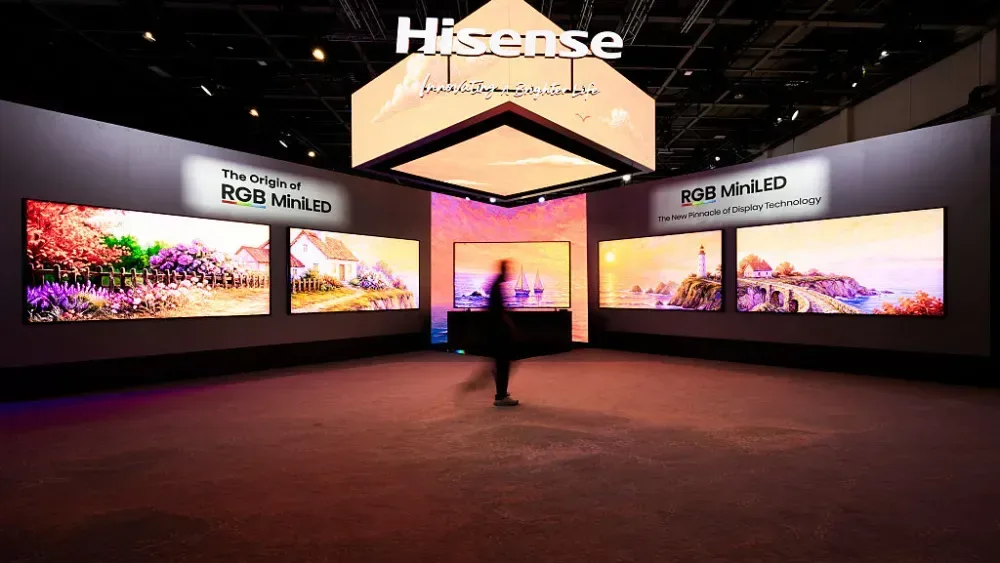
Hisense’s U7 TV range is among the large-screen display lines discounted during Prime Big Deal Days, running October 6 through October 7. The promotion covers multiple screen sizes, including 55-, 65-, 75-, 85- and 100-inch models, with advertised reductions of up to 50% and savings of up to $2,000 depending on the television.
For players considering a screen upgrade, the important part is not simply the percentage off. The U7 listings describe several display and audio technologies that can affect the experience of games, films and sports: MiniLED backlighting, local dimming, 4K resolution, HDR formats and, on the 65-inch set, a 165Hz refresh rate. Those specifications do not automatically make one size right for every room, but they provide a useful way to separate the roles each version is trying to fill.
The sale requires an Amazon Prime membership. A Prime trial is also presented as an option for customers who are not members. Since deal pricing can change during a limited shopping event, shoppers should confirm the final model designation, size, price and delivery details on the product listing before completing an order.
55-inch U7: MiniLED, local dimming and high brightness
The 55-inch Hisense U7 MiniLED ULED 4K UHD TV is listed at 50% off. Its headline hardware is a MiniLED backlight system described as using thousands of small backlights. MiniLED refers to the backlight behind an LCD panel, rather than the pixels themselves emitting light. More, smaller backlights can give a TV finer control over which parts of the image are bright and which are dark.
That control is commonly expressed through local dimming zones. Hisense lists up to 3,000 zones for the U7 Series. A zone is an independently controllable area of the backlight. In practical terms, a larger number can help a TV keep a bright HUD element, lamp, explosion or sunlit section of a game scene vivid while darkening surrounding portions of the picture. The actual result still depends on the content and the television’s processing, but local dimming is a specification worth understanding for anyone drawn to HDR games with sharp bright-to-dark contrasts.
The 55-inch listing also cites peak brightness of up to 3,000 nits. A nit is a measurement of brightness. Peak brightness generally describes the brightest highlights a display can produce under particular conditions, not the brightness of every part of the image at once. For viewers, the relevant promise is stronger-looking highlights and better visibility in brighter rooms, while the local-dimming system is intended to preserve darker image areas.
Color is another emphasis. The model is described as Pantone Validated, a certification connected to reproducing or simulating colors from the Pantone Formula Guide. That may matter to people who want consistent-looking films, animated games or vivid environmental art, though certification is not a substitute for choosing settings that work in the room where the TV will be used.
65-inch model puts 165Hz front and center
The 65-inch U7 is advertised at 45% off and is described as having dropped below $1,000 for the first time this year. Its most relevant listed feature for gaming is a 165Hz refresh rate.
Related coverage includes Hisense U7 MiniLED TVs Reach Up to 50% Off During Prime Big Deal Days.
Refresh rate is the number of times a display can refresh its image in one second. A 165Hz panel is designed to update far more frequently than a conventional 60Hz screen. Where compatible hardware and content can supply sufficiently high frame rates, the potential benefit is smoother on-screen motion and reduced perceived blur. That can be especially appealing in fast games where camera movement, rapid aiming and racing lines are constantly changing.
It is important to distinguish refresh rate from frame rate. Refresh rate is what the TV is capable of displaying; frame rate is what a console, PC or game actually renders. A 165Hz specification alone does not guarantee that every game will run at 165 frames per second. Buyers should check their own platform’s output options and the TV’s applicable input specifications rather than assume a number on the panel applies in every situation.
The listing also names Hisense’s Hi-View AI Engine Pro. It is described as automatically improving color, contrast and clarity while avoiding excessive processing. In plain language, this is the TV’s image-processing system: software that analyzes incoming video and adjusts the picture. Such processing can be useful when watching varied material, but its impact will depend on the source and selected picture mode. Players who prefer an unaltered image may want to inspect gaming-related settings after setup, while viewers focused on films and live broadcasts may value the display’s automatic adjustments differently.
There is a naming detail worth checking before buying. The deal copy calls this 65-inch U7 an “OLED 4K TV,” while the product title and the broader U7 promotion describe MiniLED ULED sets. OLED and MiniLED are different display technologies, so the actual retailer listing and model number should be treated as the deciding reference, not a stray description in promotional text.
The 100-inch U7 is aimed at a full home-theater footprint
At the other end of the range, the 100-inch Hisense U7 Mini-LED ULED 4K UHD TV is advertised at 44% off. This is the clearly home-theater-oriented option, built around a huge 4K image and a feature set that includes HDR10+, Dolby Vision IQ, Dolby Atmos and IMAX Enhanced certification.
4K UHD refers to a 3,840-by-2,160-pixel image. On a very large screen, that resolution is central to retaining image detail from a suitable 4K source. HDR, or high dynamic range, concerns the span between dark and bright parts of an image as well as the colors a display can reproduce. HDR10+ and Dolby Vision IQ are HDR-related formats or features listed for the 100-inch model; prospective buyers should check which formats their preferred games, streaming services and devices support.
Dolby Atmos is an audio format designed for a more enveloping presentation, while the U7’s IMAX Enhanced certification is described as meeting standards for brightness, contrast and sound. The listing further says the TV can use an enhanced aspect ratio to show more of a film image where applicable and includes DTS:X spatial-audio capability.
Audio is particularly notable because the 100-inch television is listed with a 2.1.2 multi-channel sound system tuned by Devialet. The “2.1.2” label identifies a speaker layout with two main channels, a subwoofer channel and two height-oriented channels. It does not remove the need to consider room acoustics or personal volume needs, but it signals that the set is trying to do more than provide basic integrated TV sound.
The 100-inch model also lists a matte surface coating intended to reduce reflections and glare, a slim bezel and a cable-management design. Those details are less flashy than brightness figures, but they can matter in a living-room installation. Glare reduction is particularly relevant if the screen will face windows or lamps. Cable routing becomes a more practical concern as a setup grows to include a console, PC, streaming device, sound system or multiple controllers and accessories.
What prospective buyers should compare
The promotion presents three very different scales of TV. The 55-inch set foregrounds high-end backlighting and color credentials; the 65-inch version puts 165Hz motion capability at the forefront; and the 100-inch model layers in cinematic audio and presentation features. A bigger number in any individual category does not settle the decision on its own.
- Screen size: Consider the actual viewing distance and whether a larger set can be placed safely in the intended space.
- Room light: High peak brightness and a matte coating are relevant claims for bright rooms, but the placement of windows and lamps remains important.
- Gaming hardware: Confirm what refresh-rate and resolution outputs your PC or console can deliver, and inspect the specific TV listing for its supported input modes.
- Audio plan: The 100-inch model’s 2.1.2 system is a notable built-in feature, but a buyer using an external audio setup should factor that into the purchase.
- Exact model identity: Verify the retailer’s technical sheet, especially given the inconsistent “OLED” wording in the 65-inch deal description.
The timing is also convenient for people preparing a shared screen before the end-of-year run of games, sports and movie releases. Anyone looking for a new title to put a larger display through its paces can also see how Star Wars: Galactic Racer is launching across PS5, Xbox Series X|S, PC and Amazon Luna. The practical point is less about finding a single “best” screen and more about matching the display’s documented strengths to the hardware, room and viewing habits already in place.
Hisense’s U7 reductions are scheduled for the October 6-7 Prime event, with 55-, 65- and 100-inch models receiving the most detailed feature breakdowns and 75- and 85-inch versions also included in the wider promotion.