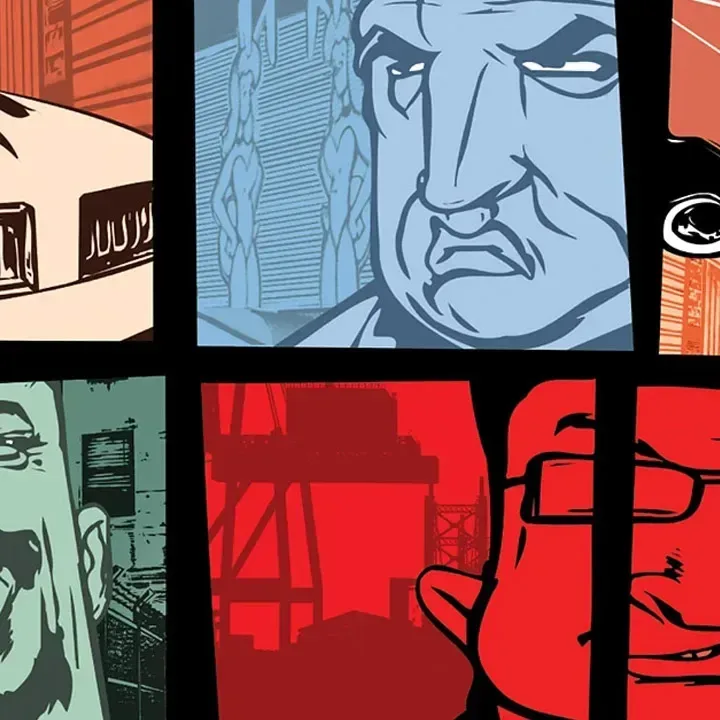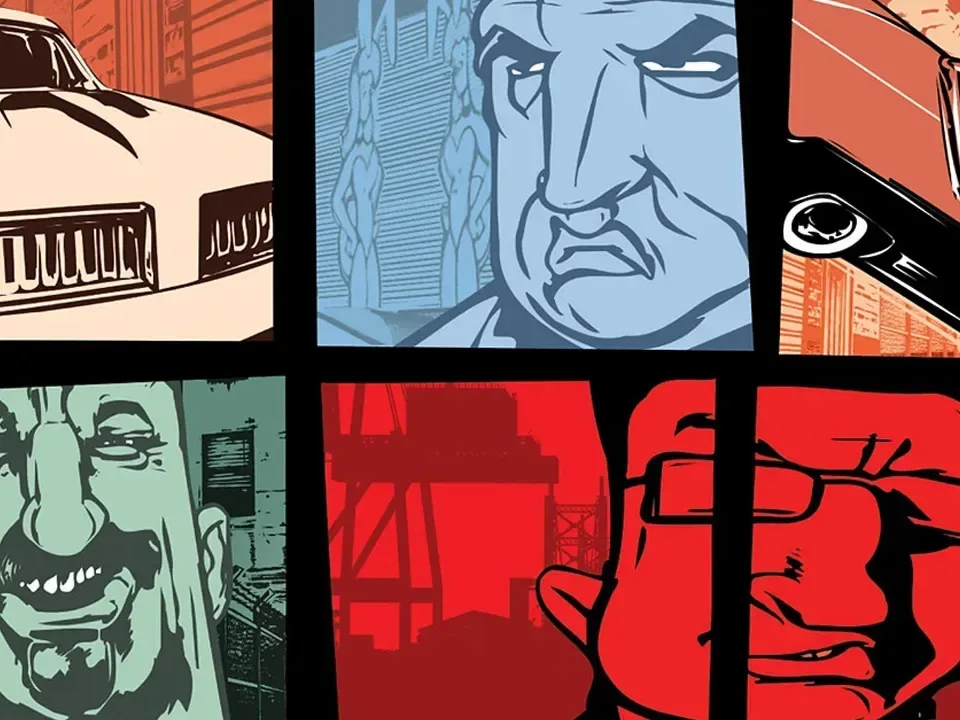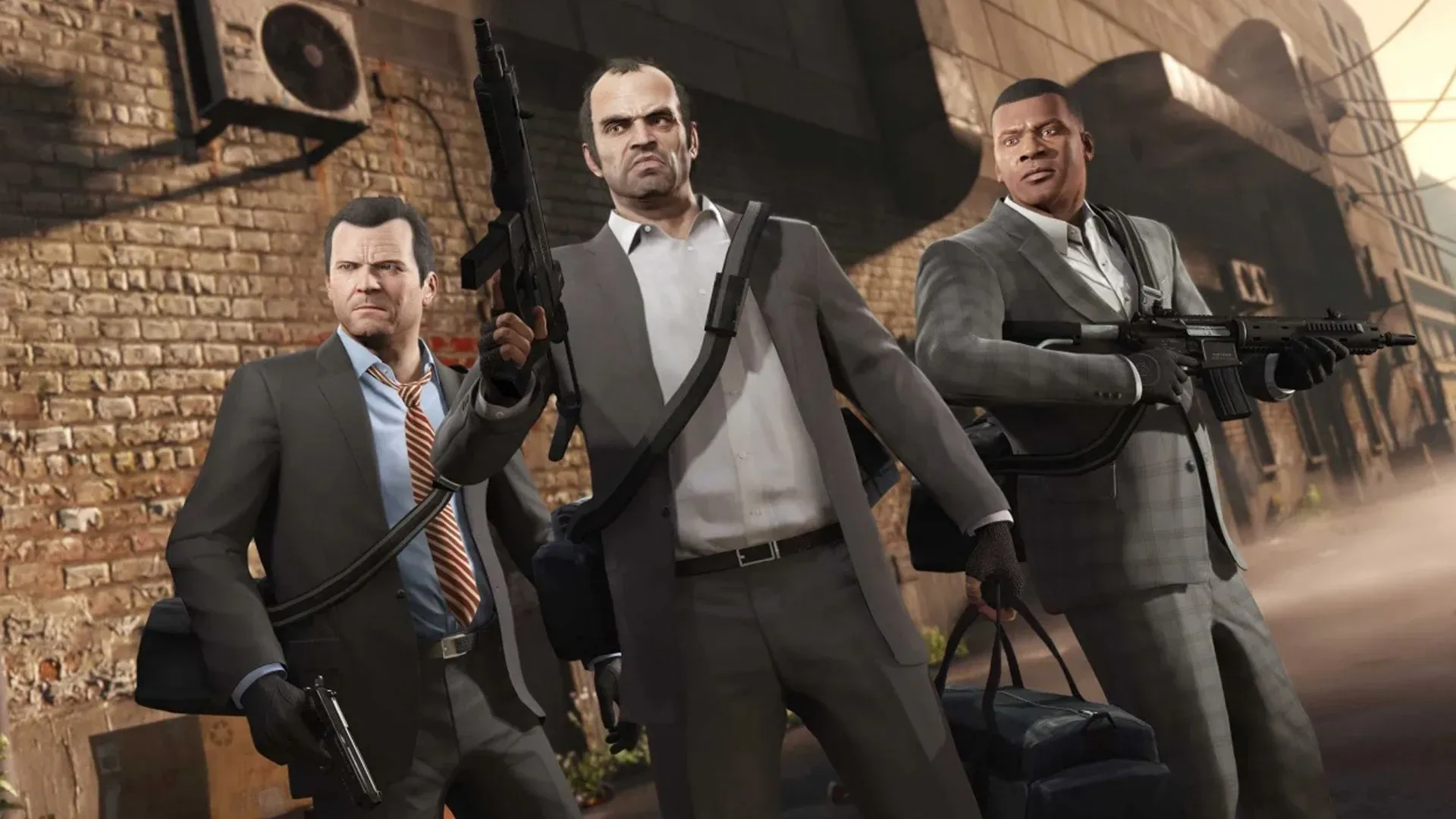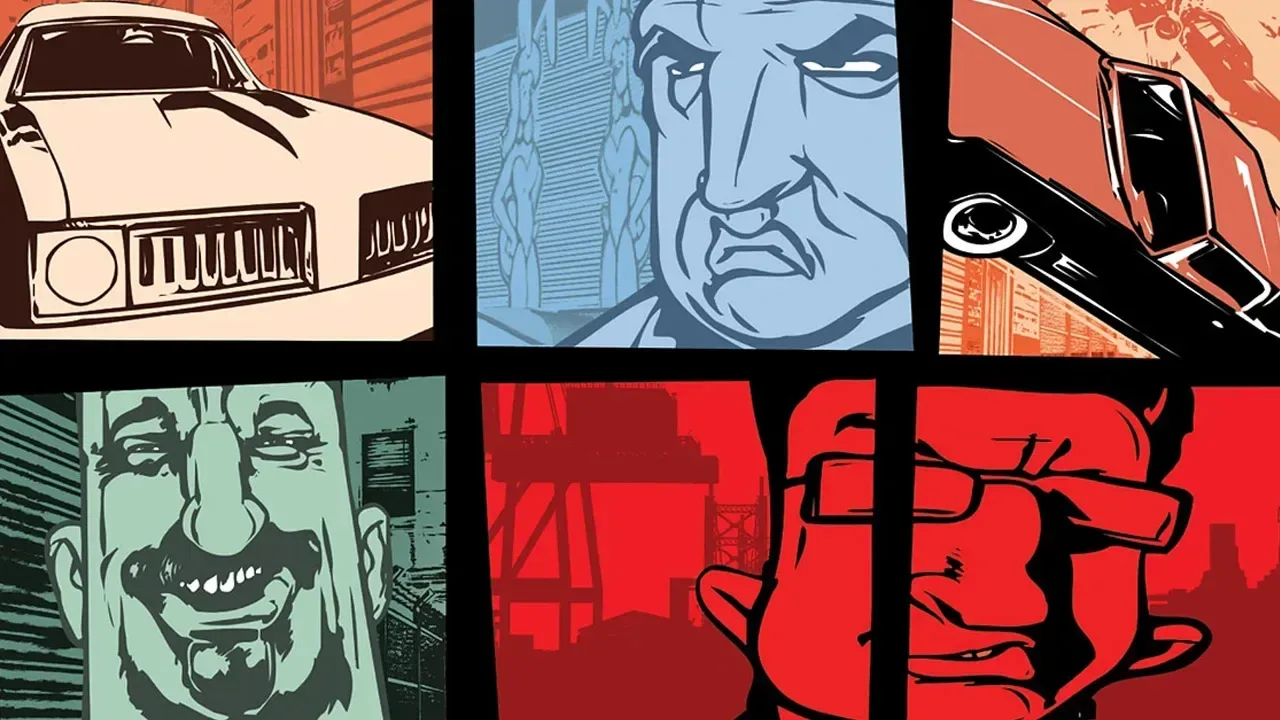
Grand Theft Auto’s promotional artwork has always carried a visual signature that is almost as immediate as the games’ logos: a collage of characters, places, vehicles and mood-setting details arranged in bold, separate panels. That language has changed from entry to entry, but Stephen Bliss, a former Rockstar Games artist, sees parts of its early design DNA still present in the cover art for GTA 6.
Bliss, who worked at Rockstar from 2001 until 2016, has said he was flattered to spot familiar choices in the new image. He specifically identified the continuing box-grid composition and a helicopter placed in the upper-left portion of the artwork—an element he says he developed. At the same time, he was explicit about an important distinction: he had no involvement in the GTA 6 cover and is not claiming authorship over the current team’s work.
“I had nothing to do with that,” Bliss said of the GTA 6 cover, while adding that it was meaningful to see the grid and helicopter placement remain part of the visual language.
A recognizable structure, not a claim of credit
The nuance in Bliss’s comments matters. Creative continuity can be easy to misread as a claim that a former contributor made new work. Bliss instead describes his influence as a set of small references and a surviving heritage within an approach that has become larger than any one artist. He called GTA 6’s presentation “its own language,” acknowledging both the lineage and the independence of the new artwork.
That is a useful way to understand enduring franchise art direction. A visual language is the collection of recurring choices that help an audience recognize a brand: composition, color treatment, typography, character framing and the types of objects that appear in an image. It is not merely a logo. In Grand Theft Auto’s case, the segmented layout has become a powerful shorthand. Even before a viewer takes in each individual panel, the overall arrangement can suggest the series.
The “box grid” Bliss mentions is exactly what it sounds like: imagery divided into distinct rectangular areas, with each section carrying a piece of the setting, cast or fantasy. The comic-book-inspired effect comes from the controlled separation of those images. Rather than presenting one continuous scene, the design gives the eye several snapshots to scan. A helicopter in one corner can therefore be more than background decoration; repeated placement can become part of the composition audiences subconsciously expect.
The artist behind part of Grand Theft Auto’s established look
Bliss was instrumental in shaping the comic-book-influenced promotional style associated with Grand Theft Auto. His tenure at Rockstar covered a period in which the series’ artwork became deeply familiar to players and to people who may only have encountered it in advertising, on packaging or in storefront displays.
But Bliss did not present that history as a solo achievement. He also pointed to fellow Rockstar artists Anthony Macbain and Steven Olds, a reminder that an iconic identity is typically built through collaborative art direction rather than a single person’s contribution. That is especially relevant with an image system as adaptable as Grand Theft Auto’s. The grid can remain recognizable while the people, locations, palette and atmosphere inside it shift to suit a different game.
Related coverage includes Stephen Bliss Says GTA 6 Cover Art Carries Forward His Classic GTA Design Legacy.
Bliss has spent the decade since leaving Rockstar developing an artistic identity beyond the company. His reaction to GTA 6 is consequently less about revisiting an old job than seeing a design idea outlive his direct participation in it. The response is appreciative rather than possessive: the visual heritage persists, but the present-day cover belongs to the artists who made it.
Why recurring cover-art details matter
Promotional art has a different job from screenshots or a trailer. A screenshot documents a particular game moment. Cover art has to communicate a broad promise quickly, often at a small size, while staying distinct among countless other images. A stable format gives a long-running series an immediate advantage. It lets the art team establish continuity without requiring the new game to look identical to its predecessors.
For players, this can make the transition between eras feel intentional. A familiar layout says “Grand Theft Auto” before the viewer has inspected the details, while newly selected characters and locations signal the identity of the specific installment. In that sense, inherited design conventions function much like a recognizable musical motif: the arrangement can be new, but a small structural cue maintains a connection.
There is also a practical marketing benefit. A grid layout supports many focal points rather than betting everything on one central image. That flexibility can accommodate a broad cast and a setting full of vehicles, action and local texture. It creates a controlled sense of density, which suits a series known for large fictional worlds and multiple strands of activity.
None of that means the format should be treated as frozen. Bliss’s wording suggests the opposite. His observation is that GTA 6 contains references to an established heritage, not that it is simply recreating a past cover. That difference is central to franchise design: repetition can make a brand recognizable, while adaptation keeps each entry from becoming a museum piece.
A legacy shaped around individual GTA eras
Bliss’s wider discussion also addressed the creative work behind the distinctive visual treatments of Vice City and San Andreas, as well as the way the September 11 attacks influenced the cover art for GTA 3. Those subjects underscore that Grand Theft Auto’s art has never been created in a vacuum. Its look is tied to artistic decisions, the identity of a particular game and the real-world circumstances surrounding its development and release.
That background gives added weight to the idea of a continuing “language.” A visual tradition is not just a template that gets copied forward. It is a framework that has been revised in response to each project’s own needs. The same basic compositional device can carry markedly different moods depending on its imagery and treatment.
For readers interested in the design side of games, it is worth remembering that visual identity does not only live in a game’s interface or character models. Marketing art is frequently where a series becomes legible to the wider public. It is where a studio condenses a huge fictional space into a single image that has to be memorable, flexible and durable enough to represent the game for years.
What Bliss’s reaction says about GTA 6
Bliss’s comments do not disclose new gameplay details, features or release information for GTA 6. What they do offer is a narrow but interesting observation about continuity: the new cover art still appears to employ parts of an aesthetic vocabulary that was built during his time at Rockstar.
His stated position is clear. He appreciates seeing the grid and upper-left helicopter reference endure, but he did not make the GTA 6 artwork and does not overstate his connection to it. The current cover is new work, shaped in its own way, with small echoes of a visual framework that fans have come to associate with Grand Theft Auto.
That balance is likely why the observation resonates. The strongest franchise aesthetics do not depend solely on nostalgia, nor do they discard every recognizable convention when a sequel arrives. They identify which elements convey identity and allow new creative teams to interpret them. As other game projects find their own presentation styles—whether through distinct world-building, as in Hokko Spaces’ diorama-building focus, or through more conventional key art—Grand Theft Auto’s panel-based approach remains a particularly clear example of a format that has become inseparable from its series.
For Bliss, that survival is personal but measured: a thoughtful acknowledgement of artistic influence, shared authorship and a design legacy that continues without needing to be claimed as his alone.