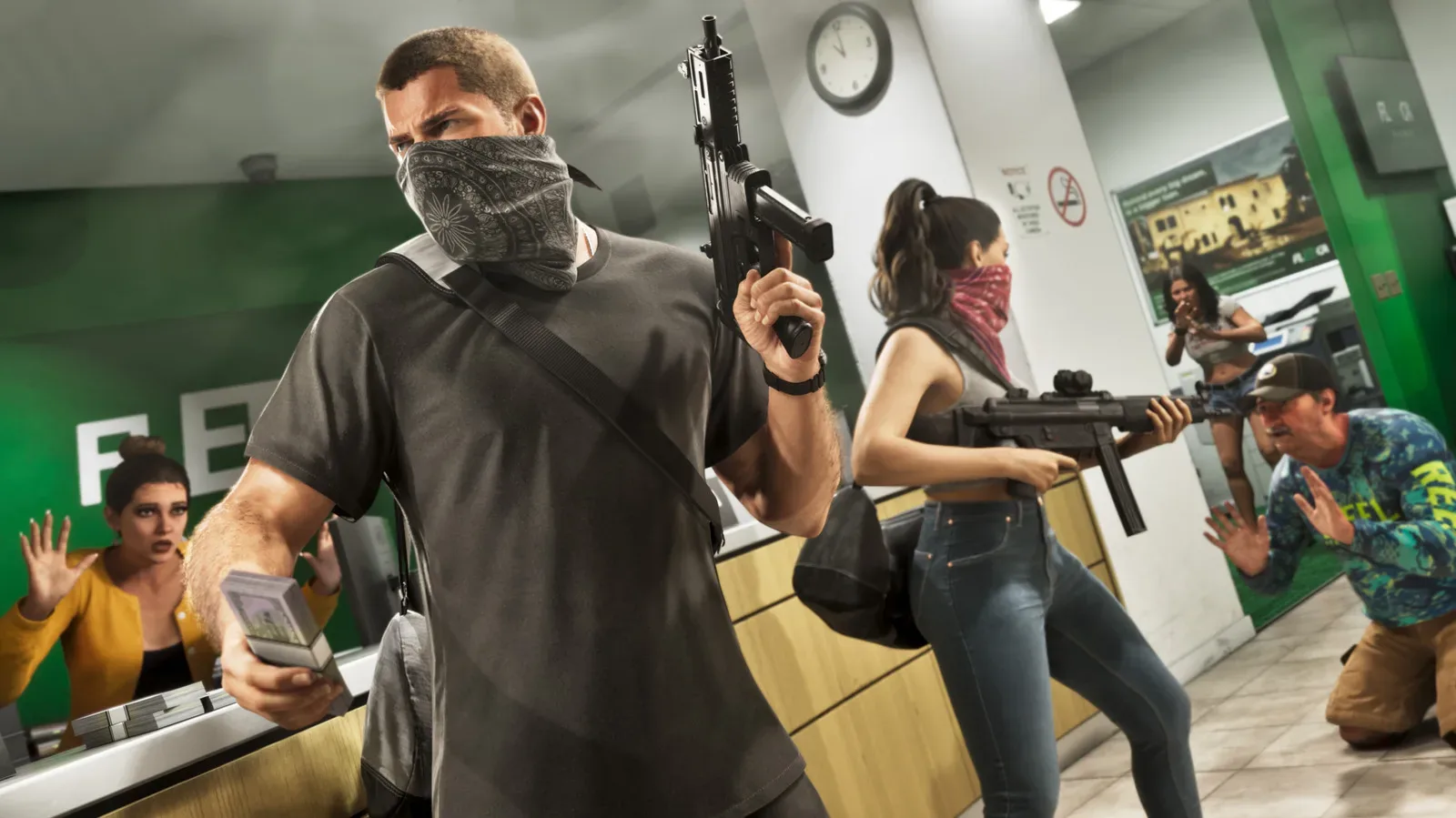

Grand Theft Auto VI does not include the ability to hire sex workers from the street, ending a mainline-series pattern that began with 2001’s Grand Theft Auto 3. Rockstar’s explanation is not that the feature was overlooked or technically impossible. The studio says it chose the game’s activities and systems around the story of protagonists Jason and Lucia: a couple under pressure and on the run.
That is a meaningful distinction in a series where features can become so familiar that their absence is initially easy to miss. GTA VI still carries forward several major staples: vehicles including tanks, car customization with turbo upgrades, store robberies and car theft. Rockstar also specifically identifies the wanted system and radio among the areas it sought to build on. But familiarity alone was not the stated bar for inclusion.
Instead, the studio’s position is that every implemented feature needed to complement the tone, motivations and gameplay direction of Jason and Lucia’s criminal story. In short: GTA VI is not treating a decades-old interaction as mandatory simply because earlier games had it.
A series tradition GTA VI chooses not to continue
The first entry in the franchise to let players hire prostitutes was Grand Theft Auto 3, released in 2001. The mechanic subsequently appeared in every mainline GTA game until GTA VI. Its removal therefore breaks a roughly 25-year run of continuity, even as GTA VI retains plenty of the open-world crime sandbox’s better-known ingredients.
In practical terms, this is a change to one specific ambient interaction rather than evidence that the new game has discarded adult material across the board. GTA VI still has strip clubs and nudity. It also allows Jason and Lucia to have sex at home. The distinction Rockstar draws is narrower: street-based hiring is not part of this particular game’s design.
That matters because “mature content” is not a single switch that is either on or off. A game can contain nudity, sexual content and adult settings while declining to include a particular recurring activity. Rockstar’s account frames GTA VI’s boundary as a narrative and systems decision, not as a wholesale retreat from mature themes.
Rockstar’s reasoning: support the story and the systems
Rockstar characterizes GTA VI as a story about lovers in difficult circumstances. The studio says it brought forward elements from past GTA titles, but only where they supported the feeling it wanted to emphasize and the gameplay systems it intended to expand.
Those systems include:
Related coverage includes Rockstar Explains Why GTA 6 Leaves Out a Longtime Series Feature.
- Wanted system: the game’s law-enforcement and pursuit framework.
- Radio: the in-vehicle audio and station system associated with the series.
- Robberies: criminal activities involving theft from locations such as stores.
- Car theft: the core act of taking vehicles that gives the series its name.
Rockstar’s explanation does not identify one isolated replacement for the omitted interaction, nor does it suggest that a feature has to be a mission objective to earn a place in the game. Rather, it presents GTA VI as an exercise in selection. Even a huge open-world game has a set of priorities, and the studio says its priorities were narrative fit and systems that reinforce the central crime-story fantasy.
There is an important technical-design idea underneath that statement. A gameplay system is more than an individual animation or a single location on the map. It is a reusable set of rules and interactions that can affect player choices across the game. A wanted system can change the consequences of crimes; vehicle theft and robberies directly feed the criminal activity at the center of GTA. Rockstar is saying it concentrated on systems with that kind of broad connection to the experience it wanted GTA VI to deliver.
Why a missing legacy feature can be revealing
Long-running franchises are often judged by checklists. Players remember activities, vehicles, side interactions and oddball details from earlier installments, then look for their return in the next one. That impulse is understandable: repeat features help establish continuity, and GTA’s cities have long been designed to feel packed with distractions beyond the main plot.
But the GTA VI decision shows the limit of a checklist approach. Rockstar has effectively said that legacy status is not, by itself, a reason to preserve a mechanic. A feature can be historically associated with a series and still be left out when it does not serve the current game’s narrative focus or its chosen systemic expansion.
That does not make every omitted feature insignificant. For some players, ambient interactions are part of what makes a fictional city feel reactive, irreverent or unpredictable. Others may never seek out the interaction at all. The available information does not establish how broadly players will feel the change across GTA VI’s wider world. It does establish Rockstar’s reasoning: the omission was deliberate, and the studio does not view the feature as necessary to its version of the game.
The choice is also notable because Jason and Lucia are not merely two separate playable criminals placed in the same city. Rockstar’s description places their relationship at the heart of the story. That foundation gives the studio a straightforward argument for focusing sexual content differently than in older entries: it has kept sexual material in the game, while declining to make the older street interaction part of the player’s activity set.
What remains in GTA VI’s open-world crime toolbox
Removing one longstanding feature should not be confused with shrinking GTA VI down to a narrowly linear experience. The game still includes tanks, turbo-focused vehicle customization and store robberies, alongside car theft, the wanted system and radio. These are all examples of activities or systems that fit the series’ familiar crime-and-driving identity.
Vehicle customization, for example, gives players a way to alter a car rather than merely acquire and abandon one. Robberies create an explicit criminal action beyond driving. The wanted system supplies consequences and escalation, while the radio gives journeys through the game world a distinct layer of atmosphere. Taken together, they show what Rockstar means when it talks about expanding gameplay systems: GTA VI is retaining and developing components closely tied to criminal action, vehicles and the city-traversal loop.
For more on the game’s broader configuration options, see what GTA VI settings can be changed at launch.
The practical takeaway for players
Players revisiting the series’ older habits should set one expectation clearly: they will not find the street sex-worker interaction in GTA VI. Searching Vice City for it will not produce the result that it did in previous mainline games, because Rockstar says it is not implemented.
Players looking for the familiar pillars of a GTA open world, meanwhile, still have the core elements Rockstar has highlighted: stealing cars, robbing stores, modifying vehicles, dealing with law-enforcement consequences and using the radio while moving through the world. The game also retains strip clubs and nudity, so the absence is not a statement that GTA VI contains no sexual material.
The wider takeaway is less about one interaction than about how Rockstar is defining continuity. GTA VI takes forward many recognizable parts of Grand Theft Auto, but it is not presenting itself as an inventory of every mechanic that appeared before. Rockstar’s stated standard is whether an element strengthens Jason and Lucia’s story or supports the systems the team wanted to deepen. In this case, a series hallmark dating to GTA 3 did not meet that standard.