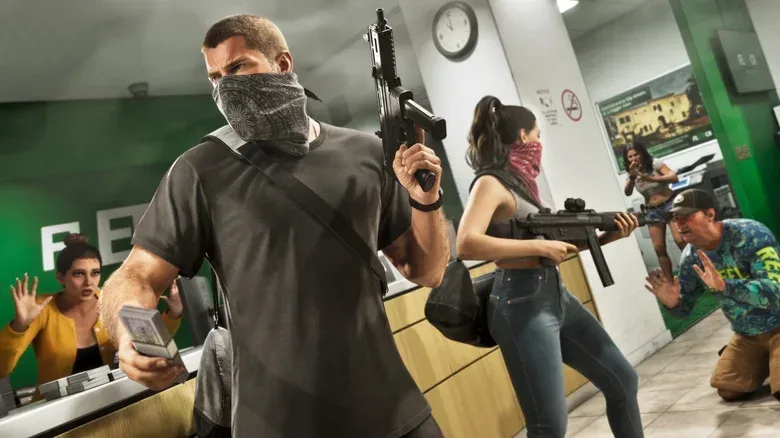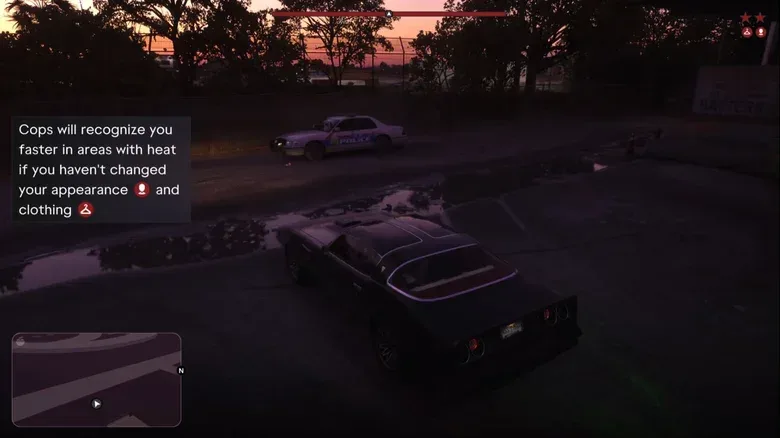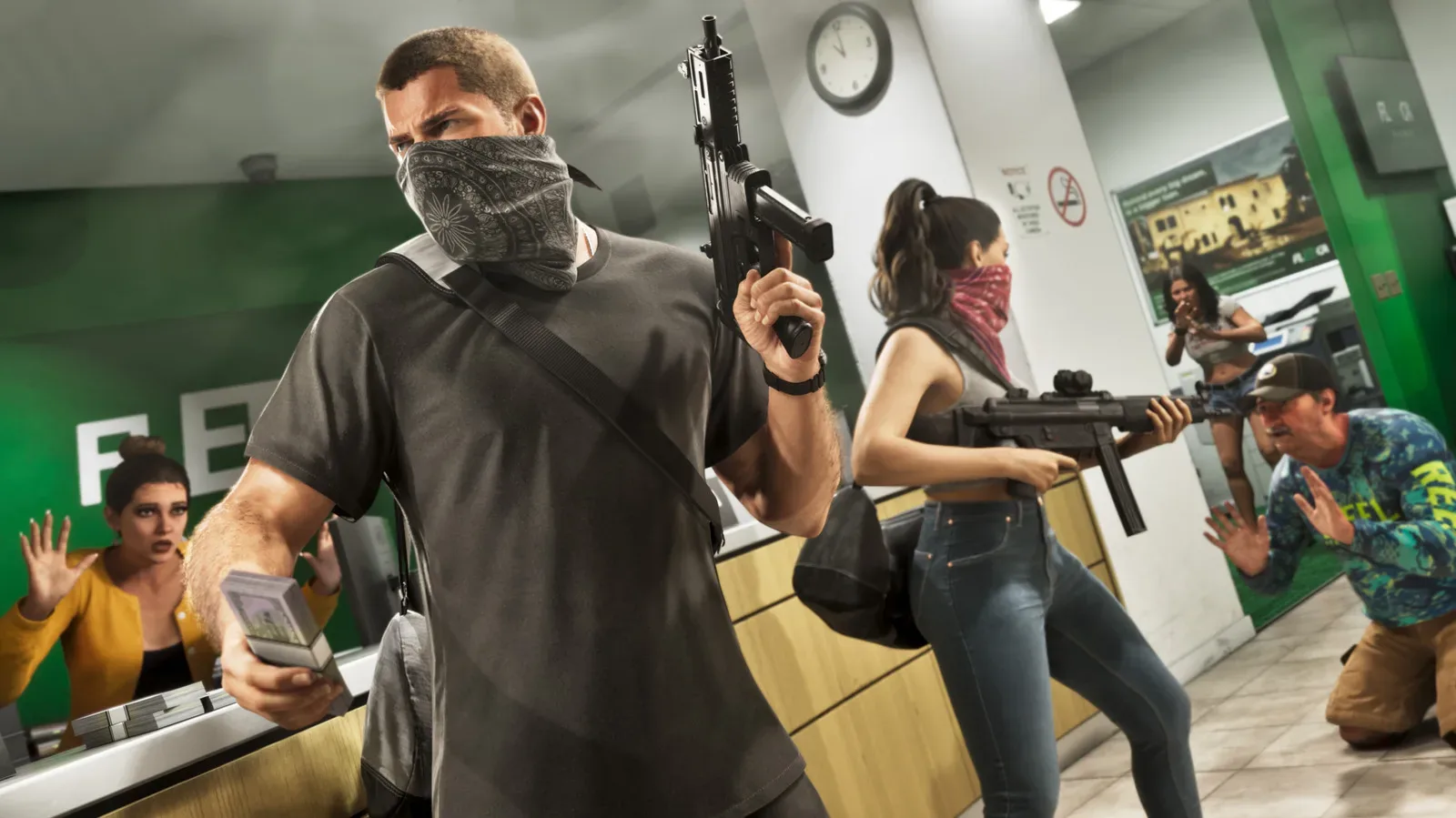
Grand Theft Auto 6 is retaining the series’ familiar Wanted-star framework, but the police response in Vice City and the wider state of Leonida now appears to care about a much more specific question: not simply whether a crime happened, but whether officers can connect it to Jason and Lucia.
The new Heat system expands the usual chase-and-escape loop with changing star colours, a row of identification indicators, and a regional pressure system. Together, those layers make evading the VCPD less about driving far enough away from flashing lights and more about managing the evidence that points back to the protagonists.
That is a meaningful change to the rhythm of criminal activity. A player may escape an immediate pursuit yet still be vulnerable to being recognized again. Conversely, somebody who commits a crime without being personally identified may have a cleaner route out: leave unnoticed, and the investigation can end without a full police chase.
Wanted stars now communicate what police know
GTA 6 still displays up to six Wanted stars, with escalating police force as the level rises. At one star, patrol cars begin pursuit. At four stars and above, the VCPD can bring in helicopters and armored vehicles against Jason and Lucia. The broad message remains instantly readable: more stars mean a more dangerous response.
Heat adds another layer of information to those stars. Their colour and presentation indicate the state of the investigation rather than merely its severity. The currently observed states are:
- White stars with a black outline: Police are investigating, but have not identified the player as the offender. The apparent objective is to get away without drawing attention.
- Gray stars: Police possess some identifying information about Jason and Lucia.
- White stars: Police have actively identified the protagonists and are pursuing them. Breaking line of sight is necessary to shake the immediate chase.
- Red stars: The immediate pursuit has been lost, but police can resume the chase if they identify the protagonists again.
This distinction matters because “lose the cops” no longer seems to be a single finish line. Red stars describe a precarious kind of escape: the patrol has stopped chasing, but the underlying recognition problem remains. A player may need to alter the clues that police are using rather than treating the end of sirens as total safety.
The six ways Jason and Lucia can be recognized
Beneath the Wanted display, GTA 6 presents tracking icons that explain how police can tie a crime to the protagonists. Six have been seen so far. Each corresponds to a distinct form of identification, and each suggests a practical response.
- Security camera: A camera icon means surveillance footage captured the crime. Avoiding cameras, or dealing with them before an offense, can reduce a key lead.
- Accomplice: Police know Jason and Lucia are operating as a pair. Separating them can help each character escape.
- Clothing: A clothes-hanger icon means officers have an outfit description. Changing clothes can undermine that description.
- Face: A face icon signals that police know what Jason and Lucia look like. Wearing a mask before committing a crime is presented as the countermeasure.
- Weapon: A weapon icon indicates police saw the weapon used. Hiding it can make later detection less likely.
- Vehicle: A vehicle icon means the escape vehicle has been identified. Players can abandon it or use a Pay ’n’ Spray.
The important design idea is that these are not simply cosmetic status symbols. They translate police knowledge into readable gameplay conditions. Instead of guessing why an old pursuit restarts, players can see whether the weak point is their car, wardrobe, weapon, uncovered face, companion, or a camera record.
Related coverage includes GTA 6 Heat System Makes Police Remember More Than Your Crimes.
In technical terms, the system tracks identifiers: characteristics that can link a suspect to an offense. A car is an identifier; so is a recognizable outfit. The more active identifiers shown at once, the easier it is for the VCPD to pick Jason and Lucia out and renew the hunt. It is a game-facing abstraction rather than a simulation of every investigative process, but it creates a clear cause-and-effect relationship for the player.
Preparation matters before the crime, not only after it
The most immediate practical implication is that a successful getaway may begin before a crime is committed. Masks can address facial recognition. A different vehicle can be prepared for departure. Cameras on the intended route become hazards to avoid or neutralize. If Jason and Lucia are together, players may need to consider whether keeping them paired creates a recognizable pattern that is worth the convenience.
Afterward, the cleanup is similarly multi-step. Changing clothes, concealing a weapon, abandoning or modifying a known vehicle, and splitting the protagonists are all ways of reducing the available links. The system consequently gives more importance to actions that might once have been treated as role-playing flavour between missions.
That does not mean every crime requires an elaborate plan. The colour states suggest that some incidents can remain investigations rather than turning into direct confrontations, provided the player gets away unseen. But the mechanic creates a stronger trade-off. Loud, visible action may be quicker in the moment, while a concealed approach may prevent a larger and longer-running police problem.
Breaking line of sight is only one phase
In many open-world police systems, breaking line of sight is the core escape task: get out of view, wait, and resume normal activity. GTA 6 still uses that idea when police are actively onto the player. Yet Heat appears to divide escape into two separate questions:
- Can Jason and Lucia end the current pursuit?
- Can they prevent police from recognizing them afterward?
The red-star state sits between those questions. It acknowledges that pursuit and identification are related but not identical. Escaping a cruiser does not necessarily erase a photographed face, identifiable getaway car, or memorable outfit. The visible tracking icons should therefore be the first thing to check once the immediate danger subsides.
Crime also leaves a regional footprint
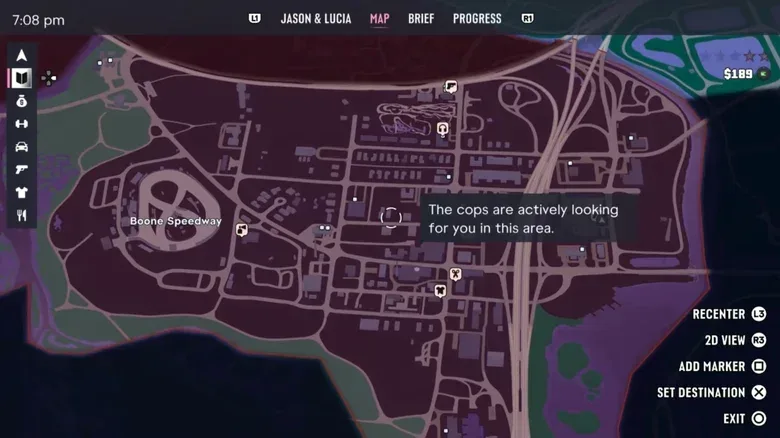
Heat is not limited to the player’s current star level or personal description. Leonida also remembers where repeated offenses occur. Committing more crimes in the same region increases police presence there, and patrols can remain even after the Wanted level has been cleared.
The map marks a hot area with a purple overlay. Over time, that local Heat cools down if no further crimes are committed there. The result is a simple territorial pressure system: repeatedly treating one neighborhood as a reliable place for chaos can make it increasingly inconvenient to operate there.
This regional layer could change how players use the map. Rather than immediately returning to a familiar block after an escape, it may be wiser to move to another part of Leonida and let the purple zone settle. Players who want to avoid a gunfight have a reason to rotate their activities, while players looking for a high-intensity encounter can knowingly keep working in a hot zone where patrol density has risen.
It also makes the map a planning tool instead of just a navigation screen. The purple overlay gives an at-a-glance warning that a location has become unfriendly. Combined with the personal identifiers beneath the stars, GTA 6 is effectively asking players to monitor both who they look like to police and where police are expecting trouble.
Why the change is more than a new HUD feature
The core Wanted mechanic has long been legible because it turns criminal escalation into a simple visual scale. Heat preserves that clarity while supplying reasons behind a pursuit and tools for responding to it. A player can make an informed choice: keep the same car and risk recognition, or abandon it; stay together, or split up; revisit the same district, or wait for local Heat to fade.
That approach may make GTA 6’s law enforcement feel more persistent without requiring every encounter to become a maximum-star battle. The pressure can come from surveillance and recognition as much as raw firepower. It also gives the two-protagonist setup a direct mechanical role through the accomplice indicator, rather than leaving it solely to story presentation.
Rockstar’s broader design choices will continue to draw attention as players explore the new game, particularly after the long road to its arrival. For more discussion of the business and technology questions around major game development, see this look at the limits of the “Toy Story moment” analogy for AI games.
For GTA 6 players, though, the immediate takeaway is straightforward: watch the stars, read the icons, and do not assume that being out of sight means being forgotten. In Leonida, the police may no longer be chasing only the last crime scene. They may be chasing the person, outfit, weapon, vehicle, companion, and neighborhood history connected to it.