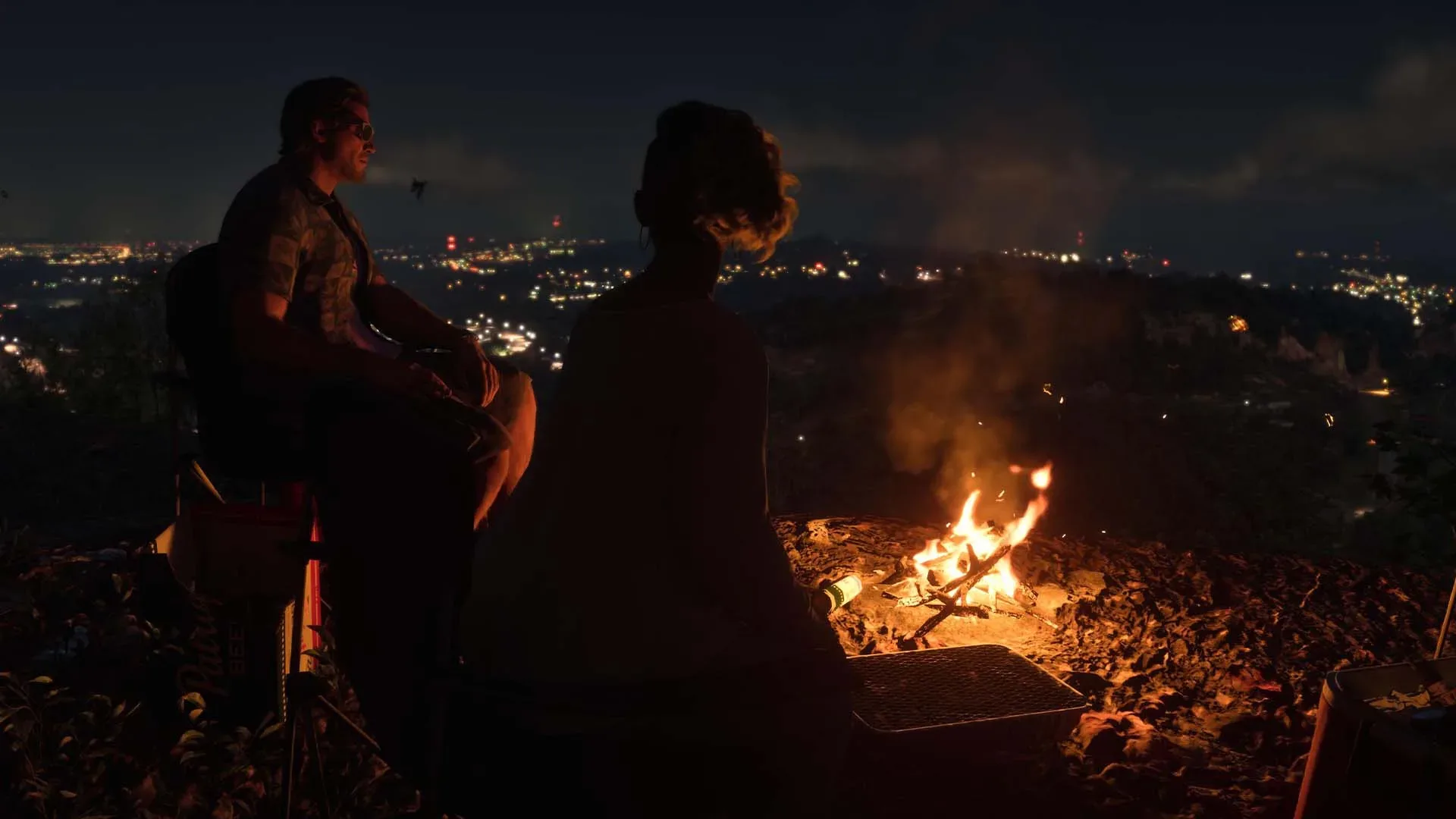

Grand Theft Auto VI may be built around fast cars, impulsive crimes and the universal human desire to see whether a lamppost has physics, but its creation sounds considerably more methodical. Rockstar North co-studio head and head of development Rob Nelson has outlined a process defined by persistence, long-serving specialists, repeated evaluation and, crucially, a willingness to decide where the game’s ambitions have to stop.
The clearest message is that a game of this scale does not emerge from one all-knowing command centre. Nelson describes GTA 6 as something assembled in layers by departments with deep expertise: animation, technology, programming, missions, world-building, interface design and more. Individual leaders may understand their own areas closely, but no single person holds every technical and creative detail in their head. That is less a confession of chaos than an honest description of a modern blockbuster game. The city-sized digital sandwich has too many ingredients for one chef, and someone still has to stop the mayonnaise department from adding another three years.
A development model built on iteration, not one giant reveal
Nelson says Rockstar North works in roughly eight-week sprints. In software development, a sprint is a defined stretch of work in which teams aim to complete a set of tasks, then assess what has changed. The important part is not the calendar label; it is the loop: build, evaluate, record feedback, revise and repeat.
For GTA 6, that loop has apparently been essential. Nelson says a recent internal update showing how missions, locations and features had changed over several years made the progress especially striking. That reaction is understandable. Large projects can feel stagnant to the people inside them because day-to-day development often consists of small fixes, refinements and individual systems coming online one at a time. A multi-year comparison makes those accumulations visible.
The project also faced the coordination problems that come with a larger and more distributed workforce. Nelson says the team was double the size of the one behind Red Dead Redemption 2, worked across studios around the world and had to contend with time-zone separation and COVID-era disruption. Those conditions make shared direction more valuable, not less. When many groups are working simultaneously, the game needs enough common purpose that teams can solve problems independently without each solution pulling the wider project in a different direction.
Nelson attributes much of that cohesion to a team that has worked together for a long time, alongside what he calls stubborn persistence. It is not glamorous language, but it suits the job. The spectacle of GTA is the finished city. The production reality is likely a long series of unglamorous decisions about what must be improved today so that the next build is better than the last.
The tiny animation that explains the bigger philosophy
One example Nelson highlights is a bespoke animation for a character getting out of a vehicle when there is too little space for the door to swing open normally. It is a small moment on paper, yet it says a lot about GTA 6’s broader intent.
Most open-world games have countless situations where objects collide, paths are obstructed or a player stops somewhere the designers did not explicitly expect. A standard animation may look awkward or fail outright in those edge cases. A contextual animation system can instead select a movement suited to the available space. In this case, rather than behaving as if the laws of doors have been temporarily suspended, a character can negotiate the cramped exit.
Related coverage includes Rockstar North Details the Stubborn, Layered Development Behind GTA 6.
Nelson says the animation team introduced that touch without being specifically told to do so by senior development leads. New radio adverts, the radio system itself becoming active, and user-interface elements are other examples he gives of components that can arrive in a build and give the wider team a jolt of momentum.
This matters because the most convincing game worlds are rarely defined by a single headline feature. They are made persuasive by the accumulation of responses that feel appropriate: a small spatial adjustment, a piece of ambient audio, a menu that makes sense, a population whose behavior changes with the time of day. Each may be easy to miss in isolation. Together, they reduce the number of moments where the player feels the machinery behind the illusion.
Analysis: This approach also helps explain why developers are cautious about describing every feature solely in terms of a marketing checklist. The value of a world simulation is often in the relationship between systems. A vehicle exit animation is not merely a fancier way to leave a car; it supports the impression that characters occupy physical space. New radio material is not merely background noise; it contributes to place and changing activity. The joke is that the smallest details can be doing the heaviest lifting.
Creative autonomy needs a budget, not a blank cheque
There is an obvious risk in empowering every department to chase ever more elaborate detail: eventually, every team would keep improving its corner of the game indefinitely. Nelson is direct that Rockstar does not have unlimited time, money or staff, despite assumptions that can surround an enormous release.
He describes a necessary set of checks and balances over where to push, how far to push and whether a particular addition is worth the resources it requires. In practical terms, a new feature or refinement is never just its visible result. It can need animation work, engineering support, testing, integration with other systems and ongoing fixes. Its cost is also measured in opportunity: time spent polishing one interaction cannot simultaneously be spent on something else.
That is the central production tension behind a game with GTA 6’s apparent density. Freedom for expert teams can produce inspired work, but it must be framed by priorities. The answer is not necessarily to reject unusual details; it is to choose the details that serve the whole game. That is why the small car-exit solution is useful as an example. It appears to reinforce a central goal—making the world feel responsive—rather than existing as a disconnected technical flex.
For players, this is a useful lens through which to view apparent omissions or trade-offs in any vast game. Development is not a vending machine where enough coins produce every conceivable feature. It is a series of choices about the experience the team considers most important. Some choices will be visible, such as performance targets. Others will be almost invisible, except when a character sidles out of a badly parked car and the moment does not look like a mannequin escaping a refrigerator.
Why Rockstar chose 30fps on current consoles
The most debated trade-off so far is GTA 6’s confirmed frame-rate target: 30 frames per second across current platforms, including PlayStation 5 Pro. Nelson’s explanation is blunt. A 60fps target would have required too many compromises, given the game’s visual fidelity, simulation complexity, number of systems and gameplay options on current hardware.
Frames per second, or fps, measures how many individual images a game presents each second. At 30fps, a new frame is displayed 30 times per second; at 60fps, that happens twice as often. Higher frame rates can make motion appear smoother and can reduce the time between a player input and the corresponding on-screen result. They are especially prized in games where rapid reactions are the main attraction.
But frame rate is only one demand on a console’s hardware budget. Every additional frame must be rendered and simulated in less time. Moving from 30fps to 60fps means the game has roughly half as much time per frame to do its work. That work can include graphics, lighting, character behavior, traffic, physics, world streaming, audio-related systems and the game logic that makes activities interact.
Simulation here refers to the collection of systems that model how the world behaves: inhabitants, vehicles, time-of-day changes, activities and other responsive elements. It does not mean every part of a city is calculated with perfect real-world precision. It means the game is devoting resources to making a world that reacts and changes rather than functioning as a static backdrop.
Rockstar’s stated trade-off is therefore not simply “prettier pictures versus smoother movement.” Nelson frames it as protecting the overall artistic vision: detail, density and systems that would have had to be cut back or altered to maintain 60fps on the available hardware. The studio has not ruled out different outcomes on future hardware, but that is not a promise of any specific mode, update or platform.
There is useful additional technical context in the report that GTA 6 uses FSR 4.1 on Xbox Series S. Upscaling technologies create a higher-resolution output from a lower internal render resolution, helping systems allocate performance to demanding scenes. Upscaling does not make performance concerns vanish; it is one of several tools developers can use while balancing image quality, frame rate and complex world systems.
Analysis: The 30fps decision will not satisfy players who place fluidity above all else, and that preference is legitimate. But Nelson’s comments establish the actual argument Rockstar is making: 60fps was evaluated against the game it wanted to ship, not as a free settings toggle waiting to be enabled. The real question is which compromises players would accept. Rockstar’s answer is that reducing the intended visual and systemic scope would be the worse bargain.
Preparation appears to shape GTA 6’s criminal sandbox
Nelson’s own description of play offers a more grounded clue about GTA 6’s open-world design. He talks about quietly moving through the city, watching the population shift from day to night, spending time with Lucia, visiting the beach or a nightclub, and choosing between low-key social activity and criminal escalation.
The key idea is player expression. Nelson says the game should let people feel as though they are embodying their own version of its characters. That does not imply unlimited outcomes or a completely improvised story; it describes a world designed to support different rhythms. One player may wander, socialize and observe. Another may treat every errand as an elaborate logistics exercise with a suspiciously well-funded exit strategy.
Nelson’s preferred robbery preparation is a revealing example. He describes modifying a large truck capable of carrying six bags, parking it nearby, positioning a stolen motorcycle close to the target, using the bike to escape after a robbery, transferring bags to the truck and potentially hitting more targets before fencing the goods. The player can also send their partner to fence them or do it personally.
Fencing is the process of selling stolen goods through an intermediary or buyer. In gameplay terms, it is not merely a criminal-flavored word: it makes the aftermath of a robbery part of the activity. Loot must be handled, transport matters and a partner can be incorporated into the plan.
Nelson says more preparation generally improves the chance of a successful crime spree. That suggests GTA 6 is interested in the route to a robbery as much as the moment a cash register becomes extremely nervous. Vehicle selection, proximity, storage capacity and getaway planning can all affect the plan. The result, if the systems work as described, is a sandbox where improvisation remains possible but forethought has real value.
What the development story really tells players
The most significant takeaway is not that GTA 6 contains a clever vehicle-exit animation, a truck with room for six bags, or a fixed 30fps target. It is that these details point toward the same production priority: a densely layered world in which large systems and small observations are intended to reinforce one another.
Rockstar North’s account is also a useful corrective to the idea that scale automatically makes game development easy. A larger team expands capability, but it also multiplies coordination, feedback and decision-making demands. An international operation introduces more viewpoints and more expertise, but also time zones and communication barriers. Iteration is the mechanism that lets all of that work gradually cohere.
GTA 6’s long road, then, appears to have been less about one magical breakthrough than thousands of decisions repeatedly tested against a shared vision. Some will be obvious the instant players turn on the game. Others may only register as a faint but valuable sense that the city knows what to do when a car door meets a narrow gap. In an open world this enormous, that kind of invisible competence might be the real luxury item.