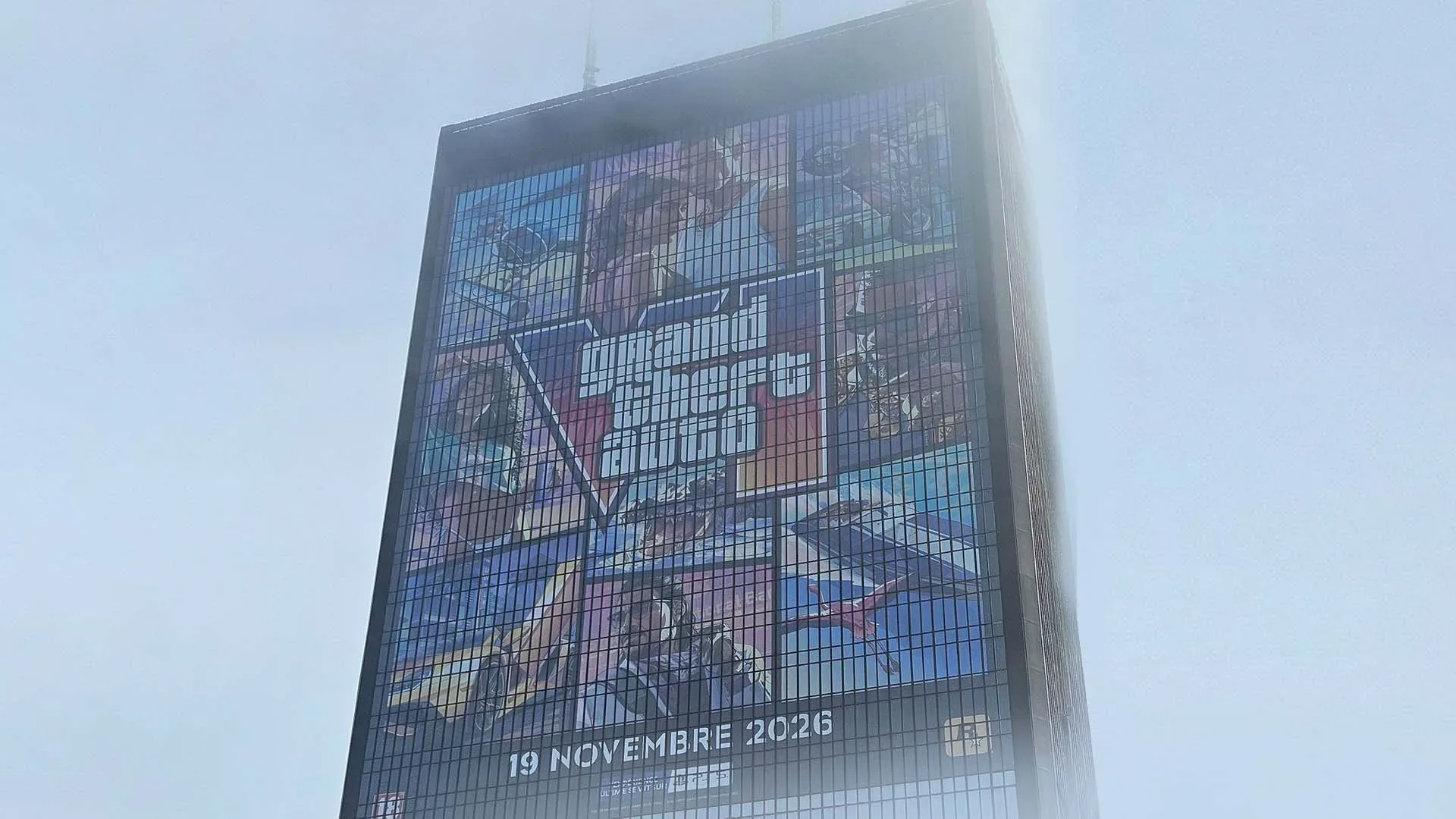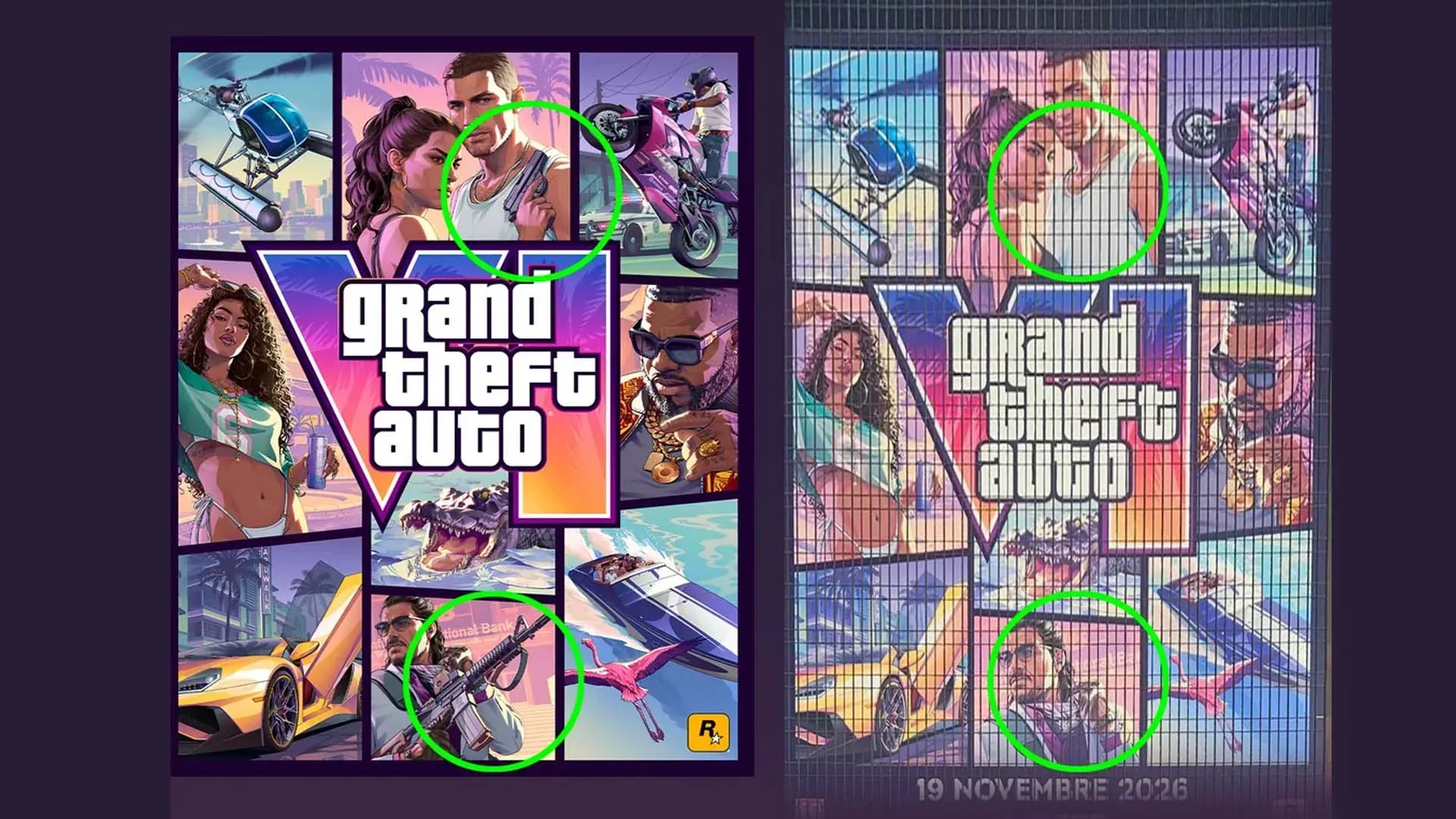
A towering Grand Theft Auto 6 advertisement in Paris is attracting attention not merely because of its scale, but because of what is absent from it. The completed banner on one of the Les Mercuriales towers recreates the game’s cover-art composition with visible edits: two guns present in the standard artwork do not appear on the building-sized version.
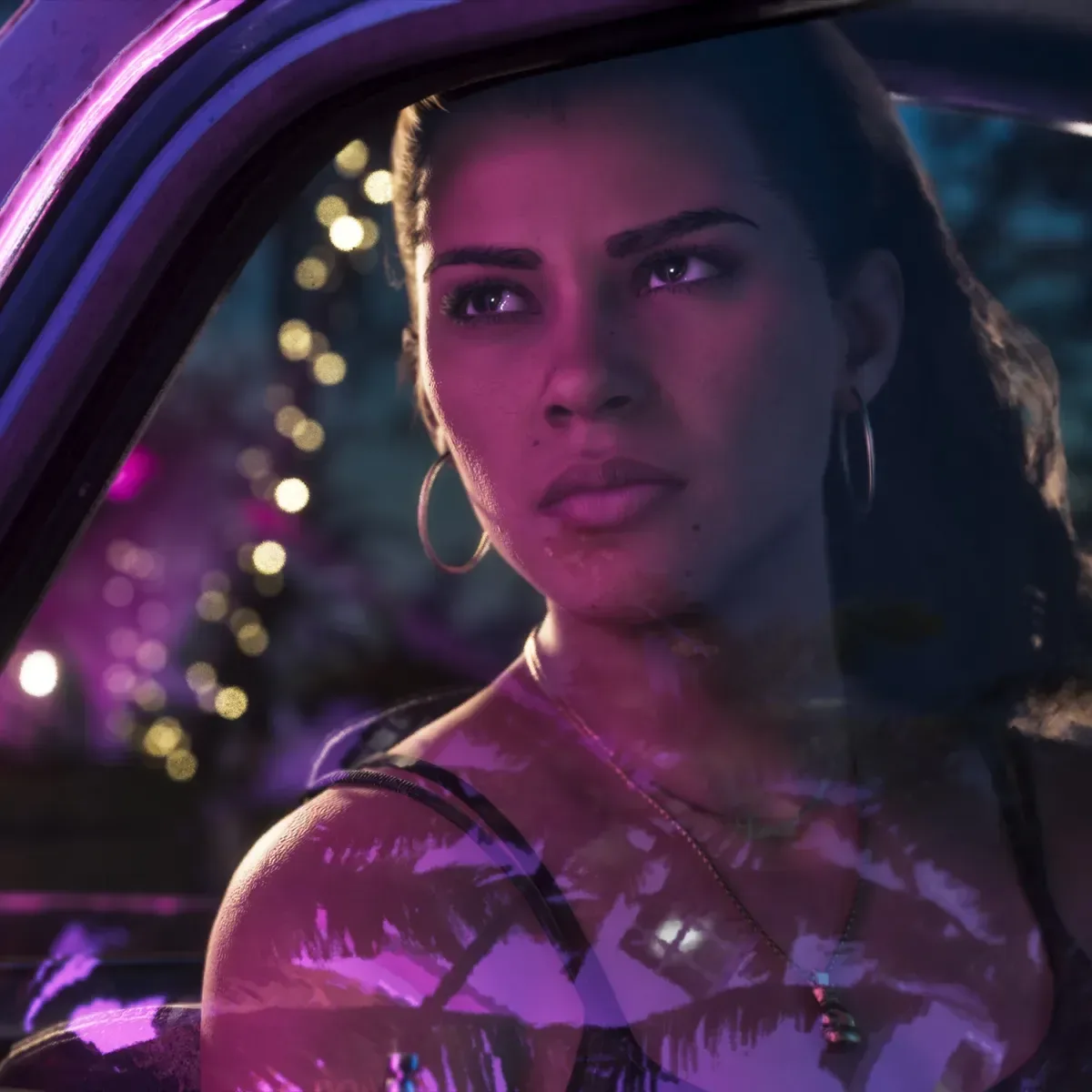
The changes are subtle enough that a passer-by may not notice them, but they are significant in an image built around recognisable character poses. In the upper central portion of the design, Lucia’s firearm has been removed along with the hand that held it. Elsewhere, an assault rifle has been taken out; the edited art instead leaves the associated character appearing to hold a hand up without the weapon in front of it.
That makes the Paris display a particularly conspicuous example of how game campaigns can adapt one central piece of art for different physical spaces. It is still unmistakably GTA 6 marketing, still promotes the same game, and still uses the same broad cover-art arrangement. Yet the omissions change the image’s tone from street level, especially when it occupies an enormous portion of a building façade.
What changed on the Paris banner
Documentation shared online over roughly two weeks showed the large advertisement being installed on a Les Mercuriales tower in Paris. Once the installation was completed, comparisons with the official GTA 6 artwork highlighted two alterations.
- Lucia’s gun is gone from the upper middle image featuring Lucia and Jason. The edit removes both the weapon and Lucia’s hand rather than simply obscuring the firearm.
- An assault rifle is gone from the lower middle part of the composition. The revised image appears to leave the character’s hand raised, with no gun placed before it.
These are not changes to the game itself, nor is there evidence here of altered gameplay, content, ratings, or a different edition for Paris. They are changes to a piece of out-of-home advertising: promotional material intended to be viewed in public places rather than on a console storefront, television screen, or a viewer’s personal device.
That distinction matters. Cover art and campaign art often have to work at radically different sizes. On a game case or online product page, a firearm might be one small visual detail among logos, characters, vehicles, and scenery. On a massive tower banner, those same details become part of the public streetscape and can be visible from a considerable distance.
Why the comparison stands out
Promotional murals and banners in the United States have used GTA 6 imagery that retains guns. A New York City mural, for example, has been shown with weapon-bearing artwork intact. The contrast makes Paris’ edited execution difficult to write off as a universal redesign of the campaign visual.
Instead, it appears to be a location-specific treatment of the same underlying art. What exactly prompted that treatment is not established. The tower’s owners may have preferred not to put giant firearms on their property, or a local advertising requirement may have shaped the final design. The available information does not confirm either explanation, so it would be premature to present either as fact.
Related coverage includes Paris GTA 6 Banner Removes Guns From Cover Art.
There is also no stated indication that Rockstar Games changed the art independently of the property owner, the advertising partners involved, or any local rule. The useful, supportable takeaway is narrower: the Paris banner was installed without the two firearms visible in the comparison artwork, while examples in the U.S. have retained weapons.
A practical lesson in adapting game marketing
Grand Theft Auto is an especially revealing case because its imagery is designed to be loud. The series’ public identity routinely incorporates crime, cars, nightlife, danger, and weapons. Removing a gun does not make GTA 6 read like a completely different kind of game—nor does the banner appear to be attempting that. But it does show how a campaign can preserve characters, color, composition, and brand recognition while changing individual elements that may be more sensitive in a particular public setting.
For marketing teams, this is the difference between a fixed asset and a modular asset. A fixed asset is used identically everywhere. A modular asset has separate components that can be adjusted without rebuilding the entire campaign. Here, the art seems to have been adjusted at the character-detail level: poses and framing remain familiar, but selected weapons are removed.
That approach can be useful for huge-format advertising. A campaign may need artwork suitable for a range of landlords, city environments, display sizes, or local standards. The public usually only sees the final installation, so the design work can look oddly simple after the fact: one hand is gone, one rifle is gone. In reality, a clean edit has to preserve the balance of the composition, prevent an obvious visual hole, and keep the character readable from far away.
The Paris result also demonstrates why fans compare regional executions so closely. GTA 6 is approaching a stated November 19 release on PS5 and Xbox, and the campaign is escalating through trailers, cover stories, merchandise, murals, and other large-scale promotion. When a key piece of campaign art appears in several cities, differences between the versions become part of the conversation just as quickly as the art itself.
What it does and does not indicate about GTA 6
The banner is a marketing artifact, not a product specification. It should not be used to infer that weapons have been cut from GTA 6, that its content has changed, or that one region will necessarily receive a different game. The supplied information only identifies edits made to this physical Paris advertisement.
Likewise, the lack of a confirmed explanation is important. It may be tempting to treat the missing guns as proof of a French or Parisian advertising prohibition, but no specific restriction has been identified. It is equally possible to assume the building owner made the call, but that too remains unconfirmed. The responsible reading is that the final creative was tailored for the placement and that the decision-making details are unknown.
For players waiting on the release, the more direct consumer questions remain about platform access and requirements. Joking Joystick has also examined whether GTA VI needs an internet connection to play, a separate issue from what appears on an outdoor campaign display.
The billboard-sized irony
There is an inherent irony in sanitising isolated weapons from a public ad for a series long associated with criminal worlds and open-ended mayhem. That irony is likely why the Paris banner has travelled so widely online. A weaponless hand does not erase GTA’s reputation, its title, or the visual language of the rest of the artwork. It simply makes the tower version a little more restrained than its counterparts elsewhere.
Still, restraint is not the same as inconsistency. Physical advertising is negotiated space: a publisher has a campaign to communicate, while a building owner and the surrounding environment shape what ultimately appears on a wall. The Les Mercuriales banner shows that even one of the most closely watched game launches can have a tailored public face from one city to the next.
As GTA 6’s November 19 launch window draws closer, more murals, banners, and other installations may appear. The Paris design offers a useful reminder to separate confirmed facts from assumptions: the guns were removed from this giant banner; comparable U.S. displays have retained them; and the reason for the edits has not been confirmed.