
Grand Theft Auto VI’s release in Japan is not simply the same download with a different storefront label. Players are discovering a specifically tailored version whose changes reach from shower scenes and beaches to violence effects and language support. The biggest difference is straightforward: nudity is absent in the Japanese edition.
That conclusion began with a small but conspicuous technical clue. During pre-loading, the Japanese download was more than 1 GB smaller than versions offered elsewhere. Its CERO rating information also did not list sexual-content references that appeared in ratings material in other regions. The full scope of the edits only became clear after players began the game, however, as Rockstar had not confirmed the changes before launch.
The result is a release that remains broadly recognisable as GTA VI, including mature subject matter and adult-oriented locations, but presents some of that material differently. It is not a wholesale rewrite of the game. It is a regional cut with targeted alterations to nudity, some scenes, visual gore, and the available language package.
Nudity is covered, altered, or removed
The clearest dividing line is nakedness. GTA VI does not allow unrestricted player nudity in any region, despite prior speculation suggesting otherwise. In Japan, though, nudity of all kinds has been removed from the experience. A shower, for example, is depicted with the character still wearing underwear rather than unclothed.
Other situations have reportedly been adjusted in a few different ways. Some sex scenes and beach appearances use additional clothing, while certain scenes have been removed altogether. That matters because it suggests the Japanese version is not applying one uniform blur or screen overlay. Instead, individual content has been modified in ways appropriate to the scene: cover the character where a scene can still function, or omit a sequence where that is not the workable route.
That distinction is useful for players trying to understand what “censorship” means here. It does not necessarily mean every mature reference has vanished. The game still permits entry to strip clubs, and characters can still wear very little clothing. Drug use remains present in-game as well. The boundary described by the Japanese version is specifically around visible nudity, rather than an attempt to purge every sexual, suggestive, or illicit theme from GTA VI’s world.
Violence remains, but its aftermath is dialled back
Japan’s edition also tones down gore. GTA VI can depict extremely graphic damage when civilians are killed, including skull fragments, brain matter, and dismembered body parts. In the Japanese release, the amount of visible blood has been reduced.
The difference is not only about how much blood appears at the moment of violence. Blood reportedly disappears faster as well. That is a small technical and visual decision with a meaningful practical result: an encounter may still be violent, but the evidence it leaves behind on the street does not linger as long.
Related coverage includes Grand Theft Auto VI's Japanese Release Removes Nudity and Reduces Blood Effects.
For players, this means the fundamental action appears to remain intact while its presentation is softened. The supplied information does not establish changes to mission structure, combat controls, weapons, progression, or the wider open world. It supports a narrower claim: GTA VI’s violence is still there, but the most graphic visual effects and persistent blood are reduced in the Japanese edition.
Whether that is a disappointment or a benefit will depend on the player. Some people value a release matching another region as closely as possible; others may prefer that especially gruesome details are less prominent. Either reaction can coexist with the key point: regional releases can differ in texture and presentation even when the central game remains substantially content-complete.
The download-size clue was real, but not a complete measure
A difference of more than 1 GB drew early attention, and the later discoveries provide a plausible explanation for at least part of it. Removed scenes and altered assets can affect a game’s installed size. But download size should not be treated as a precise scoreboard for every edit. Compression, duplicated assets, audio packages, regional files, and how a platform builds an install can all influence the final number.
What the size gap did accomplish was flag that players might not be receiving identical data. Once the release was available, comparisons of scenes and effects showed that the concern was not just about a harmless packaging discrepancy.
It is also important not to stretch the evidence further than it goes. The available details identify nudity-related edits, some removed scenes, reduced blood, and shorter persistence of blood effects. They do not provide a comprehensive, scene-by-scene inventory of every asset that differs between regions. Anyone expecting a definitive list of all changes should treat the currently known examples as examples, not a guaranteed exhaustive catalogue.
Japanese copies have a much smaller language selection
Content is not the only regional difference. Global copies contain more than a dozen languages, while the Japanese release is limited to an English voice track and English and Japanese subtitles. For a game built around dialogue, radio, incidental conversations, and satire, subtitle availability is part of the product rather than a trivial menu option.
The regional separation runs in the other direction, too: global copies do not include Japanese subtitles. That arrangement makes switching to a different regional version less useful for someone hoping to combine Japanese text with the less-altered content package. In digital games, language files can be a practical route around region-specific restrictions; withholding Japanese subtitles from global editions closes off that particular option.
For import-minded buyers, this is the most immediate practical implication. The choice is not just between a Japanese box and an overseas box. It can involve a trade-off between subtitle needs, the visual-content differences, account or platform compatibility, and the exact version being bought. Players should check their storefront and product listing carefully rather than assuming every GTA VI edition carries the same language assets.
A code-in-a-box purchase has its own deadline
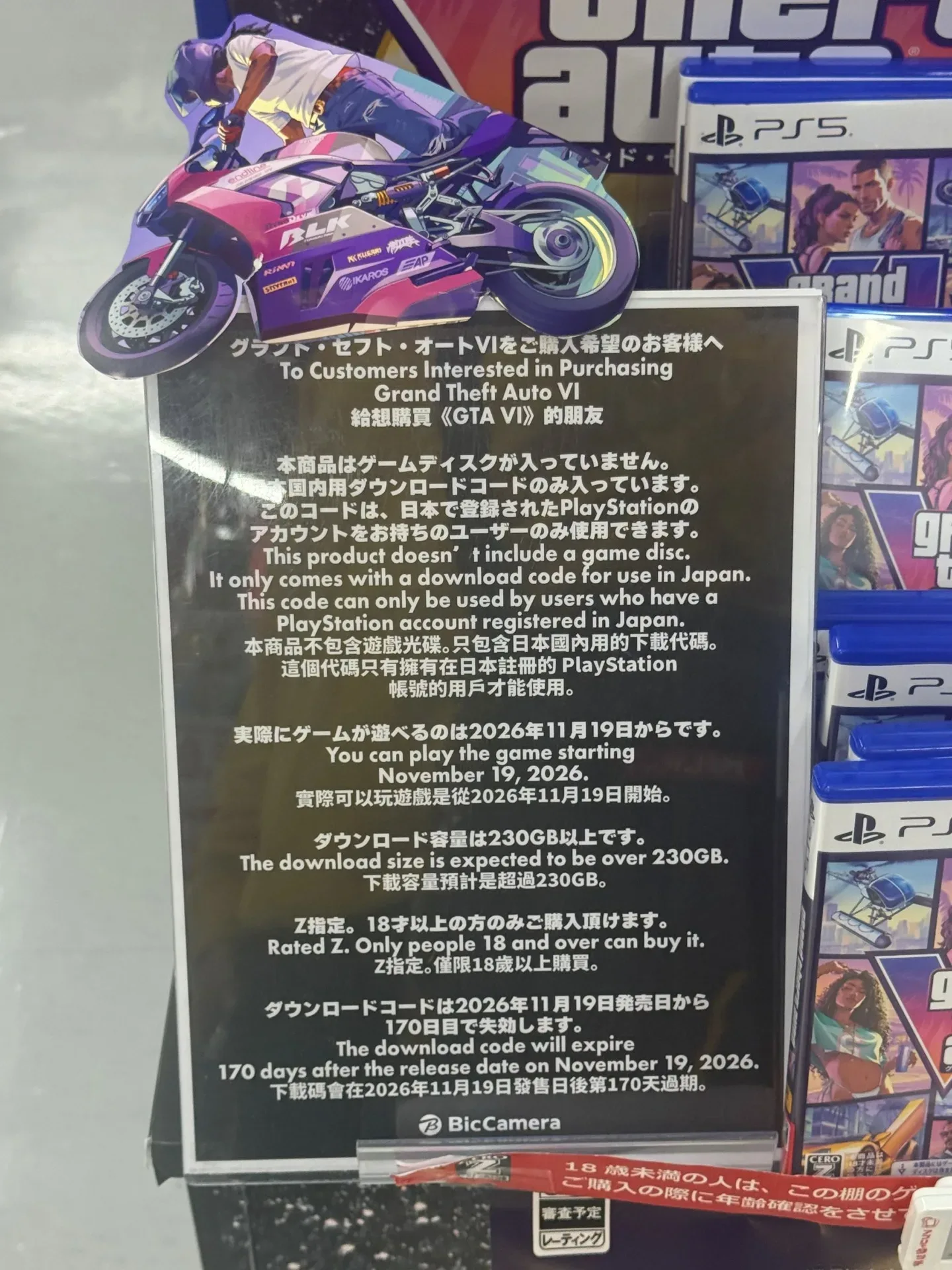
Japan’s physical code-in-a-box release adds another condition. The included digital code must be redeemed within 170 days of the game’s release because of local legal requirements. A code-in-a-box product looks like a physical game purchase, but it is functionally a retail package for a digital entitlement. The disc-less distinction is particularly important for collectors and anyone buying later from a retailer or resale market.
Unlike a cartridge or disc that can be inserted years later, an unredeemed code can expire. The packaging may remain pristine, but the central purpose of the purchase—claiming the game—may no longer be available. Buyers interested in this Japanese format should therefore distinguish between a sealed collectible and a usable game code, and should verify the redemption status and deadline before treating an older copy as playable.
What this means for GTA VI players
Japan’s GTA VI release illustrates how regional versions can diverge across several layers at once. A rating classification can correspond with content changes; a modest install-size difference can invite scrutiny; language availability can shape which versions are practical to import; and a physical retail package can carry a hard redemption window.
For players already in Japan, the main takeaway is that the local release is not missing the entire adult identity of GTA VI. Strip clubs, drug use, scantily clad NPCs, and violent action remain. The presentation has simply been redrawn at particular limits: no visible nudity, some scenes changed or absent, and blood effects less explicit and less persistent.
For players outside Japan, importing is not automatically a route to a more flexible edition. The Japanese version has only two subtitle choices and the English voice track, while global versions omit Japanese subtitles. Anyone comparing editions should decide which factor matters most: Japanese-language text, a broader language library, or the content treatment they prefer.
And for anyone following the game’s broader world-building, these regional differences sit alongside other observations about Leonida’s exaggerated culture and satire, including GTA VI’s “Furverts” encounters. The Japanese edits do not change the fact that the game is constructed around provocative material; they show how that material can be selectively reframed from one market to another.
In short, the Japanese GTA VI is a distinct release rather than a separate game: mostly complete, visibly moderated in specific areas, linguistically narrower, and subject to a time-limited redemption rule for its code-in-a-box format.