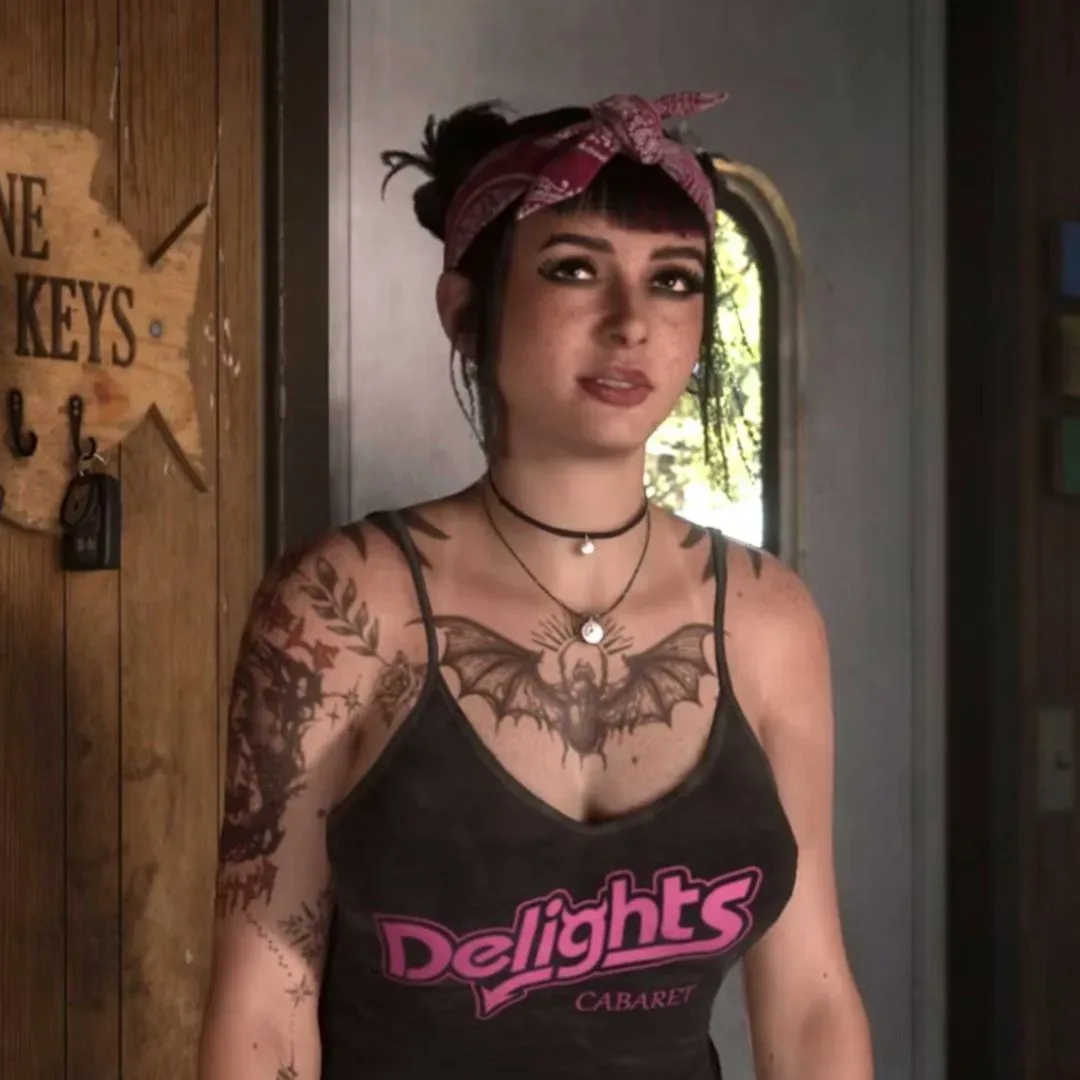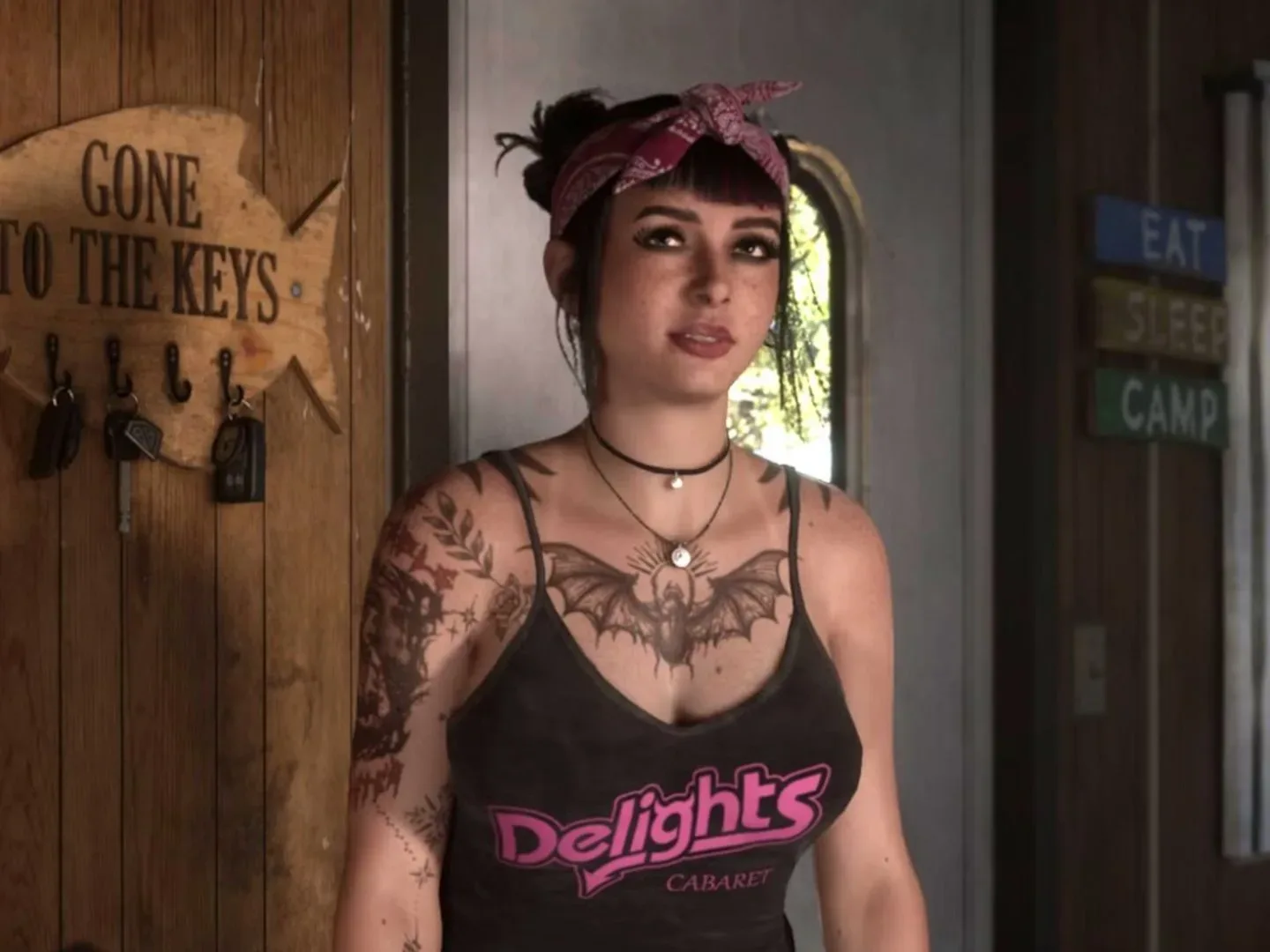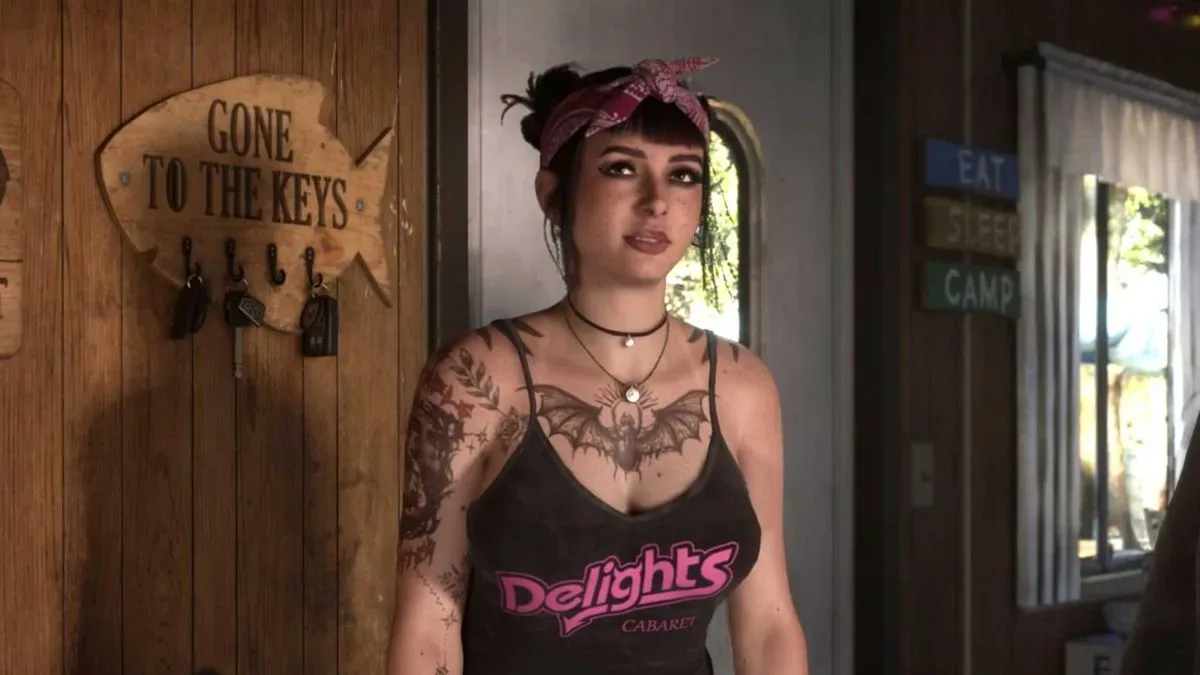
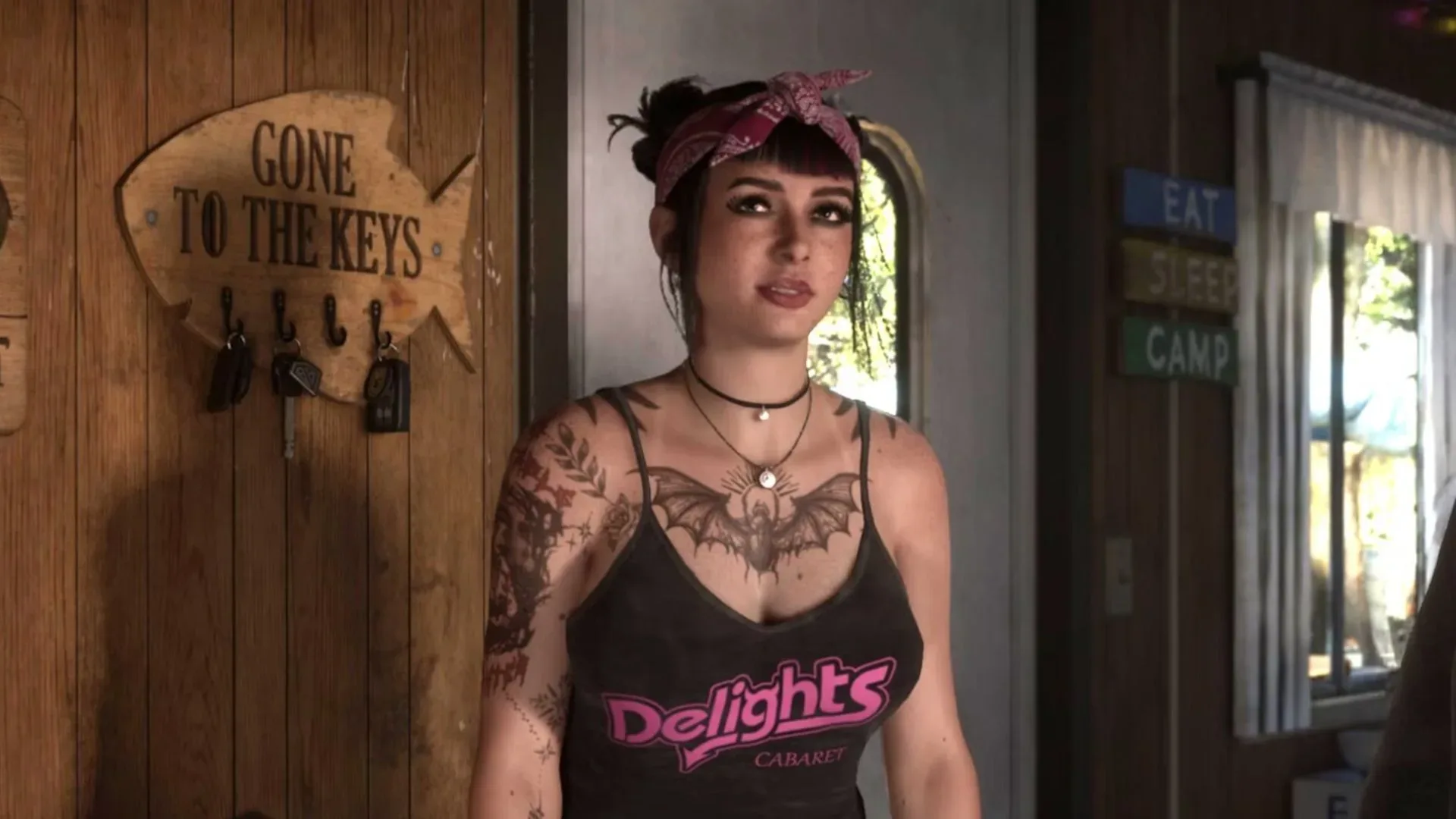
Grand Theft Auto 6 players appear to have found their latest breakout supporting character, and she arrives in Chapter 2 with tattoos, an all-black wardrobe, an alternative edge and a workplace called Delights Cabaret.
Vicki has quickly become a favorite in community discussion as players reach the point where Lucia seeks pain medication for a worn-down Jason. The character works at Delights Cabaret, and the combination of her styling and performance by Taryn Manning has proved memorable enough to set off a steady stream of posts, rankings and affectionate reactions.
The shorthand fans have settled on is suitably specific: “swamp goth.” It is a label that captures the appeal more efficiently than a character ranking ever could. Vicki’s look is distinctive, but the conversation also points to performance and personality as crucial parts of why players are responding to her.
A supporting character with immediate presence
Vicki is not being discussed simply because she is another face encountered during the main story. Fans are highlighting details that make a brief introduction feel like the arrival of a person with a defined sensibility: the tattoos, goth and alternative fashion, and Manning’s vocal work. One widely shared reaction praised the character as “so cute” while specifically calling out the strength of her voice acting.
That distinction matters. A character design may grab attention first, especially in a game built around a heavily stylized setting, but voice performance is what gives written dialogue rhythm, mood and identity. Voice acting, in this context, means more than reading lines clearly. It is the delivery that can make a character feel dry, guarded, funny, tired, warm or unpredictable before a game explains every aspect of their history.
Nothing in the reaction requires players to agree on exactly what Vicki’s role means for the wider story. The immediate point is much simpler: she has made an impression. That is a useful result for any large open-world crime game, where a huge cast can otherwise blur together as mission contacts, vendors or one-scene story devices.
From Mandy discourse to Vicki discourse
Before Vicki’s rise, much of the community attention had centered on Mandy. Now Vicki is becoming the subject of the same kind of appreciation, from grounded praise for a fun character to more intense fan enthusiasm that is best left outside a work-safe discussion.
Some players have framed the shift as a competition among Mandy, Vicki and Lucia. Those comparisons are inherently subjective, and the available reactions do not establish a definitive winner. They do show that the cast is prompting the kind of immediate audience attachment that turns individual characters into recurring community reference points.
Related coverage includes GTA 6 Players Rally Around Vicki as Delights Cabaret Character Becomes a Fan Favorite.
One social-media quip summarized the handoff by saying Mandy “walked so Vicki could collect the simps.” It is a joke, but it also describes the pattern: as more people progress into Chapter 2, a newly encountered character receives a fresh burst of screenshots, praise and debate.
There is no need to turn that into a scoreboard. Mandy has not stopped having admirers, Lucia remains one of the game’s central figures, and Vicki’s audience is growing because players are newly reaching her introduction. Different characters can resonate for different reasons without one fan reaction cancelling another out.
Why Chapter 2 changes the conversation
Chapter structure gives players a shared vocabulary for discussing where they are in a campaign without disclosing every plot beat. In this case, “Chapter 2” has become a useful marker: it tells other players when Vicki enters the picture while keeping the focus on her introduction rather than on later-story speculation.
It also explains why community attention can appear to shift suddenly. A character may be present in public discussion for a while, yet their audience expands in waves as players advance through the same portion of the game. The surge around Vicki is therefore not necessarily evidence that fans have collectively discarded Mandy. It is evidence that more players are now seeing a moment that gives them something specific to discuss.
That process is particularly visible when communities trade character rankings. Rankings are less a factual measure of quality than a prompt for conversation: What aspect of a character stands out? Is it visual design, dialogue, performance, story role or a combination? In Vicki’s case, the early answer from fans is clearly a combination of style and delivery.
The “swamp goth” label is doing real descriptive work
The phrase may be playful, but it is not empty. Character coding is the use of visual, behavioral and tonal signals that suggest a character’s tastes, social world or attitude without requiring an explicit biography. Vicki’s black-heavy alternative fashion and tattoos provide an immediate visual code. The Delights Cabaret setting, along with the performance attached to the role, helps turn those signals into a recognizable identity rather than a random collection of accessories.
Fans calling her a “swamp goth” are responding to that blend of imagery and setting. It is a concise way of identifying what separates her from the game’s other personalities. The label is also more useful than treating the reaction as purely romantic attraction, because it acknowledges the aesthetic and performance choices that players are actually naming.
In other words, the discussion is not only about who players find appealing. It is about a character landing quickly enough that the community has already created a durable shorthand for her.
What the response says about GTA 6’s cast
The strongest takeaway is not that Vicki has “won” fan discussion. It is that multiple characters are generating distinct forms of interest. Mandy’s appeal, Vicki’s alternative presentation and Lucia’s standing as a co-star have all become points of conversation. That range suggests a cast with enough definition for players to form preferences instead of treating everyone outside the principal duo as interchangeable scenery.
For players who have not reached Chapter 2, the practical implication is modest: Vicki is a character worth watching for when the story takes Lucia to Delights Cabaret. The community response does not reveal a major plot development or demand that everyone share its enthusiasm. It simply signals that this is one of those introductions that has stuck with a noticeable portion of the audience.
For those already there, the discussion may be a reminder of how rapidly a game’s social conversation can move. Early impressions can focus on one figure, then pivot when a later chapter introduces someone whose design and performance catch fire. That cycle will likely continue as more of Leonida is explored and players encounter more of the game’s cast.
Vicki’s moment is also a good reason to separate appreciation from certainty. Fans are entitled to their preferences, but character popularity does not automatically reveal narrative importance, future story direction or how a character will be received months from now. At this stage, the supported conclusion is narrower and more interesting: players are reacting strongly to a distinctive Chapter 2 character, and Taryn Manning’s performance is central to that response.
Elsewhere in the ongoing conversation around the game, a potential musical reference in a GTA VI clip remains unconfirmed. That ambiguity is worth keeping in mind when parsing early GTA VI community theories. Vicki’s popularity, by contrast, is not a hidden-easter-egg claim: it is a visible pattern in player discussion around her Chapter 2 appearance.
For now, Vicki has a clear niche in the GTA 6 conversation: a tattooed Delights Cabaret employee whose goth-adjacent style, alternative vibe and vocal performance have made her an early favorite. Whether the next wave of players decides Mandy, Vicki or Lucia is their top pick is a matter of taste. The more concrete point is that GTA 6’s supporting cast is giving fans plenty to talk about.