
Grand Theft Auto 6’s ability to leave a character carrying something in each hand is more than a convenient setup for strange social clips. It represents a demanding animation and systems problem that Rockstar chose to solve at considerable scale.
Mike Jones, Rockstar’s director of gameplay animation for GTA 6, has said the team produced three versions of every item interaction: one when both hands are available, one when only the right hand is available, and another when only the left hand is available. In some situations, that work was repeated for crouching as well.
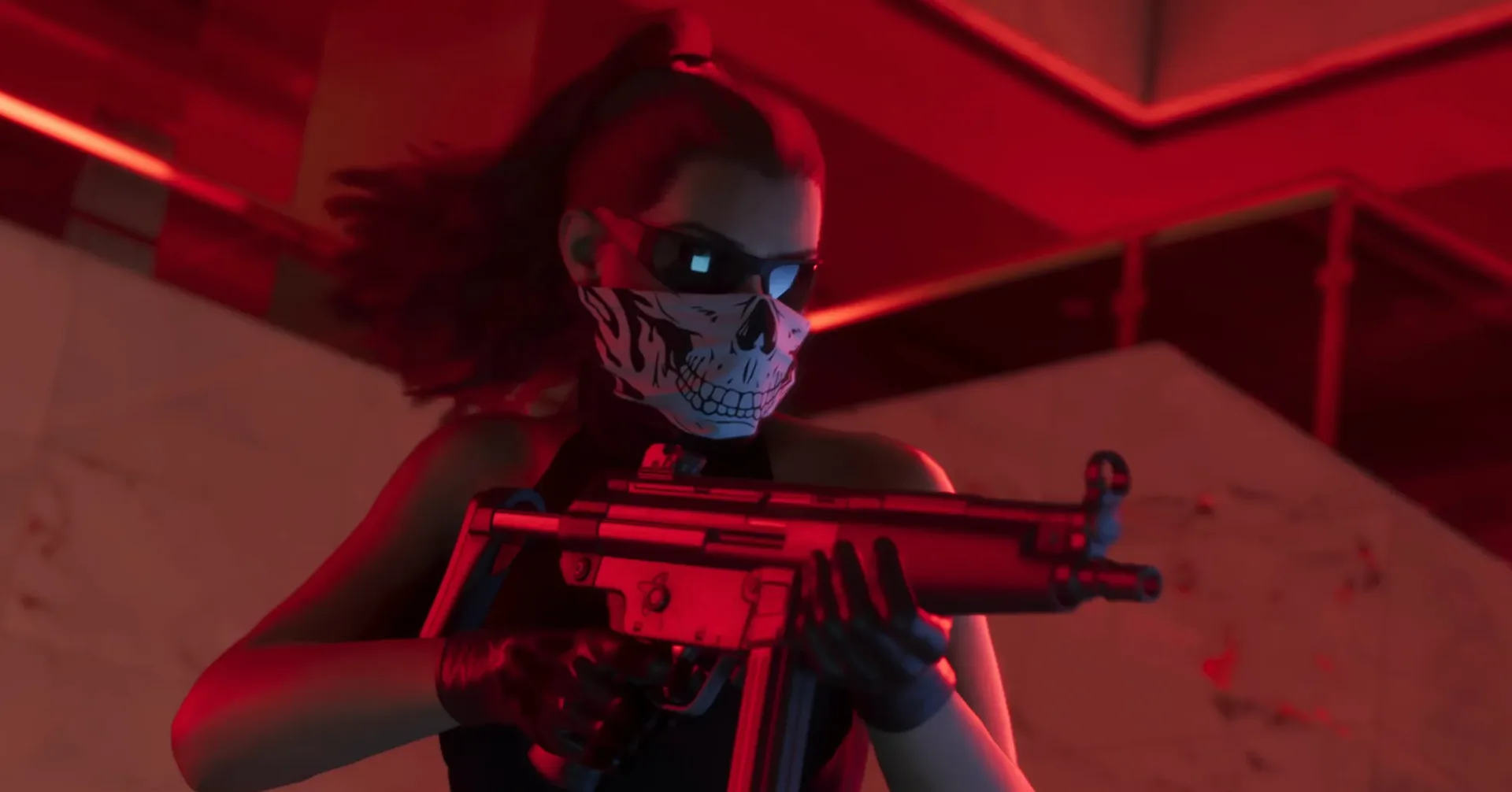
It is the sort of detail a player may never notice as a discrete feature. Pick something up, interact with an object, move on. But the feature changes what the game can permit during everyday play. Rather than forcing a character to empty both hands before every interaction, GTA 6 can account for what the character is already carrying and select an appropriate action. A character holding a drink in one hand and food in the other, for example, needs a different response from one standing empty-handed. So does somebody carrying a bag while keeping a gun available during a robbery.
That may be a modest change in the moment, but it makes the game’s activity flow feel less like a sequence of tiny administrative pauses. And for an open-world game built around interruption, improvisation and ridiculous timing, that matters.
Three animations, one interaction, many possible player states
The important word in Jones’ explanation is every. The team did not simply add a few bespoke animations for obvious two-item combinations. The stated approach was to make an interaction capable of handling three hand-availability states:
- Both hands free: the standard two-handed or unconstrained version of an interaction.
- Right hand free: a version that can proceed while the left hand remains occupied.
- Left hand free: the mirror case, allowing the right hand to stay occupied.
Jones described the work as a major pain, but said the payoff was that game logic became easier once the team knew an interaction could cope with those conditions. That is an unusually useful glimpse into the relationship between animation and gameplay systems.
In plain language, game logic is the set of rules that determines what a game allows, when it allows it, and what happens afterward. An interaction system has to answer basic questions constantly: Is the player carrying something? Which hand is occupied? Can the action happen from this posture? If it can, what should be shown on screen?
A less flexible system can handle that complexity by saying no. Put down the item. Cancel the action. Switch to a special state. GTA 6’s approach instead gives the system options. When an object interaction is requested, the game has a tailored animation available for the free hand rather than treating an occupied hand as an automatic blocker.
Related coverage includes GTA 6 Animation Lead Explains Why Every Item Interaction Needed Three Versions.
That does not mean every conceivable action becomes possible in every situation. Jones’ comments establish the three hand states and, in some cases, crouched versions; they do not lay out an exhaustive list of permitted combinations or interactions. Still, the principle is clear: Rockstar invested in a broad baseline so ordinary interactions can accommodate an occupied hand.
Why the left-hand and right-hand distinction is not trivial
It might sound as if one one-handed animation could have covered the job. But left and right are distinct in an animated character. The hand that reaches, grips, steadies an object, or is kept out of the way affects the body pose and the action’s readability. A version designed around a free right hand will not necessarily look correct when the right hand is busy and the left must do the work.
There is also the player-facing issue of continuity. If Jason is visibly holding an item in one hand, an interaction that suddenly acts as though that hand were empty risks breaking the illusion. Even when a player cannot describe why an action looked wrong, mismatches between what a character holds and what their animation does tend to register.
Three dedicated states provide a sturdier answer than relying on the player to notice and work around restrictions. The game can preserve the held item, use the available hand and continue the interaction. That is the core practical gain behind the detail.
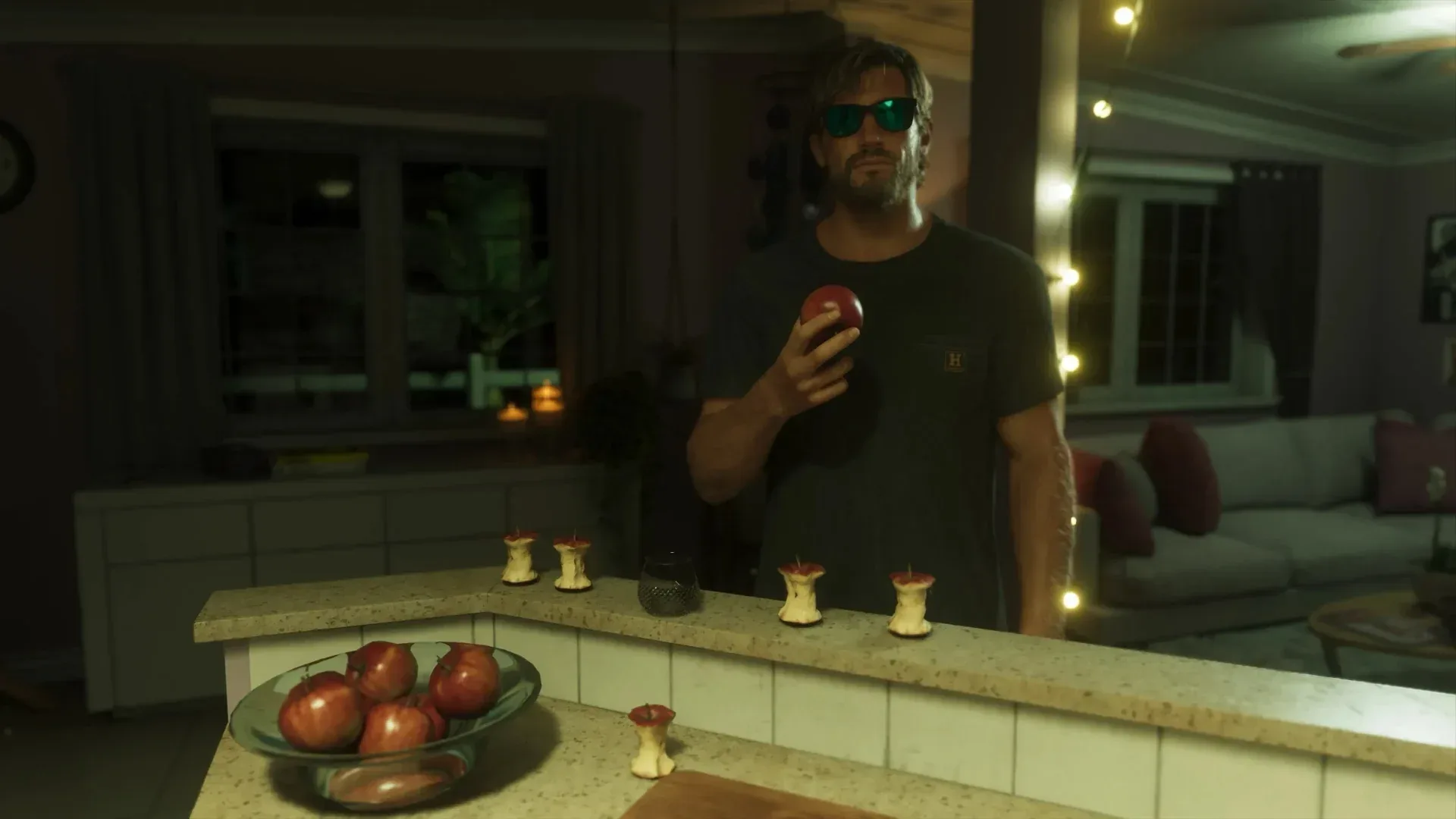
It also gives GTA 6 a valuable kind of comedy engine. Social posts have already found humor in Jason carrying different objects while recreating the “six-seven” meme. The joke only works because the game lets the character retain props in both hands long enough for players to stage unlikely combinations. The same underlying technology that helps a robbery move more smoothly can also create an accidental scene involving lunch.
That overlap is part of why detailed simulation gets so much attention in a Grand Theft Auto game. A feature does not need to be a formal minigame to become part of the game’s culture. Players test boundaries, discover incongruous situations and share the results. Flexible interactions create more room for those unscripted moments.
Crouching raises the workload again
Jones added that the three-way treatment was sometimes replicated for crouching. This is significant because crouching is not just the same pose at a lower height. It can change how a character reaches, balances, turns and frames an object. If an interaction must work with both hands free, only the right hand free and only the left hand free, then crouched variants can multiply the animation coverage required.
The word sometimes is important. It indicates that crouched versions were not necessarily made for every interaction. That distinction is a reminder that production polish is not the same as making every component equally elaborate. Teams prioritize where variants will support the gameplay experience and where the extra work is justified.
It is also why Jones’ comment about a “massive” effort lands. The complexity is not merely the number three. It is the number of interactions multiplied by the relevant character states, then integrated with the rules that decide which one should play. The result is a system intended to stay dependable even when the player arrives at an interaction in an inconvenient but valid condition.
A deliberate compromise is still part of the design
Jones also acknowledged that shortcuts were made during development. A player had pointed to the game’s refueling sequence as an example that felt simplified compared with the broader level of polish, and Jones agreed that corners had been cut in places.
That admission gives useful context to the hand-animation reveal. The presence of a highly comprehensive system in one area does not mean every scene has the same degree of simulation or bespoke staging. It means the developers made choices about where detailed coverage was most valuable.
That is not a contradiction. In a game where players can combine actions, carry objects, enter crouched states and interrupt themselves in ways scripted scenes cannot fully anticipate, hand availability is a foundational concern. Refueling, as discussed here, is a specific sequence. The animation system for item interactions has to support the game repeatedly across many activities.
Analysis: the contrast suggests Rockstar’s priority was not to eliminate every visible simplification. It was to build reliable rules for actions players can trigger again and again in unpredictable circumstances. That is why an interaction system can merit extensive variant work while another sequence may use a more economical solution.
For players, the useful takeaway is not to start hunting for every production shortcut. It is to recognize what the three-version system enables: less friction when carrying objects, fewer forced resets before an interaction, and more consistent character behavior in the small moments between major missions.
How GTA 6 differs from earlier Rockstar games
The new hand behavior stands apart from the more limited carrying arrangements described for earlier Rockstar titles. Grand Theft Auto 5 and Red Dead Redemption 2 generally constrained players to carrying one thing at a time. Grand Theft Auto: San Andreas allowed dual-wielding of certain guns, while Red Dead Redemption 2 and Max Payne 3 could show a character with a long gun at their side while firing a pistol.
Those examples demonstrate that previous games could support particular combinations of held or equipped objects. GTA 6’s reported distinction is broader item interaction coverage built around either hand being occupied. A sandwich and drink is a deliberately mundane illustration, but its value is that it establishes the system outside weapon-specific behavior. A bag-and-gun scenario shows the more consequential side: players can manage two tasks at once rather than having a carrying state halt an action.
That consistency feeds into GTA 6’s wider appeal as a place to spend time beyond straightforward story progress. Players have been drawn to activities including treasure diving in Key Lento, fishing with Cal and billiards at the Rusty Anchor, even early in Chapter 1. A world with that kind of optional activity benefits when small actions do not continually demand that the player clear their hands first.
It also makes the game feel more responsive to player intent. Holding onto an item is a choice, whether it is practical, aesthetic or purely for a joke. Giving that choice mechanical recognition is what separates a visible prop from an interactive state.
The real achievement is making a complicated rule feel ordinary
Players are unlikely to count animation variants while they play. They will notice the absence of annoyance: the interaction that works while one hand is occupied, the robbery that does not require an awkward extra step, the absurd screenshot that holds together because the character does not silently discard half the setup.
That is often the best outcome for a technical feature. The complexity stays backstage, while the player receives a more coherent world. Rockstar’s reported three-animation rule does not make GTA 6 limitless, and the acknowledgement of shortcuts makes clear that it was never meant to. Instead, it is a specific solution to a specific open-world problem: a character can arrive at an action with their hands full, and the game has a way to handle it.
For more of the player-driven humor already emerging around Jason, see GTA 6 Players Have Made Jason’s Apple Habit an Early Vice City Running Joke. It is exactly the sort of minor behavioral detail that becomes memorable once a game gives players enough freedom to turn it into a bit.