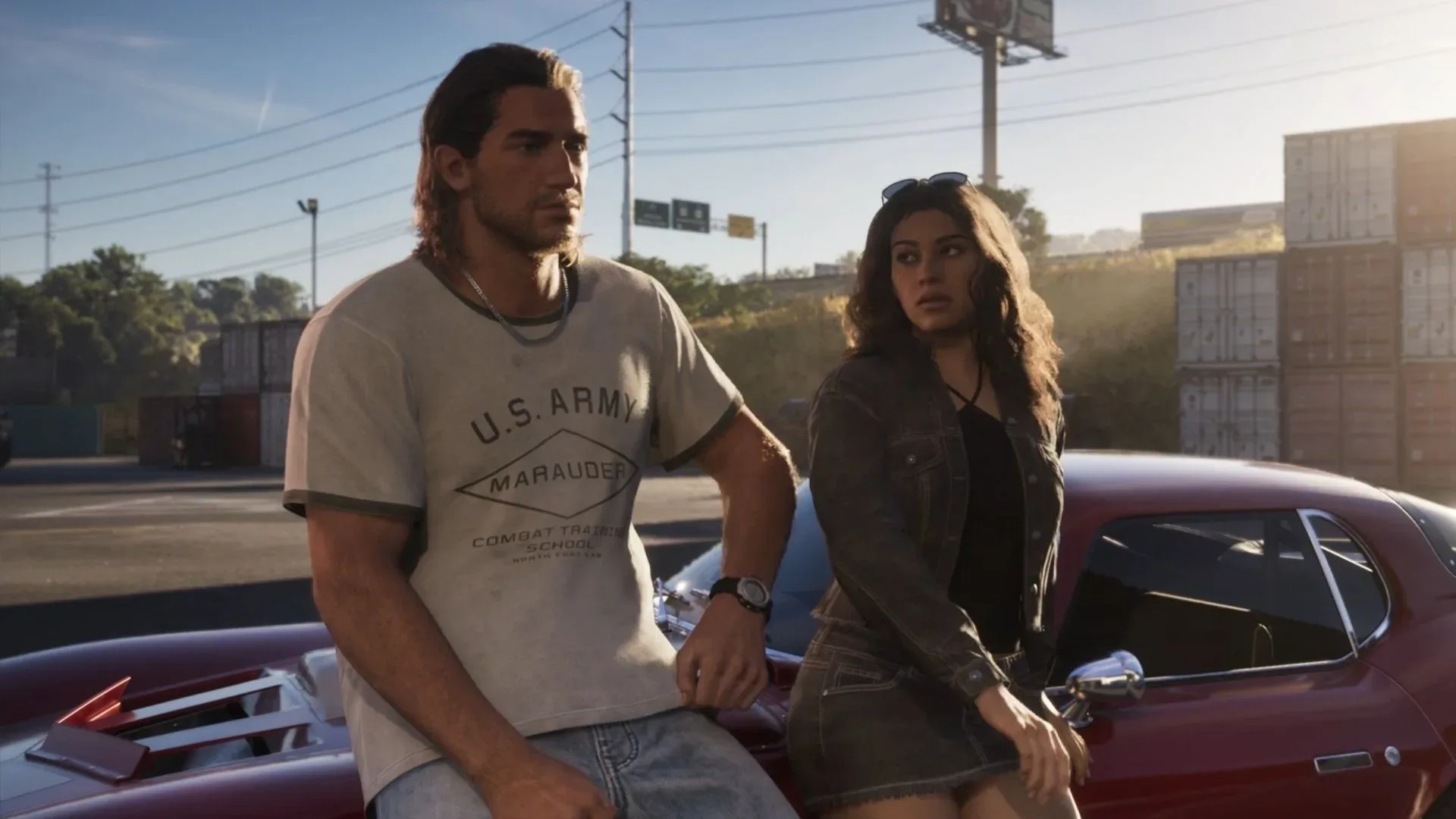
Grand Theft Auto 6’s launch trailer has the expected big-ticket material: Jason and Lucia, scenes built to sell the scale and heat of Rockstar’s next open-world crime story, and the kind of polished montage designed to work on television as well as online. But its most meaningful few seconds for longtime fans may be at the end.
After the trailer’s main footage, a deep voice delivers the essential release-card information: “Grand Theft Auto 6. Coming November 19. Rated M for Mature.” It is simple advertising copy. It is also a remarkably durable Rockstar ritual—one that has turned a conventional trailer tag into an audio cue associated with a game finally nearing the finish line.
The effect is less about learning new information than recognition. A release date on a title card is useful. A familiar voice saying it aloud can make the message feel ceremonial. For players who encountered previous Grand Theft Auto ads between television programs, on small screens, or during the long wait for a new release, that voice is part of the series’ launch vocabulary.
A short line with a long memory
The tradition stretches back to the launch-era trailers for Grand Theft Auto III. The early approach in trailers for GTA III and Vice City was not yet as fixed as the version many people remember. By Grand Theft Auto: San Andreas, though, the signature had settled into a recognizable form: a deep, emphatic read of the Grand Theft Auto name at the trailer’s close.
That closing style subsequently appeared around the releases of Liberty City Stories, Vice City Stories, Grand Theft Auto IV, and Grand Theft Auto V. Rockstar has also used the same basic narration flourish for the launch trailers of Red Dead Redemption and Red Dead Redemption 2.
That history matters because launch trailers do a particular job. They are not necessarily intended to explain every system, neighborhood, character motivation, or piece of a game’s structure. A launch trailer is the broad, final-facing sales message: here is the game, here is when it arrives, and here is the rating. It has to be readable in a brief ad break and memorable after a single viewing.
The narrator turns that job into an instantly legible format. The voice does not need elaborate language because the cadence carries the point. The title is announced; the date is stated; the age rating is supplied. It is a hard stop after the visual rush of the trailer.
Why the rating is part of the signature
The inclusion of “Rated M for Mature” is not merely decorative. In the United States, the Entertainment Software Rating Board, or ESRB, assigns age guidance and content descriptors to games. The M rating indicates that a game is generally intended for players ages 17 and up. For Grand Theft Auto, an adult-oriented rating has long been inseparable from the brand’s public identity, so the spoken rating becomes part of the familiar trailer punctuation.
Related coverage includes GTA 6's Launch Trailer Revives a Familiar Rockstar Tradition.
It also helps explain why this voice-over is especially suited to broad advertising. A trailer that may circulate on television, social platforms, and video services has a practical need to put its title, release timing, and rating in front of viewers clearly. Rockstar’s narration formula packages all three into one concise closing beat.
None of that makes the line less emotional for audiences who have heard its predecessors. Advertising conventions often become traditions through repetition, and repetition is especially powerful for a series whose numbered releases arrive with substantial gaps between them. The voice can recall not only the earlier games, but the circumstances in which fans first met them: seeing an ad unexpectedly, trading trailer talk with friends, or realizing a wait was beginning to look like a release.
GTA 6’s ending is a confidence signal—within limits
The new GTA 6 trailer’s conclusion states a November 19 launch date. That is the concrete takeaway. Its use of the familiar narrator adds an understandable layer of confidence for fans who associate the voice with Rockstar’s release campaigns.
Still, it is worth separating the official information from the fan interpretation. The trailer explicitly gives a date and rating. The idea that the narrator’s return means a game is “truly ready” is a reading based on the pattern of prior campaigns, not a technical guarantee that plans can never change. In practical terms, the most reliable detail is the one said on screen: Grand Theft Auto 6 is scheduled for November 19.
That distinction does not weaken the moment. It clarifies why it works. The spoken title is not a secret message or a newly revealed feature. It is an established piece of Rockstar presentation that tells returning players this is no longer just another look at an anticipated game; it is material shaped like a launch advertisement.
It also lands at a useful point in GTA 6’s public cycle. Previous trailers have been watched closely for character details, location hints, action, and the evolving picture of Jason and Lucia. A launch trailer has a more immediate purpose. It gives those images a destination. The final narration makes that destination unmistakable.
The value of a recognizable audio logo
In marketing terms, this kind of repeated sound functions much like an audio logo: a brief sonic identifier that audiences connect with a company, product, or series. It does not need to be a sung jingle. A particular delivery, rhythm, or voice can do the same work if it appears consistently enough.
Rockstar’s deep-voice sign-off is unusual because it is tied less to every piece of Grand Theft Auto marketing than to a particular moment: the launch push. That scarcity is what makes it effective. If the same voice appeared at the end of every teaser, gameplay clip, and social post, it might quickly become background noise. Used sparingly, it becomes a cue for a specific kind of announcement.
For GTA fans, the effect is also generational. Someone whose earliest exposure was San Andreas may hear the cadence and remember one era. Someone who came in through GTA IV or GTA V may attach it to another. The common denominator is not one specific console or one specific game. It is the feeling of a Rockstar launch trailer reaching its final card.
That makes the GTA 6 use of the tradition an efficient bridge between a new entry and the series’ past. The trailer does not need to pause for a retrospective. It only has to end the way several major Rockstar releases have ended before.
What viewers should take from the trailer
- Release timing: The trailer states a November 19 launch date for Grand Theft Auto 6.
- Rating: It closes with an ESRB M for Mature designation.
- Campaign format: The narrator and release-card treatment position the video as launch-focused advertising rather than simply another teaser.
- Series continuity: The final line revives a trailer convention associated with Grand Theft Auto releases from GTA III onward, particularly the established style heard from San Andreas onward.
For readers tracking the wider run-up, GTA 6’s timing also places it just inside a notable awards-calendar cutoff, as covered in our look at its Game Awards eligibility window. That is another reminder that a date on a launch trailer has consequences beyond a marketing graphic: it gives fans, retailers, media, and industry observers a point around which to organize expectations.
One line, no over-explaining required
There is a temptation to treat nostalgia as something that must arrive through a grand remake, a lengthy callback, or a detailed recreation of an old scene. GTA 6’s closing narration demonstrates the opposite. A few words in a familiar voice can be enough.
That economy suits Grand Theft Auto. The franchise has changed settings, protagonists, platforms, and scope across its history. Yet its launch-trailer ending provides a tiny thread of continuity across those shifts. Hearing the name delivered with the old dramatic weight makes GTA 6 feel connected to earlier waits and earlier release days without pretending it is the same game or the same moment.
The launch trailer therefore has two jobs at once. For people encountering it cold, it supplies the most important practical information in direct terms. For veterans, it adds a ceremonial nod that likely needs no explanation at all. The screen fades, the voice arrives, and for a moment the gap between the next Grand Theft Auto and the last several becomes a little shorter.