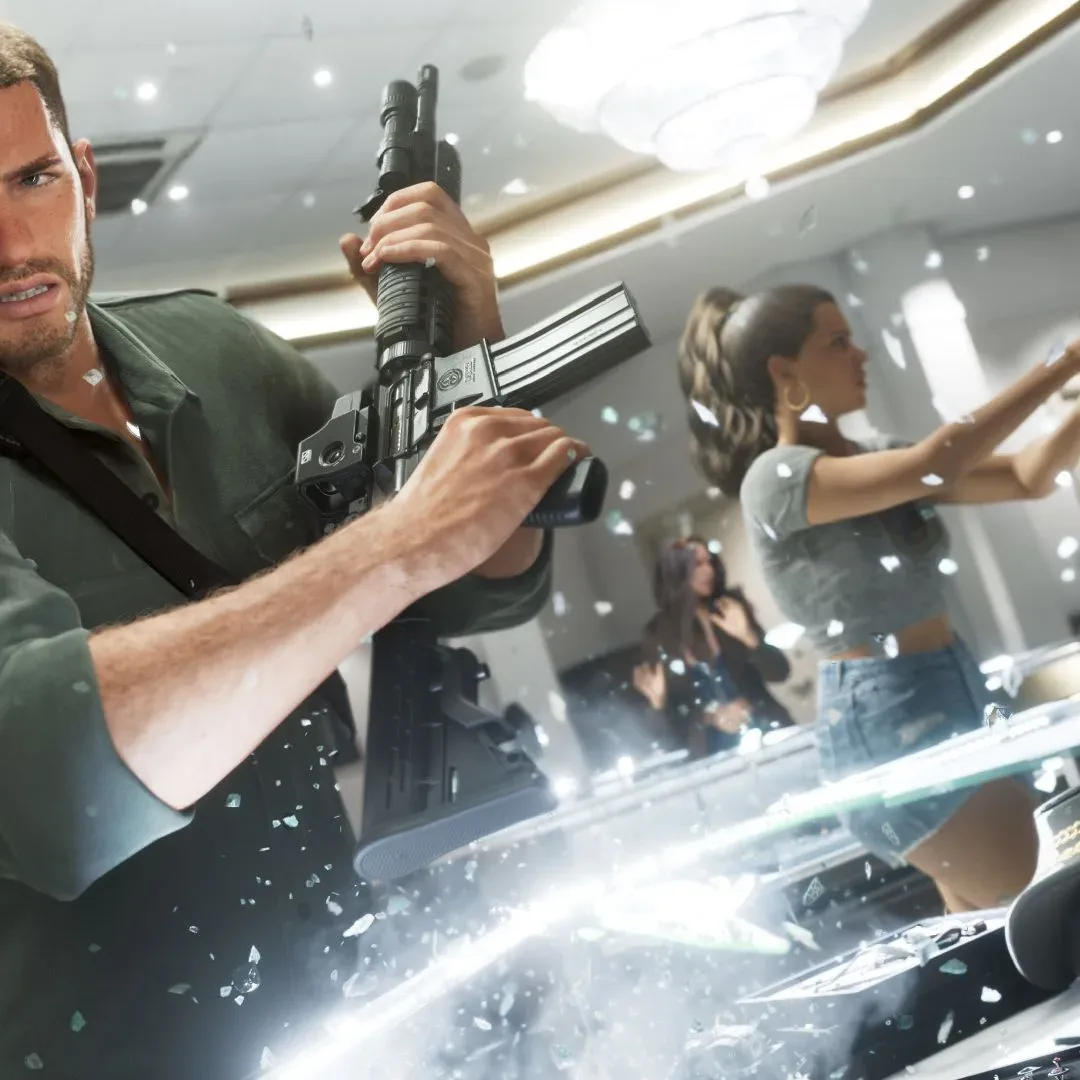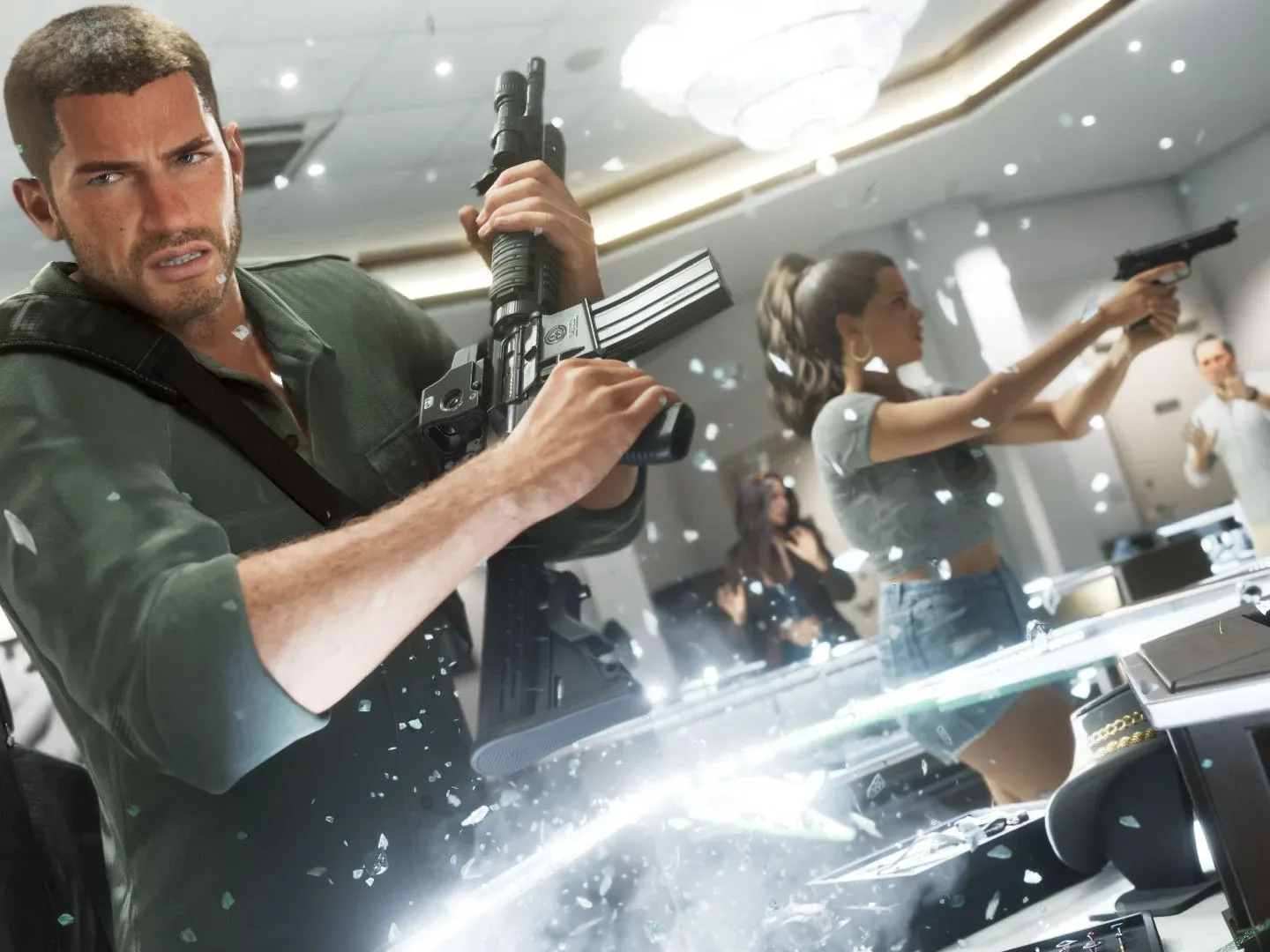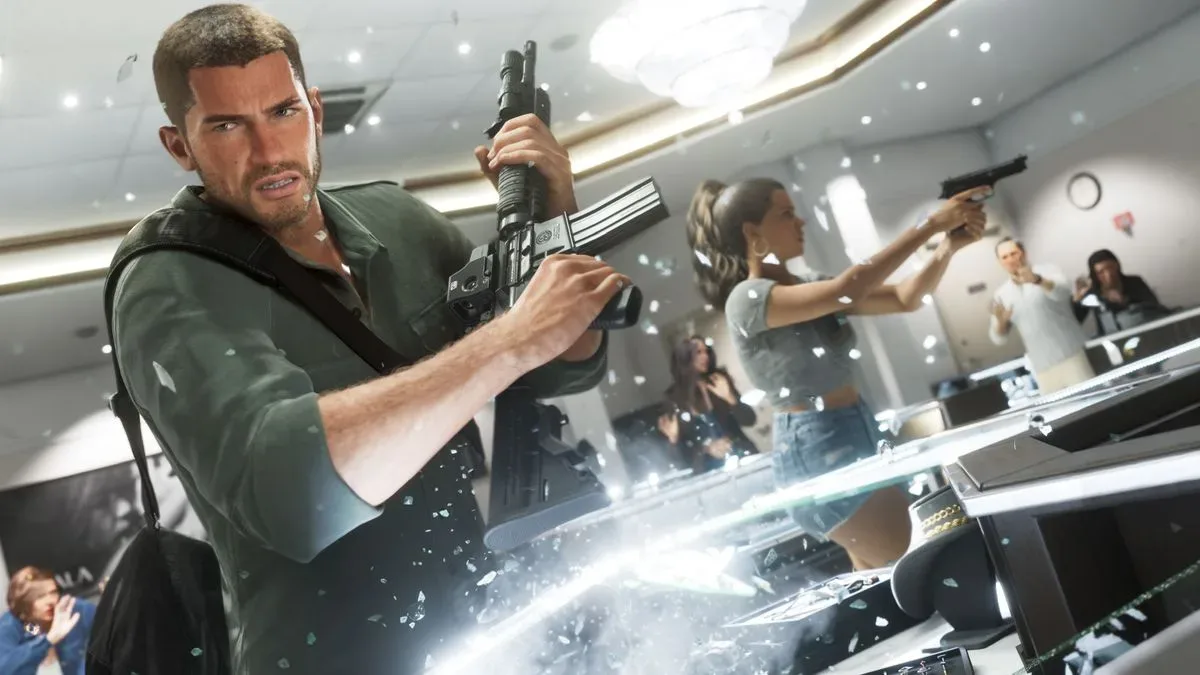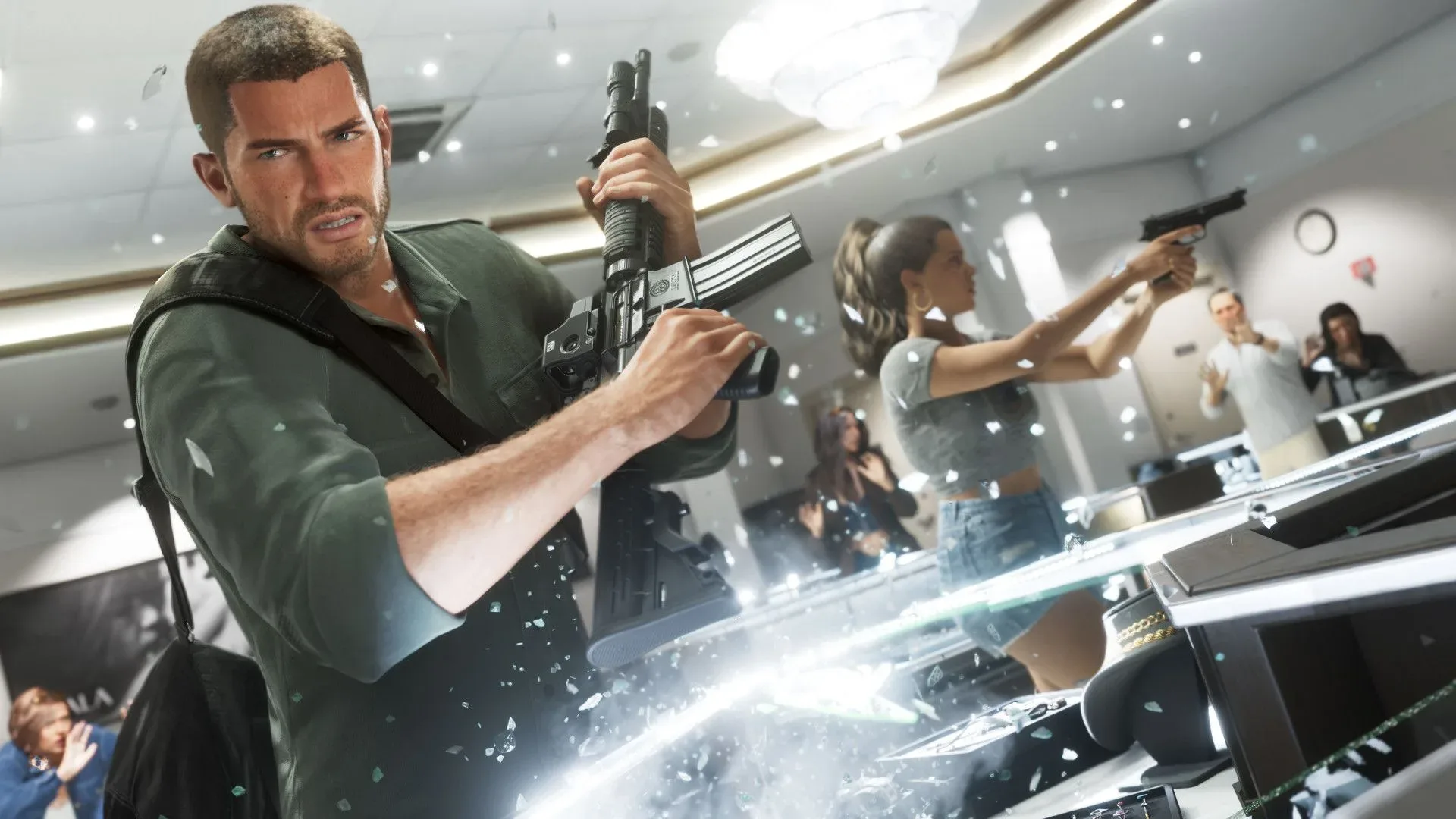
Some of the most demanding work in a big open-world game is also the work players may barely notice. In Grand Theft Auto VI, that includes the problem of what Jason and Lucia do when both of their hands are occupied.
Rockstar Games animation director Mike Jones has described an unusually granular solution: interactions were made in three versions, covering situations where both hands are available, only the right hand is available, or only the left hand is available. He says the work took months, but argues that it was worth doing because the game needs characters to behave convincingly even during mundane transitions.
That can mean carrying food and a drink, trying to use a phone, opening a door, greeting another character, or managing a weapon while holding something else. In the examples discussed, Lucia might turn and use her hip to open a door while her hands are occupied. Another scenario raises a more action-heavy question: how does she reload a weapon ordinarily handled with two hands when she is also carrying a sports bag containing cash?
Why a full pair of hands changes so much
On paper, “open a door while holding drinks” sounds like a tiny variation on a standard animation. In practice, it changes the character’s available body parts, posture, timing and the actions that can logically follow. A normal door-opening sequence may assume a hand reaches for a handle. That assumption no longer works if a character is carrying an object in each hand.
Jones’ description points to a central open-world animation challenge: an action is rarely isolated. It has to make sense in the state the character is currently in, then transition cleanly into whatever the player asks for next. If a protagonist is holding an item, the game cannot simply play an animation made for empty hands without risking an obvious visual contradiction.
Interaction animations are the short movements tied to an object or activity: using a door, drawing a phone, picking something up, or responding to another character. The issue here is not just adding a single new animation for one prop. The interaction must be adapted to the character’s hand availability.
That is why three versions matter. They establish a basic set of hand states:
- Both hands free: the conventional version of an interaction can play.
- Right hand free: the character needs an alternative that keeps the left hand and its item accounted for.
- Left hand free: the opposite-side alternative is needed when the right hand is occupied.
Even this simplified structure can affect many interactions across a large game. A door, a phone, a hug and a reload are different actions, with different timing and body positioning. The point is not that every conceivable situation needs an entirely unique routine. It is that the game has to recognize enough meaningful states to avoid repeatedly breaking its own illusion.
Related coverage includes GTA 6's Hand-Full Animations Took Months Because Small Details Change Everything.
The “massive pain” is partly about system logic
Jones called the process “a massive pain,” while also explaining the payoff: once the team knew each interaction could cope with those conditions, the broader game logic became easier to manage.
Here, game logic means the rules that decide what the game can do at a given moment. An interaction system has to know not only that a door is usable, for example, but whether the character can use it in their current state and which animation should be selected. If the system has reliable versions for hands-free, right-hand-free and left-hand-free states, it has clearer answers to those questions.
That can be more valuable than simply making a scene look polished. It provides a consistent framework for interactions. Rather than treating a character carrying something as a special exception every time a new activity is added, the developers have a pattern to work from. That does not make the underlying work easy—Jones’ comments make clear that it was not—but it can reduce uncertainty once the pattern is in place.
The same challenge becomes more complicated when movement changes. Jones said that some of these animations were sometimes replicated for crouching. Crouching alters a character’s height, balance and range of motion, so an animation that works while standing may not visually fit the same action at a lower stance. Reusing the hand-state idea in that posture means another layer of coverage for the interaction system.
Small details can protect the larger illusion
Games often ask players to accept rapid shifts between ordinary life and extreme action. GTA 6’s examples make that contrast especially clear: Jason and Lucia might be carrying everyday food and drinks one moment, then dealing with a bag of cash and a firearm the next. A world feels more coherent when its characters respond to those situations physically instead of appearing to ignore whatever is already in their hands.
That does not mean players will stop and consciously inspect every door sequence. The likely value is cumulative. A character who shifts their body to use a hip, preserves an occupied hand, or chooses an appropriate side for an interaction reinforces the sense that the animation system recognizes the situation. Conversely, a character instantly using a hand that is visibly holding a drink can make the world feel less grounded.
Jones framed this as a case of teams caring about an apparently mundane detail. That framing is important. The detail is mundane precisely because it occurs in the connective tissue between headline moments: moving through spaces, handling objects and changing from one task to another. Those are the actions players may perform or witness repeatedly across an open world.
Not every detail is about spectacle
Technical ambition in major games is often discussed through scale, visual density or set-piece action. The hand-occupancy work described here is a different kind of ambition. It is about continuity: keeping a character’s movements credible when the game’s circumstances change.
It also illustrates why animation can be costly even where the outcome looks simple. A player sees a character use a door with their hip for a moment. The development team has to consider the item state, which side is available, the interaction itself, and in some cases whether the character is crouched. Multiply that structure across the kinds of objects and actions an open-world game supports, and the workload grows quickly.
For a related look at the same report and its focus on hand-occupied character interactions, this overview examines why the work matters.
What this suggests for players in Leonida
The practical promise is not a particular feature list or a guarantee that every object will have a bespoke response. Jones’ comments support a narrower, but still meaningful, expectation: GTA 6’s interaction system was designed to account for whether Jason and Lucia have a hand free, and some of that work extends to crouching.
Players may therefore notice more context-sensitive body language during routine activities. The game can choose a different response when one hand is unavailable rather than assuming every interaction starts from a neutral pose. In action scenarios, that same attention may help transitions involving carried items and weapons read more clearly.
There is also a design lesson in the way Jones describes the effort. The goal was not merely to make a single animation impressive. It was to make the system dependable enough that teams could trust an interaction to “cope” with the relevant hand states. In a game with many possible player actions, dependable behavior can matter as much as an individually striking movement.
GTA 6 has been described as a major critical and commercial launch, with claims that it leads aggregate review rankings and represents the biggest entertainment launch to date. Those broad milestones are separate from the animation work, but they help explain why tiny production details are drawing attention. The door example is a useful reminder that a game’s visible polish can be built from decisions that are easy to overlook until they are absent.
For readers interested in another game-focused technical project, see the Gran Turismo 3 A-Spec Vita project.