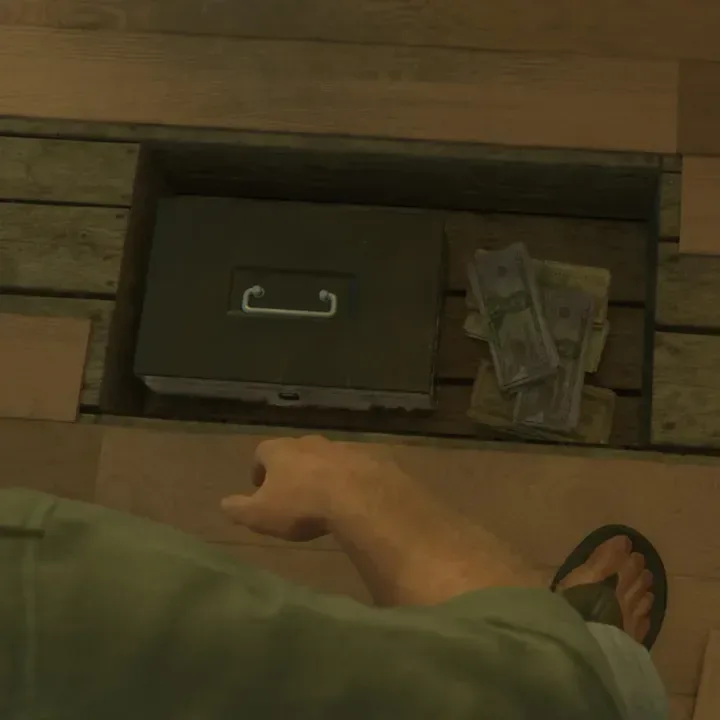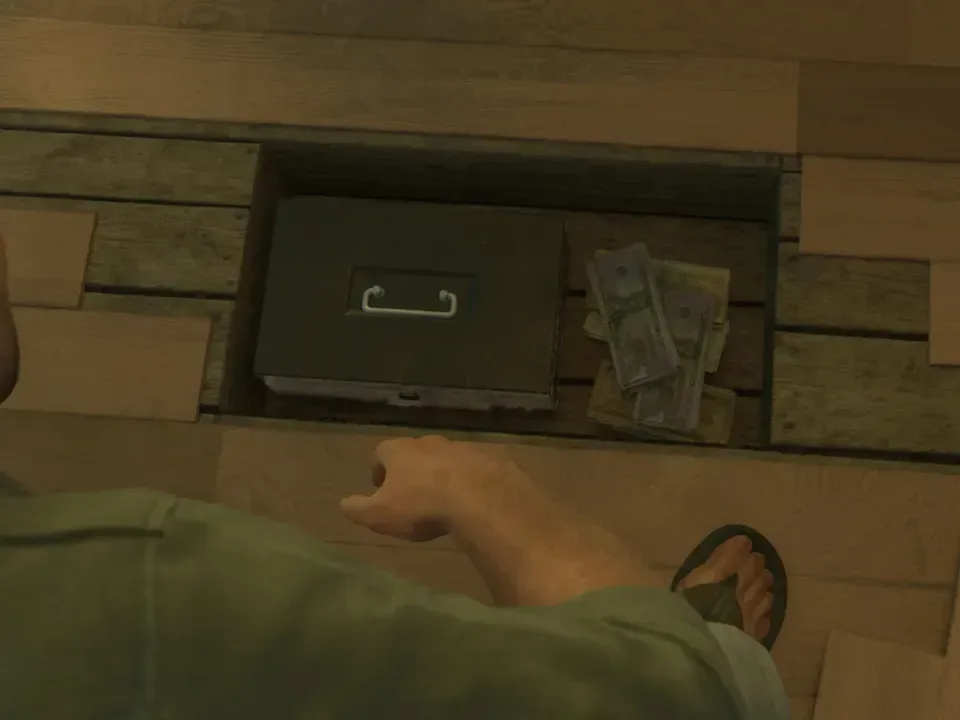
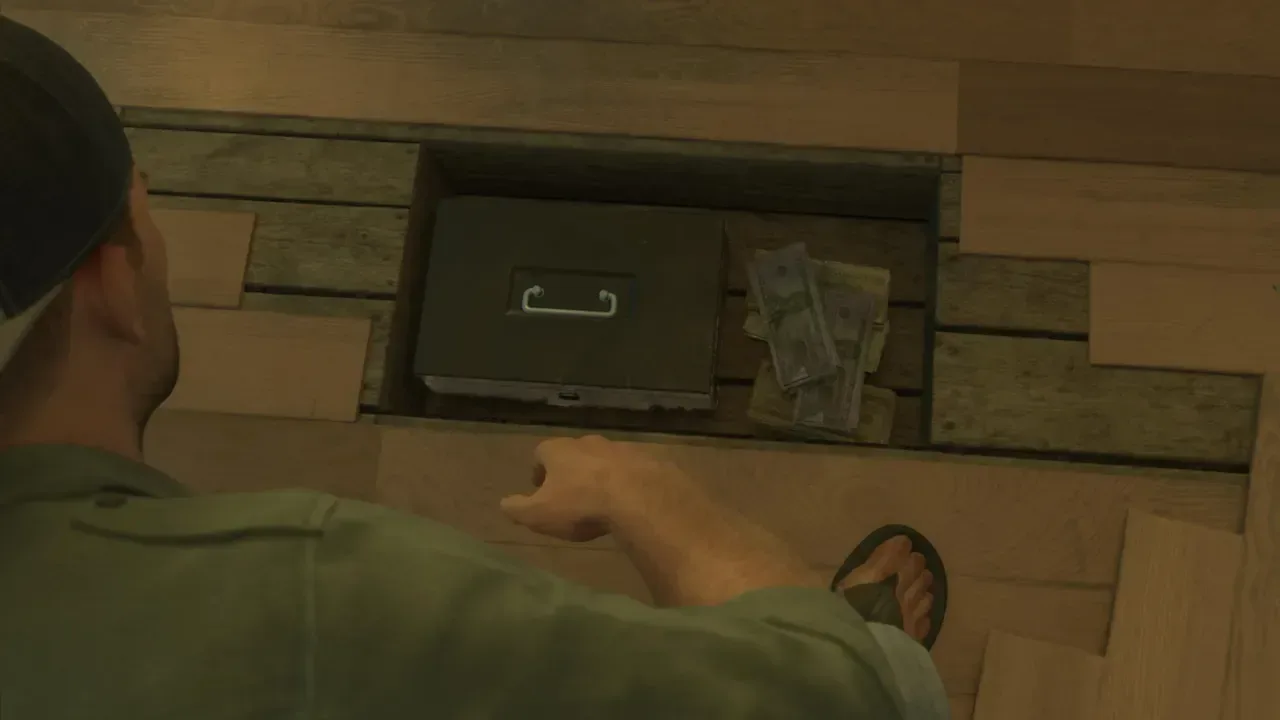
Grand Theft Auto 6 players have identified an unusually specific irritation in Leonida: moving cash in and out of Jason’s Stash. The storage spot, found beneath the floorboards of Jason’s bedroom early in the story, is meant to give players a place to keep valuables and protect money from the risks of carrying it around. In practice, many players say its cash controls are too imprecise to use comfortably.
The complaint is not that the stash lacks a purpose. It has a very clear one. Players can put aside money they do not want to risk losing while roaming the world, then retrieve it when they need it. The problem is the interface used to choose an amount. Individual inputs move the total dollar by dollar, while holding the D-pad causes the number to accelerate sharply. Players describe trying to select a reasonable figure, only for the value to jump into the thousands before they can stop it.
That turns a simple bank-style transaction into a tiny contest of reflexes. As one player summarized the experience online, the counter feels like it goes from “1, 2, 3, 4, 5, 6” to “10,000.” It is a joke, but it captures the central issue: there appears to be little middle ground between painstaking single-dollar adjustments and a rapidly escalating total.
What Jason’s Stash is supposed to solve
Jason’s Stash is available very early in GTA 6, within roughly the first hour of the story. That placement matters. It means the system is not a late-game curiosity that only completion-minded players will encounter. It is one of the first recurring money-management tools many people will be taught to use.
Its value becomes more obvious because cash carried by the player can be lost after getting “Wasted.” Players have described losing substantial amounts after deaths that followed everyday open-world chaos, including confrontations that spiraled out of traffic incidents. The intended loop is easy to understand: return home, deposit surplus money, travel with only what you are willing to risk, and pull out more when a purchase or activity demands it.
In design terms, that makes the stash a risk-management system. The game asks the player to weigh convenience against security. Carrying everything means no trip home and no menu interaction, but it increases the potential loss when a bad situation ends in a death. Banking money creates a protective buffer, but demands another step before spending it.
That trade-off can add tension to an open-world crime game. It only works cleanly, however, if the protective option is convenient enough that players will actually use it. Players now voicing frustration are not asking for the danger of losing carried cash to disappear. They are asking for the mundane process of protecting it not to be the hardest part.
The problem is input acceleration, not the idea of a stash
The terminology here is important. Input acceleration is the way a menu increases the speed of a value change when a button is held. It is common in games because it prevents players from needing hundreds or thousands of presses to change a large number. A well-tuned accelerated control starts slowly enough for small corrections, then scales predictably for big changes.
Related coverage includes GTA 6 Players Want Jason's Stash Money Controls Fixed.
Players’ feedback suggests the current tuning does not provide enough control across those two jobs. Tapping through a large deposit is slow. Holding the input saves time at first, but apparently reaches large denominations too abruptly. The result is overshooting: the player passes the desired figure, reverses direction, overshoots again, and repeats.
That is a small usability issue with an outsized effect because of frequency. A giant mission can leave a strong impression once. A frustrating menu that returns whenever players manage money can create a smaller, repeated annoyance across dozens of hours. The more diligently someone tries to safeguard their cash, the more often they run into the same friction.
It is also why the concern has extended beyond Jason’s Stash. Players discussing the issue have pointed to the same type of money-selection interface at ATMs. If both systems use the same underlying controls, a refinement could potentially improve more than one location where cash is handled. That remains an inference from player discussion rather than a confirmed technical detail, but it explains why the request has gathered attention.
A straightforward player request: fixed-value buttons
The most common proposed solution is simple: add fixed increments such as +$100 and -$100. Such buttons would give the player a reliable middle-speed option between single-dollar taps and held-input acceleration.
There are several ways an interface could preserve the stash’s present purpose while reducing frustration:
- Fixed denominations: Options such as $100, $500, or $1,000 would make routine deposits predictable.
- Slower initial acceleration: A held input could begin with smaller increases before rising to high values.
- Separate fine and coarse controls: One input could adjust by small amounts while another changes the number by larger steps.
- Direct amount entry: A player could type or select a precise sum rather than scroll to it.
- Deposit-all and withdraw-all choices: These could help in situations where precision is not needed, though they would not replace granular controls.
None of those possibilities has been confirmed as an upcoming change. They instead illustrate why players see the complaint as a fixable quality-of-life problem rather than an unavoidable consequence of GTA 6’s cash-loss system.
A quality-of-life change generally means an adjustment that makes routine play smoother without radically changing the game’s balance, world, story, or core challenge. Better money-input options fit that definition. They would not eliminate the consequences of being Wasted, automatically insure every dollar, or change the function of Jason’s Stash. They would simply let players decide more accurately how much money to protect.
Why some players are avoiding the stash altogether
The irony is that an awkward safeguard can encourage the risky behavior it was designed to discourage. Some players have said they chose to carry their bankroll rather than wrestle with the stash interface—then promptly lost it after dying. Others have framed the irritation as being less about a single major loss than the repeated experience of trying to stop on a number such as $2,000 and landing somewhere else.
This is a useful example of how menu design affects player behavior. A system can be mechanically sound on paper while still being bypassed in practice if it creates too much administrative work. In this case, the decision is not merely “Do I want to keep cash safe?” It becomes “Do I want to spend time fighting the counter to keep cash safe?”
For players who prefer to role-play cautiously, plan purchases, or maintain a limited amount of spending money on hand, exact control is especially meaningful. They may want to deposit most of their funds while retaining a deliberately chosen amount. A slider or counter that skips past target values makes that otherwise ordinary decision harder than it needs to be.
For everyone else, the issue may remain a minor irritation. That distinction is worth keeping in view. The reports do not indicate that Jason’s Stash prevents progress or breaks GTA 6’s economy. The objection is about usability. Still, small points of friction can be the complaints that unite a community precisely because almost every player has to use menus, handle money, and occasionally recover from a disastrous drive through Vice City.
A conspicuous blemish in a system players want to use
The tone of the discussion is telling. Alongside genuine annoyance, players have often expressed relief that this is among their biggest gripes. That does not make the complaint meaningless; it puts it in proportion. GTA 6 offers a densely detailed setting across Leonida, and the stash problem is not competing with a claim that the game’s broader premise is broken. It is a highly visible rough edge attached to an otherwise practical early-game feature.
There is no indication that a change has been promised, or when one might arrive if it is considered. Rockstar Games will have its own priorities for post-launch updates, including bugs and glitches reported across the game. But Jason’s Stash has a strong case as a targeted patch candidate: the request is concrete, affects a repeated activity, and has player-proposed remedies that do not require changing the underlying risk of carrying money.
Until then, players who use the stash may find the least frustrating approach is to avoid repeatedly chasing precise mid-range amounts with a held input. Tapping for small adjustments and reserving longer holds for broad changes appears to be the trade-off the present design demands—even if that is exactly the trade-off the community would like revised. Players still learning how Leonida’s systems work can also consult our guide to what GTA 6’s first-person mode can and can’t do in Leonida.
For a game built around freedom, the request is refreshingly narrow: let players choose a number without turning a deposit into a high-speed guessing game.