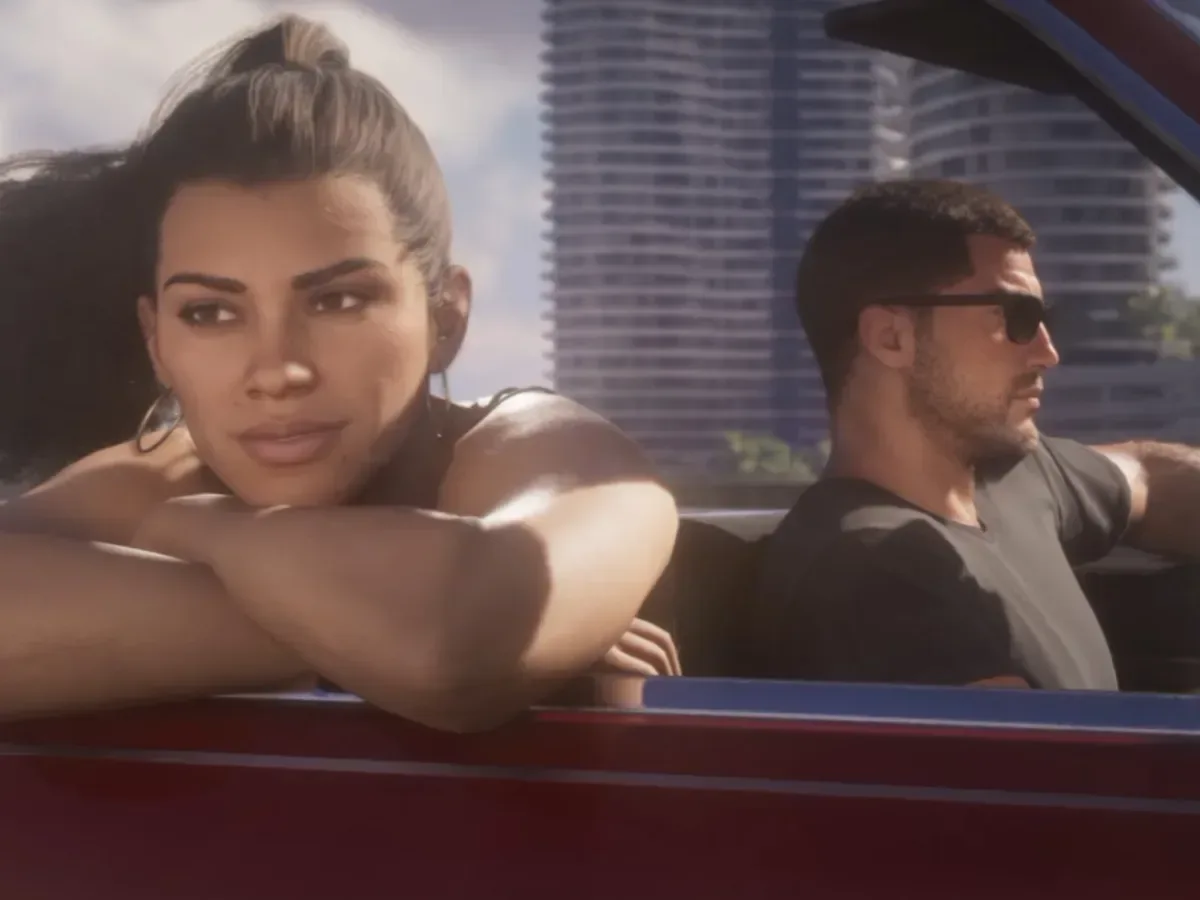
Grand Theft Auto VI’s new launch trailer is built for repeat viewing. Its large action beats are deliberately hard to miss: Jason and Lucia’s relationship, a job that goes badly wrong, and a high-altitude sequence involving a person hanging from a payload moving above Vice City. But a set of more than 30 trailer frames makes a better case for pausing than replaying. Taken individually, the images give viewers time to inspect Rockstar’s version of Vice City, the mood around its two protagonists, and small pieces of incidental character detail that can disappear in a fast cut.
One especially easy-to-overlook moment has Jason accompanied by a dog during a helicopter ride. It is a small image rather than a confirmed explanation of a system, mission, or companion mechanic. Still, it illustrates why frame-by-frame trailer viewing is useful: not every meaningful detail is dialogue or an explosion. Some details simply establish who a character is around, how a scene is staged, and how much everyday texture an open-world setting is meant to carry between the headline spectacle.
A trailer is not a feature list
The most important distinction here is between what the trailer shows and what it confirms. The footage depicts moments between Jason and Lucia, dramatic criminal action, aircraft, and a densely presented Vice City backdrop. It does not, by itself, establish a full list of missions, activities, player abilities, vehicle mechanics, or the role of every animal and side character that appears on screen.
That restraint matters particularly for a game of GTA 6’s scale. Trailer frames can be revealing, but they are still selected shots from a marketing edit. A cinematic-looking camera angle may not represent ordinary gameplay framing; a vehicle or location visible in the background does not automatically identify it as usable, enterable, or part of a named activity. And a character appearing in a sequence does not define whether they are a permanent companion, a mission-specific presence, or simply part of a scene.
For viewers cataloguing the trailer’s details, the practical approach is simple:
- Treat visible objects, characters, locations, and action as observations.
- Treat mechanics, mission structures, and gameplay access as unconfirmed unless Rockstar identifies them.
- Keep the platform context attached to every visual claim, because capture hardware affects what a trailer demonstrates.
That final point is unusually significant this time around.
Captured in-game on a base PS5
Rockstar has said the GTA 6 launch trailer was captured in-game on a PlayStation 5. The clarification specifically identifies the standard, or “base,” PS5 rather than the PS5 Pro. In plain terms, the trailer is intended to demonstrate imagery produced by the game running on regular PS5 hardware, not a separate high-end console configuration.
In-game capture means footage recorded from the game itself rather than a purely pre-rendered video made outside the game engine. That is useful context for evaluating the trailer’s lighting, city density, vehicles, character presentation, and cinematic staging. It gives the visual showcase more relevance to the released console version than an offline CGI-only trailer would.
Related coverage includes GTA 6 Launch Trailer Reveals New Vice City Details Ahead of November Release.
It does not settle every performance question. The footage does not establish the game’s final frame-rate targets, resolution, graphics modes, performance consistency, or how every gameplay scenario will run. Nor does it provide a direct comparison with other platforms. GTA 6 is also planned for Xbox Series X and Xbox Series S, but footage running on those systems has not yet been shown.
The distinction between the base PS5 and PS5 Pro is equally worth keeping clear. Rockstar’s statement ties this trailer’s presentation to the base PS5. It is not a detailed technical comparison between the two PlayStation 5 models, and it does not tell players what, if anything, might differ across possible modes or console versions. For now, it is a platform provenance note: these trailer images were captured on a standard PS5.
Jason and Lucia remain the center of the story
The launch trailer’s story pitch places Jason and Lucia together at the heart of GTA 6. The pair begin with an “easy score” that goes wrong, pushing them into a criminal conspiracy spanning Leonida. The setup frames their relationship as more than background material: their need to depend on one another is presented as central to surviving the consequences of that failed job.
That makes the trailer’s quieter, romantic, and intimate imagery function differently from the loud action sequences. Rather than presenting action in isolation, the edit connects spectacle to a partnership under pressure. The action shot of someone suspended from a payload over Vice City is the obvious attention-grabber, but the close focus on Jason and Lucia is the thread that gives the larger premise its stakes.
Leonida is the state named in the game’s official story setup, while Vice City is the location explicitly highlighted in the trailer material. The images therefore serve two scales at once: a famous city-sized focal point for the immediate visual identity, and a state-wide conspiracy for the narrative scope. Exactly how players will move through those places, and which locations are accessible, remains information for Rockstar to detail.
For more on the presentation surrounding the new video, see GTA 6’s Launch Trailer Brings Back Rockstar’s Deep-Voice Ritual.
Why individual frames are useful right now
There is a practical reason trailers are often examined as galleries instead of only watched at full speed. A trailer has competing jobs: it needs to establish atmosphere, introduce characters, sell the location, and sustain momentum. As a result, it may devote only a moment to a vehicle, outfit, street scene, side character, or environmental detail before moving to the next beat. A still frame removes that pressure.
In GTA 6’s case, that makes it easier to separate three things that the rapid edit puts together: the world, the story, and the stunt work. The world is Vice City’s visual backdrop. The story is Jason and Lucia facing the fallout from a botched score and the conspiracy beyond it. The stunt work is the deliberately heightened action, including the airborne payload sequence. Each category answers a different question, and screenshots help prevent the trailer’s most explosive moments from swallowing the rest.
The dog seen alongside Jason is a good example of the method. It is a recognizable, grounded detail within a major action scenario. But the responsible reading stops at what is visible: Jason is shown with a dog in that helicopter moment. Anything more specific—ownership, interactivity, permanence, or mechanics—would go beyond the available information.
Release date, pre-load and the final stretch
GTA 6 is scheduled to launch on November 19 for PlayStation 5, Xbox Series X, and Xbox Series S. Rockstar has also confirmed that players can pre-download the game beginning November 12.
Pre-loading is the process of downloading game files before release so a player can be ready to begin when access opens. It is useful for large releases because the download can be completed ahead of the launch window rather than competing with a busy release-day rush. Pre-loading is not the same as early play access; it is advance installation of the files, with the game becoming playable at its release time.
A PC version has been rumored for early 2027, but that has not been confirmed here. Anyone planning around a PC release should therefore treat that timing as rumor rather than a release commitment. The confirmed console platforms remain PS5, Xbox Series X, and Xbox Series S.
Even if this is the last full trailer before launch, it is unlikely to be the last piece of GTA 6 promotion. Recent campaign activity has included Miami murals, blimps, signage, and plans for GTA 6-themed decor at Miami Beach, including umbrellas. An NBA regular-season game in Miami on November 18 is also set to receive a Vice City-themed court, jerseys, and in-person activations.
Those efforts underline how closely GTA 6’s fictional setting is being associated with Miami during the run-up to release. They do not add gameplay details, but they do show the campaign extending beyond conventional trailers and social posts. For players, the more immediately useful milestones are still the practical ones: November 12 for pre-loading, followed by the November 19 console launch.
What to watch for next
The new frames supply plenty to study, but the most valuable remaining information will be official clarity on how GTA 6 plays outside the trailer’s tightly arranged sequences. Platform-specific footage, technical details, gameplay explanation, and any additional launch information would help turn visual impressions into firmer expectations.
Until then, the launch trailer is strongest as a statement of tone and premise. It presents Vice City as the stage, Jason and Lucia as a couple caught in escalating criminal trouble, and Leonida as the larger territory surrounding their problem. Its frames invite close inspection without eliminating the need for caution. They show a lot; they do not yet tell players everything.