Most players who pass a radio tower in Grand Theft Auto 6 will probably register it as part of the skyline: a tall piece of industrial scenery, useful for giving the world a sense of scale before the player drives or runs on to something more immediately explosive. For MrMcg92, a creator with real-world experience working on and climbing large communications towers, it was an invitation to stop and inspect the hardware.
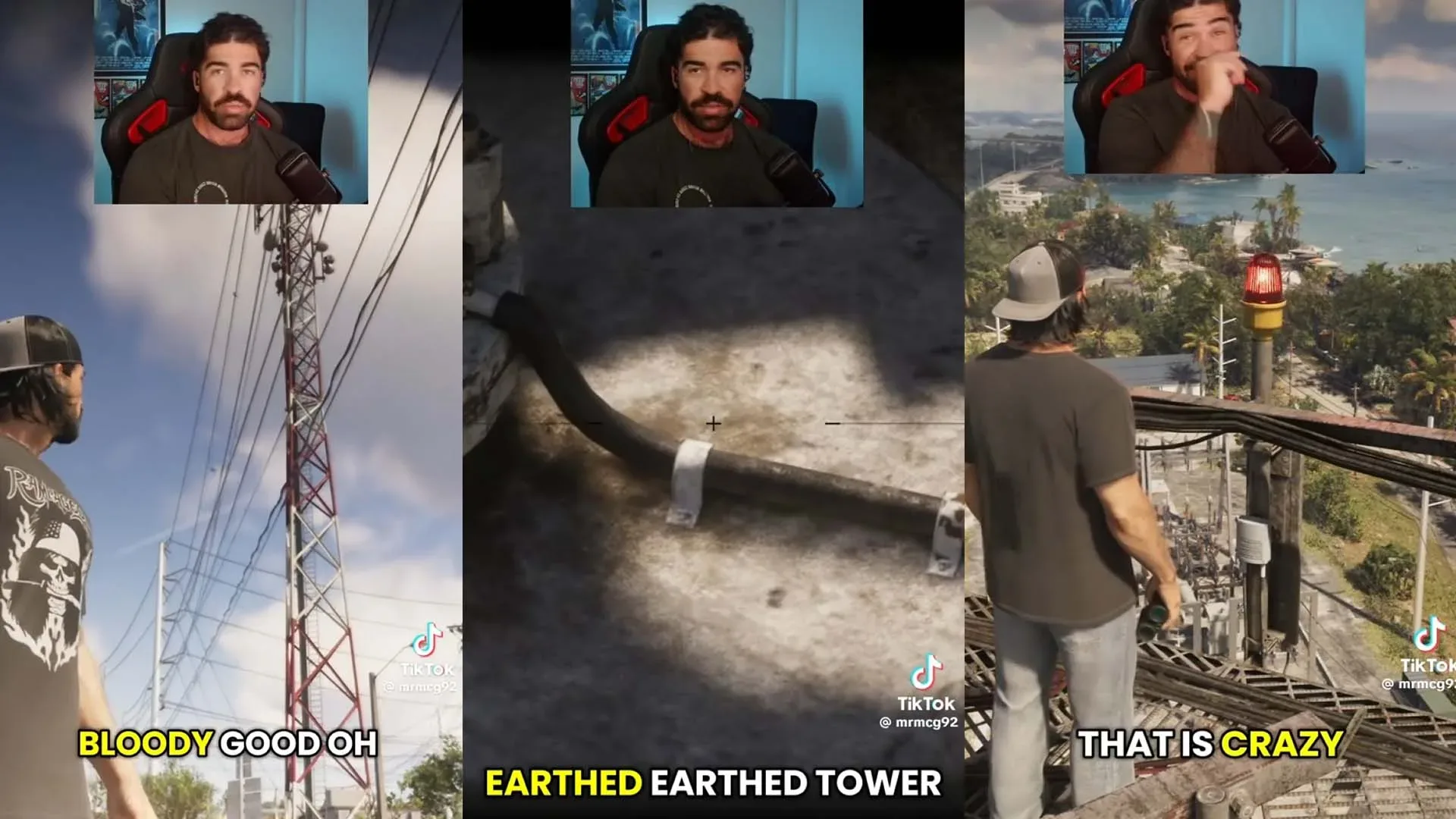
The result was an unusually specific kind of video-game praise. During a close look at one GTA 6 tower, MrMcg92 reacted with astonishment to details including earthed tower legs with saddles, double locknuts, a red power cable routed up the structure, clamps at mount points, panel tails leading to an RRU, and—at the top—a red aircraft warning light.
It is a narrow subject, but that is exactly why the reaction matters. General comments about a game looking realistic can be subjective. A person familiar with a particular piece of real-world infrastructure noticing several small, purposeful construction details is a more concrete indication that artists did not treat the tower purely as a distant silhouette.
The inspection that turned into a celebration
MrMcg92’s online tower inspections are informed by practical familiarity with the structures. The creator, who primarily makes content around first-person shooters and military simulations, has previously inspected towers in Battlefield, Days Gone and Far Cry. Those games had details worth noting, but he had also found omissions or choices that did not match what he would expect on a functioning communications tower.
GTA 6 prompted the opposite response. On approaching the tower, he immediately focused on its legs being earthed and fitted with saddles, then called out double locknuts on what he described as HDs. The excitement was not based on a single impressive texture or a very tall climbable object. It came from seeing multiple components that, to someone with tower experience, appeared to have been represented with uncommon care.
“For the first time ever, we got the tower legs earthed,” MrMcg92 said, before highlighting the saddles and double locknuts.
His enthusiasm continued on the way up. He pointed to what he called proper AA clamps on mount points and tails running from the bottoms of panels to the RRU. He also noticed a red cable running through the middle of the tower. Before reaching the summit, he said the presence of an aircraft warning light would be the final flourish. It was there.
That sequence is amusing precisely because the payoff is so specialized. A blinking red light atop a tall tower might be background flavor to nearly everyone else. For this inspection, it functioned as a final confirmation that the model had been built around a recognizable real-world logic rather than a checklist of broad visual clichés.
Related coverage includes GTA 6 Radio Tower Inspection Wins Praise From Tower Worker.
Why those tiny parts drew such a huge reaction
The terminology can sound like a second language to players who have never worked around communications infrastructure. The important point is not that every GTA 6 player needs to learn it, but that the vocabulary identifies specific, functional-looking parts rather than vague “extra detail.”
- Earthed tower legs refers to the legs being connected to earth or ground. MrMcg92 identified this as a feature he had not previously seen represented in a game tower inspection.
- Saddles were visible alongside the earthing arrangement, and were another detail he singled out at the base.
- Double locknuts are paired locking nuts. The creator repeatedly celebrated their inclusion on the tower’s HDs, using them as evidence that the fasteners had received attention too.
- AA clamps were the clamps MrMcg92 identified at the tower’s mount points. In his assessment, they were the correct kind of detail to see there.
- Panel tails and the RRU describe visible cable runs from the bottoms of panels toward a component he called the RRU. The creator’s focus was on the fact that the routing existed and appeared deliberate.
- Aircraft warning light is the red light visible at the tower’s top. Its inclusion capped the inspection.
None of this means a game needs to turn its players into tower technicians. It does show how environmental realism is often constructed: by stacking many details that are individually easy to overlook. The model can still read as a radio tower from far away without the locknuts, routing, clamps or grounding elements. Up close, though, those elements can determine whether a specialist sees a convincing installation or an attractive approximation.
Environmental authenticity is not the same as gameplay importance
It is worth separating what this clip demonstrates from what it does not. It demonstrates that at least one inspected radio tower in GTA 6 contains details that impressed someone experienced with large communication towers. It does not establish that every tower in the game is built to the same standard, that each identified part behaves as it would in reality, or that the tower has a gameplay function beyond being part of the world.
That distinction makes the achievement more interesting, not less. The tower appears to be an environmental object, yet it received enough attention to withstand scrutiny from a viewer who knows what to look for. Games frequently benefit from this kind of work even when players never consciously catalogue it. A credible built environment helps roads, neighborhoods and open spaces feel connected to a plausible material world.
There is also a practical visual benefit. Industrial assets can easily become repetitive if they are made from a small number of generic pieces. Visible cables, mounting hardware and differentiated components create a sense that an object has a job to do. In this case, the creator’s reaction suggests GTA 6’s tower was not merely designed to occupy vertical space; it was designed to resemble a particular category of working structure.
A useful reminder about expertise in game worlds
Specialists often see games differently from the audiences games are designed for. A driver may notice lane treatment, a mechanic may study an engine bay, and a person familiar with communications towers may start their own inspection the moment they spot a lattice structure on the horizon. Their standards are often demanding because they are not evaluating whether an object is generally recognizable. They are evaluating whether its parts make sense together.
MrMcg92 had already applied that perspective to Battlefield, Days Gone and Far Cry, identifying both strong details and elements he felt were absent or mistaken. That prior habit gives the GTA 6 reaction context: this was not simply excitement at seeing a tower rendered at high detail. It was delight that a game included construction and equipment cues he expected to find.
The moment also makes a case for giving environmental artists credit beyond the game’s headline attractions. Character animation, vehicles, missions and dramatic vistas usually attract the largest share of attention. But a tower artist’s work can become memorable when somebody with the right knowledge looks closely enough. The earthed legs, clamps and cable tails are not likely to appear on a bullet-point feature list. They are the kind of decisions that can make a virtual place feel considered from an angle most players will never use.
What players should take from the clip
The immediate takeaway is delightfully simple: GTA 6 has at least one radio tower that passed an unusually rigorous informal inspection. The broader takeaway is that “realism” is often less about a giant visual effect than about consistency at miniature scale. A red cable needs somewhere sensible to go. Mounted equipment needs hardware that looks appropriate. A tall tower can benefit from a warning light at its top. When these choices align, they can create a level of credibility that a trained observer recognizes almost instantly.
Players inclined to explore may now have another reason to look upward rather than only at the map route or mission marker. That does not make tower inspection a required activity, and it should not be confused with a guide to unlocks or collectibles. It is simply an invitation to notice the background labor that helps an open world feel less like a set and more like a place with systems, maintenance and infrastructure behind it.
For more GTA 6 coverage on the site, see our report on a GTA 6 demonstration using brain-computer input. For now, the standout lesson from the tower clip is more grounded: sometimes the most enthusiastic response to a huge game world comes from a pair of earthed legs, correctly placed clamps and a tiny red light blinking at the top.