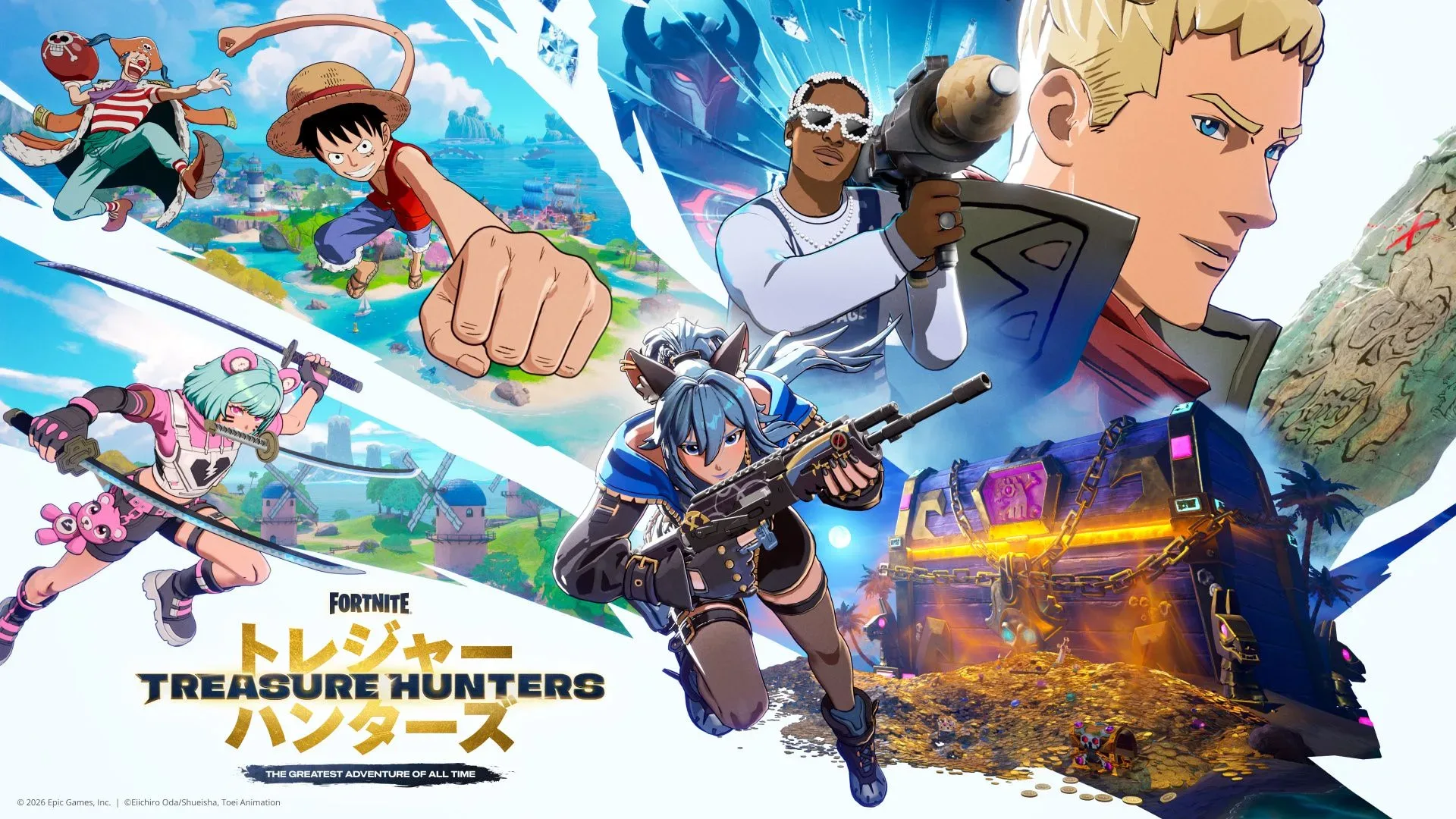
Fortnite’s One Piece crossover has turned a single ultra-rare in-game find into a flashpoint for alleged exploits, paid “help,” dubious software and eye-watering account listings. The item at the center of it is the Pirate Shop Token, a chest reward that grants Pirate Shop Access for two weeks. During that window, the holder can claim nearly all eligible Item Shop offerings without paying for them.
That is a major prize on its own terms: items claimed through the access period remain on the player’s account permanently. But the promotion has boundaries. Real-money offers, gifting and Battle Pass rewards are excluded. The result is not an unlimited pass to every Fortnite product, but it is still valuable enough that some players appear to be treating the chance-based token like a scarce commodity that can be optimized, brokered or resold.
Epic Games’ position is unusually direct: buying an account or using fake tools is a scam. The company also says that Pirate Shop Access works like other Battle Royale chest rewards, with every player having an equal opportunity to find it.
“Buying an account or using fake tools is a scam,” Epic Games said. “This is just like any of the chests in Battle Royale, so every player has an equal opportunity to find Pirate Shop Access.”
For more context, explore Report: Apple Could Eventually Retire Non-Touch High-End MacBook Pros.
What the Pirate Shop Token does — and does not — unlock
The token is tied to Fortnite’s One Piece crossover and its Treasure Hunters mini-season. Finding it unlocks access to a special version of the Item Shop for 14 days. Within that period, players can claim qualifying shop items for free, and those claims are permanent additions to the account.
Two distinctions matter here. First, the token’s value comes from its temporary access period, not from becoming a tradeable object. Second, “almost everything” does not mean every type of Fortnite content. Offers requiring real-money payment, gifts and Battle Pass rewards remain unavailable through Pirate Shop Access.
That structure explains why the token has generated so much attention. A random chest drop ordinarily provides a momentary gameplay reward. This one can translate into a two-week opportunity to add eligible cosmetics or other shop content permanently, which makes the discovery feel more consequential than a standard match reward. It also creates an obvious incentive for players to maximize chest openings rather than simply play matches normally.
Related coverage includes Fortnite's Pirate Shop Token Hunt Draws Exploit Claims and Costly Account Listings.
The rarity claim is a player estimate, not an official rate
There is no official published drop rate for the Pirate Shop Token. Players have estimated the chance at roughly one token per 700,000 chests, but that figure should be treated as an unverified community estimate rather than a confirmed probability.
That distinction is important. A stated drop rate would describe the designed chance of an outcome. A player estimate is an attempt to infer that chance from observations, assumptions or reported finds. Without a disclosed rate or a clearly established dataset, it cannot tell players how many chests they personally will need to open, nor can it establish that a particular match, vault or strategy is more likely to produce the token.
What can be said with confidence is that players perceive the reward as extraordinarily scarce. Scarcity changes behavior: a reward that seems merely uncommon encourages casual searching; one believed to be vanishingly rare encourages optimization, rumor-sharing and, in this case, attempts to turn access into a paid service.
Why vault-chest shortcuts are a problem
Players have circulated methods intended to speed up chest farming. One reported approach involves using grenades and cannon balls to destroy chests inside locked vaults, allowing players to access large numbers of chests without first obtaining a key. Others have shared or promoted tools said to automate farming.
The practical appeal is simple: if the token comes from opening chests, more chest interactions could mean more chances to receive it. But the method is the issue. Skipping a lock requirement is not just a question of playing efficiently; it is an alleged attempt to bypass part of the intended game loop. Automation raises an even clearer concern because it can substitute software for normal player action.
Epic’s terms prohibit cheating and exploiting. They also prohibit buying and selling Fortnite accounts. That means a player does not need to reach the point of a successful sale to face potential consequences: using exploit-based methods or fake tools can itself put the account at risk.
There is also a less dramatic but useful rule for players: a tool that promises to reveal, generate or automatically obtain a rare reward should not be treated as a shortcut simply because it is advertised that way. Epic specifically calls fake tools a scam. In this context, “fake” can encompass an offer that does not deliver its promised result, while players also face the separate policy risk of using software or methods that violate the game’s rules.
Paid escorts and chest overlays add another layer of risk
One player shared an image of an overlay that purportedly identifies chest locations in a match while offering paid assistance to help others pursue the token. Even without judging every individual service claim, the arrangement is a red flag for players who want to keep their accounts secure and compliant.
An overlay is software or a visual layer that appears on top of a game display. Some overlays can be legitimate utilities, but an overlay that exposes game information or is paired with a paid promise to optimize a rare drop warrants caution. The available information does not establish that any individual advertised service works, nor does it prove that a payment will result in Pirate Shop Access. It does show that the rare-token chase has created a market for people selling an advantage or the appearance of one.
Players should also separate help from guarantees. No third party can legitimately promise that a random chest reward will appear on demand. A paid guide, chaperone or farming arrangement cannot turn a chance-based drop into a certainty. And if a service relies on exploits, automated play or unauthorized tools, it may expose the customer’s account as well as the operator’s.
$9,000 and $10,000 listings do not make an account safe to buy
Some sellers have listed Fortnite accounts with Pirate Shop Access on eBay for thousands of dollars. The reported listings included one at $9,000 and another at $10,000 or nearest offer. At the time observed, neither had bids. The Treasure Hunters mini-season is due to end on December 4, which may be adding urgency to the effort to monetize temporary access.
A listing price is not evidence of an account’s true value, demand or legitimacy. It is only the amount a seller has chosen to request. The absence of bids is relevant, particularly when the price is so high, but it does not settle what someone might later offer. More importantly, it does not remove the basic risk: account sales are prohibited under Epic’s terms.
Buying a game account is fundamentally different from buying an officially supported digital item through the platform. The account is not a protected collectible being transferred through an authorized marketplace. It is a login-controlled service account governed by the publisher’s rules. If Epic determines that an account has been sold, the account could be banned. A buyer could spend thousands and lose access to the account and its contents.
There is an additional ownership risk. The prior account holder may be able to contact support and report the account as stolen. Whether or not a seller’s story is credible, the buyer has little reason to assume that an informal transfer will be recognized or protected. In short, a high price tag does not create a legitimate chain of ownership.
What players can safely take from the token hunt
The legitimate route is also the straightforward one: play normally and open Battle Royale chests when the opportunity arises. Epic says all players have an equal opportunity to find Pirate Shop Access through chests. There is no verified shortcut in the available information that changes a player’s underlying odds without raising policy or security concerns.
- Do not buy Fortnite accounts. Account sales violate the terms and can leave a buyer without the account or its claimed items.
- Avoid fake tools and automation offers. Epic has called fake tools a scam, while cheating and exploiting are prohibited.
- Be skeptical of paid token guarantees. The reward is chance-based; a third party cannot honestly promise a random drop.
- Understand the reward limits. Pirate Shop Access applies to eligible Item Shop content for two weeks, not real-money offers, gifts or Battle Pass rewards.
- Keep expectations grounded. The oft-repeated one-in-700,000 figure is a player estimate, not an official drop rate.
The Pirate Shop Token is compelling precisely because it combines rarity with potentially lasting account rewards. But that combination also makes it ideal bait for people selling shortcuts, tools or accounts. The practical value of the promotion is best preserved by treating it as Epic describes it: a chance chest reward, not a commodity worth risking an account over.
Shop the products
Check current price, model and availability at the retailer.