There is no shortage of reverence for classic Japanese role-playing games in modern RPG design. The harder trick is finding a mechanical reason for that reverence to exist beyond familiar imagery, party banter and a world-threatening crisis. Eternal Anima, an original Japanese RPG from Marvelous, has a potentially compelling answer: make its story’s central idea—knowledge of an unhappy future—directly shape every important decision in combat.
The project brings together creators with unusually deep connections to the genre’s past. Director Katsuhisa Higuchi previously programmed several early Final Fantasy games, worked on Chrono Trigger, and later directed Capcom’s first two Monster Hunter Stories games. Kazushige Nojima, whose previous writing credits include Final Fantasy VII, Final Fantasy VIII and the Kingdom Hearts series, is also involved. Its narrative premise stems from a concept submitted by Keisuke Makino, whose work includes contributions to Persona 5 and Metaphor: ReFantazio.
That lineage creates understandable expectations, but it also presents Eternal Anima with a challenge. A game built by people associated with landmark RPGs will inevitably invite comparisons to them. Its most interesting material so far is not simply that it invokes legacy, but that it treats legacy as a burden: what a society inherits, what it chooses to ignore, and what it leaves to the people who arrive afterward.
A world built on a forbidden past
Eternal Anima follows Wade, who can learn an object’s history through touch. He lives in Urvis Ael, a world where historical truth has been lost and where investigating that past is forbidden. That ability makes Wade dangerous to the established order. Pursued as a dissident, he travels into the past in an attempt to understand how his world reached its present state—and whether its future can be changed.
One key destination is Ambulis, a continent that has become submerged and disappeared from history by Wade’s era. The journey takes the party roughly 200 years into the past, to a point when Ambulis can still be explored and perhaps saved. The developers have also named three other continents expected to face comparable troubles: Wistregen, Himeshiro and Rotala. The broader details of how the past and present connect, the major antagonists, and the precise circumstances behind the party’s journey remain deliberately unclear.
That restraint matters. Time travel stories often become less about changing history than explaining their rules, but Eternal Anima’s available setup is focused on a more immediate question: what does someone do when they know in advance that passivity leads to disaster? The game’s answer appears to be action, not merely understanding.
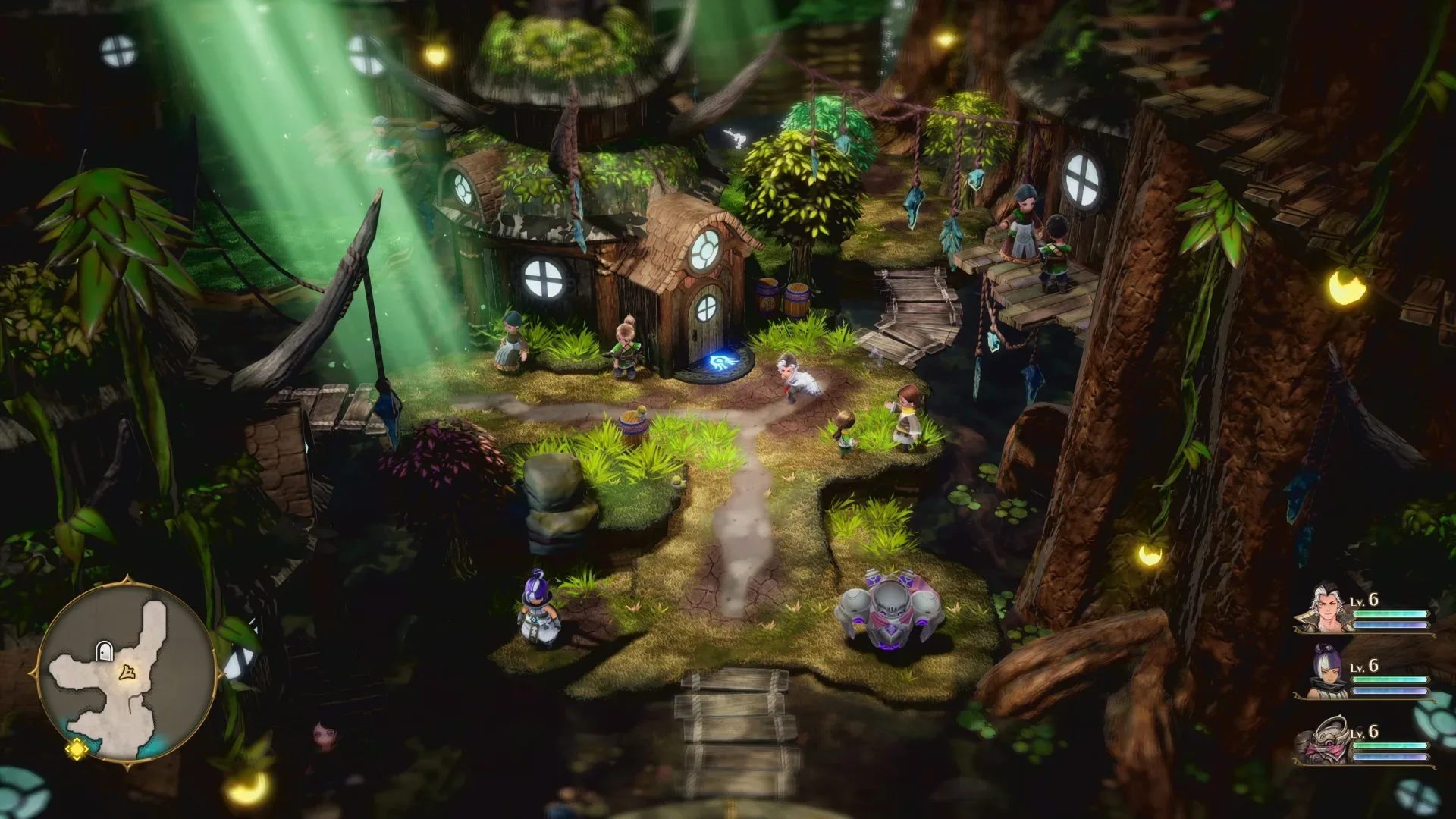
An early section set in the Somber Woods makes that point plainly. The forest is not flourishing; it is dying. Its planet-wide life force, called Anima, is being depleted through human exploitation of natural resources. People tasked with protecting the land have settled into prayer and complacency, trusting that the problem will resolve without a change in behavior. Wade and his companions know the eventual result. If nothing changes, Ambulis will be lost and the consequences will extend far beyond one forest.
The environmental framing is direct, but it has room to be more than a simple warning sign. La Boset, a village near the Somber Woods, reportedly includes elders who believe that existing alongside nature is equivalent to listening to it or caring for it. That distinction is useful. Coexistence can become a pleasant slogan if it never asks who bears the cost of extracting resources, who gets to define “balance,” or what happens when established authorities mistake inaction for wisdom.
Related coverage includes Eternal Anima Turns Future Sight Into a Tactical RPG Battleground.
Higuchi has indicated that parallels to the real world are intended to be central to the game. The premise is therefore not just “save a fantasy kingdom before it is too late.” It is about people in the future confronting the evidence of earlier failures, while people in the past still have the opportunity—and obligation—to prevent those failures.
Future Sight turns prediction into a turn-based puzzle
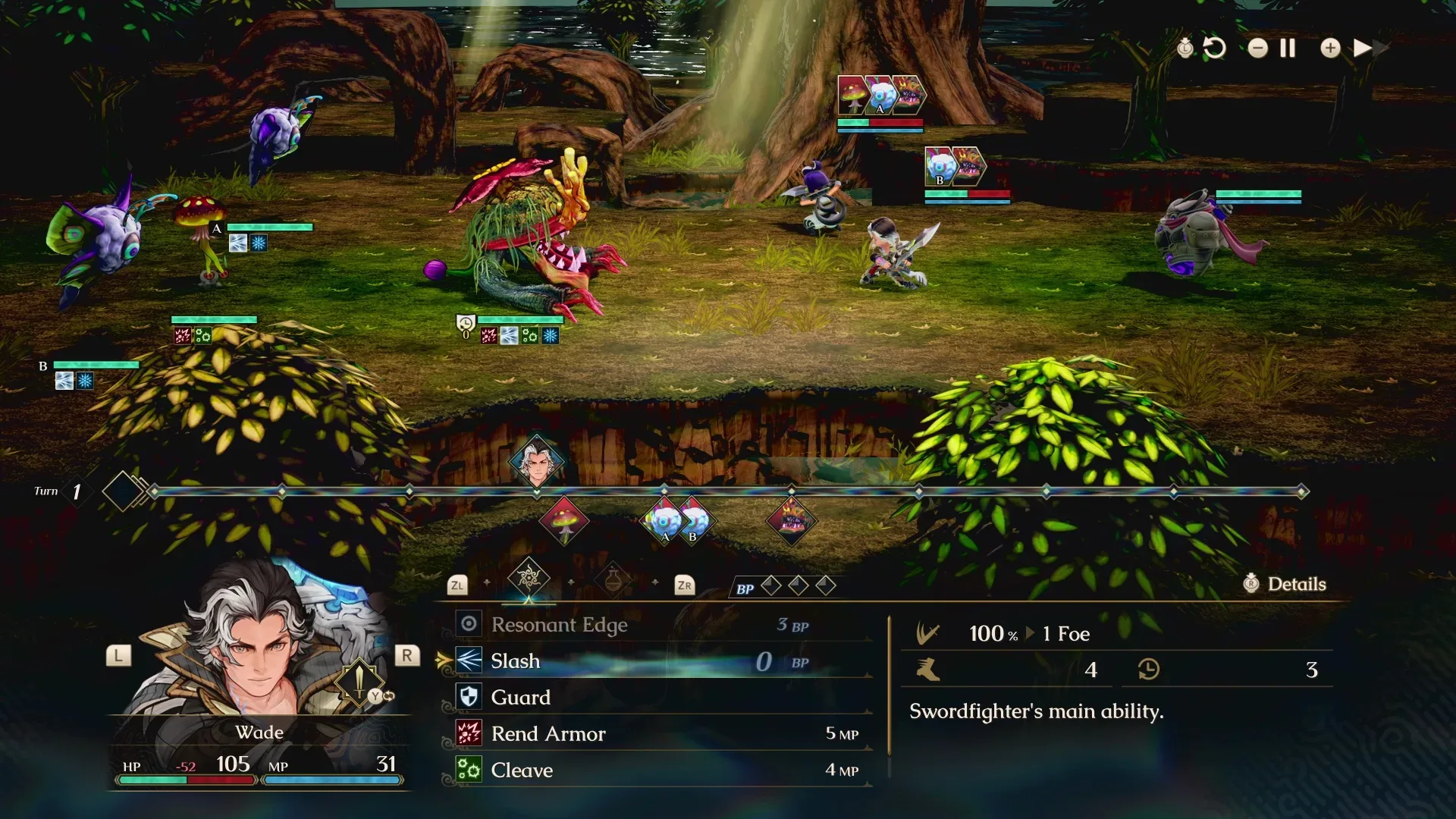
The clearest sign that Eternal Anima wants its ideas to inform its play is Wade’s Future Sight ability. Rather than keeping foresight confined to cutscenes, the game uses it in battle. Players can see enemy actions before committing to their own moves: when each foe will act, what attack it plans to use, its target, and the expected damage.
On paper, that might sound like a way to make combat easier. In practice, the system is designed to make each turn more demanding. Information is valuable only if the player can use it to alter the outcome.
Enemy actions are represented on a progress bar above the command menu. Attacking a foe with one of its weaknesses delays that enemy’s next turn. Continue pushing the enemy back far enough and it can be forced off the bar entirely, triggering a break. A break leaves the target vulnerable to substantial damage. In genre terms, a break system rewards identifying and attacking vulnerabilities; Eternal Anima’s additional wrinkle is that the player can see the dangerous event they are trying to prevent before it occurs.
That changes the question behind a turn. Instead of asking only, “Which attack gives me the best damage right now?” the player must also ask, “Which action changes the next several moments in my favor?” A powerful hostile move may be aimed at a vulnerable party member. The immediate priority may become delaying that enemy, breaking it before its turn arrives, or defeating it altogether. The intended satisfaction is not surviving an unknowable ambush. It is reading an approaching disaster and constructing the sequence that ensures it never happens.
This is a meaningful distinction for turn-based combat. Randomness and hidden intentions can create tension, but they can also make a loss feel like information that was unavailable until after it mattered. Eternal Anima instead appears to locate tension in optimization. The player knows the threat; the puzzle is whether their current party position, available attacks and resources are enough to rewrite it.
BP is the resource behind the rescue plan
The system is further shaped by BP, a resource allies gain each turn. BP can enhance an attack’s strength and increase the amount of turn delay earned when exploiting a weakness. In other words, BP is not just an extra power meter. It affects whether a well-timed attack merely hurts an opponent or moves that opponent far enough down the timeline to prevent a catastrophe.
That creates a familiar but promising tactical trade-off. Spending BP now may finish an enemy quickly or create a stronger delay. Saving it can be the safer long-term choice if a boss has a devastating move approaching. A player may accept limited damage on one turn because preserving BP makes it possible to secure a vital break later. The future is visible, but resources are finite, which prevents prediction from becoming a free answer.
Producer Makoto Shioda has described the logic in straightforward terms: if Future Sight shows a coming attack that would kill a party member, players can act first to remove that enemy and thereby erase the predicted damage. It is a small example, but it captures the game’s central mechanical promise. The forecast is not fate; it is a state of play that can be revised.
There is another restriction that should keep the approach from becoming rote. Players cannot repeatedly lean on the same weakness forever. The game limits repeated exploitation of a single vulnerability, forcing a broader use of a party’s tools. That makes battle knowledge more dynamic. Discovering one weakness is only the beginning; players must consider timing, alternate options, BP levels and the most dangerous actions on the progress bar.
Routine encounters in the field reportedly do not demand this level of calculation, which is likely important for pacing. A system that asks players to study every possible turn in every minor fight could turn an adventurous RPG into administrative work. Bosses are where Future Sight, breaks and BP are expected to become essential, giving major encounters a more deliberate, puzzle-like identity.
Where homage becomes a risk
Eternal Anima calls itself a love letter to RPGs of the past, and the people involved give that phrase weight. Yet a love letter has to communicate something of its own. In the material shown so far, there are signs the game may occasionally resemble a collection of familiar genre memories more than a fully distinct new work.
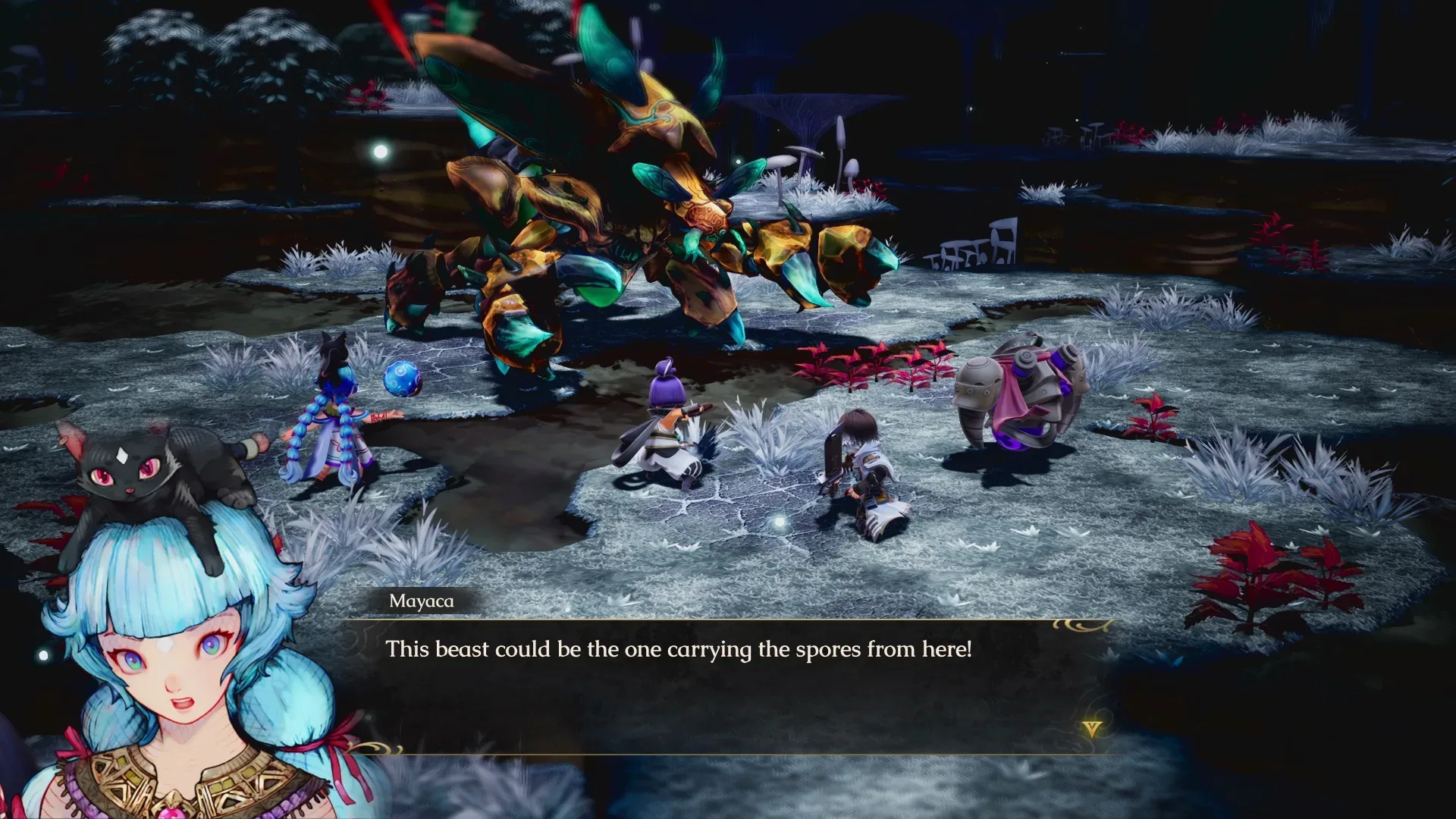
M.O.S., the party’s robot companion, has drawn a particularly close comparison to Robo from Chrono Trigger. There is nothing inherently wrong with recognizable archetypes; JRPGs have always reshaped shared vocabulary. But Eternal Anima’s themes make originality especially important. A story concerned with inheriting the past cannot afford to treat inheritance as pure replication. Its most persuasive version will be one where old forms are actively transformed rather than simply displayed with affection.
The combat system offers a path toward that transformation. Future Sight does not just decorate conventional turns with a narrative label. It asks the player to perform the game’s argument: see the consequences, prioritize the harm that is coming, and choose the intervention that changes the outcome. If later battles continue to build on that relationship between foreknowledge and responsibility, Eternal Anima could establish a sharper identity than its visual and character echoes initially suggest.
The narrative has a similar opportunity. Ambulis is already a place defined by the knowledge that it will be drowned and forgotten. Wade’s capacity to read history from objects gives the world a powerful way to make vanished lives, choices and failures materially present. The potential is not only in revealing lore. It is in making historical knowledge costly, contested and useful—knowledge that can change who is believed, who holds power and what must be done.
Why its legacy theme is more than marketing
Higuchi has said that the team did not begin by framing the game’s theme around its own real-world legacy, but that feeling became more relevant during development. He described the present as a culmination of what has been handed down before. That is a fitting perspective for a project made by veterans of multiple generations of Japanese RPGs.
For players, the practical question is simpler: will Eternal Anima make its past-facing premise produce new decisions? The early evidence says yes in combat. Seeing an enemy’s future action, assessing a weakness, budgeting BP and deciding whether to delay or break a foe turns knowledge into responsibility. The game does not merely tell players that the future can be changed; it asks them to demonstrate how.
Much remains unknown, including how the story’s timeline operates at scale and whether its other continents will deepen the same themes without repeating Ambulis. But Eternal Anima has already outlined an intriguing tension at its heart. It looks back to the RPGs that shaped its creators, while asking what people should do with what they inherit. Its best chance of honoring that history is not to preserve it untouched. It is to build something capable of changing what comes next.
For another look at a current game built around puzzle-minded world manipulation, see Nonolith’s copy, rotation and world-breaking puzzle concept.