The wasteland has acquired flippers, bumpers and the sort of financial hazard usually reserved for an unguarded radscorpion nest. Stern Pinball has introduced a Fallout pinball machine inspired by the Amazon Prime television series, translating post-apocalyptic Los Angeles into a physical table packed with recognizable locations, characters and irradiated troublemakers.
It is a particularly natural fit for a franchise built around scavenging, branching paths, sudden catastrophes and spending far too long staring at a screen full of numbers. Pinball may not allow anyone to negotiate with a faction or load up a save from 45 minutes ago, but it does offer its own high-pressure version of wasteland decision-making: hit the shot, keep the ball alive, and try not to watch it roll helplessly toward the drain.
The new machine places players in the L.A. wasteland through the perspectives of several central figures from the show: vault dweller Lucy MacLean, Brotherhood of Steel squire Maximus, and Cooper Howard, the ghoul gunslinger. The table’s objectives include visiting notable settings from the series, collecting Nuka-Cola caps for trading, and taking on familiar threats including ghouls, radscorpions and the Deathclaw.
In other words, it appears determined to make a pinball player feel right at home in Fallout’s universe: treasure is useful, monsters are abundant, and the cheerful branding may be covering a fairly grim scenario.
A Vault 33 lock and a Pip-Boy at the center of the action
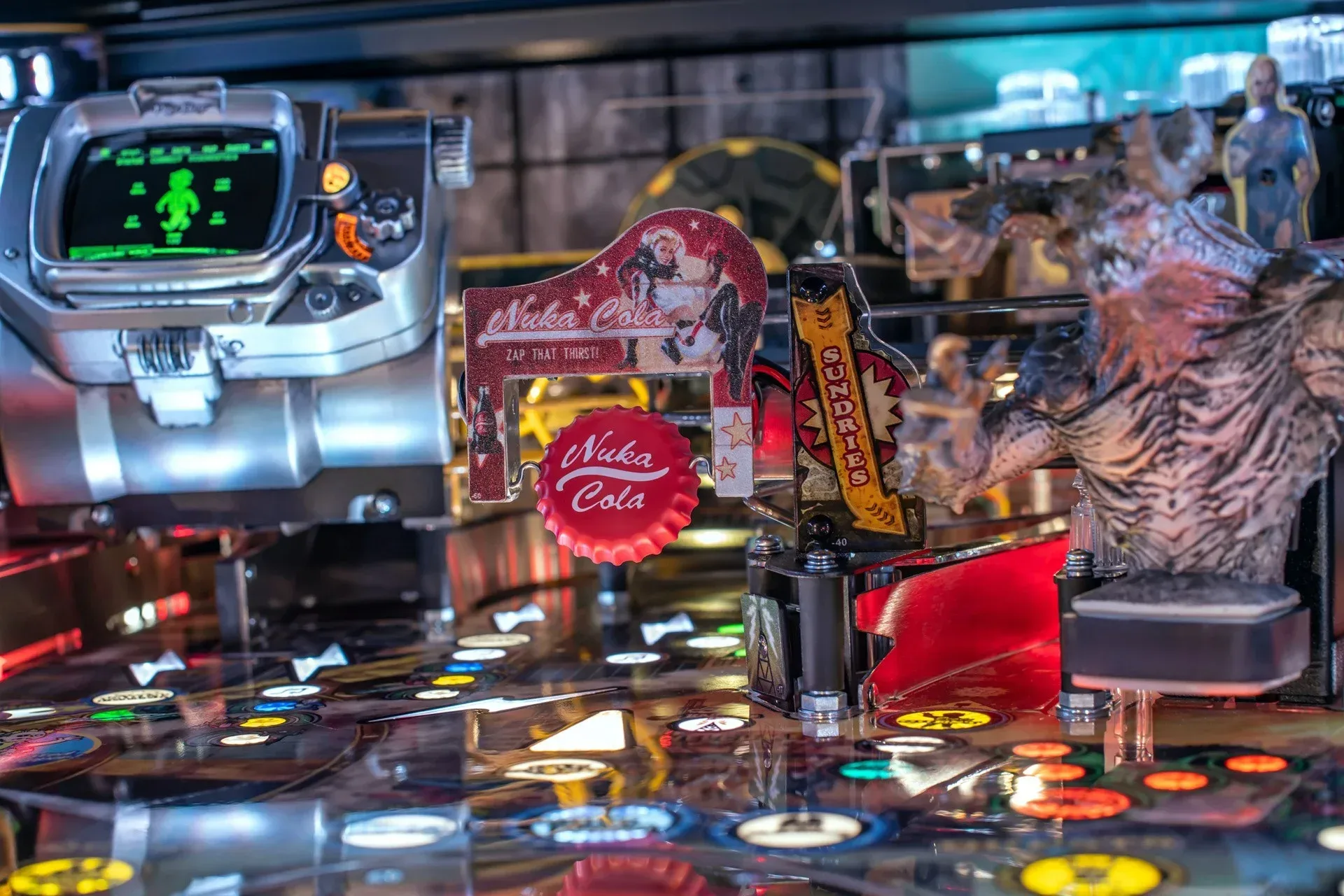
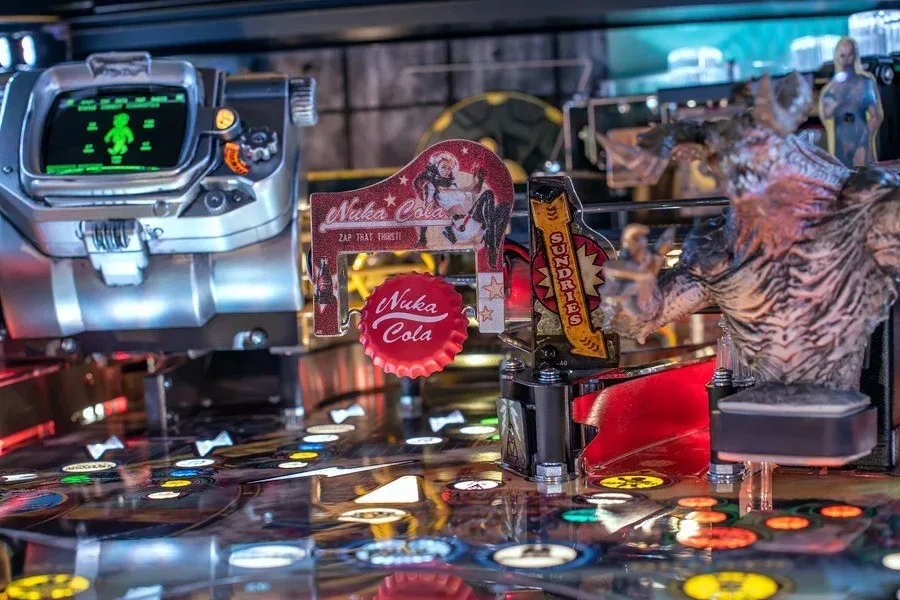
Stern’s Fallout machine uses a dense, toy-heavy playfield to establish its setting. Among the standout elements is a rolling Vault 33 ball lock, giving the iconic vault a mechanical role rather than leaving it as scenery. There is also a reproduction of the series’ Fat Man launcher, one of those details that sounds exceptionally sensible until one remembers that Fallout has never been especially interested in sensible.
The cabinet also includes a Pip-Boy 3000 mkV with a pseudo-LED screen intended to communicate scoring and mode information. It is an especially appropriate interface for pinball. The Pip-Boy has always been Fallout’s portal to character stats, maps, inventory lists and ominous status readouts; on this table, it becomes the player’s guide to the far more immediate concern of where the ball went.
Another major feature is a mini-playfield in the machine’s center, designed to represent the interior of a vault. This makes the table feel more spatially ambitious than a design that simply applies Fallout art to conventional ramps and targets. The feature list suggests a playfield built to keep the eye moving between the wasteland surface, Vault 33, its score display and the various hazards waiting for a well-timed shot.
The visual approach is deliberately busy, which suits a property where every landscape is cluttered with ruined infrastructure, retro-futurist technology and things that would be better left undiscovered. That density may not appeal to every pinball collector’s preferred cabinet aesthetic, but it gives the machine a strong series identity. Rather than attempting a clean or minimal interpretation, Stern appears to have leaned into the maximalist, hazardous clutter of a Fallout expedition.
Show characters, game-inspired music and wasteland landmarks
The table is based on the television adaptation, but it does not leave the games behind. Its soundtrack takes inspiration from the original game series, pairing the newer live-action setting and cast with a sonic connection to Fallout’s longer gaming history. That choice should help bridge the gap between fans who arrived through the show and those who have spent years wandering the franchise’s earlier digital wastelands.
There is a pleasing fit between pinball’s repeat-play structure and the larger Fallout idea. A pinball run is rarely about a perfectly safe route to a single ending. It is about experimentation, recovering from errors, discovering what activates what, and gradually learning how a complicated system responds. A machine can turn one bad bounce into disaster with no ceremony whatsoever, which is arguably a more authentic wasteland lesson than any loading-screen tip.
The Fallout theme also gives Stern plenty of material beyond a few recognizable faces. Nuka-Cola caps, the Brotherhood of Steel, the vault system, predatory creatures and Los Angeles landmarks provide a broad pool of visual and mechanical ideas. The result is positioned as a full themed environment rather than a cabinet that asks collectors to do most of the imaginative lifting themselves.
For people whose game rooms already function like museums of favorite worlds, this is exactly the kind of object that turns fandom into furniture-sized commitment. As the familiar cycle of buying one small collectible demonstrates, the phrase “one small thing” has a habit of expanding. A full-size Fallout pinball machine takes that phenomenon and gives it legs, lights and a ball drain.
Three editions, with prices that escalate faster than wasteland stakes
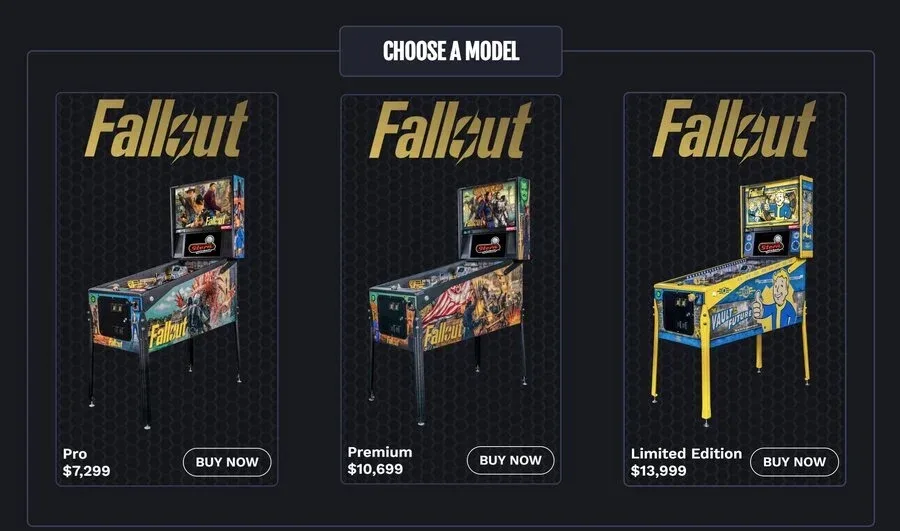
Stern is offering Fallout in three versions. The entry point is the Pro model at $7,299. Its cabinet uses a comparatively restrained design with artwork centered on the Battle of Griffith Observatory. “Restrained,” naturally, is relative when discussing a giant illuminated machine based on nuclear devastation, but the Pro version is the least expensive route into this particular vault.
The Premium model costs $10,699. It adds a more stylized cabinet-art treatment and powder-coated framing, while its art depicts a Brotherhood of Steel and Deathclaw conflict on the streets of New Vegas. It is the edition for collectors who look at a $7,299 pinball machine and think, quite reasonably within this niche, “Yes, but what if the frame itself had more presence?”
At the top is the Limited Edition, priced at $13,999. This version uses Fallout’s immediately recognizable blue-and-yellow Vault-Tec color palette and centers its artwork on Pip-Boy, the smiling mascot whose optimism has endured with impressive resilience considering the state of the world around him.
Each tier presents a different visual identity, with the price differences clearly placing these machines in the premium collectible category rather than the casual impulse-buy aisle. Prospective owners should also remember the practical side of pinball ownership: a full-size table needs a suitable space, safe transport, room for maintenance and an audience that will not panic when the living room suddenly starts making arcade noises.
Fallout pinball editions at a glance
- Pro — $7,299: Modest cabinet treatment featuring Battle of Griffith Observatory artwork.
- Premium — $10,699: Stylized artwork, powder-coated framing, and Brotherhood of Steel-versus-Deathclaw art set in New Vegas.
- Limited Edition — $13,999: Blue-and-yellow cabinet styling with Pip-Boy-focused artwork.
Pre-orders are live
Pre-orders for Stern Pinball’s Fallout machine are live through Stern Pinball’s website. No release timing or other availability details are specified here, so anyone interested in a particular edition should check the manufacturer’s current listing for the relevant ordering information.
As a piece of gaming and television memorabilia, Fallout pinball is aiming squarely at collectors who want the show’s version of the wasteland to occupy more than a streaming queue. The theme has room for spectacle, gallows humor and a parade of iconic objects, while the pinball format gives those elements a tactile, score-chasing purpose.
Its prices may induce the same reflex as spotting a Deathclaw silhouette in the distance. But for fans with the budget, the floor space and a healthy respect for multiball, Stern’s latest table promises a visit to Fallout’s L.A. that is considerably less radioactive than the usual kind—provided the player can keep the ball out of the drain.