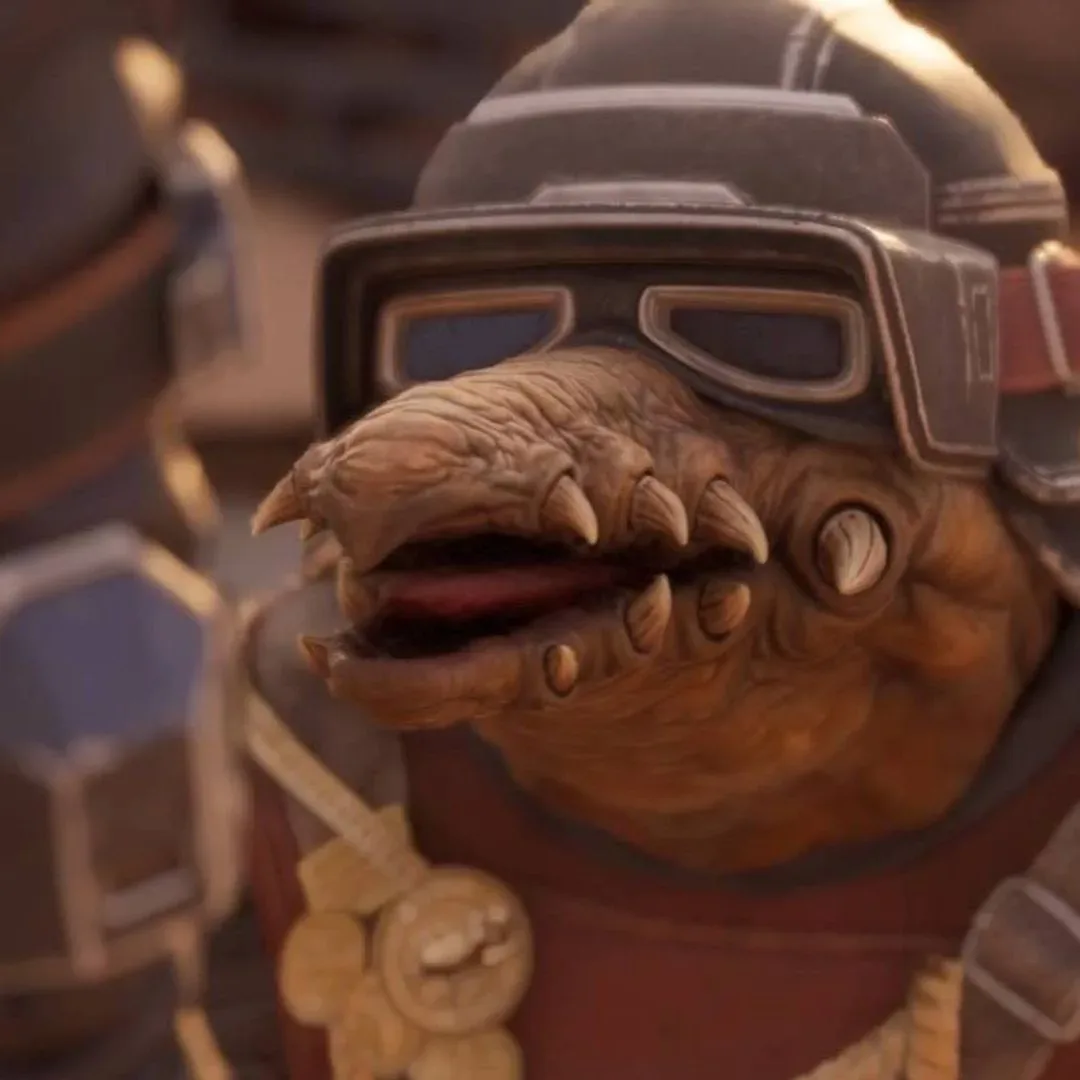
Biddy Blas may not have an official LEGO release on the horizon, but fans now have a detailed brick-built alternative. Jordan DeVries, a UI/UX director at Respawn who has worked on Star Wars: Zero Company and Star Wars Jedi: Survivor, has published a custom model of the Star Wars: Galactic Racer character along with free build instructions.
The finished Biddy Blas stands about 6.7 inches, or 17cm, tall. Rather than requiring a long shopping list of loose elements, DeVries designed it around the LEGO Jurassic World Spinosaurus Escape set. The model uses fewer than half of that set’s pieces, leaving a substantial number of parts behind for another project.
It is a nicely practical answer to a very specific fan desire: putting a conspicuous, characterful version of Galactic Racer’s loudmouthed Crocin racer on a shelf without waiting for a licensed product that has not been announced.
A fan build with a deliberate parts strategy
DeVries’ instructions are hosted on Rebrickable, a site used by builders to share custom LEGO creations and their required inventories. In LEGO circles, these projects are commonly called MOCs, short for “My Own Creation.” A MOC can range from a completely original design to a major transformation of an existing retail set. This Biddy Blas lands firmly in the latter category.
That distinction matters for anyone considering the build. A custom model based around one established set can be more approachable than a design that calls for individually ordering every component. Loose-part orders can involve sourcing pieces from multiple sellers, managing color and element variations, and deciding whether substitutions will compromise the appearance. Starting with a set sidesteps much of that logistical work.
The trade-off is equally clear: the builder needs access to the particular Jurassic World set, and it is not an efficient option if they only want every piece used in one final display. But for people who enjoy alternate builds, the unused parts are not necessarily waste. They become raw material for a future MOC, modifications, or a return to the original dinosaur-themed model.
DeVries has said the creation began by repurposing the Spinosaurus Escape box. The choice is part of what makes the project more than a simple character tribute. The build asks a recognizable LEGO set to perform a completely different role, converting its inventory into a squat, expressive sci-fi personality rather than leaving it in its intended franchise setting.
Why Biddy Blas was an apt candidate
Biddy Blas has quickly become a social-media favorite among Star Wars fans, in large part because of the character’s combative Huttese dialogue. That kind of popularity is especially fertile ground for a fan model. A character does not need to be a saga-long mainstay to inspire a physical display piece; it needs a silhouette, attitude, and an instantly legible joke or emotional connection. Blas appears to have all three.
Related coverage includes Star Wars Developer Builds a Brilliant LEGO Biddy Blas Model Fans Can Recreate.
The appeal here is not realism in the traditional minifigure sense. DeVries’ model is a larger, display-oriented interpretation, built to read as Biddy Blas from a distance. It emphasizes the character’s form and costume over a tiny, standardized figure scale. That makes it closer to a brick sculpture than a hypothetical minifigure accessory.
DeVries has acknowledged that the outfit is not a perfect replica and that Biddy Blas’ racing medals are absent. Those are useful caveats for builders who want a screen-accurate recreation. Still, the design’s success is in the overall recognition factor: the posture, proportions, and costume treatment make its intended character clear even with the compromises imposed by a donor set’s limited selection of bricks.
That is a core part of custom LEGO design. Builders often work under constraints involving color availability, part geometry, structural stability, and the inventory they have on hand. The best result is not always the one with the most specialized element list. Sometimes it is the model that makes purposeful visual choices while remaining buildable from a practical collection of parts.
Free instructions lower the barrier to entry
The free instructions are the key detail. A one-off build can be a fun post; documented steps turn it into a repeatable project. Fans can evaluate the part requirements, use the named Jurassic World set as a starting point, and decide whether they want to follow the design exactly or treat it as a platform for their own Biddy Blas variation.
For collectors and display builders, that also changes the nature of the item. There is no official boxed Biddy Blas product here, no claim of a licensed release, and no standardized edition. Each completed model is a fan-built creation assembled from ordinary LEGO elements. Its value is personal and creative rather than based on product scarcity or an official production run.
That is worth keeping in mind for anyone sharing, buying, or trading custom builds. Instructions and a finished model are separate things, while the underlying LEGO parts retain their own ordinary collector and play value. The most sensible expectation is a project to build and enjoy, not a substitute for a confirmed official collectible.
A familiar skill set for DeVries
The Biddy Blas model is not DeVries’ first major conversion build. Previous creations include a Rocky model inspired by Project Hail Mary and a Monaco-style Formula 1 circuit made from Ninjago-themed parts. That background helps explain why this new character build feels designed rather than improvised.
Repurposing a set well takes more than identifying matching colors. A builder must inspect which curved pieces, hinges, plates, slopes, connectors, and decorative elements are already present, then translate that inventory into a new silhouette. A strong conversion also has to remain structurally coherent enough for someone else to reconstruct it from instructions. The Biddy Blas project’s use of less than half its donor set makes that inventory discipline especially notable.
There is also a useful connection between interface work and this kind of LEGO design, even though they are different disciplines. Both require attention to how people understand a system: what catches the eye first, what communicates purpose, and where friction might confuse someone trying to use the finished work. In a custom brick model, the “interface” is physical—part placement, step order, stability, and the visual cues that identify the character.
Game-development craft continues to spill into fan communities in similarly hands-on ways. Recent discussion around studios and their long-term projects, including how Romero Games is reshaping a shelved FPS for a smaller future, is a reminder that developers’ public-facing work can take many forms. In DeVries’ case, it is a freely shared design that gives another fandom an accessible project.
What prospective builders should know
- Start with the instructions: Review the published parts inventory and steps before taking apart a set or ordering anything.
- Expect a custom interpretation: The design is recognizable, but it does not include every costume-specific detail from Biddy Blas’ on-screen appearance.
- Plan for leftover bricks: Since the model uses less than half of the Spinosaurus Escape inventory, the donor set is also a parts pack for future builds.
- Keep official and fan-made products distinct: This is a community creation, not a revealed LEGO Star Wars product.
- Use the build as a starting point if desired: Builders with extra elements may be able to experiment with additions such as the omitted medals, provided they are comfortable departing from the published design.
For now, DeVries’ Biddy Blas is a compact example of what fan creativity can accomplish when a new character catches on quickly: a shared set of instructions, a clever donor-set conversion, and a display model that lets the character’s oversized personality escape the screen.
Shop the products
Check current price, model and availability at the retailer.