Pokémon collectors have found a new way to gamble on cardboard nostalgia without receiving any cardboard at all: a skateboard deck sealed in an opaque bag.
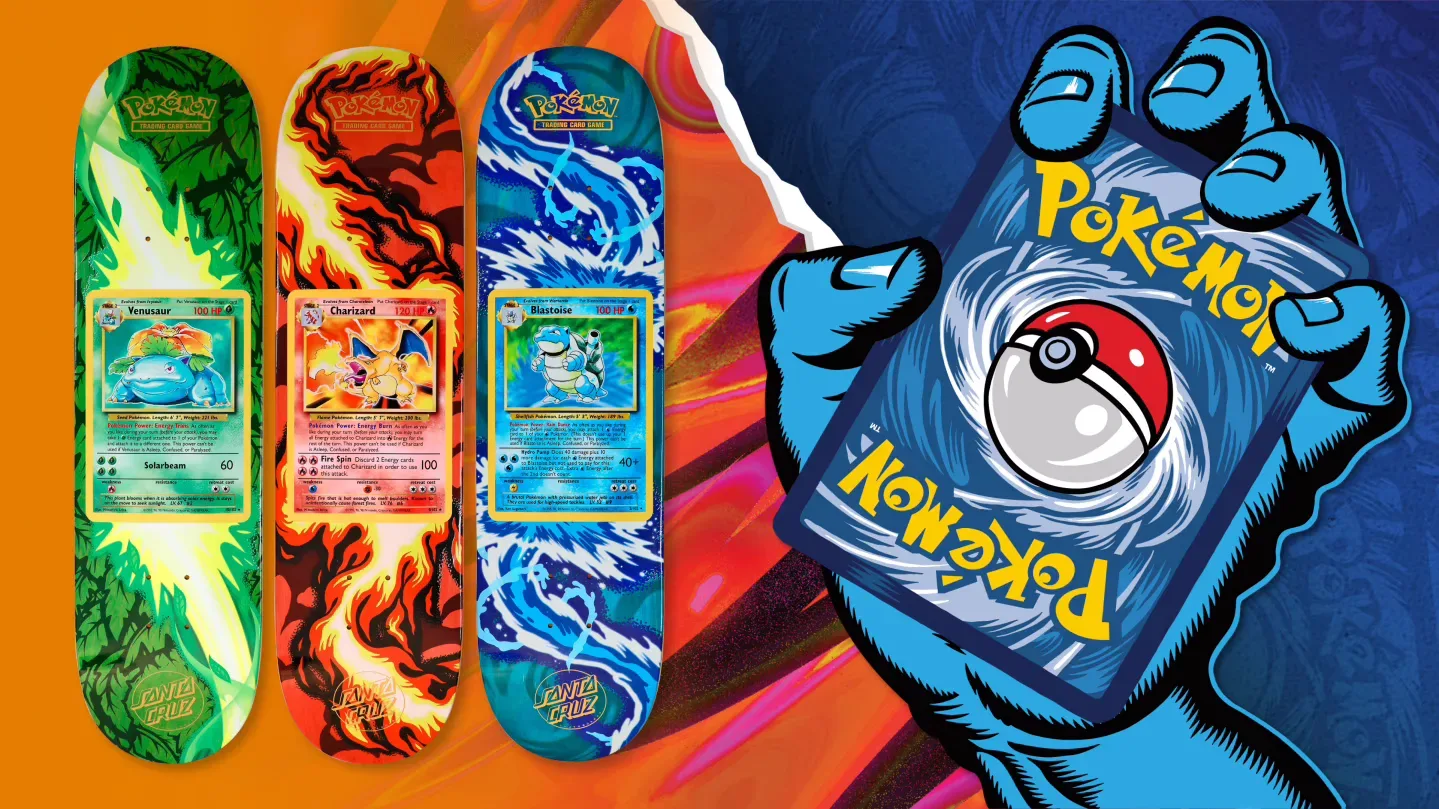
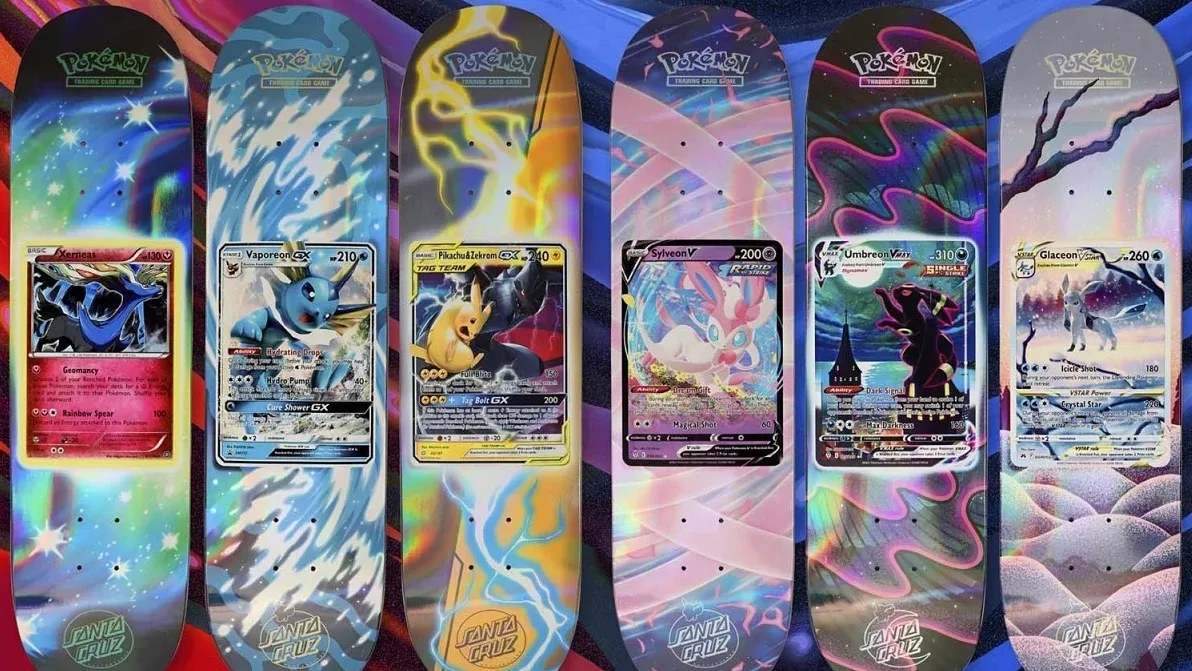
Santa Cruz has released a limited Pokémon deck series built around 30 different pieces of Pokémon Trading Card Game artwork. Buyers were asked to pay $140 without knowing which design they would receive. The stock has already sold out across the United States and United Kingdom, as well as the Canadian and Australian stores, despite a one-per-customer purchase limit.
It is an unusual retail proposition even by the standards of modern collectibles. A skateboard deck is normally an object where the exact graphic matters enormously to the purchaser. Here, the graphic is the mystery. The product turns the familiar booster-pack reveal into a large-format display item, with all the tension—and all the uneven outcomes—that entails.
For collectors who want one particular Pokémon or one particularly celebrated card illustration, the blind-bag format shifts the purchase away from choosing an item and toward accepting a one-in-30 shot. That distinction is the whole story behind the sellout, and behind the rapid split in secondary-market asking prices.
Thirty card-art designs, not thirty equal outcomes
The lineup reaches across several eras of the Pokémon TCG. Early Base Set favorites Venusaur, Blastoise and Charizard are included, while other decks draw from Team Rocket’s Dark Espeon, Plasma Storm’s Lugia EX, XY Flashfire’s M Charizard EX, and the Umbreon VMAX image popularly known as “Moonbreon” from Evolving Skies. Pikachu & Zekrom from Team Up also appears in the range.
That is a potent selection of recognizable imagery, but the 30-board set also contains designs with less collector heat. Sylveon V from Evolving Skies and the Vaporeon GX promo are examples of card designs whose underlying singles have been described as selling for around $5. Their presence does not make the decks inherently poor-looking or unusable, but it demonstrates why buyers cannot treat every sealed bag as though it has the same practical value after opening.
A blind product creates two separate markets:
- Sealed bags: Buyers are purchasing uncertainty, potential, and the ability to conduct the reveal themselves.
- Opened, identified decks: Buyers can target a specific Pokémon, card era, artist-driven image, or high-demand design.
That divide is well understood in trading cards. A sealed booster can contain a chase card, but it can also contain something far less coveted. Santa Cruz’s collaboration transfers that logic onto a product that is much bigger, harder to store, and potentially intended to be ridden. The purchase is still one board; what varies is how likely that board is to match the buyer’s taste or resale hopes.
Related coverage includes Pokémon Santa Cruz Blind Bag Skateboards Sell Out as Resale Prices Surge.
Why the card connection matters
Calling these “Pokémon skateboards” only tells half the story. Their appeal is specifically tied to the visual and collecting history of the Pokémon TCG. The decks use established card art rather than merely placing character logos on standard skateboard graphics. That gives a buyer several possible reasons to care: affection for a particular Pokémon, nostalgia for a set, admiration for a familiar illustration, or interest in a card that has become a collecting landmark.
Moonbreon is the clearest illustration of that effect. The Umbreon VMAX from Evolving Skies has developed a formidable reputation among modern Pokémon collectors, and the underlying card has been cited at around $2,300. The skateboard version is not that card, does not confer ownership of it, and should not be confused with it. But the association gives the Umbreon deck immediate cultural cachet among people who know why the image is important.
Likewise, Base Set Charizard is not simply another orange Pokémon graphic. Charizard has long been a focal point of Pokémon card collecting, so using its Base Set art carries a meaning that stretches beyond the deck itself. That familiarity helps explain why a series can contain a broad mix of designs but still have a small cluster of obvious chase outcomes.
Pokémon’s ability to make a graphic instantly legible across games, cards and physical merchandise remains unusually broad. The same long-running Nintendo nostalgia that keeps old mysteries and iconography in circulation can be seen in conversations around other classics, including the enduring speculation around Super Mario 64’s castle plaque. In this case, though, the nostalgia is being sold as a randomized object rather than a game-world secret to solve.
Sold out does not mean every deck is worth the same
The initial run disappeared quickly from the Pokémon Center and Santa Cruz storefronts, and notification options for possible restocks remain available. A sellout confirms strong demand for the release at the available retail supply; it does not establish a permanent price for every individual deck.
Early resale listings underline that point. Sealed bags have appeared around $300, while one Jolteon ex example was listed at $212. Listings for Pikachu & Zekrom and Mega Charizard EX have reached at least $600. Base Set Charizard listings have stretched as high as $1,800, though reported sales have ranged as low as $400 and more often around $500 to $800. The Umbreon/Moonbreon deck has appeared in the roughly $500-to-$800 range.
The important word throughout is listed. An asking price is what a seller hopes to receive, not evidence that a buyer has paid it. Even completed sales are snapshots rather than guarantees, particularly during the first rush after a sellout. A high-profile design may bring bids that a more common or less desired deck cannot match, and the existence of a $1,800 listing does not set the market for every Charizard deck.
The same caution applies to sealed bags. A sealed deck has a different proposition from a revealed one: it preserves the suspense and the chance at a desired graphic, but it also leaves the buyer with the possibility of receiving a design they would not have selected at retail. Paying a premium for that uncertainty only makes sense if the buyer values the sealed experience itself or is comfortable with every possible outcome.
What “blind bag” changes for buyers
Blind packaging is often associated with small collectibles, where a duplicate may be irritating but relatively inexpensive. At $140 per deck, the calculation is far more consequential. A buyer seeking one or two of 30 designs is not simply deciding whether they like the collaboration; they are deciding whether they can tolerate the chance of landing any of the other 28 or 29 graphics.
There is no supplied rarity breakdown indicating that particular designs were printed in different quantities. That means collectors should avoid assuming that the most coveted decks are officially rarer simply because they command larger resale prices. Demand, design recognition, and the card art’s existing reputation can produce a large price gap even if the physical quantities are identical. Until verified production information exists, “rare” and “expensive” should not be treated as interchangeable.
There is also a difference between a functional deck and a display collectible. Someone buying to skate may prioritize deck shape, setup plans, or simply a design they enjoy. Someone buying to display may care most about condition, the sealed bag, and the identity of the art. Someone buying mainly for resale faces the most unpredictable version of the transaction: a premium-priced product whose appeal is concentrated in a subset of designs and whose resale market is still being established.
Practical checks before buying aftermarket
- Decide whether you want a surprise or a specific design. If only one Pokémon or card image will satisfy you, an identified deck is generally a clearer purchase than a sealed bag.
- Separate sold prices from asking prices. A dramatic listing can be informative, but it is not proof of market value.
- Do not equate card value with deck value. The skateboard is a separate collectible with its own demand, condition concerns and supply.
- Check what is actually being offered. A listing may be for a sealed blind bag, an opened deck with a named design, or merely a pre-sale-style promise. Those are not equivalent.
- Factor in the purpose of the deck. Display, collecting and riding can lead to very different ideas of acceptable condition and acceptable price.
A collaboration designed around the chase
The sellout shows that the booster-pack idea can travel surprisingly well beyond cards. Santa Cruz and Pokémon have used one of the TCG’s defining sensations—the reveal—to make the purchase decision part of the collectible. That is clever as a piece of product design, but it also makes the result less consumer-friendly for anyone with a very specific favorite.
For a person who would be delighted by any of the 30 boards, the sealed $140 format offers a themed surprise with a substantial physical keepsake. For a person who only wants Base Set Charizard, Moonbreon, Pikachu & Zekrom, or another key graphic, the format effectively adds a randomized toll before they can reach their target. The subsequent resale market then offers the opposite: less mystery, but potentially far higher cost.
That tension is why the decks are attracting attention. They are not just skateboards and not just reproductions of card art. They are a physical collectible engineered around a familiar chase mechanic, where the thrill of not knowing is also the main risk. With stock already gone at retail and prominent designs commanding steep early premiums, collectors now have to choose which part they value more: the sealed surprise, or the certainty of the board they actually want.
Shop the products
Check current price, model and availability at the retailer.