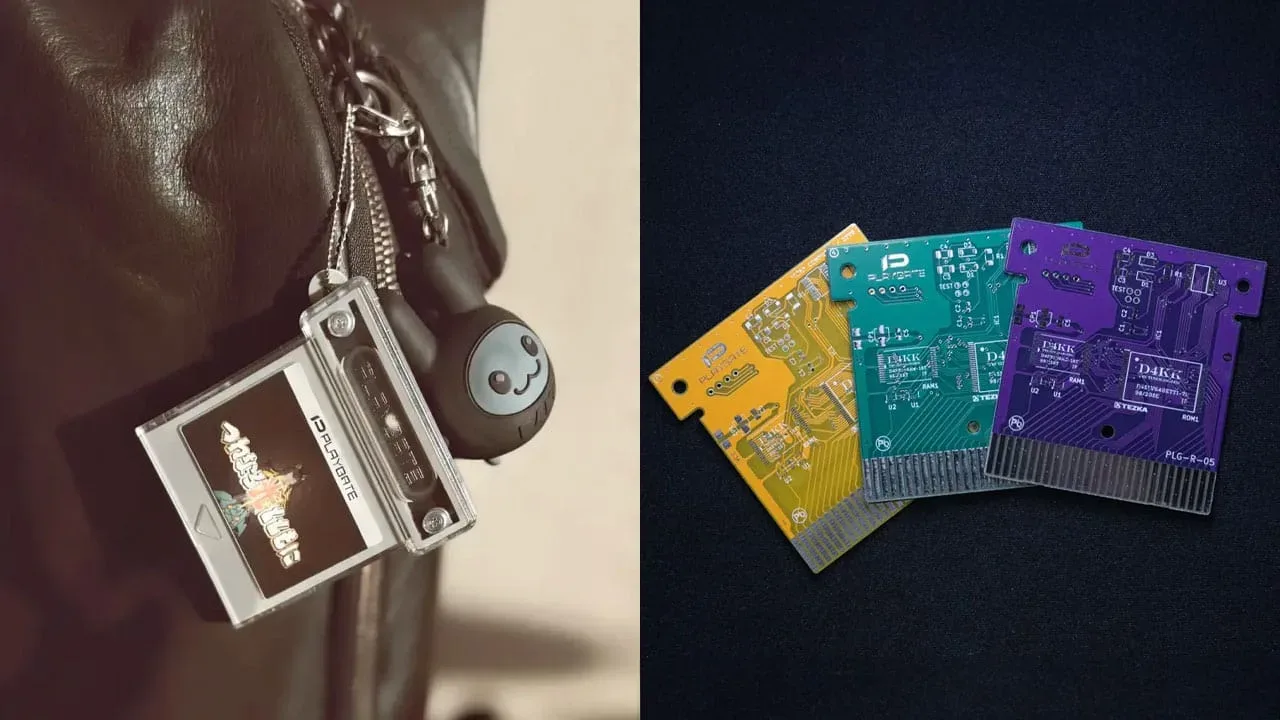
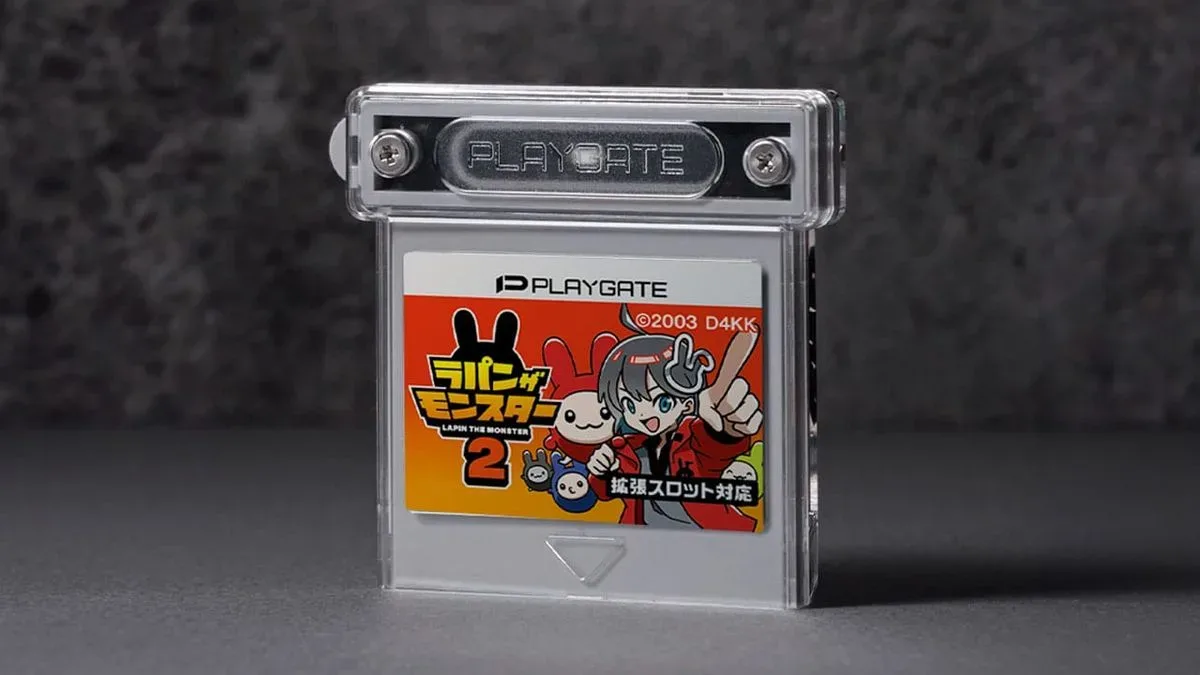
A fictional handheld has gained a rather tangible accessory. Japanese company Daiyonkyokai has created a cassette craft kit built around the PlayGate, an invented portable console that previously appeared in one of the company’s augmented-reality projects.
The kit is designed to let people make their own miniature PlayGate cartridges: decorative objects that can be displayed, attached to keys or worn as accessories rather than inserted into an actual commercial game system. It includes materials for replica cartridge artwork, coloured circuit boards and NFC chips, giving the finished pieces more of the visual language of old handheld games than a simple paper craft.
That is a wonderfully specific niche: fictional hardware for people who miss the small, chunky, label-covered objects that used to sit in pockets, backpacks and under sofa cushions. The PlayGate does not need to be a real console for its cartridge format to trigger that particular collector instinct. A tiny plastic rectangle with art on the front and a pretend circuit board inside is apparently enough to make the brain start organising a display shelf.
What the PlayGate kit is actually for
The clearest purpose is customization. Rather than reproducing an official cartridge from an established game library, the package lets the owner create a one-off PlayGate cassette. The appeal is in choosing or making artwork and assembling an object with the proportions and presentation of a retro portable game.
That makes it closer to a craft collectible than a replacement game cartridge. A finished cassette could work as desk décor, a keyring piece or jewelry-like accessory. Its appeal also comes from the opportunity to invent the game that supposedly lives inside: a title, a label design, a colour scheme and perhaps the imaginary story that goes with it.
The source material compares the object’s look to Game Gear-style cartridges, while also framing it as a companion to the made-up PlayGate. That distinction matters. The kit is drawing on familiar cartridge aesthetics, but the PlayGate itself is its own fictional setting rather than a newly uncovered piece of gaming hardware.
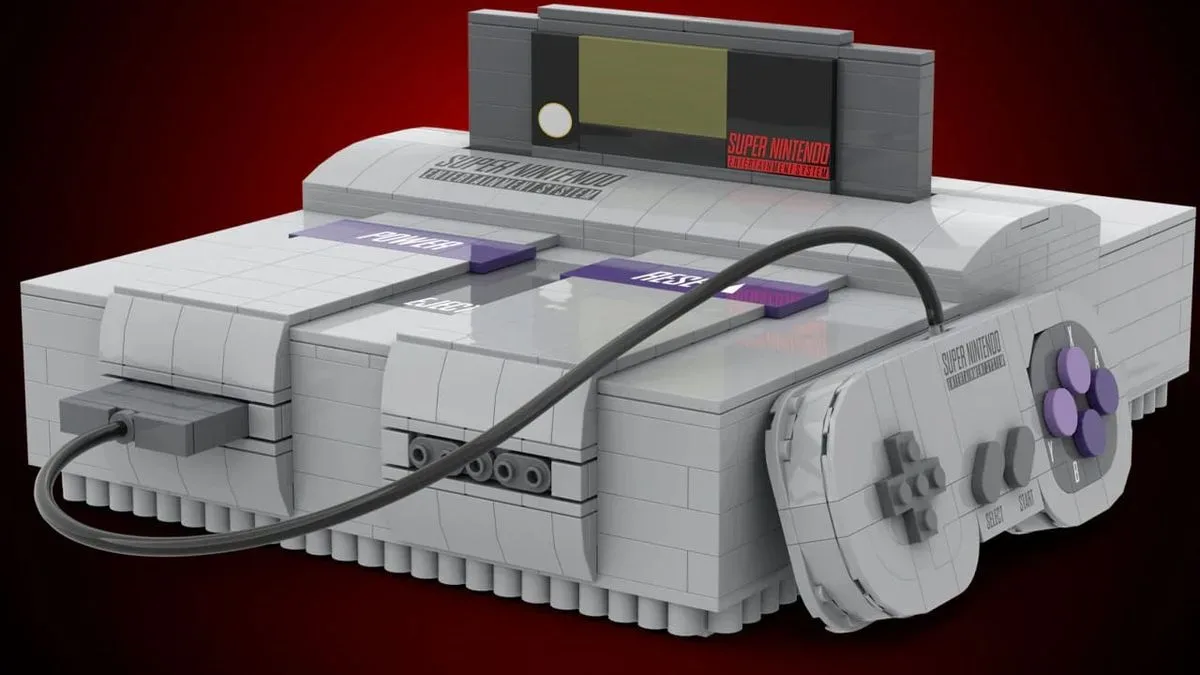
For a different kind of retro-game construction project, see this LEGO Ideas SNES concept, which similarly turns affection for old hardware into a display-focused object.
The NFC question needs some caution
The inclusion of NFC chips is the detail likely to make people look twice. NFC, or Near Field Communication, is a short-range wireless technology commonly used when devices exchange small pieces of data at close distance. The presence of NFC hardware can make a crafted cartridge feel more interactive than a purely decorative prop.
Related coverage includes PlayGate Craft Kit Turns Fictional Handheld Cartridges Into Custom Collectibles.
However, the supplied information does not establish a supported consumer feature, a compatible PlayGate device, or a confirmed method for loading and playing commercial games. Claims that the replicas could hold games are presented as theoretical speculation, not as verified functionality or an advertised use case.
That uncertainty is important for both practical and legal reasons. A chip being present does not, by itself, explain what data it carries, what software can read it, or whether it performs any gameplay-related role at all. It is therefore safest to view the NFC element as part of the kit’s interactive design concept unless Daiyonkyokai provides clearer technical documentation.
It is also not a reason to assume the kit authorizes copying or sharing copyrighted games. The craft set’s documented appeal is its physical customization, and that is where its most distinctive value lies anyway. Plenty of hobby projects are more interesting because they invite a person to make an imaginary game artefact rather than duplicate a real one.
A collectible built around invented nostalgia
There is an unusual charm to memorabilia for hardware that never existed as a retail console. Traditional retro collecting is often about recovering real objects from the past: a cartridge, a box, a controller or a machine tied to a particular era. The PlayGate kit reverses that impulse. It offers the sensation of discovering a forgotten format while openly admitting the format is fictional.
That can be liberating. No one needs to argue over an original label, hunt for a complete-in-box copy, or worry that a display piece is too rare to handle. The object is meant to be made personal. A deliberately absurd game title, handmade art and an unexpected circuit-board colour are not defects; they are the point.
The approach also leaves room for people who love the material culture of older games without treating every cartridge-shaped object as an investment. A custom cassette can be a small creative project first and a collectible second. In a hobby often dominated by scarcity, that is a refreshingly low-stakes proposition.
Availability appears to have been limited
The kit was reported to have been available at a pop-up event held at ZAspace Daikanyama in Japan on November 21. Based on the available details, there is no confirmed wider release, restock or official online purchasing route.
That means interested collectors should be careful about treating resale listings as a sign of a broader launch. Limited event items can command inflated asking prices quickly, particularly when they combine a niche creator, a physical craft component and retro-gaming-inspired design. An asking price is not proof of rarity, condition, completeness or future value.
Anyone who encounters one should also check what is actually included. The appeal described here depends on the craft materials, artwork components, coloured board and NFC element; a loose finished cartridge may not offer the same experience as a complete kit. Since the product’s interactive capabilities remain unclear, buyers should avoid paying extra for claims about playable content unless those claims are independently and specifically documented.
Why this odd little kit stands out
PlayGate cartridges sit in a sweet spot between prop-making, wearable design and retro-game nostalgia. The kit is not asking players to preserve an old game library. It is asking them to build evidence of a game library that exists only in the imagination.
That is a neat trick for a collectible. It gives the owner a familiar object with none of the historical baggage of a real cartridge, then adds enough hardware-like detail to make the fiction feel convincingly physical. Whether a finished PlayGate cassette ends up on a desk, a set of keys or a necklace, its strongest feature may be the story its maker chooses to put on the label.