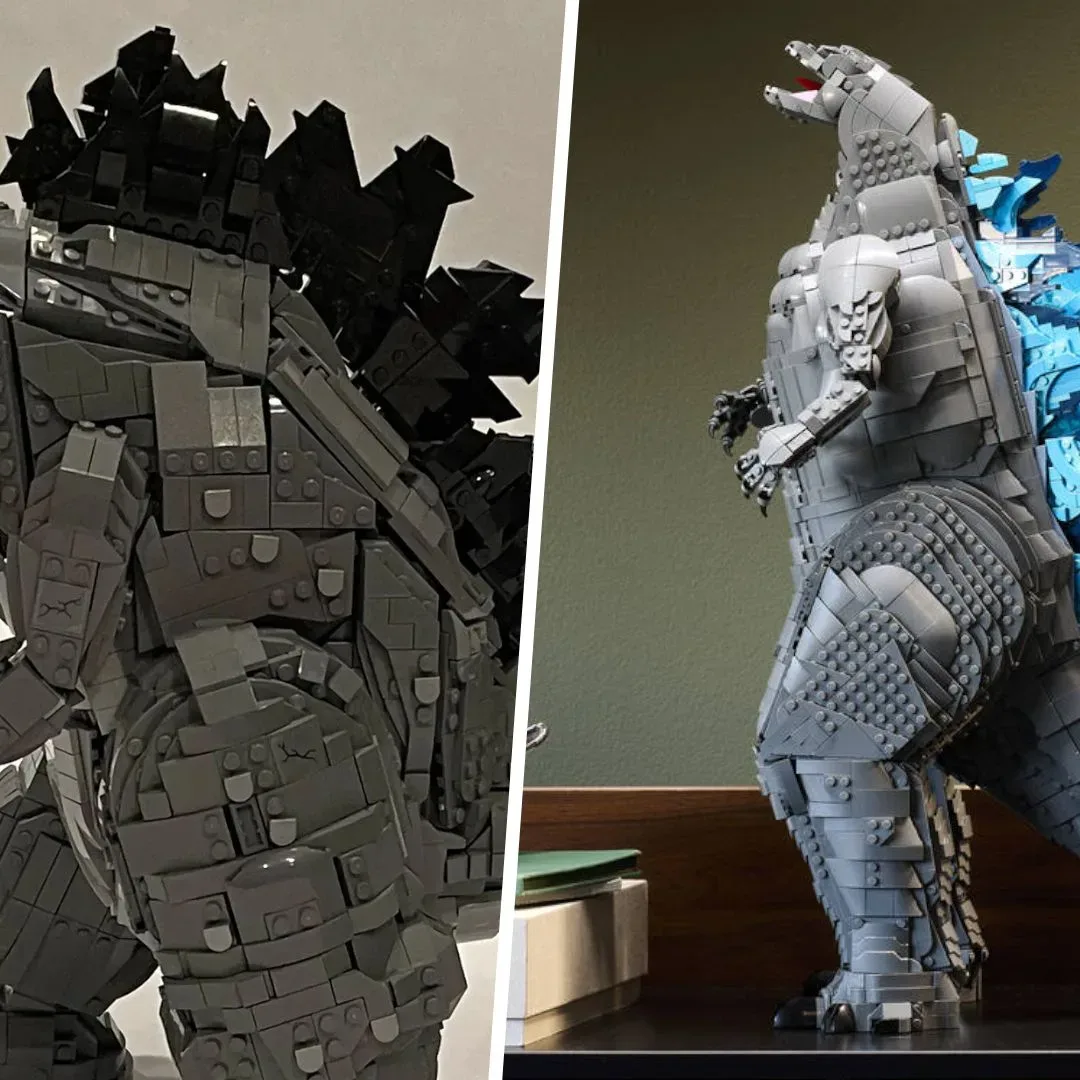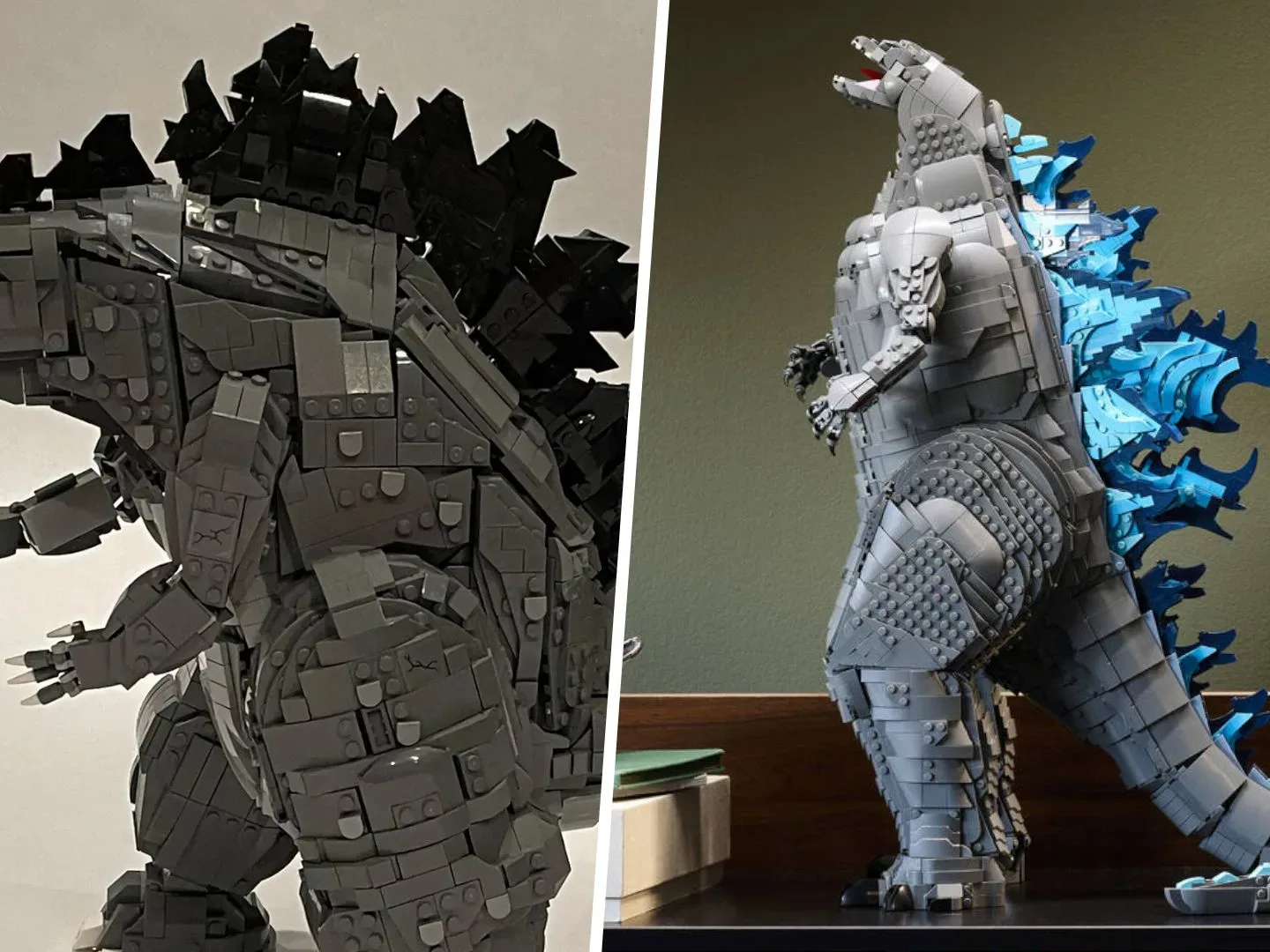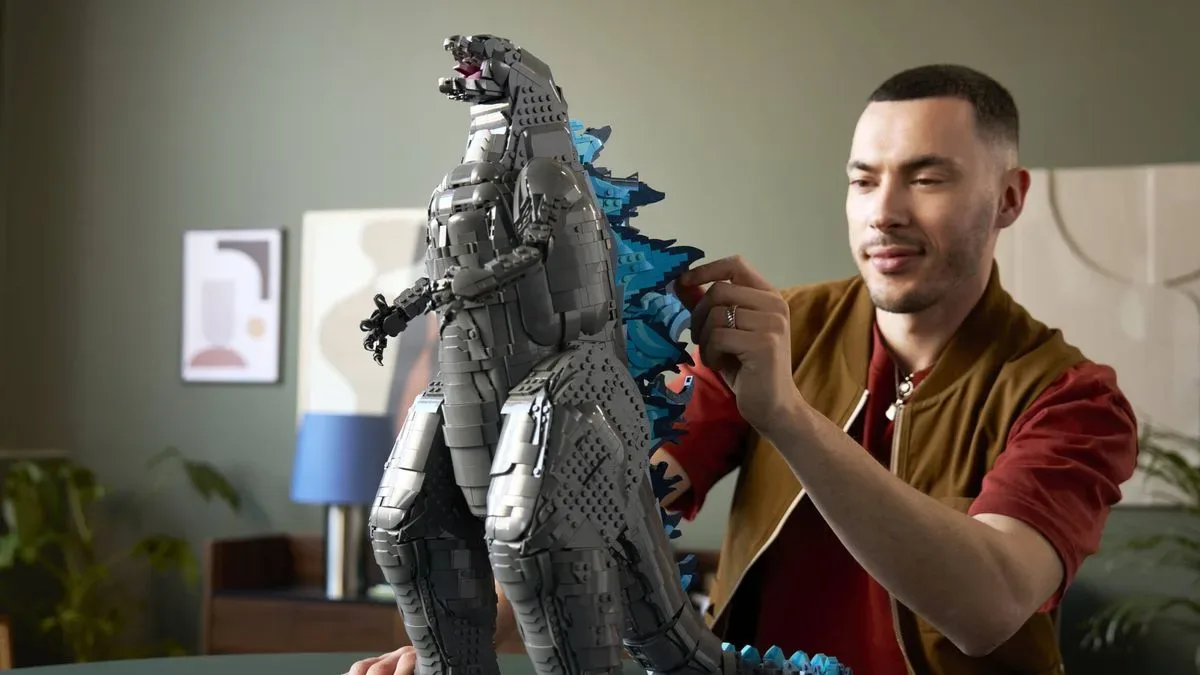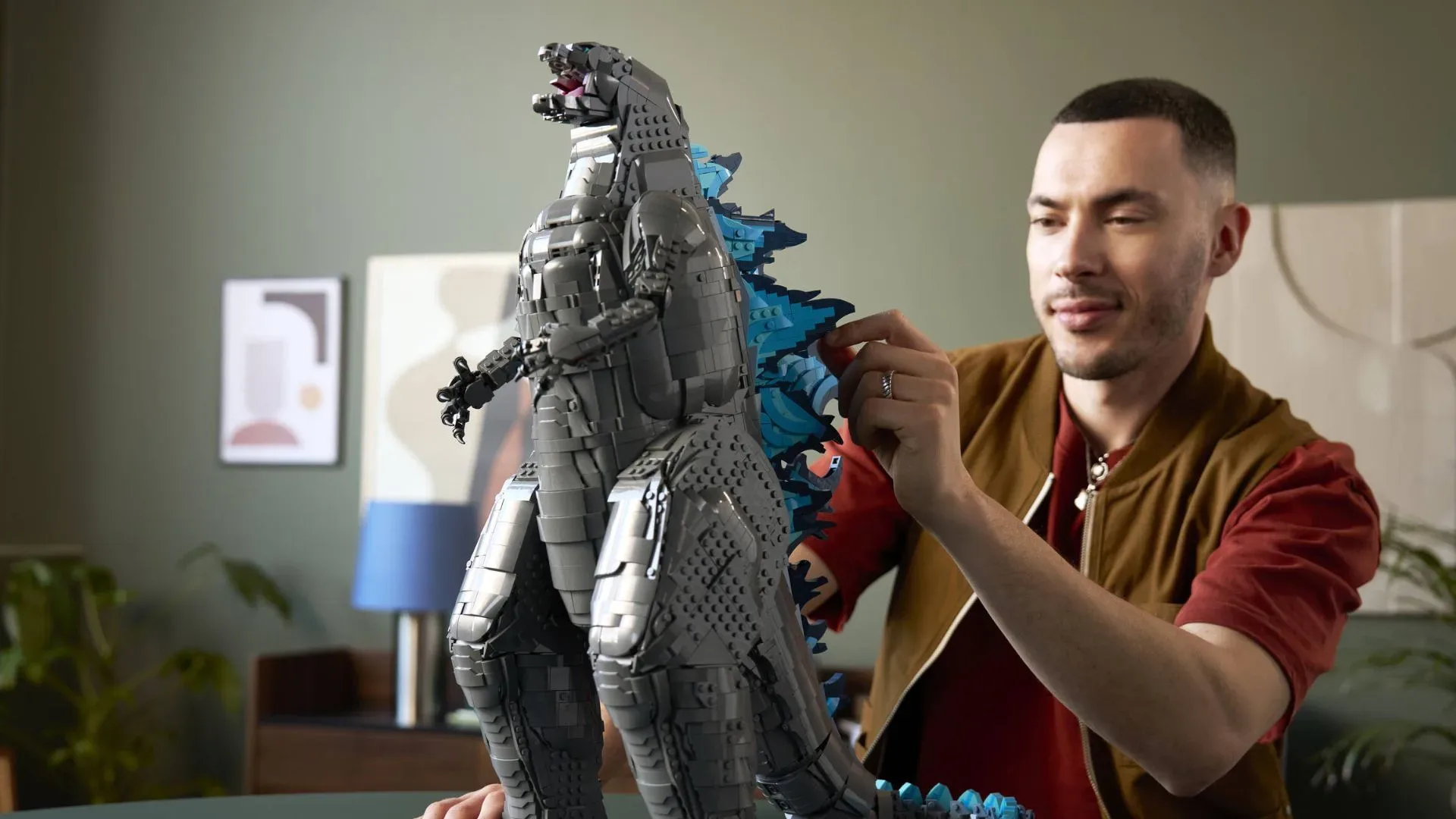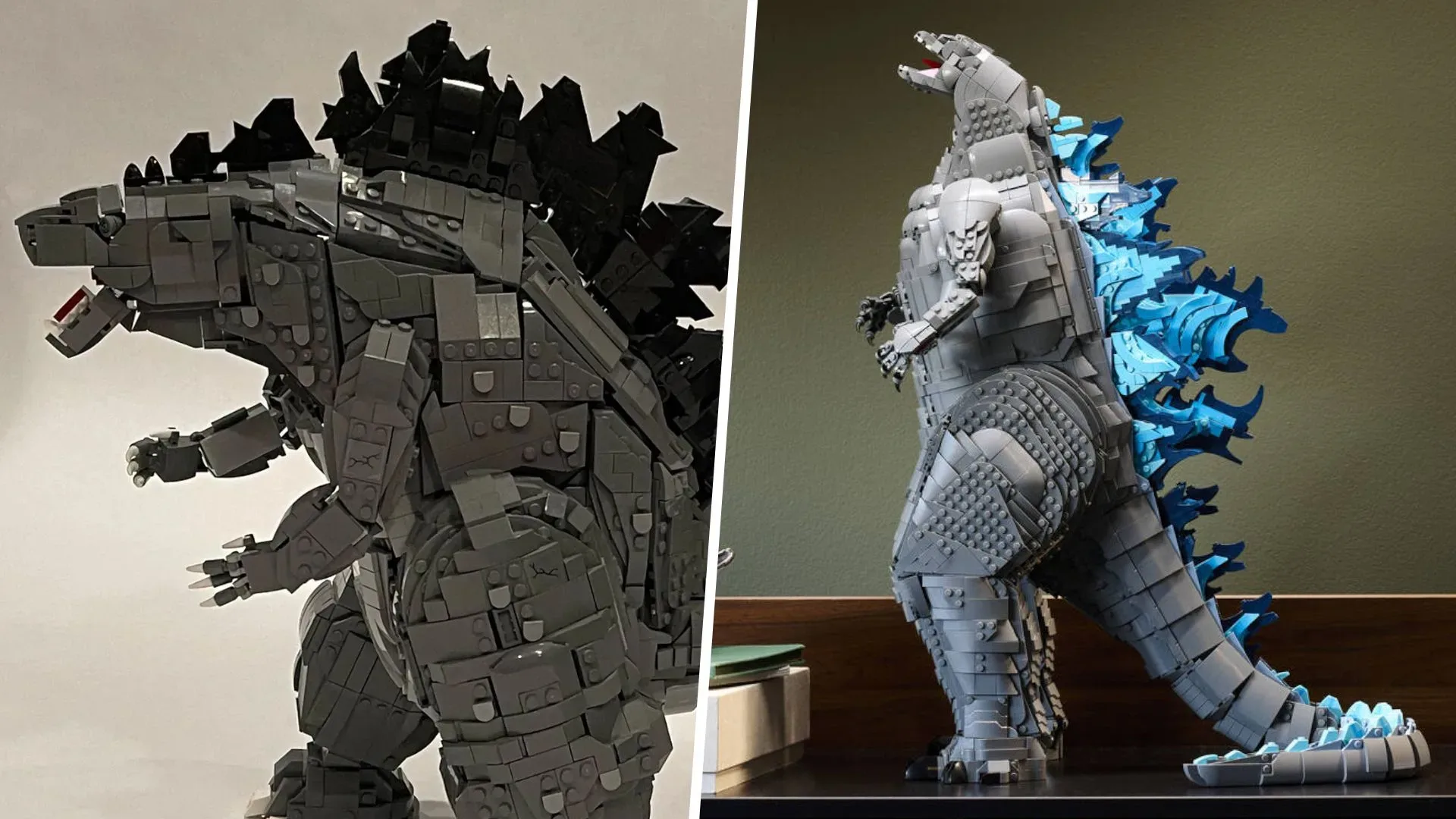
Godzilla has made the jump from community concept to official brick-built colossus, but the finished model is not a simple one-for-one conversion of the fan submission that helped put it on the path to production. The officially revealed LEGO Godzilla is a 5,364-piece display build measuring 27.5 inches tall when its Heat Ray effect is included, and it takes a much more theatrical approach to the character than the original design.
The common thread is clear: both versions draw on the broad, heavy-set Monsterverse interpretation of the King of the Monsters. Yet the official model narrows that inspiration to one dramatic screen-like moment—Godzilla standing upright and firing its nuclear breath into the sky. That decision changes almost everything a viewer notices first, from the silhouette and balance of the body to the treatment of the dorsal spines and eyes.
The set is listed for release on November 27. LEGO describes it as its largest creature figure to date, a designation supported by the considerable jump in piece count over the community-built proposal.
The Monsterverse foundation remains
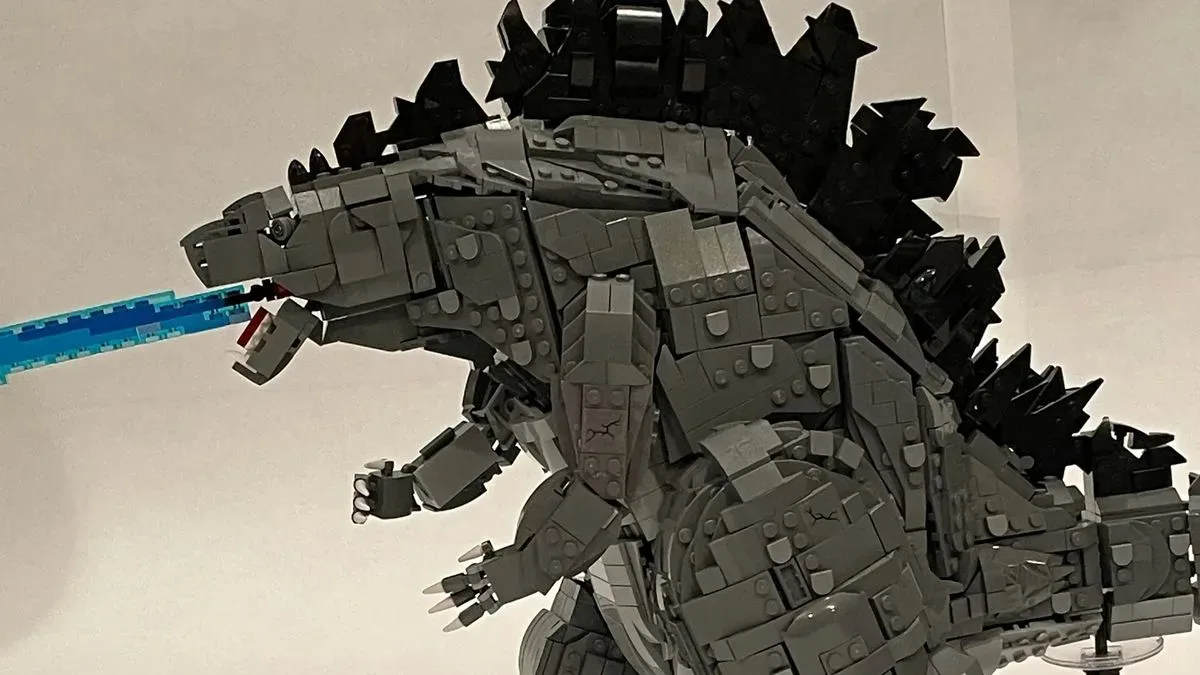
The original project was created by community builder Matthew Esposito, also known as MattE720, and reached the vote threshold in the LEGO Ideas program needed for consideration as an official product. The design was based on the Monsterverse version of Godzilla, the incarnation seen in films including Godzilla vs. Kong and The New Empire.
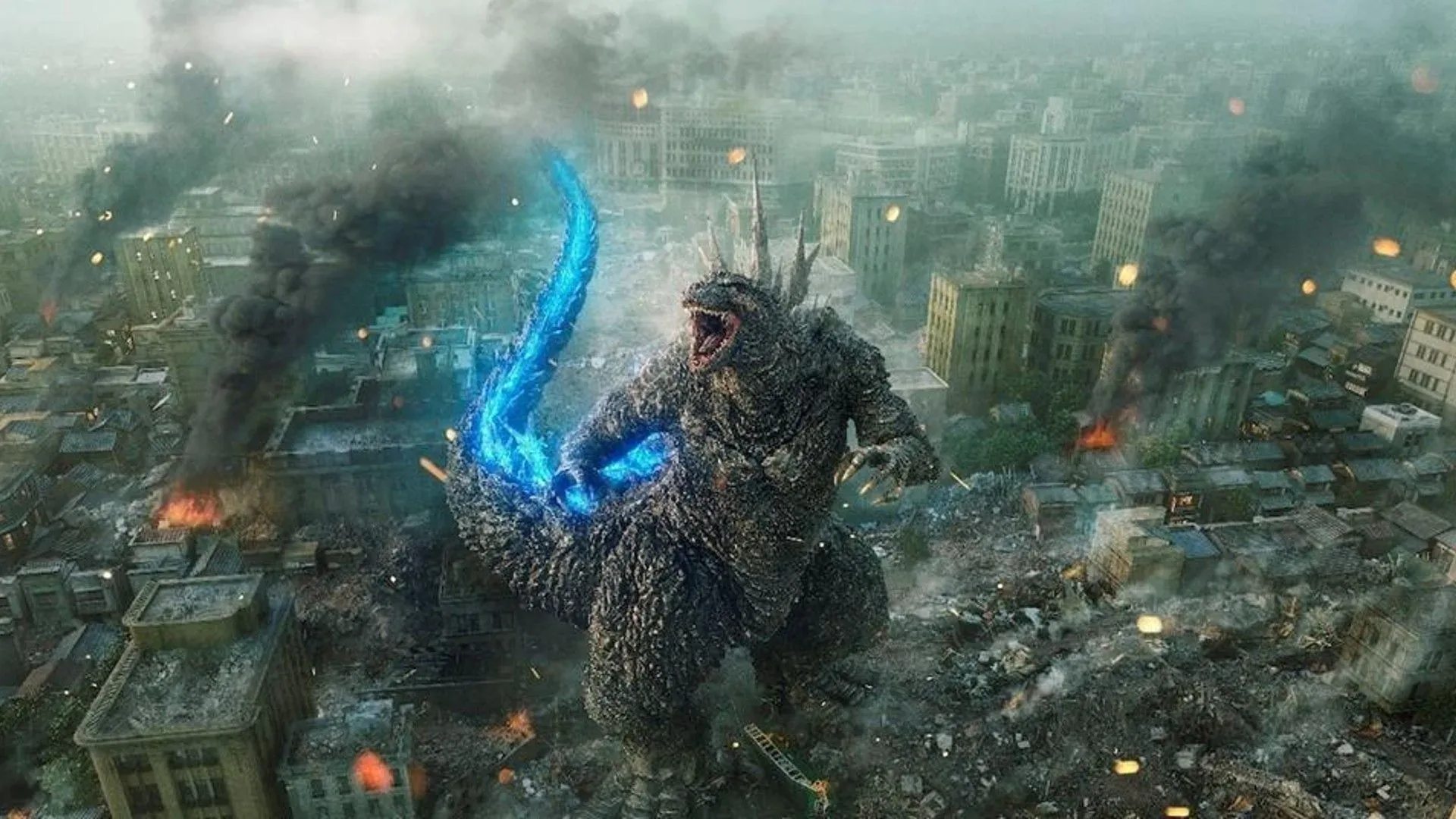
That distinction matters because Godzilla’s look differs substantially among film continuities. The Monsterverse creature has a particularly weighty build: a thick torso, immense legs, a comparatively squat overall profile and a powerful tail. Those traits are well suited to a large LEGO sculpture because they offer broad areas for layering plates, slopes, hinges and other elements to suggest muscle, scales and armor-like texture.
“Creature figure” here means a build whose main purpose is to represent a character or animal as a sculptural model, rather than a playset centered on rooms, vehicles or minifigure-scale action. In practical terms, the official Godzilla’s size and part count place it firmly on the display side of that divide.
The official build still preserves the core Monsterverse identity selected by Esposito. It has not pivoted to the leaner visual language of older Toho-era portrayals or the more recent Minus interpretation. Instead, the major evolution is in how that same version of Godzilla is staged.
A new pose creates a different silhouette
Esposito’s concept presented Godzilla in a more familiar forward-leaning stance, the kind of posture associated with a creature advancing through a city. The official version straightens the body and directs the head upward, depicting Godzilla unleashing a nuclear breath attack into the sky, as seen in Godzilla: King of the Monsters.
That is more than a cosmetic adjustment. A silhouette is the recognizable outer outline of a character or object, and it is especially important for a creature that needs to read clearly from across a room. A hunched Godzilla emphasizes forward momentum: the torso, head and tail create a more horizontal line. The official upright pose shifts attention upward. The extended Heat Ray becomes part of the composition, and the creature reads as a towering display centerpiece rather than a monster caught mid-stalk.
The change also explains the headline height. The official measurement includes the Heat Ray, so it should not be read as the height of the body alone. Still, 27.5 inches is an imposing vertical footprint for a brick-built creature, and the full model appears substantially taller than the earlier proposal. The initial fan design was already ambitious at an estimated 2,500 to 3,000 pieces, but the official version reaches 5,364.
That scale increase is not just a numbers contest. More pieces can give a designer more room to refine contours, vary surface texture and shape transitions between body sections. The available information does not provide a full technical breakdown of the construction, so it would be premature to make claims about articulation or internal support. What the visible design does show, however, is a model with enough scale to prioritize a more elaborate, deliberate pose.
Blue lighting replaces a mostly monochrome finish
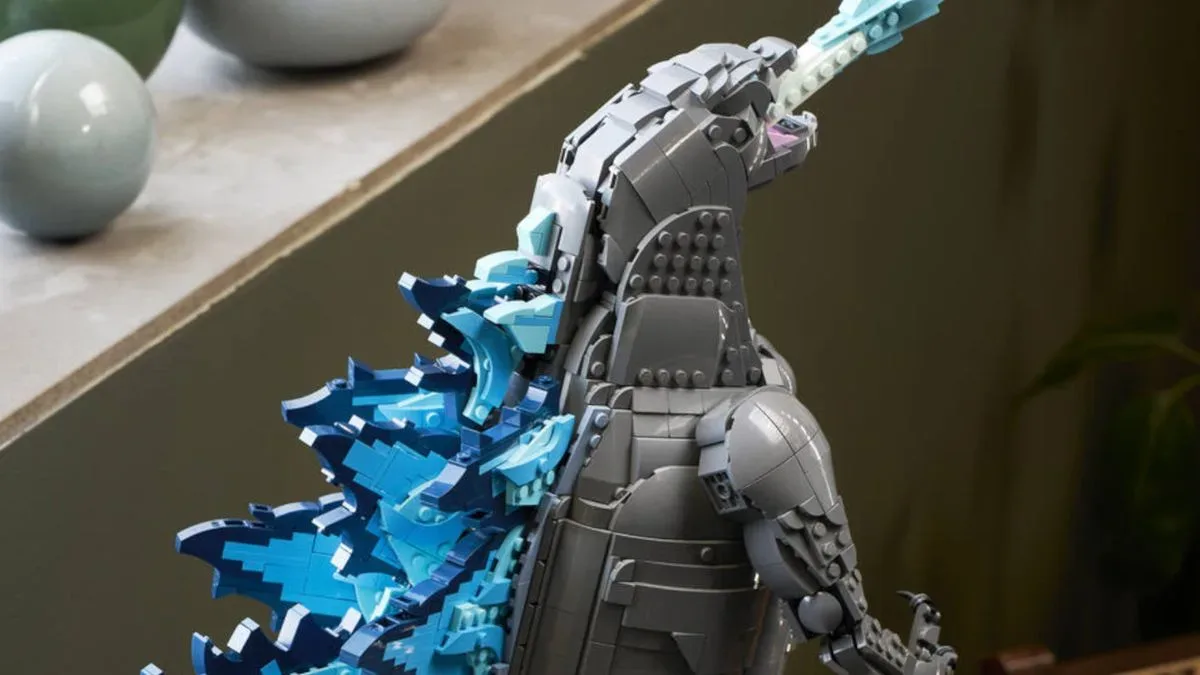
Color is one of the clearest visual departures. The community model used a dark gray body with black spines, an approach that aligned with a shadowy, neutral Godzilla palette. The official model lightens the gray of the body and turns the dorsal spines vivid blue, with matching blue eyes.
The blue treatment is tied directly to the Heat Ray pose. Rather than simply using a different color for contrast, it visually suggests energy moving through Godzilla’s spine as the attack is fired. This helps the model communicate its specific scene even when seen without context.
It also makes a practical display difference. Large gray-and-black builds can have plenty of shape up close but appear as a single dark mass at a distance, particularly in ordinary indoor lighting. Bright blue elements split the body into more readable zones: gray mass for the creature, blue highlights for the charged attack state. The official set’s color choices therefore serve both the screen reference and the legibility of a large shelf display.
The eyes take a similar route. The original design used printed or sticker-based eye details on studs, while the official model gives the eyes a distinctive blue appearance. Tiny facial details carry outsized importance in a sculpture of a famous character. Even when viewers cannot inspect every brick, eye color helps establish the expression and reinforces the idea that the creature is actively channeling energy.
The mouth effect is designed to be placed in Godzilla’s jaws. Alongside the illuminated-looking spines, it gives the entire build a single visual direction: upward and outward. The fan concept communicated a Monsterverse Godzilla with an energy attack; the finished design commits more strongly to the instant immediately before or during its release.
Official proportions favor Godzilla’s massive lower body
The official model’s head and arms appear smaller relative to the body than the same features on the original fan design. This may partly be an effect of the model’s greater overall scale, but it also brings the proportions closer to the source creature’s notably bottom-heavy frame.
Godzilla’s enormous legs and torso do much of the character-recognition work in this version. Enlarging those areas while holding the head and arms in check produces a more monumental look. It is a useful reminder that accuracy in a character model is not always about enlarging every recognizable component. Sometimes the more convincing result comes from emphasizing the most dominant shapes and letting secondary features recede.
For builders, this is also an illustration of the difference between a fan model and a finalized retail set. A fan design proves that a subject can be made compellingly in bricks. An official adaptation can then revisit its pose, scale, color and proportions to pursue a distinct display goal. The final model is therefore best understood as an adaptation of the proposal’s central idea, not a promise to reproduce every one of its decisions.
What the 5,364-piece count means for display-minded fans
A 5,364-piece build demands space and time before it becomes a display object. The 27.5-inch quoted height includes the Heat Ray, but anyone considering the model will still want to account for its full pose, tail and surrounding clearance rather than measuring a shelf only by the vertical figure. The upright composition may make it visually efficient in one direction, yet a creature this large will remain a substantial presence.
Its scene-specific design is likely to be a strength for collectors who want a centerpiece rather than a general-purpose Godzilla statue. The raised head, energized spines and skyward attack form a coherent image. On the other hand, people who preferred the fan project’s lower, stalking profile may see the official rendition as a different interpretation of the same screen monster rather than a direct upgrade in every respect.
Neither response requires treating one design as invalid. The two builds are solving different visual problems. The community design focused on a hulking Godzilla in a conventional monster posture. The official set turns the same basic incarnation into a frozen action tableau, using brightness and verticality to make the moment instantly recognizable.
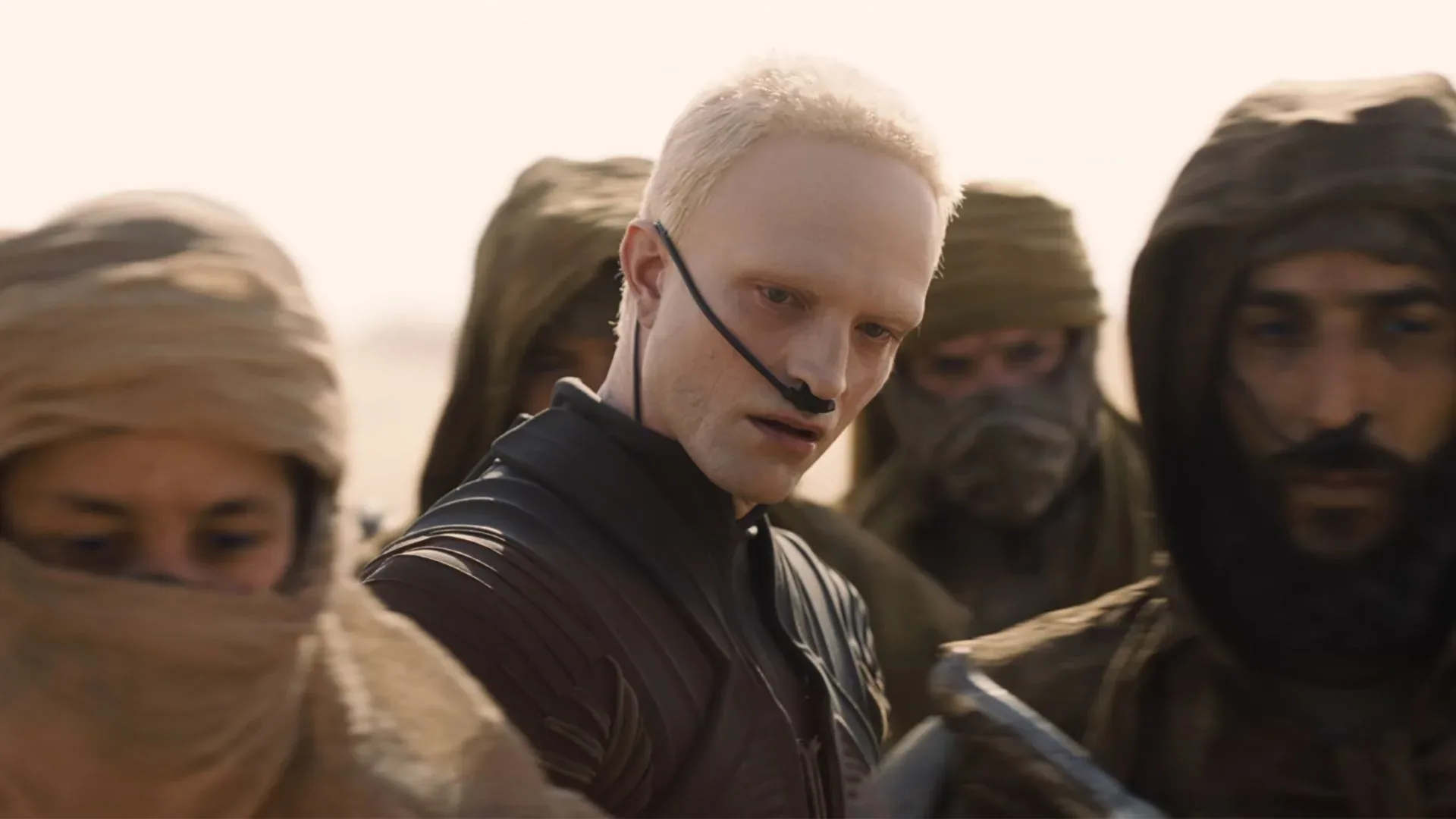
Large physical recreations of movie creatures often face the same basic challenge: they must decide whether to depict a neutral character model or one defining dramatic instant. For another example of how sheer scale can become part of the appeal of a screen-creature build, see this report on a 350-foot sandworm model used for Dune 3. LEGO Godzilla is obviously a very different kind of object, but it similarly makes scale central to the experience.
The Ideas path remains central to this release
The final set’s differences should not obscure the role of the original submission. Without Esposito’s Monsterverse-focused concept earning enough support through LEGO Ideas, there would be no direct before-and-after comparison at all. The finished product retains the essential premise: a large brick-built Godzilla using its nuclear breath attack.
What changed is the degree of spectacle. The official build has nearly doubled the upper end of the fan model’s stated piece estimate, adopted a much taller pose, introduced a more vivid blue energy treatment and adjusted the relative scale of the head and arms. In exchange, it presents one unmistakable cinematic image rather than a broader all-purpose monster stance.
For fans weighing the two side by side, that is the most useful lens. The official LEGO Godzilla is not merely bigger. It is designed to be seen differently: as a towering Monsterverse creature caught in an explosive upward blast, with every major visual choice—from its silhouette to its bright dorsal spines—supporting that singular moment.