The LEGO Super Mario Game Boy is listed at $50, a $10 reduction from its stated $60 usual price. That works out to roughly 17% off for a 421-piece model built around the look of Nintendo’s original Game Boy, with a focus on desk-and-shelf display rather than a working game system.
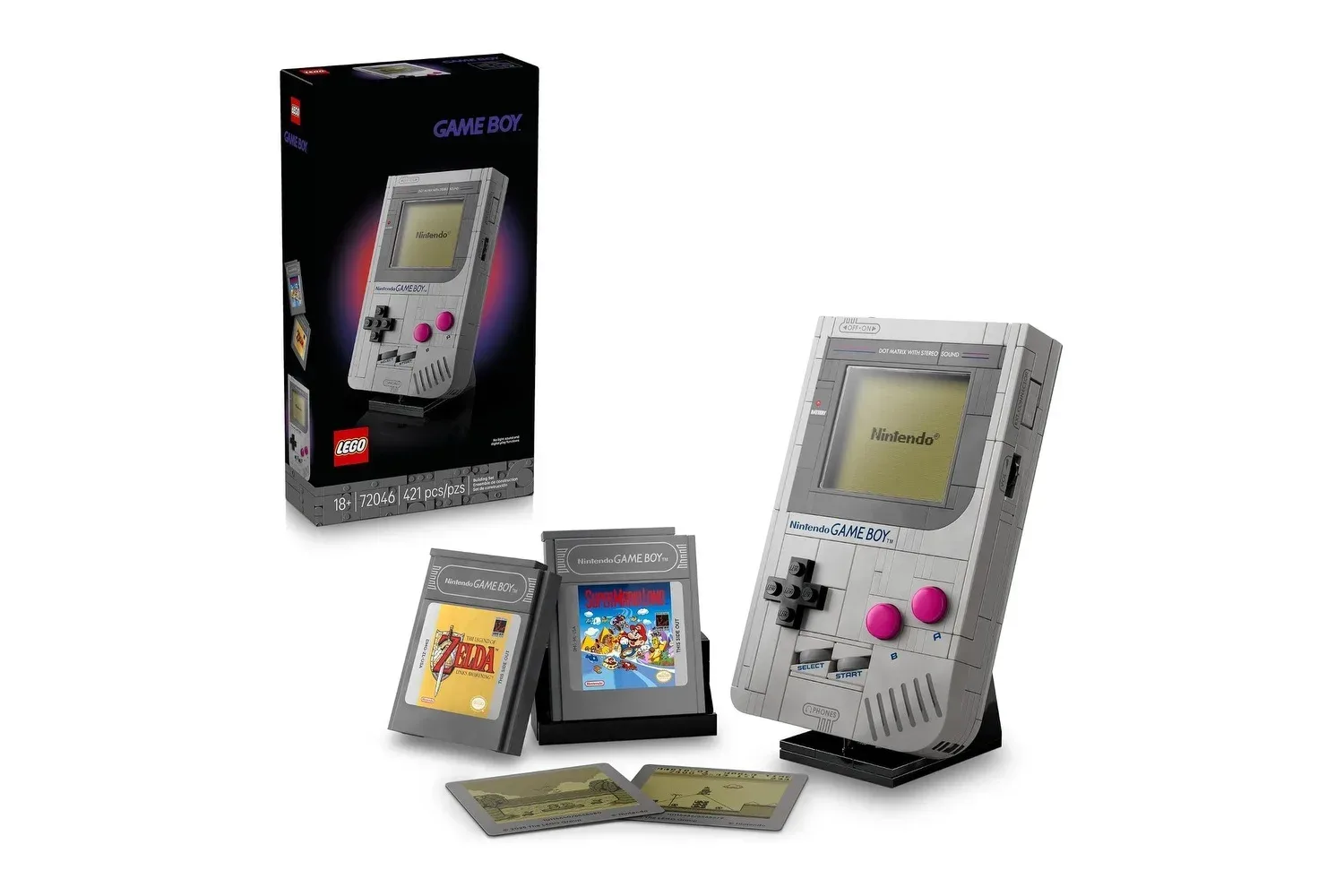
For retro-gaming fans, the notable part is not simply the gray handheld silhouette. LEGO’s model reproduces several of the physical cues that make the Game Boy instantly recognizable: the +Control Pad, A and B buttons, SELECT and START buttons, contrast and volume dials, a Game Pak slot, printed labels, and a rear battery cover. The controls are functional in the literal mechanical sense—they can be pressed or adjusted—but the finished model does not play games.
The set’s interchangeable elements give it more display flexibility than a single static replica. It comes with brick-built versions of Super Mario Land and The Legend of Zelda: Link’s Awakening, along with three swappable lenticular screens. One screen depicts the familiar Nintendo start display, while the others correspond to the two included Game Paks. The $50 listing has been presented as a record-low price; as with any retailer listing, pricing can change.
What is included in the 421-piece build
The completed LEGO Game Boy measures over 5.5 inches high, 3.5 inches wide and 1 inch deep. It is described as nearly 1:1 scale, making it a compact display object rather than an oversized brick-art interpretation. That matters for anyone deciding where it will live: the set is intended to fit on a desk, office shelf, entertainment center or a display cabinet without needing the footprint of a full-sized construction set.
For more context, explore WD Elements 2TB Portable Hard Drive Is Listed at $132, With a Discounted 6TB Model Too.
- A 421-piece, near-full-size brick model of the original Game Boy
- Brick-built Super Mario Land and The Legend of Zelda: Link’s Awakening Game Paks
- Three interchangeable lenticular screen pieces
- A buildable display stand
- Pressable face buttons and adjustable-looking control details, plus printed exterior labels
Both included Game Paks fit into the model’s Game Pak slot. That insertion detail is important because it ties the screen choices to the cartridge on display: a builder can show the handheld with either game installed, or position a Game Pak next to the console using the stand. The stand angles the completed model upward, helping preserve visibility of the screen and control layout instead of leaving it flat against a shelf.
Why the screens create the most visual variety
A lenticular screen is a printed surface designed to change its visible image as the viewer shifts position. In this set, that means the game scenes appear to move when seen from different angles. It is a visual effect, not a powered display, but it suits a replica of a handheld whose original screen was central to its identity.
The practical upside is that the set does not need to remain locked into one configuration after construction. The Game Paks and screens can be swapped, so a collection display can alternate between Super Mario Land, Link’s Awakening, and the Nintendo start screen. That is a useful distinction from a conventional display model with one permanent front panel: the build itself stays the same, while its most visible gaming reference can change.
For readers putting together a Nintendo-themed shelf, this also makes the model an easier visual match for different arrangements. A Mario-focused setup can use the Super Mario Land display; a Zelda grouping can switch to Link’s Awakening. Neither option requires rebuilding the console body.
Display replica first, gaming hardware second
It is worth setting expectations correctly. The LEGO Game Boy faithfully borrows the physical language of a handheld console, including a cartridge slot and moving button elements, but it is not a replacement for original hardware and its Game Paks are brick-built display accessories. The screen effect comes from lenticular printing, not software or electronics.
That clarification helps identify the best audience for the set. It is aimed at people who appreciate the Game Boy as an object of game-design history, LEGO builders looking for a contained evening project, and Nintendo fans who want a recognizable display piece. Someone searching for a way to play the included games would need actual compatible gaming hardware instead.
The design also appears to be considered from multiple viewing angles. The rear battery cover and printed detailing mean it is not solely intended to be viewed straight on. That can matter for open shelving or a desk placed where visitors may see the back or sides, although the front—with the screen, directional control and buttons—remains the centerpiece.
How the $50 price changes the decision
At the stated $60 usual price, the set is a niche nostalgia purchase: a detailed LEGO object for a specific generation of Nintendo fans. At $50, the $10 difference is modest in absolute terms, but it reduces the entry cost while retaining every display component: the console, stand, cartridges and three screens.
Potential buyers should still evaluate it based on what it is designed to do. The strongest reasons to choose it are the recognizable Game Boy proportions, the tactile button and dial details, and the ability to rotate between two game-themed presentations. It is less suitable for someone who wants an electronic replica, a large-scale centerpiece, or a build whose appeal depends on complex mechanical functions.
The 421-piece count suggests a project substantial enough to feel like a build rather than a small impulse assembly, while remaining far smaller than a massive multi-thousand-piece set. Step-by-step instructions are included, positioning it as approachable for newcomers as well as experienced builders. That does not guarantee that every builder will find it effortless, but it means the package is designed to support the assembly process rather than require prior LEGO expertise.
Details to check before buying
Because retailer prices and stock status can move, the key thing is to verify the price shown at checkout rather than relying on a prior listing. Buyers may also want to confirm that the package description still lists the 421-piece count, two Game Paks, three lenticular screens and the display stand, especially when comparing listings or considering third-party offers.
- Confirm that the listed price remains $50 rather than the stated $60 usual price.
- Check that the seller and fulfillment details match the option you intend to buy.
- Make sure the listing includes the two game-inspired cartridges, the three screens and the stand.
- Plan a shelf or desk space at least large enough for a model over 5.5 inches tall and 3.5 inches wide.
- Remember that its interactive pieces are physical LEGO mechanisms, not game-playing electronics.
For a concise overview of the current deal framing, see the listing coverage for the LEGO Game Boy price drop. The bigger appeal, though, is the object itself: a brick-built handheld that can shift from Nintendo’s startup imagery to Mario or Zelda shelf art without rebuilding the entire display.
For collectors of gaming memorabilia, the model occupies an appealing middle ground. It celebrates the form of a classic portable console with more dimensionality and interchangeability than a flat print, while avoiding the maintenance concerns that can accompany vintage electronics. The current reduction makes that proposition a little easier to justify for anyone whose nostalgia is aimed at the Game Boy’s design as much as the games once played on it.
Shop the products
Check current price, model and availability at the retailer.