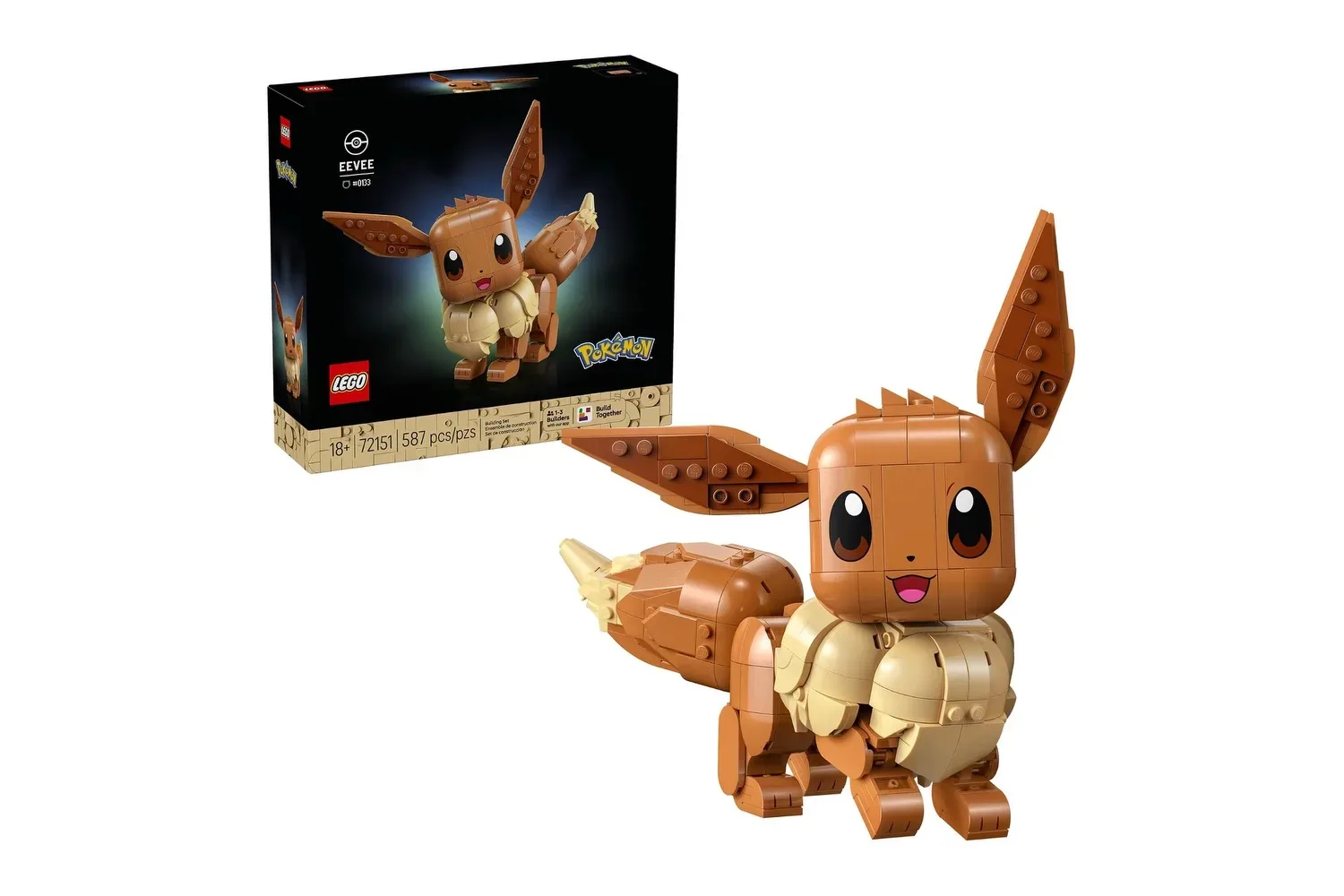
LEGO Pokémon Eevee is currently listed for $48, down from a stated usual price of $60. That is a $12 reduction, or 20% off, for a brick-built version of the Pokémon designed as a display piece rather than a tiny minifigure-scale extra.
The important caveat with any retailer listing is that a price is a snapshot, not a promise. The $48 figure is the reported price at the time of publication, and stock or pricing can change. Still, the reduction gives prospective buyers a simple benchmark: anyone who was already interested in Eevee as a shelf model is looking at a discount below the stated regular price. The reported $48 listing identifies the same deal.
What the Eevee build is designed to do
This is a character model built around Eevee’s most identifiable shapes: oversized ears, a cream-colored neck ruff, a bushy tail with a cream tip, and a largely brown body. Those details matter because brick models face a basic visual challenge. LEGO elements naturally favor hard edges, studs, and straight lines, while Eevee is defined by a soft, curved silhouette.
The build addresses that challenge with angled and curved components instead of relying solely on stacked rectangular bricks. From close up, it will still read as a LEGO construction; that visible construction language is part of the appeal. From a typical shelf-viewing distance, however, the intended silhouette is meant to read clearly as Eevee.
For more context, explore Warlock: Dungeons & Dragons Skips Waypoints to Make Exploration Matter.
Color separation is doing substantial work, too. The contrast between the brown body and cream ruff and tail tip helps distinguish the character’s major features. On a brick-built character, that separation is more than decoration: it prevents visually important areas from running together and makes the design recognizable without needing a printed backdrop or a pose card to explain it.
Posability is the practical feature to watch
Eevee is not described as a fixed statue. Its head can rotate, its legs can bend at the joints, and its tail can move from side to side without the owner having to partially disassemble the model. In display-model terms, posability means the finished build supports intentional changes to its presentation after construction. It is distinct from simply being able to move loose bricks around.
That flexibility gives one model a little more range on a shelf. A forward-facing head position may suit a straightforward display, while a turned head or changed tail angle can make the figure look different beside other items. The report does not specify how many poses the joints support, how strong they are, or whether every configuration is equally stable, so buyers should not infer action-figure-like articulation. What is established is that the major areas—head, legs, and tail—are designed to move.
For a display set, this is a meaningful distinction. A static model asks the builder to accept one final silhouette. A posable one allows periodic adjustments without turning a decorative object back into a repair project. That is especially relevant for Eevee, whose personality is often conveyed by an alert stance, head angle, and prominent tail.
A base is more useful than it sounds
The set includes a display base. That may sound like a small inclusion, but it serves two functional purposes: it gives the completed model a more finished presentation, and it helps stabilize the build on a shelf or desk.
Stability matters more once a model has movable parts. A design resting only on brick-built feet can be vulnerable to a bump, an uneven surface, or an awkward pose. A base provides a defined footprint, making the figure feel less like a loose construction placed on furniture and more like an intentional display object. It also creates a consistent way to place Eevee alongside other models in the LEGO Pokémon line for people planning a coordinated shelf arrangement.
That does not mean the base eliminates all risk. The available details do not establish its dimensions, attachment method, or weight distribution. But as a design choice, it points toward display use rather than a model meant to live permanently in a parts bin.
Build pace and audience
The construction is described as something that can be finished in a single evening rather than a project that demands an entire weekend. Its instructions divide the process into smaller stages, making it easier to stop and return later. That is helpful for builders who prefer a calmer, incremental build schedule, whether they are fitting it around school, work, or limited table space.
The directions are also characterized as simple enough for a child to follow without constant adult help. That should be understood as a statement about the clarity and segmentation of the instructions, not a guarantee about every builder’s age, experience, or need for assistance. A younger builder’s comfort with sorting parts, following diagrams, and handling smaller pieces will still vary.
For gift buyers, the reported single-evening scope gives the kit a fairly clear role. It is not positioned here as an enormous technical build for someone seeking days of mechanical complexity. Its appeal is a recognizable Pokémon, a manageable assembly process, adjustable display options, and a base intended to keep the result looking tidy once construction is over.
What the $48 price changes—and what it does not
At $48, the deal saves $12 versus the stated $60 normal price. That is the concrete value claim supported by the listing. It does not establish that this is the lowest price ever offered, that it will remain available, or that the set is automatically the right purchase for every Pokémon or LEGO fan.
Potential buyers should separate the build’s appeal from the sale itself. Someone who wants an Eevee display model with adjustable parts and a dedicated base may see the discount as a useful reason to buy now. Someone looking for a large collection of characters, a highly technical build, or a confirmed long-term investment has less information to work with. The reported details center on one Eevee model and its display-oriented construction.
For the audience the set does serve, the design has a focused pitch: it translates a recognizable, rounded Pokémon into a brick form without abandoning its key visual traits, then adds articulation so the finished result need not stay locked in a single pose. The current listed price makes that proposition $12 less expensive than its stated usual cost, as long as the retailer’s listing remains at that level.
Shop the products
Check current price, model and availability at the retailer.