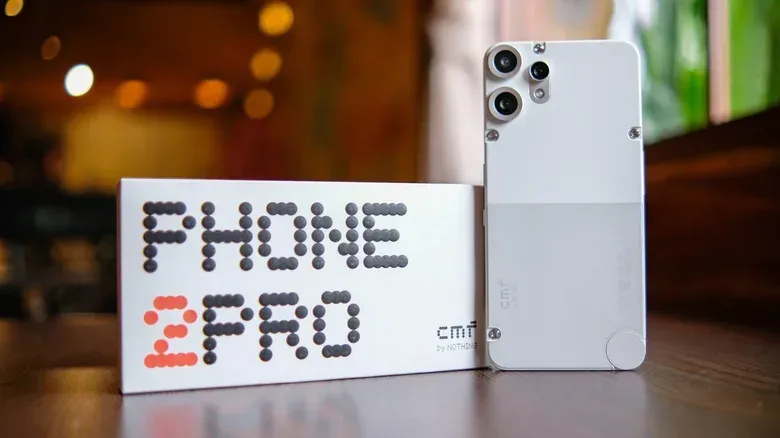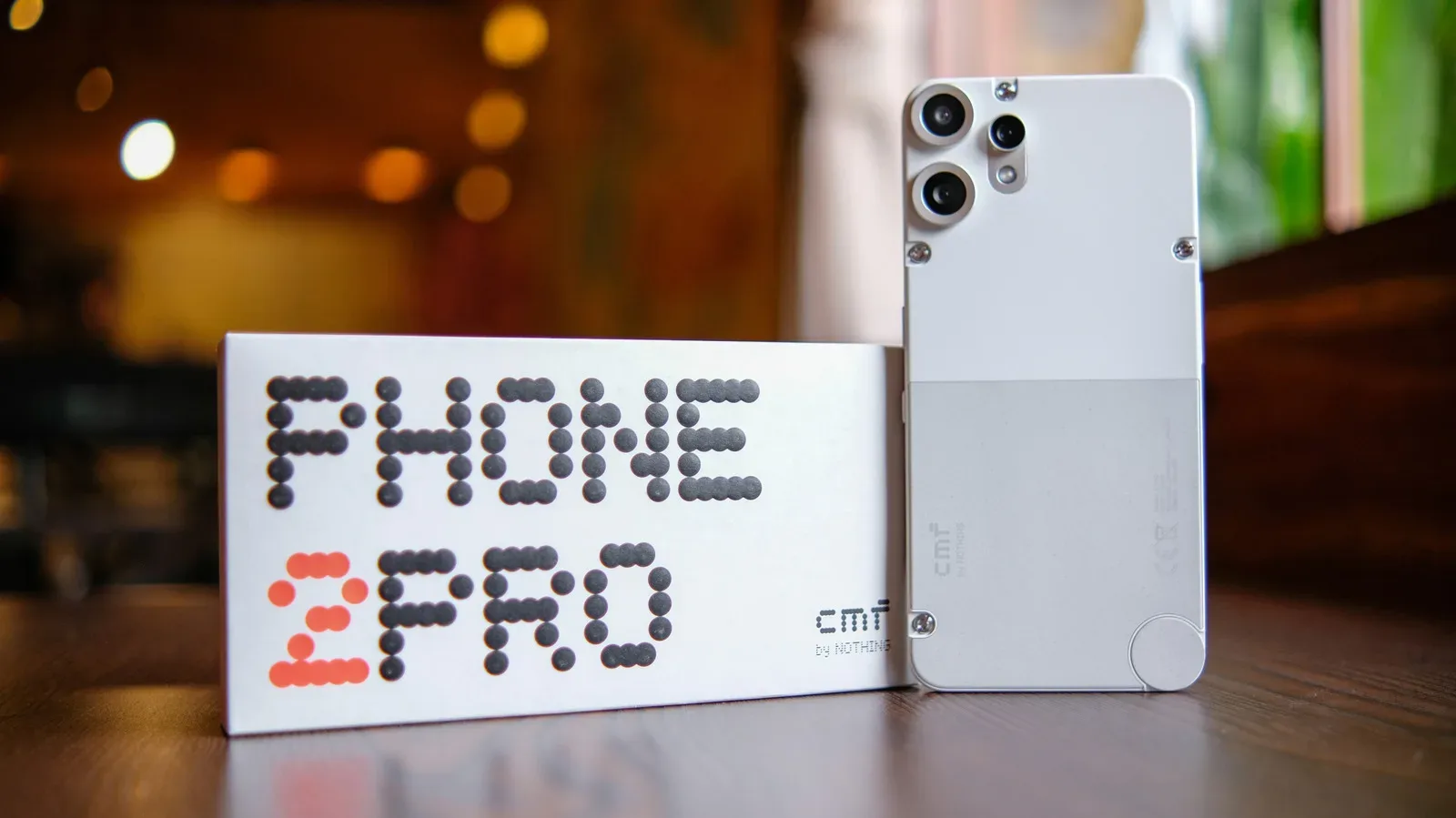
The CMF Phone 2 Pro is a useful example of how a budget phone can look far less compromised than its price suggests. Its base model was offered for $279 through Nothing’s now-ended US Beta Program, placing it $100 below the $379 Nothing Phone 3a. Yet the less expensive handset retained several specifications buyers encounter constantly: a 6.77-inch FHD+ AMOLED display, a 120Hz refresh rate and a 5,000mAh battery.
That is the central logic behind CMF’s value proposition. Instead of making the lower price obvious every time the display turns on or every time the battery percentage is checked, it made cuts in components and capabilities that matter most in tougher or more specialized situations. The Phone 2 Pro is not identical to the Nothing Phone 3a wearing a smaller price tag; it is a deliberately different set of priorities.
For people whose phone use revolves around messaging, maps, web browsing, social apps, video and casual photography, that distinction can be meaningful. A bright, large screen and substantial battery capacity are daily-use features. Faster performance under sustained load, better stabilization in difficult camera conditions and quicker wired charging can be equally important, but not to every buyer every day.
The expensive-looking essentials stayed in place
CMF did not skimp on the parts most likely to shape an owner’s immediate impression of the phone. The 6.77-inch FHD+ AMOLED panel matches the Nothing Phone 3a on size, resolution class and 120Hz refresh rate. AMOLED is the screen technology used here; in practical terms, it is part of the display specification rather than a separate software setting. The 120Hz figure refers to how often the display can refresh per second, while 5,000mAh is the stated battery capacity.
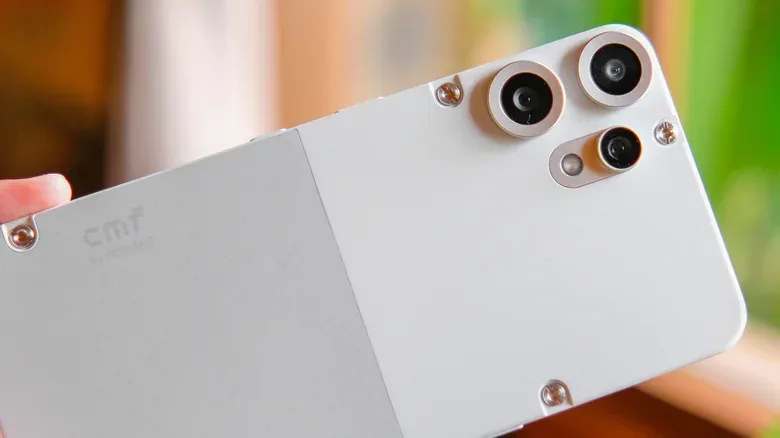
The camera hardware also looks unusually expansive for the price positioning. The Phone 2 Pro includes a 50MP main camera, a 50MP 2x telephoto and an 8MP ultrawide. Those three cameras offer different fields of view: the main camera for general shooting, a 2x telephoto for a narrower view of distant subjects, and an ultrawide for fitting more into a scene. Having those options does not settle the question of image quality, but it means CMF did not reduce the phone to a one-camera experience.
Storage flexibility is another place where CMF preserved value. The phone supports microSD cards up to 2TB, allowing owners to add capacity rather than necessarily choosing a higher-storage configuration from the start. It also supports NFC in certain regions. NFC, or near-field communication, is the short-range wireless technology used for compatible tap-based functions, although regional support means prospective buyers should confirm that capability for their market.
CMF also lists three years of Android updates and six years of security updates. The difference matters. Android updates refer to platform updates, while security updates are intended to continue addressing security-related issues after the stated platform-update window. For a lower-cost device, a longer security commitment can be an important part of its usable-life calculation.
Where the $100 difference shows up
The most consequential trade-off is the processor. The CMF Phone 2 Pro uses MediaTek’s Dimensity 7300 Pro, while the Nothing Phone 3a uses Qualcomm’s Snapdragon 7s Gen 3. These are not interchangeable names on a specification sheet: the processor is the component responsible for executing apps and handling demanding workloads.
That difference is less likely to define basic tasks such as extended browsing, social media or messaging. The Phone 2 Pro is generally responsive for ordinary daily activity. It becomes more apparent when the phone is pushed with games or similarly demanding workloads. High graphical settings and extended sessions in Genshin Impact, for example, are identified as a scenario where the CMF handset will struggle.
For gaming-minded buyers, that makes the Phone 2 Pro a phone to assess by the kinds of games they actually play, rather than by its display alone. A 120Hz screen can be attractive on paper, but it does not erase the processing limits that appear in graphically intense games. Casual and less demanding games are not the same use case as long sessions at high settings in a particularly demanding title.
It is also worth separating phone performance from the broader gaming ecosystem. Software, services and game libraries can matter alongside the handset’s silicon. For example, PC players are also seeing changing policies around mod discovery and disclosure, as covered in this look at AI disclosures and filtering on Nexus Mods. But a phone buyer’s immediate question here is simpler: the Dimensity 7300 Pro is positioned as adequate for ordinary use, with clearer limits when sustained gaming pressure rises.
Stabilization is a camera cut with real consequences
The camera comparison is similarly nuanced. The Phone 2 Pro provides three useful focal lengths, but its main and telephoto cameras use electronic image stabilization rather than optical image stabilization. The Nothing Phone 3a’s main camera has true OIS.
Electronic image stabilization, often shortened to EIS, is a stabilization approach handled electronically. Optical image stabilization, or OIS, refers to stabilization in the camera hardware. The relevant practical point is not merely the acronym: the absence of OIS on the CMF main and telephoto cameras may be felt when hands are shaky or light is poor. The Phone 2 Pro can take decent photos, but those are conditions in which it may have more difficulty producing strong shots.
This is a particularly telling budget-phone decision. Camera megapixel counts and the number of lenses are easy to notice in a product listing. Stabilization is less flashy, yet it can influence the situations where a camera is easiest to rely on. CMF retained the 50MP main and 50MP 2x telephoto cameras, but accepted a limitation that is more likely to emerge when the conditions become challenging.
Charging, sound and protection were also trimmed
The rest of the price-saving formula is made up of several smaller concessions. The Phone 2 Pro tops out at 33W charging, compared with 50W on the Nothing Phone 3a. That does not change the 5,000mAh battery capacity, but it does establish a lower maximum charging speed.
Audio is another less glamorous but potentially noticeable compromise: the CMF Phone 2 Pro has a single speaker. The protection rating is also lower. It carries IP54, while the Nothing Phone 3a is rated IP64. IP ratings are ingress-protection classifications; in this comparison, the numbers are a concise indication that the Phone 3a has the higher stated rating. Buyers should not treat the two models as having the same level of protection.
None of these reductions necessarily make the Phone 2 Pro a poor fit. They instead explain how CMF could retain the screen size, display specification, battery capacity and multi-camera arrangement that make a handset immediately appealing while arriving at a lower base price.
Why this approach made sense for CMF
Budget hardware is often defined less by a single dramatic omission than by the discipline to decide what remains. CMF kept spending focused on features that many people interact with repeatedly: the display, battery and everyday camera versatility. It then accepted constraints in areas that may be encountered less frequently by a buyer who does not play demanding games, take many low-light photos, depend on the fastest available charging, or need the stronger of the two IP ratings.
The approach does not mean every trade-off is invisible. A single speaker is a concrete hardware limitation. Charging at 33W rather than 50W is a measurable difference. The processor gap matters when games or workloads get demanding. And stabilization is important enough that someone who frequently takes photos in difficult light should treat it as a key buying consideration rather than a footnote.
Still, the Phone 2 Pro’s configuration shows that a lower-cost handset does not have to make every compromise in the most visible places. For the right usage profile, the omissions may be easier to accept than cutting the screen, battery or storage expansion would have been.
Memory costs complicate a repeat performance
The larger issue is whether CMF can repeat the same formula. Nothing co-founder Akis Evangelidis said the company had been working on a successor, but could not make a phone that felt like a genuine forward step at a price that made sense for CMF, specifically pointing to increased memory costs.
That concern is substantial because memory is not a trivial line item. TrendForce estimated in February 2026 that memory represented roughly 30% to 40% of a smartphone’s bill of materials. A bill of materials is the combined cost of the components used to build a product; it is not a complete public breakdown of a phone’s final retail price. Nothing has not published a component-by-component bill of materials for the Phone 2 Pro, so there is no basis for assigning a precise dollar value to each of its compromises.
What can be said is that rising costs in a component category that large reduce the room a budget brand has to preserve attention-grabbing features while also improving performance, cameras, charging and durability. That pressure helps explain why a successor is not coming in 2026.
For now, the CMF Phone 2 Pro stands as a clear illustration of selective budget engineering: preserve the big display, large battery and flexible camera setup, then save money on performance headroom, optical stabilization, charging speed, speaker hardware and ingress protection. Whether that is a winning equation depends on how often a buyer reaches those limits—and on whether the savings remain possible as component costs move upward.