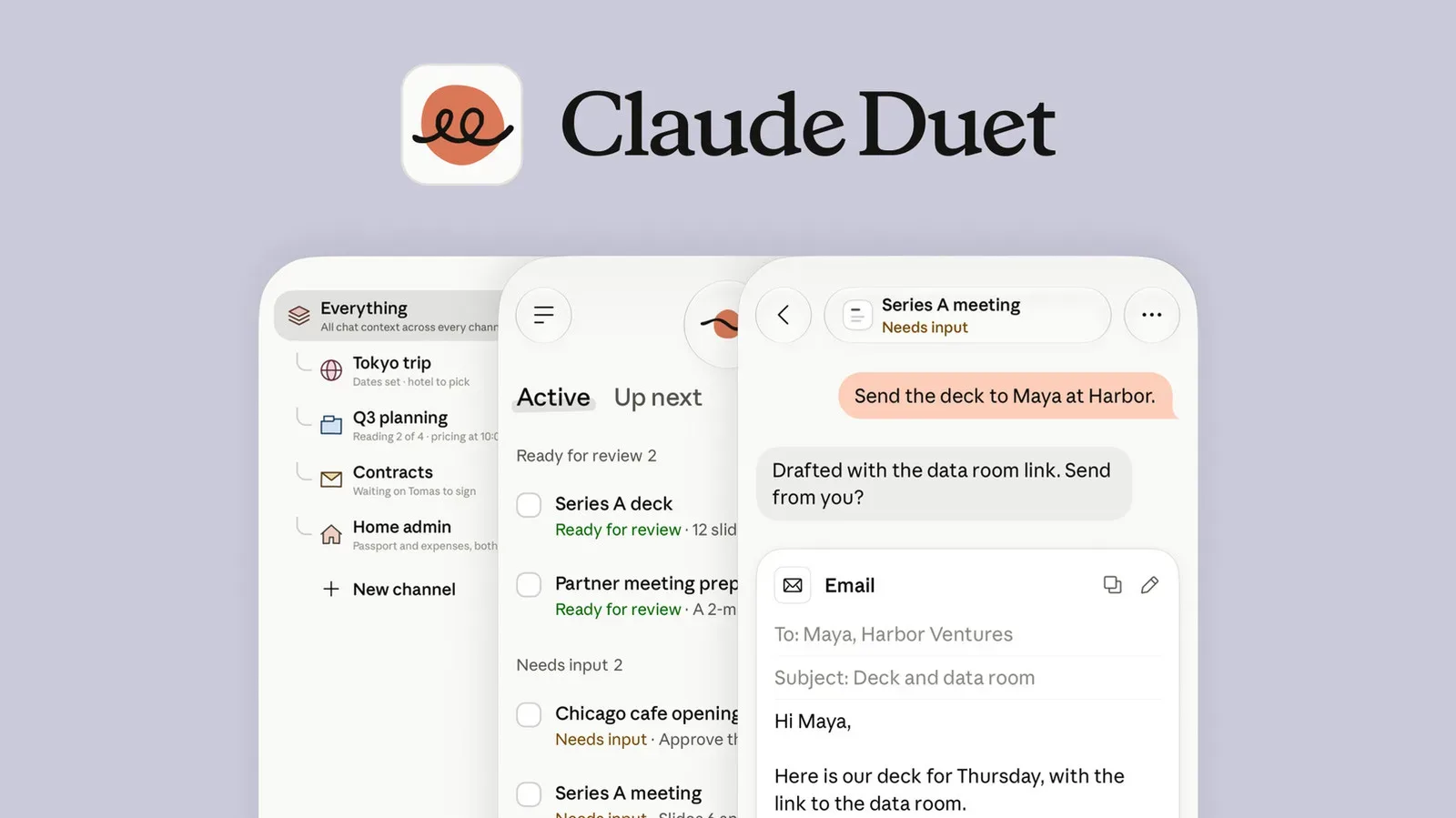
Anthropic’s Claude Duet is designed to make a familiar chatbot behave less like a tab you open and more like a digital assistant that periodically returns with work. The agent is presently in preview, however, and access is limited. For people considering it, the important details are not just the potential convenience of automated briefings, scheduling and web tasks, but also eligibility, shared plan limits and the account data required to make the feature proactive.
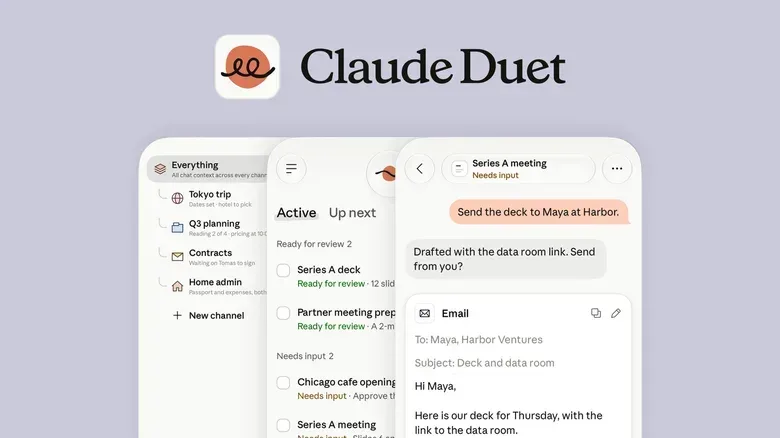
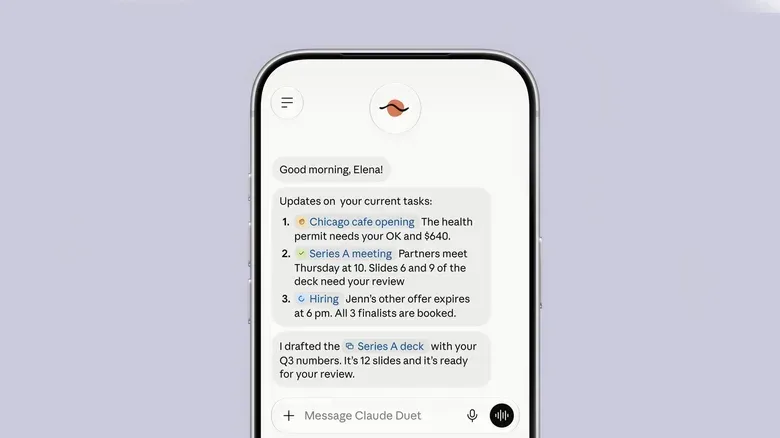
Claude Duet runs in its own virtual machine and uses a dedicated browser to browse the web and complete jobs. It can also work with apps connected to a person’s Claude account. That setup distinguishes it from a conventional chat exchange: instead of waiting for a user to open Claude and ask a question, Duet is intended to check connected information, prepare a daily briefing, accept delegated jobs by message and contact the user when an item is complete or needs approval.
That promise comes with an obvious tradeoff. An agent cannot proactively identify calendar conflicts, create a sales dashboard or surface newly published research from information it cannot access. Its usefulness will therefore vary with the breadth of data a person is prepared to connect to their Claude account. For users who prefer to keep their digital services separate, the privacy cost may outweigh the convenience.
Who can join the Claude Duet preview?
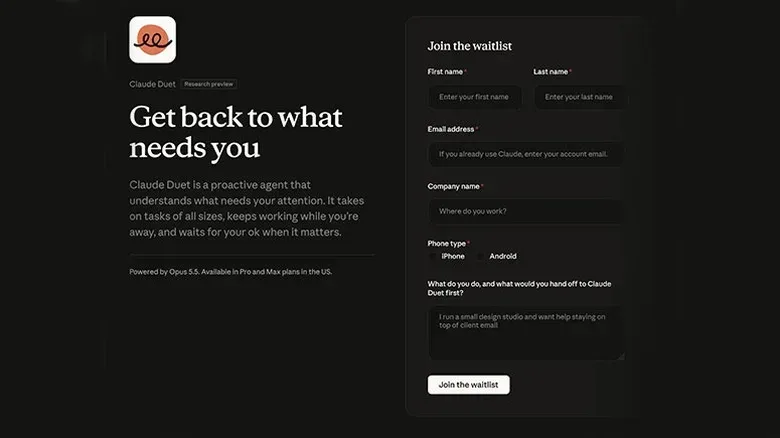
At this stage, Claude Duet is available only through a waitlist. The preview is restricted to Claude Pro and Max subscribers in the United States. Being on an eligible subscription does not itself mean immediate access; prospective users still need to submit the waitlist form.
The form requests a name, company and email address. It also asks applicants whether they use an Android phone or an iPhone, plus a short description of the work they want to delegate. The phone question is relevant because Claude Duet has a standalone app for Android and iOS.
The practical takeaway is simple: a user outside the US, someone without a Pro or Max subscription, or someone hoping for a Team or Enterprise rollout cannot assume Duet access yet. Anthropic has not made the agent available to Team and Enterprise customers at this point. Preview programs can change, so the current restrictions should be treated as a snapshot rather than a guarantee of the eventual release structure.
What to put in a waitlist request
The application’s description field is an opportunity to be specific about the intended task rather than simply saying “productivity.” The supported examples point to recurring operational work: a business owner could seek a weekly sales and cashflow dashboard, while a scientist might want notices about research papers in a particular field. Meeting scheduling, forecasts and web-app building are also among the kinds of tasks presented for Duet.
A useful description identifies the result someone wants, the source of the relevant information and how frequently it should happen. For example, “create a weekly dashboard from the apps already connected to my account” communicates more than “help with sales.” This is not a claim that a particular wording secures entry; Anthropic has not stated a selection formula. It is simply a clearer way to describe a real use case.
Related coverage includes Claude Duet Preview: Eligibility, Waitlist and What the Agent Can Do.
Price: what is known, and what remains uncertain
Anthropic has said Claude Duet is included with its $20-per-month Pro plan and above, although that arrangement may change. Max subscribers are also eligible for the preview. The key point is that access is tied to paid individual plans, not sold as a separately stated Duet subscription in the information available so far.
Eligibility should not be confused with unlimited use. During preview, Duet shares usage with other Claude applications, including Claude Code and Cowork. In other words, work given to Duet draws from the same overall usage pool as those other Claude tools. A subscriber who uses those products heavily should view Duet activity as part of the same capacity decision, rather than an isolated bonus that cannot affect anything else.
The agent is designed to check connected accounts every few hours instead of continuously. Anthropic’s stated rationale is that nonstop checking would consume plan limits more rapidly. This means the service’s “always-on” framing should be understood as periodic and proactive, not as a promise of constant real-time monitoring.
That distinction matters for time-sensitive work. A routine morning summary or a recurring dashboard may fit an every-few-hours rhythm well. Tasks that require instant awareness of a change may not. The preview is also meant to collect feedback on how frequently users want messages, making notification cadence one of the unresolved parts of the product experience.
What a virtual machine means in this context
A virtual machine is a software-based computing environment separated from a user’s own device. In Duet’s case, it is where the agent runs and where it can use its dedicated browser for web-based tasks. The significance is functional: the agent can work through browser actions without requiring a person to sit in front of their phone or computer while every step happens.
It does not mean the agent acts without boundaries or that a user should hand over every task unchanged. The product description says Duet can reach out when it needs approval, and that checkpoint is important. A user should think about which jobs are suitable for delegation, which require review before an action is finalized, and which should remain entirely manual.
Browser-capable agents also make account hygiene more important. Connected apps can unlock useful automation, but every connection expands the information that can feed an agent’s briefings and task execution. Before connecting an app, users should understand what they want Duet to do with that app and whether the expected time savings justify the access. This is a practical consideration based on the service’s model, not a claim that every connection is inherently unsafe.
What Claude Duet is supposed to do
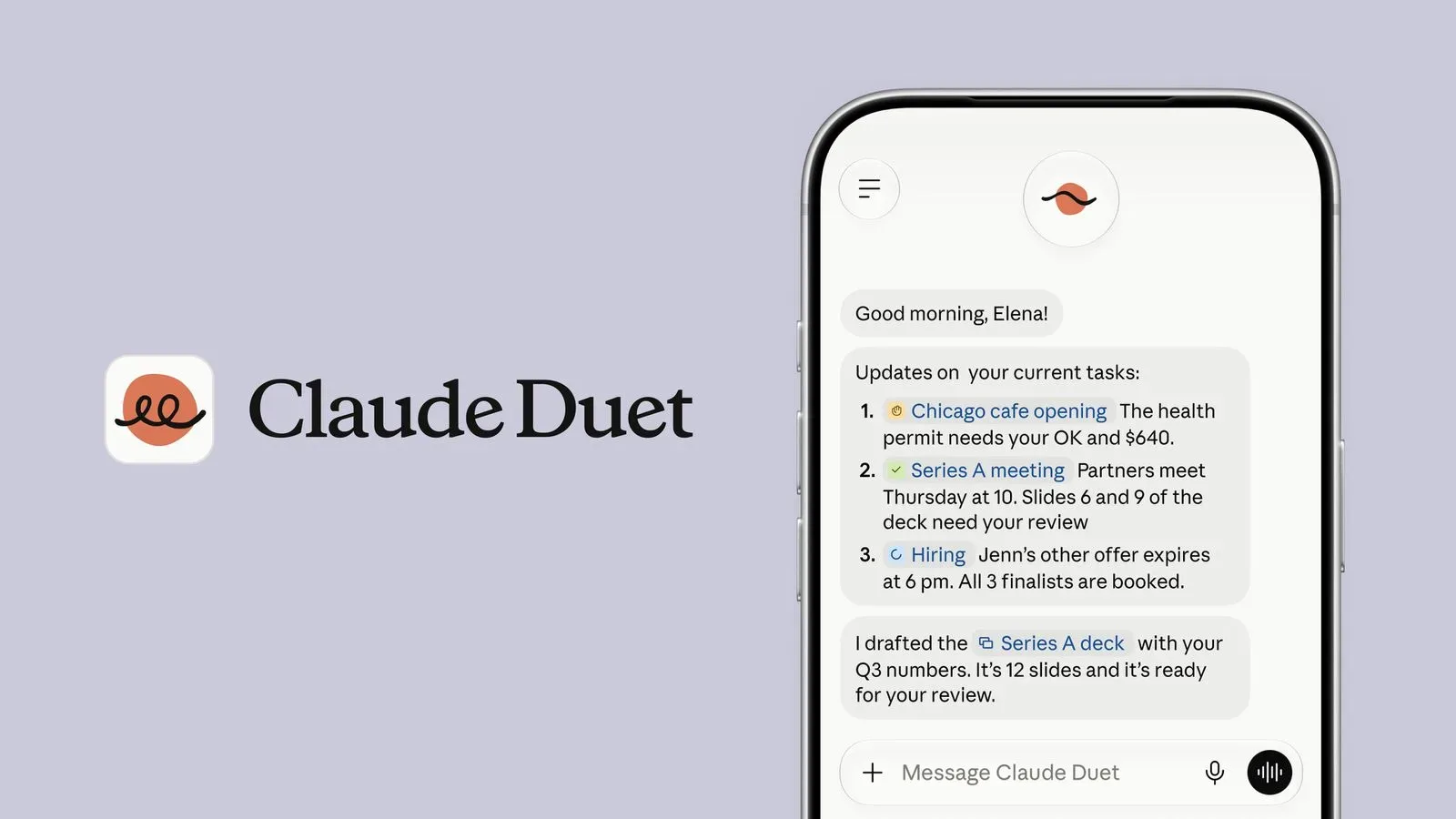
Duet’s central feature is proactivity. It can generate a brief daily overview and list action items based on the apps linked to a Claude account, then accept assignments through messages. Anthropic describes the difference in terms of initiative: standard Claude waits for a user to start a chat and work alongside it, while Duet is intended to bring items requiring attention back to the user.
The examples indicate several broad categories of work:
- Coordination: scheduling meetings and identifying items that need attention.
- Analysis: creating forecasts and recurring sales or cashflow dashboards.
- Monitoring: flagging newly published research relevant to a scientist’s area of study.
- Building: creating web apps.
These are categories of intended capability, not proof that every task will work identically for every account or plan. Much depends on the apps a person connects, the clarity of the delegated request, the available usage limits and whether a job requires a human decision. The preview status is especially relevant here: users should expect the product’s practical behavior and messaging patterns to be refined through feedback.
Why connected accounts are the heart of the experience
Duet’s daily briefings and proactive behavior draw on two sources within a Claude account: information Claude has stored in memory and data from connected apps. In this setting, memory refers to information the chatbot has written to its memory, while connected apps are the services a user has linked to the account. Together, those sources give the agent context beyond the text in one chat window.
That context can be genuinely valuable. A daily action list is more useful when it can reflect actual connected work rather than a generic template. A research alert only makes sense when the agent has enough information about the relevant subject. Likewise, an operational dashboard needs access to the appropriate business data. But richer context also means the user is making a more consequential data-sharing choice.
It is worth separating two questions that are often blended together. The first is whether an agent can do a requested task. The second is whether a person is comfortable giving it the connected information necessary to do that task proactively. A feature may be capable and still not be a fit for a particular user’s privacy preferences.
A cautious way to evaluate the preview
For eligible subscribers, the strongest use cases appear to be repeatable, clearly scoped tasks where periodic updates are sufficient. A weekly dashboard, a recurring research watch or a scheduling workflow has a defined output that a user can inspect. Those cases are easier to evaluate than vaguely asking an agent to “manage” a broad part of someone’s life.
Start by deciding what outcome matters. Next, identify the minimum connected data needed to produce it. Then account for the fact that Duet usage is shared with Claude Code and Cowork. Finally, retain review points for anything where the consequences of a mistaken action would matter. The service is designed to request approval when it needs it, and users should treat that moment as part of the workflow rather than an interruption to be ignored.
There is also a hardware-adjacent angle to the expanding AI-agent conversation. As more tools take on background-style tasks, questions about where computing work happens and what resources it consumes will only become more relevant. For a related discussion touching on AI and PC memory, see why PC gamers have questions about RAM and AI.
Claude Duet’s early appeal is easy to understand: it aims to reduce the gap between noticing work and getting started on it. Yet the preview’s limitations are just as important. Access requires a US-based Pro or Max subscriber to join a waitlist, usage is shared across Claude products, account checks happen every few hours rather than nonstop, and the most useful version of the agent may demand the greatest degree of account connectivity. For now, the sensible approach is to judge it not as a magical replacement for oversight, but as a potentially helpful assistant whose value depends on carefully chosen access and well-defined jobs.