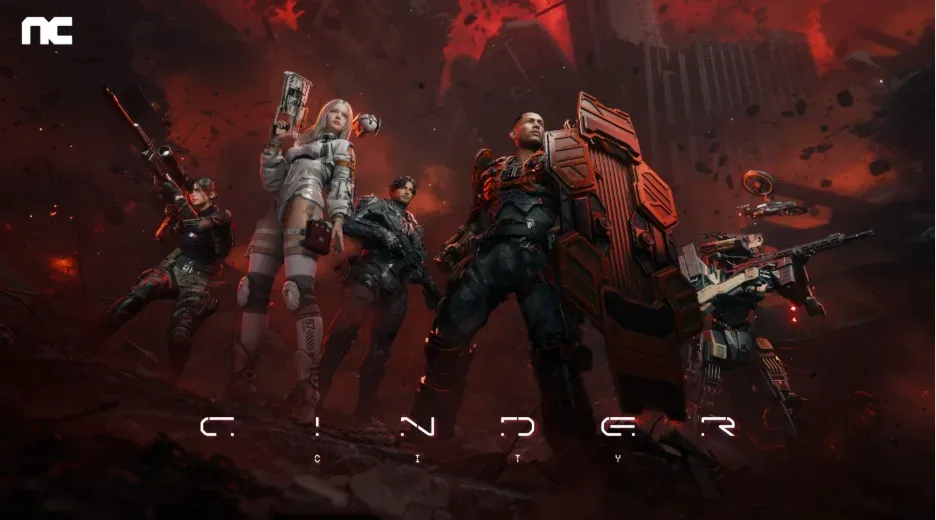
BigFire Games’ upcoming sci-fi cinematic open-world shooter CINDER CITY is putting a tactical spin on the traditional “point weapon at problem” formula. A newly released developer video—the second in the game’s video series—lays out how character-specific equipment, vehicle choices and flexible multiplayer encounters are intended to shape fights in its 23rd-century setting.
The broad pitch is familiar enough: modern firearms share the battlefield with futuristic weapons, players explore an open world, and enormous hostile things eventually require a coordinated application of firepower. The more distinctive element is called Tactical Gear, a collection of skills and equipment intended to give players different battlefield responsibilities rather than simply handing everyone the same enormous laser and wishing them luck.
The game’s earlier Gamescom 2026 trailer introduced protagonist Seven. This follow-up shifts attention from who players may be following to how combat and cooperation are expected to work once the shooting starts.
Tactical Gear is the centrepiece of CINDER CITY’s combat plan
CINDER CITY’s combat mixes contemporary-style firearms with weapons from its future setting, but the video frames Tactical Gear as the system that supplies the deeper strategic layer. The term refers to character-specific skills and equipment designed to alter a player’s role in an encounter.
Examples shown include specialized shields, support bots, deployable traps and mechanics for recovering shields. That is a deliberately broader toolkit than a simple weapon loadout. A shield can imply protection or space control; a support bot suggests a utility-focused contribution; traps create the possibility of preparing an area rather than only reacting to it. Shield recovery, meanwhile, points toward survivability as something players may need to actively manage.
Each piece of Tactical Gear has its own resource requirement and cooldown. In practical terms, a cooldown is the waiting period before an ability or device can be used again. Resource requirements add a second constraint: using an item is not solely about whether its timer has finished. Players must also have the necessary resource available. Together, those limits can turn equipment timing into a meaningful decision rather than a button pressed whenever danger becomes loud.
That structure makes combinations important. A trap may be more useful when opponents are held in an area, and a shield may carry greater value when a team needs time to recover or reposition. The video’s emphasis is on strategic combinations and coordination, so the intended question is not merely which individual item does the most damage. It is how several players’ tools can create an opening, sustain a defensive position or help a group survive a tougher encounter.
What “battlefield roles” could mean here
The available details do not establish fixed classes, permanent builds or every possible Tactical Gear option. They do, however, support a clear design direction: equipment is meant to make players useful in different ways. One player may contribute cover, another support, and another area denial through traps. The game appears to be asking teams to consider positioning, protection and setup alongside accuracy.
Related coverage includes CINDER CITY Video Details Tactical Gear, Co-Op Systems and Boss Battles.
That is an important distinction in an open-world shooter. A game can include cooperative play while still treating teammates as extra sources of bullets. CINDER CITY’s stated approach instead places value on complementary tools. Whether that produces highly structured group roles or more flexible, moment-to-moment cooperation will depend on the full game, but the video makes its priorities unusually plain: Tactical Gear is supposed to affect the shape of a fight.
Vehicles are presented as tactical choices, not just transport
The open world includes motorbikes, cars, helicopters and power loaders, along with mechs. The key detail is that these options are described as having distinct uses and weaponry. In other words, a vehicle is not necessarily just a way to arrive at the action two minutes sooner and immediately park somewhere inconvenient.
Helicopters are associated with air superiority, while the Power Loader is presented as a source of heavy firepower for boss encounters. Those examples suggest that choosing a vehicle may depend on the immediate problem. Aerial capability could change how a team approaches threats or terrain, while a heavier machine could be the appropriate answer when a boss demands a greater volume of force.
A Power Loader, in this context, is a heavy mechanized vehicle rather than a conventional car or bike. The video identifies it as particularly useful for boss fights, but it does not detail its weapons, durability, limits, or how players obtain and operate it. Likewise, the presence of mechs establishes another large-scale combat option without confirming their precise role relative to power loaders.
Still, the design implication is straightforward. CINDER CITY appears to connect traversal and combat planning. Motorbikes and cars offer one kind of mobility, helicopters another, and heavy machinery another again. If the final game follows the structure shown, teams may need to decide not only what Tactical Gear to bring, but what kind of machine best suits the encounter ahead.
Co-op is designed to extend beyond formal parties
One of the most consequential details concerns how players meet one another in the world. During exploration, players can encounter fellow Cinderknights through side missions and dynamic events, then help each other without first joining the same party.
A dynamic event generally describes activity that arises in the shared world rather than a mission a group must organize in advance. Here, the significant promise is low-friction assistance: a player who comes across another Cinderknight dealing with an event or side mission can lend a hand without the administrative pause of forming a formal group first.
This could make the open world feel more communal, provided the system delivers on that seamless intent. It potentially removes the awkward gap between seeing a player in trouble and wondering whether the game will allow meaningful cooperation. It also means a helpful encounter need not become a long-term party commitment. Assist with a fight, complete an objective, and continue exploring—no ceremonial paperwork required.
The announcement does not specify rewards, progression rules, matchmaking, communication tools or how broadly this no-party assistance applies. Those are substantial practical details still left open. What is established is the central philosophy: CINDER CITY wants spontaneous cooperation to be possible during side activities and changing world events.
Players watching other tactical games may also be interested in Ghost Justice’s 1992 Miami tactics operation, though its premise and setting are very different from CINDER CITY’s future-shooter approach.
Three boss formats give co-op different scales
The video identifies three categories of major encounters: field bosses, four-player instanced dungeons and large-scale open-world bosses. The categories matter because they imply that cooperation will not look identical across every activity.
Field bosses: direct, difficult encounters
Field bosses are described as tough single encounters. The wording establishes their difficulty and their presence as individual confrontations, but does not define party-size rules, locations, rewards or repeatability. Their role in the overall loop appears to be a concentrated test within the wider world: one formidable foe, one immediate problem, and presumably an excellent reason to reconsider whether a light vehicle is the right answer.
Four-player dungeons: contained teamwork with mechanics
Four-player instanced dungeons have unique boss mechanics and require teamwork and tactical planning. An instanced dungeon is a separate, bounded gameplay space created for a particular group rather than an activity taking place openly alongside every player in the world. The stated four-player format gives these dungeons a more defined team size than the wider co-op systems discussed in the video.
The phrase “unique boss mechanics” is especially notable. It means these fights are not presented simply as opponents with larger health pools. The announcement does not reveal the mechanics themselves, so it would be premature to assume puzzles, phases or prescribed assignments. But it does indicate that teams must learn encounter-specific demands and coordinate Tactical Gear and plans around them.
This is also where the resource-and-cooldown structure could become especially relevant. When a boss has a distinct mechanic, using a defensive device or support tool at the wrong time may carry a cost. Conversely, a coordinated shield, trap or recovery decision may be the difference between stabilizing an attempt and watching a carefully assembled plan become futuristic scrap.
Open-world bosses: raids against world-changing entities
At the largest end are open-world bosses, described as massive cooperative raids against entities that can change the world. The announcement does not explain exactly what “world-changing” entails, so it should be read as a statement of scope rather than a confirmed list of environmental effects or persistent systems.
Even with that uncertainty, the intent is clear: these are not just bigger dungeon bosses. They are open-world events built for large-scale cooperation, placing them closer to communal objectives than the tightly defined four-player dungeon format. That contrast gives CINDER CITY several potential rhythms of play, from impromptu help during exploration to small-group planning to much larger public confrontations.
What the video confirms—and what remains unconfirmed
CINDER CITY has confirmed an upcoming sci-fi, cinematic open-world shooter with modern and future weaponry; Tactical Gear built around character-specific equipment; several vehicle types and mechs; informal player assistance during open-world activity; and boss content at field, dungeon and raid scale.
It has not, in the material outlined here, confirmed platforms, a release date, pricing, detailed progression systems, specific weapon statistics, fixed character classes, exact boss mechanics or the operational details of its multiplayer and matchmaking. Those absences are worth noting because the video is a systems overview, not a complete specification sheet.
For now, CINDER CITY’s strongest differentiator is the connection between its systems. Tactical Gear is not being presented in isolation from co-op; vehicles are not being presented solely as scenic transport; and bosses are not all being folded into one generic activity type. The game’s stated ambition is a future shooter where teams adapt their equipment, machines and level of coordination to the scale of the threat. That is a substantial mission statement. The next question is how much tactical improvisation the full game will ultimately allow when Seven and the Cinderknights meet something big enough to require a Power Loader.