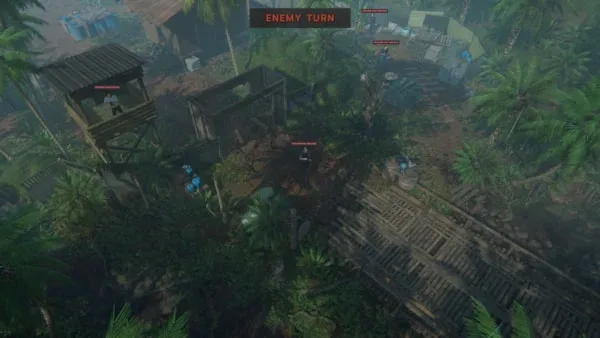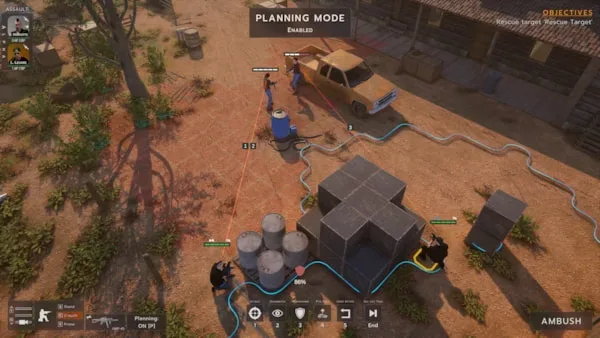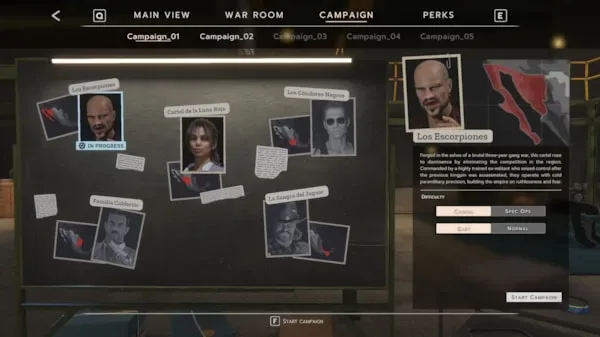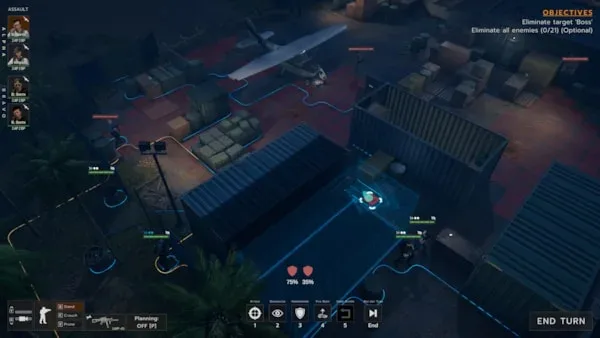
Ghost Justice, the turn-based tactics game from Centurion Developments, has received its first public demo as part of Steam Next Fest. The demo is on Steam from October 19 through October 26, 2026, offering an early look at a game built around tactical planning, intelligence work, stealth, and coordinated operations between multiple teams.
The game is currently listed for a Q1 2027 release on Steam. Alongside the demo, Centurion Developments is running a Supporter Pack giveaway with Alienware Arena. Entries close on October 26, the same day the Steam Next Fest demo window ends.
For players browsing the event’s many playable previews, Ghost Justice’s pitch is particularly focused: this is not simply a turn-based combat game about moving units into firing positions. Its announced systems place equal importance on setting ambushes before a mission, collecting intelligence, managing resources, developing operatives, and coordinating separate elements of a larger operation.
Two missions set up a cartel investigation in Miami
The demo’s briefing places Team Alpha in Miami in 1992. Its immediate target is a corrupt attorney who has been seen preparing to head to Mexico. The team’s job is to stop him before he gets away, but the scenario expands beyond a straightforward arrest attempt.
Mission 01 begins as a routine police raid. Officers discover that the location is a cartel hideout, and the operation turns into a deadly firefight. Evidence found during the encounter points toward a larger conspiracy, establishing the investigation that drives the demo’s second mission.
Mission 02 follows the attorney as he attempts to escape toward Mexico under armed protection. Team Alpha must break through that security and bring him in. Together, the missions give the demo a compact arc: a raid reveals a deeper lead, then the unit acts quickly before a central figure can leave the area.
The setup also indicates the sort of pressure Ghost Justice wants to create. The attorney is not described as waiting in a static objective zone; he is trying to flee and has guards around him. That makes positioning, reconnaissance, and a coordinated approach potentially more important than treating every fight as a simple elimination encounter.
What “multi-team turn-based combat” means here
Turn-based tactics generally refers to a structure where players make decisions in discrete turns rather than controlling every action in real time. The relevant choices tend to include where units move, which enemies they target, when they use equipment, and whether they hold position. Ghost Justice adds an emphasis on coordinated multi-team operations, meaning the player is expected to command more than one group as part of an operation.
Related coverage includes Ghost Justice Demo Arrives for Steam Next Fest as Supporter Pack Giveaway Opens.
That design direction matters because separate teams can create tactical problems and opportunities that a single squad cannot. One group can potentially establish an ambush or observe a route while another advances, for example. The announced focus is on coordination rather than on a single line of operatives moving through a map together.
Centurion Developments also highlights pre-mission planning and ambush setup. Pre-mission planning is the decision-making that happens before the main action starts: determining an approach, preparing the operation, and setting conditions that could benefit the team once contact begins. An ambush, in tactical terms, is an attack arranged to catch opponents at a disadvantage, often by concealing the attackers or choosing the place and timing of engagement.
The announcement does not specify the demo’s exact planning interface or the full rules governing those systems. Still, their inclusion makes a clear statement about the intended rhythm: preparation and information are meant to have value before shots are exchanged.
Intelligence, stealth, spotters, and snipers
Ghost Justice’s other stated pillars are intelligence gathering and stealth. Intelligence gathering refers to obtaining useful information before or during an operation, such as learning about threats, routes, objectives, or enemy positions. The practical tactical benefit is reducing uncertainty. A plan is more reliable when a team has better information about the conditions it will face.
Stealth mechanics, meanwhile, usually concern avoiding detection or controlling when an encounter begins. Within the announced structure of Ghost Justice, stealth is notable because it sits beside direct firefights rather than replacing them. The Miami briefing explicitly includes a raid that escalates into a deadly shootout, while the broader feature list presents stealth and intelligence as tools that can shape an operation.
The developer has also called out spotter and sniper tactics. A spotter is a member of a team who helps locate, identify, or direct attention toward targets; a sniper operates at long range. The pairing is a familiar tactical relationship, but Ghost Justice’s use of it is important in context: it supports the game’s stated interest in observation, planning, and operations involving more than one team.
Exactly how spotting, sniping, concealment, and detection function in the final game has not been detailed. The demo therefore represents an opportunity to see which of those high-level ideas are already present in playable form and how much they affect the two Miami missions.
Operatives and resources extend beyond a single mission
Ghost Justice is also planned to include recruitment, equipment, operative development, and resource management. These terms point to a campaign layer beyond selecting moves during combat.
- Recruitment means building the roster of operatives available to command.
- Equipment concerns the gear assigned to those operatives.
- Operative development indicates that individual team members can progress or change over time.
- Resource management is the process of deciding how limited operational assets should be used.
Those systems can make tactical choices carry forward from one mission to the next. They may determine which people and tools are available when the next problem appears, although the announcement does not lay out the final game’s specific progression rules, resource types, or consequences for a given decision. It is best understood as part of the game’s larger strategic ambition rather than as a confirmed list of demo mechanics.
The announced mission settings range from urban districts and remote settlements to dense jungle territories. Miami is the demo’s immediate setting, while the wider list suggests that the finished game intends to move between very different operational spaces. Urban areas can place objectives, civilians, buildings, and short sightlines close together; remote and jungle environments imply different terrain and visibility considerations. The exact mission designs for those locations have not been disclosed.
Supporter Pack giveaway details and deadline
The Alienware Arena giveaway offers a Supporter Pack intended for early followers of the game. Each pack includes a full Steam copy of Ghost Justice when it releases, Closed Alpha access to upcoming development builds, a name in the official game credits, and an exclusive Discord “Ghost” role with access to a private chat channel.
The distinction between the public demo and Closed Alpha access is significant. The demo is the currently available festival build, while the giveaway’s Alpha access concerns future development builds. No further schedule or content details for those builds have been provided.
Anyone interested in entering should note the stated deadline of October 26, 2026. The game itself remains targeted for Q1 2027, so the giveaway is tied to a pre-release period rather than an immediately redeemable full launch copy.
Why the demo is worth watching during Next Fest
Steam Next Fest demos are useful because they let players compare a game’s stated design priorities with what is actually playable. In Ghost Justice’s case, the important questions are not merely whether its turn-based firefights work. The more distinctive test is whether its planning, information-gathering, stealth, long-range support, and multi-team concepts reinforce one another during the Miami operation.
That focus sets it apart within an event where demos can serve very different purposes. Another recent Steam Next Fest offering, 500 Finger Fillet, uses its demo to preview a very different style of PC game. Ghost Justice instead arrives with a two-mission tactical scenario and a campaign-scale feature set still pointed toward its planned 2027 launch.
For now, the confirmed facts are straightforward: the first public Ghost Justice demo is available on Steam during October 19–26, 2026; it follows Team Alpha through two connected missions in 1992 Miami; and a Supporter Pack giveaway closes on October 26. The full game is planned for Steam in Q1 2027.