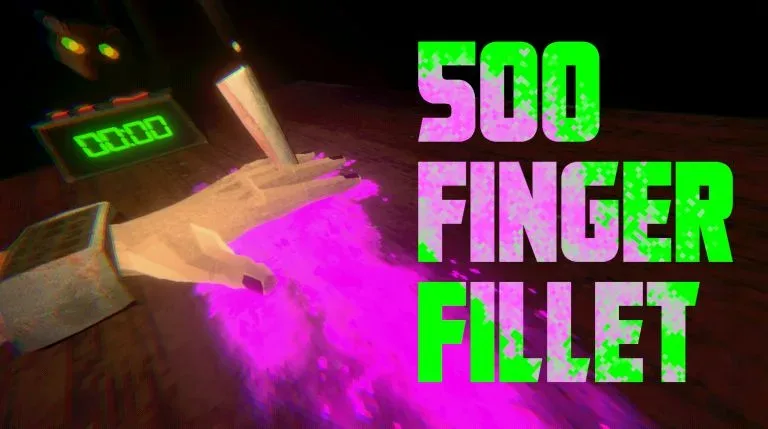
500 Finger Fillet, the horror roguelite from debut studio DEADBODY Games, is scheduled to launch on November 12. The date corrects an earlier December 12 listing. Ahead of release, a new demo is available during Steam Next Fest, offering a broader look at the game’s unnerving central challenge: surviving while handcuffed to a machine that will not release the player until 500 stabs have been made between—or into—their fingers.
It is a deliberately uncomfortable premise, but the game’s structure is more involved than a single test of timing. Players have 20 minutes to get through the ordeal, decide what the machine will stab with, earn money through stabbing, and spend those earnings on items and rings intended to improve their odds. That combination makes every action part reflex challenge, part risk calculation, and part resource-management decision.
A 20-minute horror run built around escalating choices
500 Finger Fillet is described as a single-player horror roguelite. In practical terms, a roguelite is a game built around repeated attempts in which systems, variables, upgrades, or unlocks keep individual runs from playing out exactly the same way. Here, the fixed pressure is especially clear: the player has a 20-minute survival window and a target of 500 stabs before the cuffs unlock.
The game’s tension comes from making progress under a harsh trade-off. Stabbing produces money, and money can be used to acquire items that improve survival chances. But the very act that supplies those resources also carries the risk at the heart of the game. Rather than presenting a clean divide between earning power and personal danger, 500 Finger Fillet ties them together.
That design gives the stated test of nerve, reflexes, and resourcefulness some specific meaning. Reflexes matter because the machine challenge demands player input under pressure. Resourcefulness matters because cash must be converted into helpful purchases at the right time. Nerve is the connective tissue: the player must decide when a dangerous stab is worth attempting and when a safer route or an item purchase may be the better play.
The central objective is also unusually concrete. There is no vague survival meter to interpret: the cuffs stay locked until the 500-stab condition is met. Yet reaching that total is not presented as a simple endurance exercise. The weapon choice, the available purchases, and the run’s modifiers can alter the calculation around each attempt.
What is in the Steam Next Fest demo
The updated demo includes five new knives, alongside new rings and modifiers. Knives are important to the premise because players choose what the machine uses to stab them with; additional options should therefore widen the set of risks and decisions available during a run. The supplied details do not specify the individual properties of those knives, so prospective players will need to discover how each changes the experience in the demo rather than assume they are simple cosmetic variations.
Rings and modifiers expand the game’s system layer. The available information identifies rings as purchases that can help survival chances, while modifiers suggest further effects that can shift the conditions of a run. What those effects are has not been detailed, but their presence reinforces the roguelite framing: players are not merely trying to execute the same hand-stabbing sequence perfectly every time. They are responding to a build, a set of tools, and changing circumstances.
Related coverage includes 500 Finger Fillet Targets November 12 Launch as Steam Next Fest Demo Goes Live.
The demo also contains an unspecified number of new endings, listed as “[Redacted],” an unlockable difficulty setting, and quality-of-life improvements. The redacted ending count means there is no confirmed total to report, but the addition signals that the demo is not limited to a single, obvious outcome. Meanwhile, the unlockable difficulty setting gives players a progression-based reason to revisit its challenge, without confirming precisely how that setting changes the game.
Quality-of-life improvements are generally changes that make a game easier to read, navigate, or manage without necessarily making its underlying challenge easier. No individual improvements have been named here, so it would be premature to claim interface, control, or balance specifics. Still, their inclusion is useful context for anyone who tried an earlier build and is deciding whether the new demo is worth another look.
The risk economy is the game’s defining idea
The most interesting part of 500 Finger Fillet’s setup is its economy of danger. Money is not simply handed out as a reward after overcoming a separate obstacle; it is earned through the same stabbing activity that threatens the player’s ability to endure the run. That makes spending decisions meaningful on two levels. An item or ring might improve later survival prospects, but obtaining the funds for it required taking risks now.
This is where the game’s horror framing can do work beyond presentation. Horror games often create stress through scarcity, pursuit, or limited information. 500 Finger Fillet instead places a mechanical countdown beside a visceral task and asks the player to keep choosing. The 20-minute limit prevents endless caution, while the 500-stab requirement means the player cannot simply wait for danger to pass. Progress itself is the source of pressure.
That structure may appeal to players looking for a compact, repeatable challenge rather than a lengthy campaign. A run has a defined time frame, but its decisions can still vary with knife choices, rings, modifiers, purchases, difficulty options, and potentially its endings. Conversely, the subject matter is intentionally graphic in concept. Anyone uncomfortable with simulated hand injury or body-focused horror should take the premise seriously before jumping in, even though the available details do not describe the game’s visual intensity.
DEADBODY Games’ debut and Heather Flowers’ involvement
500 Finger Fillet is the first project from DEADBODY Games, which is led by Heather Flowers, the creator of Unfair Flips. The connection establishes the creative lead behind the studio’s debut, but the confirmed information does not outline broader studio plans or additional projects. For now, 500 Finger Fillet is the focus: a tightly scoped horror roguelite designed around a single escalating scenario and a set of systems that complicate the route out.
The timing also places it among a busy run of PC game launches scheduled for November. For another upcoming PC release on the calendar, GRAVHOUNDS is set to enter Early Access on November 2 for PC and Xbox Series X|S. 500 Finger Fillet’s current details, however, only identify the Steam Next Fest demo; no additional platform availability has been specified.
What to expect before November 12
The current demo is the clearest opportunity to assess whether 500 Finger Fillet’s mix of tactile pressure, randomizing systems, and purchases lands as intended. Its new content offers more than a basic preview: five additional knives, rings, modifiers, hidden-count endings, an unlockable difficulty option, and quality-of-life updates all point to a build meant to show the game’s replayable structure.
Players should nevertheless keep the known facts separate from the unanswered questions. The release date is November 12. The game is a single-player horror roguelite from DEADBODY Games, led by Heather Flowers. Its objective involves surviving 20 minutes and making 500 stabs to escape the handcuffs, while earning and spending money on survival tools. The demo is live during Steam Next Fest and has added the listed content.
Details such as the exact behavior of every knife, the specific abilities attached to rings and modifiers, the number and requirements of endings, and the exact rules of the unlockable difficulty setting remain undisclosed. That uncertainty is appropriate for a game built around discovery and stressful decision-making, but it also means the demo—not assumption—is the place to learn how far its risk-reward systems go.