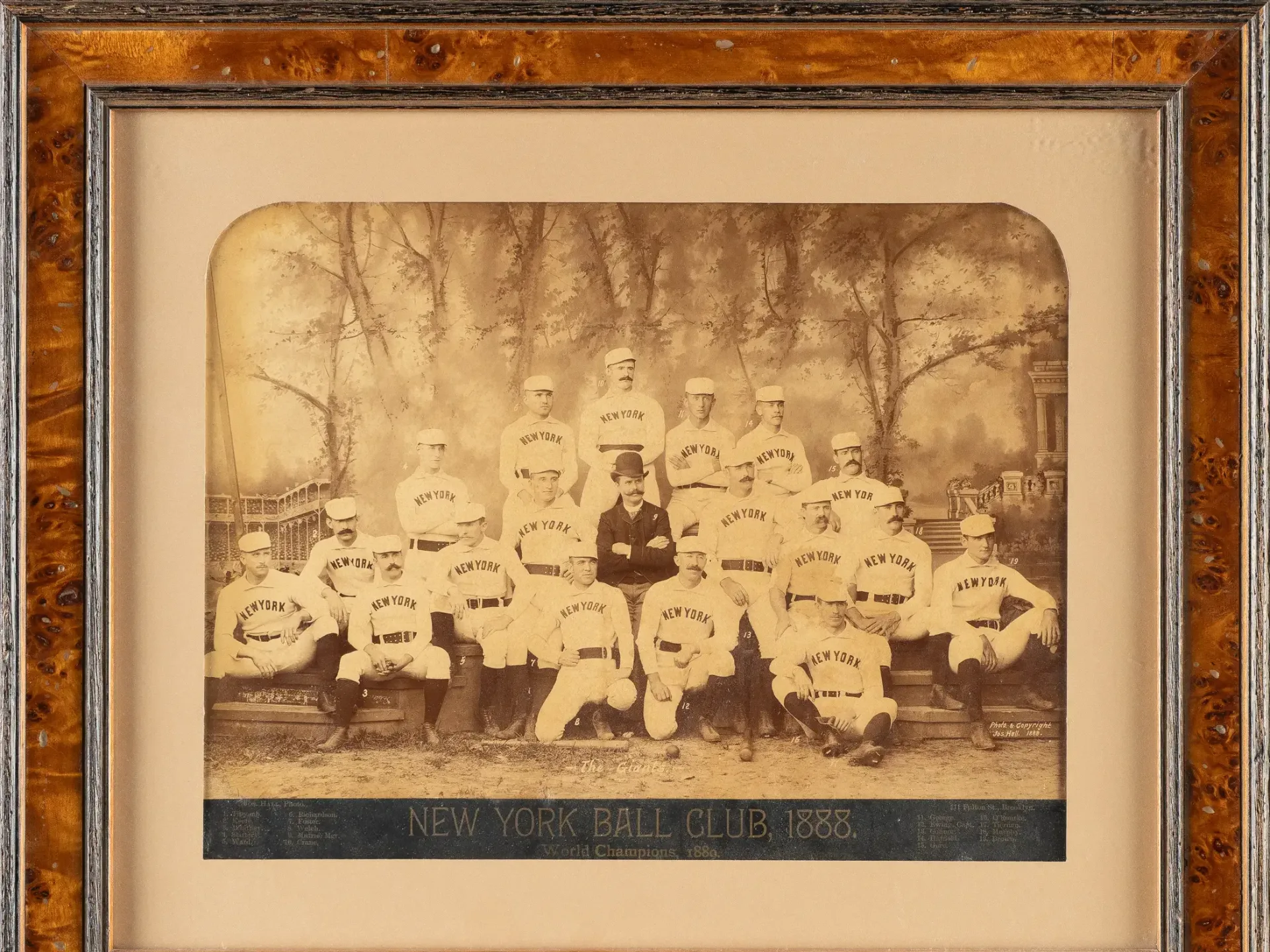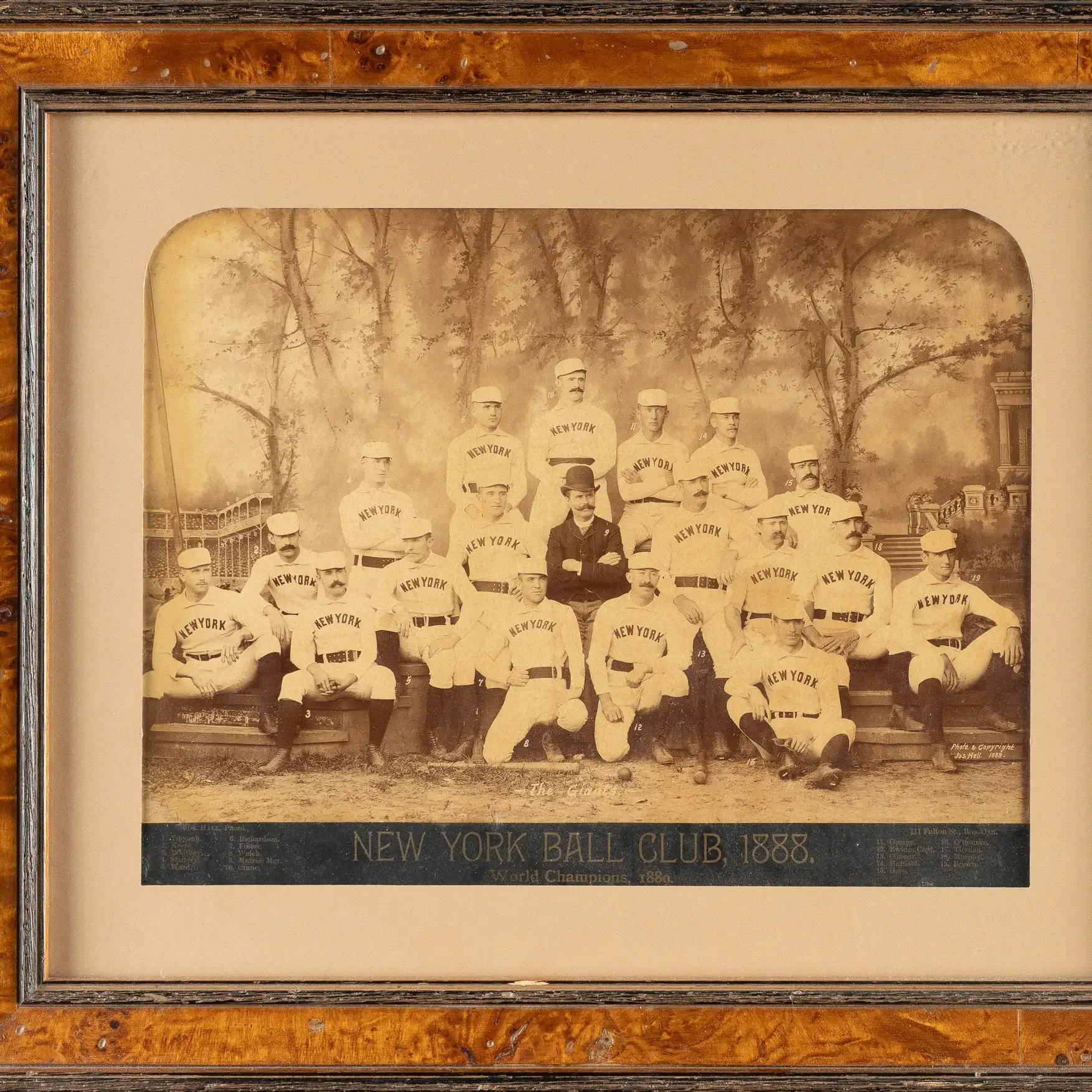
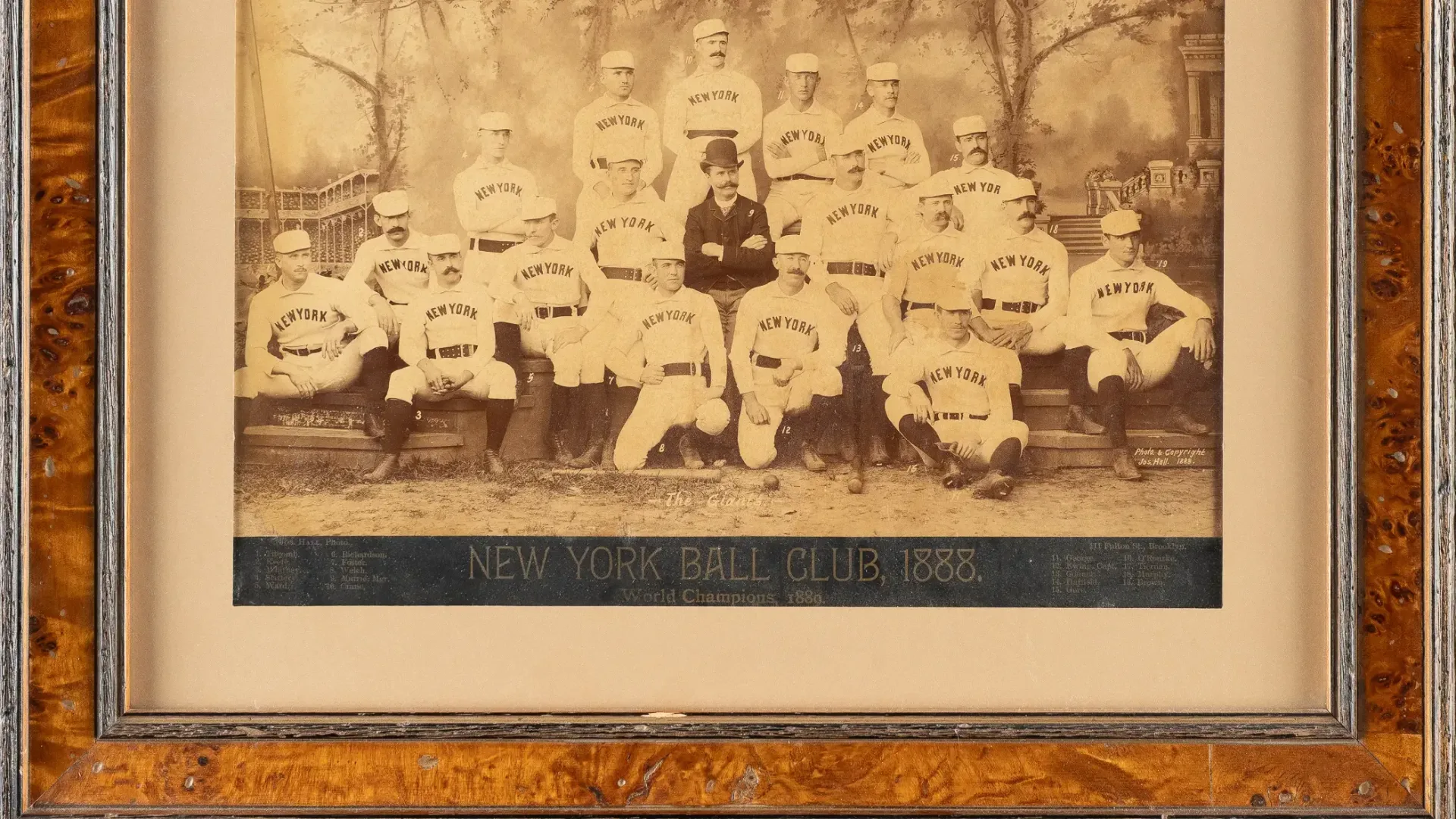
A surviving team image from baseball’s earliest championship era is the standout in Huggins & Scott’s Fall Auction. The lot is an 1889 New York Giants World Champions imperial cabinet photograph by Joseph Hall, depicting a club that had just secured its second consecutive World Series title.
The photograph has an early bid of $9,750 and is described as the only example the auction company has seen. That combination—an unusually early team artifact, championship-specific presentation, and a reported scarcity signal—makes it a notably different kind of centerpiece from the graded cards also offered in the sale.
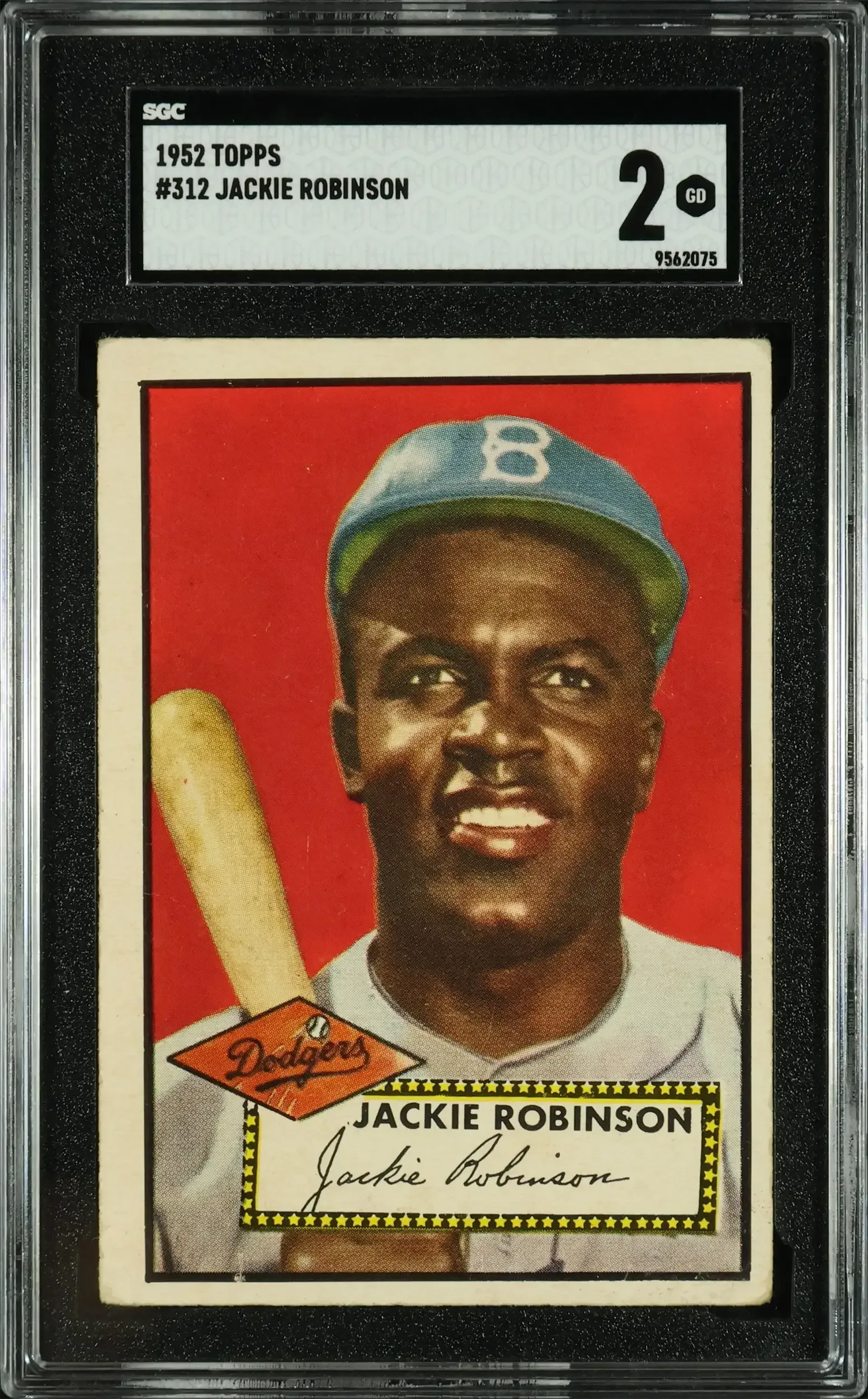
The auction runs through December 3 and ranges across vintage and modern cards, signed material, tickets, memorabilia, and comics. Its sports-card side includes a 1984 Star Basketball #101 Michael Jordan rookie, a 1951 Bowman #253 Mickey Mantle Rookie High Number, and significant rookie cards of Willie Mays, Jackie Robinson, Larry Doby, and Lefty Grove.
A photograph from the Giants’ back-to-back title run
The New York Giants were one of baseball’s first great franchises, winning consecutive World Series in 1888 and 1889. In the latter championship, the Giants defeated the Brooklyn Bridegrooms six games to three.
The Joseph Hall cabinet includes several major names from that team: Buck Ewing, Roger Connor, Jim O’Rourke, and John Montgomery Ward, along with pitchers Tim Keefe and Mickey Welch. Each is identified as a Hall of Famer in the auction material. For collectors, the appeal is therefore layered: this is not simply a period image of an old ballclub, but a title-season team piece tied to a roster filled with historically celebrated players.
Its format matters, too. A cabinet photograph is a mounted photographic display item rather than a trading card. “Imperial” describes a larger photographic format, an important distinction when considering why it occupies a different collecting lane from the auction’s cards. A piece like this is valued as an image, a team document, an era-specific object, and a display artifact at once.
The reported “only one” status should be read precisely. It means the auction company says this is the only example it has encountered; it is not a declared census of every surviving copy. Still, a claim of that nature is meaningful context for prospective bidders because it underscores how seldom such a specific 1889 championship image appears before them.
There is also a practical collecting difference between a one-of-one-seeming photograph and a familiar card issue. Card collectors can often compare public grading populations, past examples, parallel grades, and set demand. An early photograph may require a more object-by-object approach: assessing the exact image, the mount, the presentation, the stated attribution, and the degree to which its historical subject matter fits a collection. Rarity alone does not settle value, but it can make direct comparisons harder to find.
Related coverage includes Rare 1889 Giants Champions Photo Leads Huggins & Scott Fall Auction.
Jordan and Mantle add card-market star power
The auction’s other major headline lots take a more conventional graded-card route. A 1984 Star Basketball #101 Michael Jordan rookie is graded PSA EX 5, while a 1951 Bowman #253 Mickey Mantle Rookie High Number is graded PSA VG-EX 4.
Those labels communicate condition assessments by PSA, with EX short for Excellent and VG-EX for Very Good-Excellent. The numerical scores are not interchangeable with an ungraded card’s appearance or with another grading company’s label; they identify the particular third-party assessment attached to the offered copy. For a buyer, the auction listing’s grade is a concise reference point, not a substitute for reviewing the actual card and its presented details.
The words “High Number” are equally useful context in the two 1951 Bowman rookie listings. They identify cards from the high-number portion of a set, rather than serving as a general claim that a card is high-grade. The Mantle is a #253 high number graded PSA VG-EX 4, and the sale also includes a 1951 Bowman #305 Willie Mays Rookie High Number graded PSA EX 5.
The breadth of eras on offer is notable. Jordan brings a landmark basketball rookie from 1984; Mantle and Mays represent key 1951 baseball rookie cards; while the Giants photograph reaches back to 1889. That spread gives bidders multiple ways to engage with sports history, from a formally graded single-player card to a fragile-looking period team display. Anyone considering card products, graded singles, and newer digital offerings may also find our guide to digital card repacks, checklists, odds, and buybacks useful for separating format-specific questions from the basic task of evaluating what is actually being sold.
Autographs, ticket stubs, proofs, and an early bread issue
Several lots combine a collectible’s base item with authentication or a documented signature. A 1958 Topps #52 Roberto Clemente is listed at PSA VG+ 3.5, with a PSA/DNA 7 autograph. A 1949 Bowman #233 Larry Doby Rookie High Number is listed at PSA EX 5 with a PSA/DNA 7 autograph.
These listings separate the card-grade information from the autograph-grade information. That is important because the condition of a card and the quality assessment assigned to an autograph are different judgments. A collector comparing signed cards should keep both pieces of information in view rather than reducing the item to one number.
The sale also lists a Babe Ruth 1939 100th Anniversary of the Game of Baseball First Day cover. A first-day cover is a mailed or prepared envelope connected to a stamp’s first day of issue, placing it in a collecting category that overlaps sports history and postal memorabilia rather than trading cards alone.
Among the other highlighted pieces are:
- A 1964 Sandy Koufax ticket stub from his third no-hitter, graded PSA EX 5.
- A 1967 Topps Stand-Up #3 Frank Robinson Proof, designated SGC Authentic.
- A newly discovered 1921 Tip Top Bread Baltimore Orioles Lefty Grove rookie, graded PSA POOR 1.
- A 1952 Bowman #101 Mickey Mantle graded PSA 6.5.
- A 1949 Bowman #50 Jackie Robinson rookie graded PSA 5.
- A Cal Ripken Jr. full ticket, signed and inscribed for his August 16, 1981 first hit, graded PSA NM-MT 8.
The Frank Robinson item illustrates an important technical distinction: “Authentic” is not a numerical condition grade. The listing identifies it as SGC Authentic, so bidders should not interpret that designation as though it were an SGC 1 through 10 score. Likewise, the Grove card’s PSA POOR 1 grade emphasizes that historic importance and technical condition can pull in different directions. A rookie card can remain a marquee historical item even when its assigned condition is very low.
What the lineup says about collecting across categories
This auction is built around variety rather than a single set or athlete. The 1889 Giants photograph is an example of prewar photographic memorabilia; the 1921 Tip Top Bread Grove represents an early baseball-card issue; the 1949 and 1951 Bowman cards concentrate postwar rookie-card interest; and the Jordan rookie brings basketball into the mix. Signed cards, a first-day cover, ticket material, and a proof extend the roster beyond standard base cards.
That diversity can be helpful for a collector who has a narrow focus, because it makes each lot’s collecting logic easier to isolate. The Giants cabinet’s central question is its historic team subject and survival. The Mantle, Mays, Robinson, Doby, and Grove cards combine player significance, issue identity, and assigned grade. Signed pieces add autograph authentication. Ticket stubs and full tickets add event-specific context and physical format.
It also means there is no single shortcut for comparing the lots. A $9,750 early bid on the Giants image is a current auction signal, not an automatic benchmark for graded rookie cards, signed cards, or ticket stubs. Different formats have different scarcity patterns, condition expectations, and groups of interested collectors.
“We’re in a very exciting time in the hobby where almost all areas are experiencing substantial growth, and this event is a perfect snapshot of that,” said Ron Oser, vice president and director of consignments at Huggins & Scott.
Oser characterized the auction as a broad cross-section of current collecting interests, from comics and sports memorabilia to vintage and modern cards. The lot list supports that framing: a single sale can place a 19th-century championship photograph alongside cards from the 1920s through the 1980s, then add autograph and ticket collectibles that call for their own standards of evaluation.
Practical points for bidders
The supplied listings provide a starting point, but collectors should distinguish clearly between an item’s identity and the attributes assigned to that particular copy. Confirm the card number, year, player, stated grade, authentication designation, and whether a ticket is a stub or full ticket. These are not cosmetic details; they define the offered collectible.
For the Giants photograph, the primary facts are similarly specific: 1889, Joseph Hall, New York Giants World Champions, the named Hall of Fame players, and the auction company’s statement that it has seen no other example. Treating it merely as “an old Giants photo” would miss the title-year and roster context that make the lot stand out.
Finally, an early bid is not a final realized price. With bidding open through December 3, the final outcome remains uncertain. The important present-day fact is that the cabinet photograph has entered the sale at $9,750, leading an auction that puts rare historical imagery and graded card staples on the same catalog stage.