The Paul Reubens collection is headed to auction beginning October 28, 2026, with more than 400 items connected to the actor and comedian best known as Pee-wee Herman. The sale is set to take place at The Groundlings Theatre in Los Angeles as well as online through Julien’s Auctions, bringing together objects that span screen associations, television production material, promotional ephemera and retail merchandise.
That variety is the point. Not every item in a celebrity collection is valuable for the same reason, and the reported lots illustrate several very different lanes of pop-culture collecting. One buyer may be chasing a recognizable on-screen-adjacent centerpiece. Another may care most about a production-used object tied to Pee-wee’s Playhouse. Others may see the appeal in vintage consumer items that were once meant to be carried to school, displayed in a toy aisle or handed to press during a film campaign.
The result is a sale that offers more than a simple parade of nostalgia. It is also a useful snapshot of how connection, context, condition and completeness can change the character of an auction lot.
The bicycle lot pairs a signature image with a later career artifact
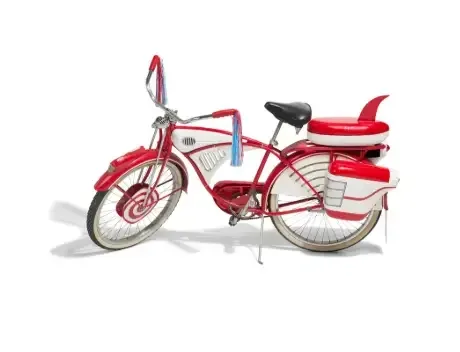
The most immediately recognizable item among the highlighted lots is a full-scale replica of Pee-wee Herman’s red Schwinn DX bicycle from Pee-wee’s Big Adventure. The bicycle is central to the film’s identity, which makes any related display piece easy to understand at a glance even for a collector who has not followed every piece of Pee-wee merchandise.
For more context, explore Vivo X500 Pro Max Puts 4K 240fps Video, Giant Battery and Teleconverters Ahead of a Cleaner Android Experience.
This particular lot has an additional documented association: Reubens rode it in character while accepting an honorary Visionary Award at the 2011 Spike TV Scream Awards. The award itself, still in its box, is included with the bicycle. The reported high bid was $8,000 at the time the listing was highlighted, though interested bidders should treat any pre-sale figure as a moment in an active auction rather than a final valuation.
There is an important collecting distinction in the wording here. This is described as a replica bicycle, not the original bicycle used in the film. A replica is a reproduction of a design or object; it should not be confused with a screen-used prop simply because it closely evokes one. That does not make the lot minor. Its appeal comes from a combination of visual recognition, Reubens’ later use of it in character, and the inclusion of the 2011 award. But collectors comparing lots should be precise about what each connection actually is.
In practical terms, this is the kind of piece where display needs matter as much as the hammer price. A full-scale bicycle needs room, protection and a plan for presenting both the vehicle and the boxed award without separating the visual story that makes the lot compelling. It is a statement piece, not a binder-page collectible.
Related coverage includes Paul Reubens Collection Heads to Auction With Pee-wee Bike, Playhouse Props and 400-Plus Pieces.
A press kit preserves the promotional side of a movie
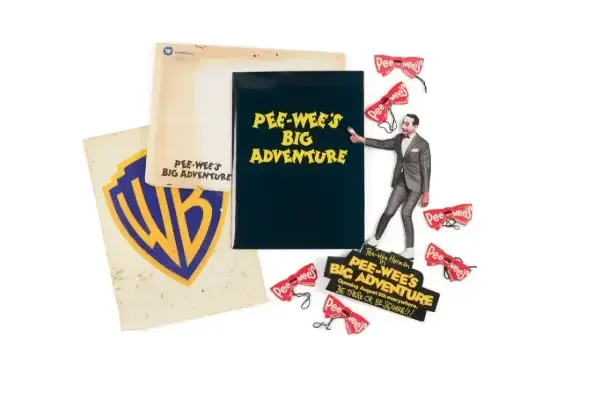
The Pee-wee’s Big Adventure press kit and promotional-items lot represents a quieter, but distinctly collectible, part of film history. Press kits were materials distributed during a film’s promotional push, including at press events often called junkets. Their original job was functional: to give media outlets material that could support coverage. Decades later, they can serve as surviving physical evidence of how a movie was presented to journalists and the public.
The reported high bid for this lot was $600. That lower figure relative to the bicycle does not make it unimportant; rather, it demonstrates that collecting can be built around documentary interest as well as spectacle. Promotional ephemera—items made for publicity rather than general retail sale—can carry a different kind of appeal. It is usually more compact, easier to store and richer in period design details than a large prop or display item.
For bidders, completeness is a key question with a press kit. The practical meaning of “kit” is that its components work together. A collector should review the lot description and photographs closely to understand what promotional items are included, how they are presented and whether the catalog identifies their condition. The value of a press artifact can depend not only on its association with a film, but also on whether it remains a coherent package.
Sealed Matchbox dolls are a different collecting proposition
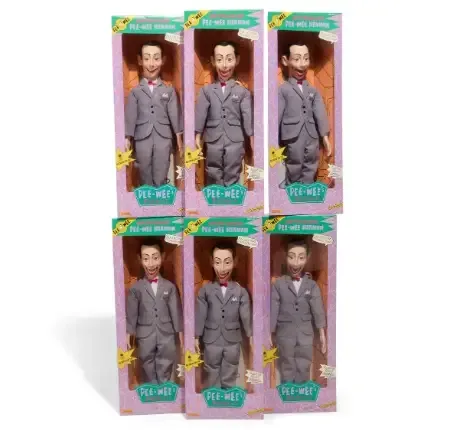
A set of six Pee-wee Herman Matchbox ventriloquist dolls, reportedly still in original packaging, was listed with a high bid of $1,250. Matchbox may be widely associated with miniature die-cast vehicles, but the company also made toys outside that familiar category. This lot points to the breadth of Pee-wee-related retail merchandise and to the different priorities that come with packaged toys.
Original packaging means the packaging that accompanied the item when sold new. In collector terms, it can matter for several reasons: it supplies period graphics, identifies the product line, protects the item and helps preserve the way the toy was originally marketed. However, “in original packaging” is a description, not a universal guarantee of pristine condition. Packaging can have wear, fading, dents, tears or other age-related issues. Collectors should distinguish between an item simply retaining its package and one whose package remains in exceptionally strong condition.
The set format is also notable. A group of six dolls gives a buyer a more complete representation of the line than a single figure would. At the same time, it presents a decision after purchase: preserve the lot as one group, or display the individual dolls together while keeping their packaging protected. The source material identifies these as a set, and keeping the grouping intact preserves the auction’s original presentation of the objects.
Unlike the bike lot, the dolls are not primarily about a single public appearance or a production connection. Their attraction is retail history: a tangible reminder that the character and television series existed not just on screen, but in everyday toy culture.
Playhouse wall panels offer the strongest production connection
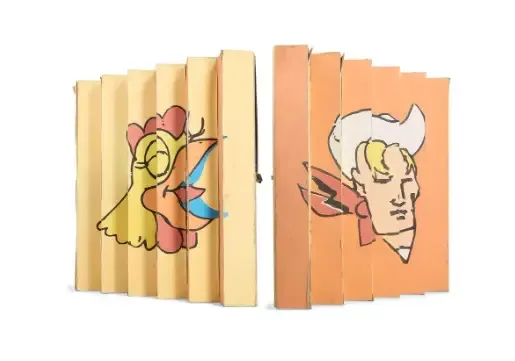
The Pee-wee’s Playhouse double-sided wall panels stand apart because they were featured in the show’s opening titles. Reported at a $3,000 high bid, the panels offer a direct connection to the visual world viewers would recognize from the program rather than merely a licensed image inspired by it.
In memorabilia language, an on-screen item is one visible in filmed footage. That is different from a prop that was made for production but never appears on camera, and different again from commercial merchandise. The distinction matters because visibility can give a production object an especially clear narrative. Here, the opening-title connection is particularly useful: the lot’s association is not an abstract claim that it belonged somewhere behind the scenes, but a stated appearance in a highly recognizable part of the show.
The fact that the panels are double-sided adds an appealing physical dimension. Television sets are often encountered by audiences only as a framed image; a double-sided panel is an object that can reveal more of the constructed environment than the final screen composition did. Still, bidders should avoid assuming unlisted details about how the panels were installed, used or displayed. The supported connection is their appearance in the opening titles, and that is substantial on its own.
Wall panels also bring special logistical considerations. Their dimensions, mounting requirements and fragility are central to whether a buyer can properly care for them. A large production object can be exciting precisely because it is unusual, but it demands more preparation than a boxed toy or paper press kit.
Two 1987 lunchboxes capture the retail memory of Playhouse
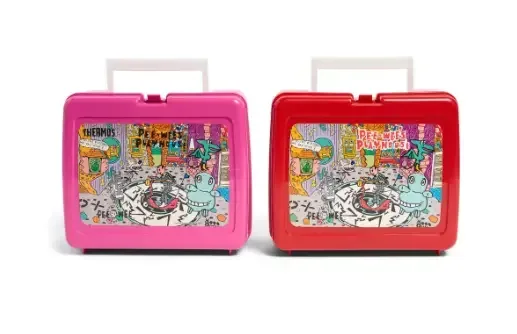
The auction also includes two 1987 Pee-wee’s Playhouse Thermos lunchboxes: one pink plastic lunchbox and one red plastic lunchbox. Each is accompanied by a matching-color thermos and carries colorful illustration connected to the series. The reported high bid was $500 for the pair.
Lunchboxes are practical objects transformed by time into pop-culture artifacts. Their appeal lies in their original use as much as in the characters and artwork printed on them. A paired lot with thermoses has an advantage in storytelling because it preserves more of the complete school-day object than an empty lunchbox alone. The two-color format also makes it a visually varied display lot rather than a duplicate pair.
For a collector considering vintage plastic lunchware, condition is likely to matter in highly visible ways. Surface wear, cracks, missing pieces, discoloration and the state of the illustrated areas can all affect presentation. The listing’s stated inclusion of both lunchboxes and their corresponding thermoses is therefore significant: the buyer is bidding on two coordinated sets, not just containers bearing a familiar logo.
Its price level also makes the lunchbox lot a useful reminder that major collection auctions can contain different entry points. The bicycle and wall panels may draw attention because of scale and screen associations, while the lunchboxes provide a more domestic and retail-focused route into the same cultural world.
How to read the auction without confusing nostalgia for documentation
All five highlighted lots are linked by Pee-wee Herman, but their collecting cases are not interchangeable. The bicycle is a replica with documented use by Reubens at a 2011 awards event and a bundled award. The wall panels have an explicitly stated opening-title appearance. The dolls are packaged retail toys. The press kit is promotional material, while the lunchboxes are period consumer products.
That is why the most useful way to evaluate them is to start with the catalog language rather than with a general feeling of nostalgia. Ask what the item is, what its stated association is, what is included, and what needs to be protected after purchase. A set may be more meaningful when kept together. A large object may require professional shipping or dedicated wall space. A boxed item may deserve protection from light and handling. These are practical concerns, but they also help preserve the traits that make each object collectible.
The high bids reported for the lots are best read as indications of early interest, not forecasts. Auctions can change quickly, and bidders should consult the relevant listing for current status and lot details. Those looking specifically at the bicycle-and-award package can review the bicycle lot’s catalog page.
The broader significance of the Paul Reubens sale is its range. It makes room for the oversized iconography of a red bicycle, the production-built texture of Playhouse panels, the small-scale charm of packaged dolls and lunchboxes, and the paper trail of a movie campaign. Together, those categories show why a personal collection can become a compelling auction: it contains not one version of a cultural legacy, but several.