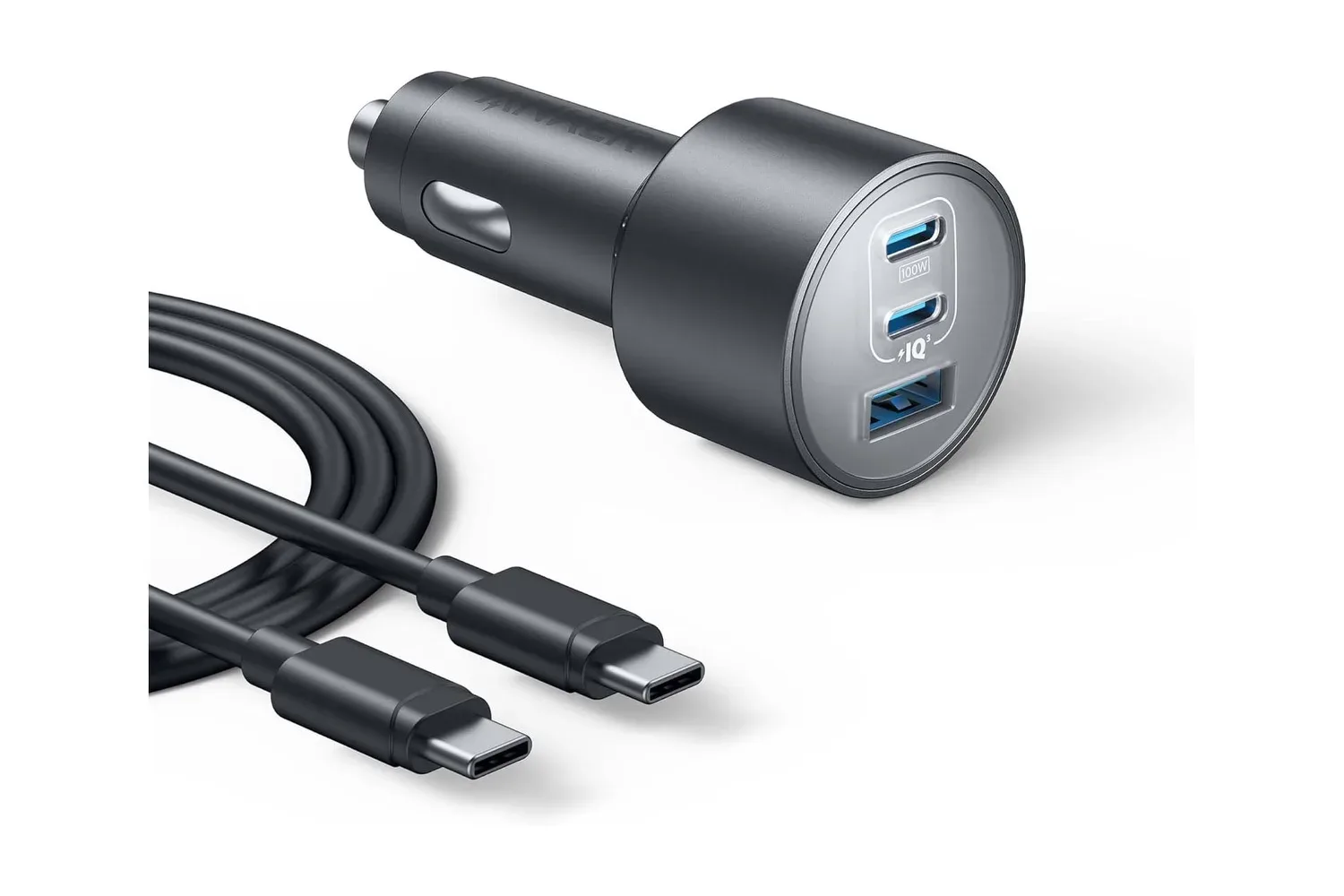
For people whose travel setup includes more than a phone and a navigation app, a car charger’s wattage can make a meaningful difference. Anker’s 167.5W Max 3-Port Ultra-Compact USB-C Fast Charging Car Charger is listed at Amazon for $34, a $20 reduction from its stated usual $54 price. That represents a 37% discount.
The headline number needs a little decoding before it earns a place in a glove box. This is a three-port vehicle charger with two USB-C connections and one USB-A connection. Its 167.5W maximum output is shared across all connected hardware; it is not an assurance that every port can provide that amount simultaneously. Crucially, though, one USB-C port can supply up to 100W to a single device. That is the part that moves this accessory beyond the ordinary phone-focused car charger.
A 100W-capable USB-C port can charge a MacBook Pro while the vehicle is running. For someone moving between work, school, events or long drives, that can turn a vehicle socket into a credible top-up point for a laptop rather than merely a place to slow battery loss. The difference matters especially when a machine is being used during a journey, or needs enough charge to be useful immediately after arrival.
It is also a practical contrast with basic car chargers, which are commonly limited to roughly 12W per port. Those lower-power models can still be perfectly adequate for a phone, particularly when it is sitting idle. But a phone actively running maps can consume enough energy that a modest charger is more about limiting the decline than rapidly replenishing the battery. A laptop creates a much larger demand again.
What the 167.5W rating does—and does not—mean
Watts measure electrical power. In straightforward terms, a higher wattage ceiling can allow compatible equipment to receive power more quickly, provided the device, cable and charging standard all support it. The most useful figure here for a one-device setup is the charger’s stated 100W maximum from a single USB-C port.
The overall 167.5W figure becomes relevant when multiple devices are connected. A car full of hardware could include a front-seat phone, a rear-seat tablet, earbuds and a laptop. The three available ports give users flexibility to charge up to three devices at once, including older USB-A accessories without forcing an immediate cable replacement.
But shared output is a budget, not magic. When several devices are drawing power, their combined needs are handled within the charger's maximum capacity. The unit is described as dynamically dividing available power according to what each device requires rather than assigning an identical share to every port. In real-world terms, that is designed to avoid a situation where a low-demand accessory receives a needlessly large allocation while a higher-demand device is constrained.
That does not mean every connected product will charge at its own theoretical peak rate in every three-device arrangement. The exact result depends on what is plugged in and what those devices request. Buyers with a laptop as the priority should view the 100W single-port specification as most relevant when that laptop is the principal load, while treating the combined 167.5W figure as useful headroom for mixed-device travel.
Why USB-C standards matter more than the port shape
USB-C describes the connector, but the connector alone does not guarantee laptop-level charging. Anker lists support for Power Delivery, often shortened to PD, and Programmable Power Supply, or PPS. These are charging protocols: sets of rules that let a charger and a connected device communicate about power delivery.
Power Delivery is particularly significant in this case because it is the standard associated with higher-power USB-C charging, including compatible laptops. PPS is a related capability intended to enable more granular adjustment of charging power for compatible devices. The charger is described as negotiating the fastest possible charging speeds with Apple, Samsung and Google devices without requiring additional adapters.
Compatibility still sits at the center of the purchase decision. A device has to support the relevant charging method to take advantage of it, and the cable matters too. A USB-C cable that is unsuitable for the required power level can become the limiting factor even if both the charger and laptop are capable. The presence of a 100W-capable port should therefore be read as potential available from the charger, not a universal promise that every USB-C gadget will accept 100W.
The remaining USB-A port is a modest but sensible inclusion. USB-A is the familiar rectangular connection found on many existing charging cables and accessories. Keeping one around means a traveler can continue using an older cable already stored in the vehicle while newer phones, tablets or computers use USB-C.
A small charger with a large stated output
Anker attributes the compact design in part to gallium nitride, usually abbreviated as GaN. This material is used in place of traditional silicon-based technology in charging equipment. The relevant practical benefit is that GaN can handle higher temperatures and voltages, allowing components to be arranged more closely within the charger housing.
That component density is why a high-output vehicle charger can be smaller than readers might expect. In a dashboard-mounted installation, physical size is more than a cosmetic issue. A bulky accessory can stick out from the socket and occupy more of the already limited cabin space. Anker says this model does not project outward in the manner of bulkier options.
Compactness should not be mistaken for an irrelevant luxury when the use case is a car. Vehicles are full of cables, cup holders, gear selectors, storage compartments and passenger movement. A lower-profile charging unit can make it easier to keep that area less cluttered, particularly when several people are charging at once.
Heat is a real part of vehicle charging
Vehicle conditions are harsher than a desk in a climate-controlled room. A dashboard socket and the equipment connected to it may be exposed to direct sunlight for long stretches. Temperature is therefore not merely an abstract specification for a high-output charger; it is a long-term reliability consideration.
The charger is described as continuously monitoring temperature in normal operation and automatically adjusting output to maintain safe temperatures. This kind of management means charging performance can be moderated when necessary rather than treating the maximum power rating as a fixed target under every condition. That is a sensible trade-off: the fastest conceivable charge is less valuable if it cannot be maintained safely in a hot vehicle.
For prospective buyers, the practical takeaway is to think about the environment as well as the port count. A charger that is intended to power a laptop from a vehicle socket is handling a more ambitious role than a basic phone adapter. Active temperature monitoring addresses one of the obvious complications of that role, especially in sun-exposed cabins.
Who this charger appears to suit
The $34 listing is most compelling for drivers who can genuinely use higher power. A person who only charges one phone occasionally may not need 100W laptop capability or 167.5W of combined capacity. A less capable accessory could cover that narrower job.
By contrast, this model makes a clearer case for people who work from a laptop while traveling, need to arrive with a computer charged, or regularly carry multiple devices. Families and carpoolers can also benefit from the mix of two USB-C ports and a USB-A port, since it accommodates both newer cables and legacy accessories.
It also fits a broader reality of modern portable electronics: the most convenient charger is not necessarily the one with the most ports, but the one with sufficient output for the device that matters most at that moment. Here, the ability to send up to 100W through one USB-C port is the key differentiator, while the other two ports make the charger more useful once the car becomes a shared charging space.
Readers weighing a broader mobile-device purchase may also find useful context in this look at the Galaxy Z Fold8 deal and its trade-in math. Any portable-device setup is ultimately only as convenient as its charging plan, particularly on the road.
Warranty and buying checklist
Anker backs the charger with a 24-month warranty. That coverage is relevant because the device is meant to operate in an environment where heat and frequent plugging and unplugging are routine. It does not replace sensible compatibility checks, but it is a stated part of the package.
- Prioritize the correct number: for one compatible laptop, the notable specification is up to 100W from one USB-C port.
- Remember that 167.5W is combined: three connected devices draw from a shared maximum output.
- Check the device and cable: a USB-C connector does not by itself establish 100W charging capability.
- Use the port mix strategically: two USB-C ports cover newer gear, while USB-A supports existing cables and accessories.
- Consider cabin heat: the charger monitors temperature and may adjust output to maintain safe operating temperatures.
At its listed $34 price, this is not simply a cheaper way to add another phone charger to a car. Its value proposition rests on bringing up to 100W USB-C charging, three-port flexibility and compact GaN construction to a vehicle socket. For the right mix of laptop, phone and passenger devices, that is a much more substantial upgrade than the typical low-power adapter.
Shop the products
Check current price, model and availability at the retailer.