


 Joseph ZadaHaymitch Abernathy
 Mckenna GraceMaysilee Donner / Merrilee Donner
 Ralph FiennesPresident Coriolanus Snow
 Jesse PlemonsPlutarch Heavensbee
 Glenn CloseDrusilla Sickle
 Whitney PeakLenore Dove Baird
 Elle FanningEffie Trinket
 Kieran CulkinCaesar Flickerman
 Maya HawkeWiress
 Kelvin Harrison Jr.Beetee Latier
 Lili TaylorMags Flanagan
 Ben WangWyatt Callow
The Hunger Games: Sunrise on the Reaping returns to Panem with a built-in contradiction. Set during Haymitch Abernathy’s adolescence, it has a compelling subject in the future mentor whose hard-won cynicism helped define the earlier films. Yet it also arrives in a franchise whose rituals are deliberately recognisable: selection, public spectacle, cosmetic preparation, political coercion, and an arena built to turn young people’s deaths into entertainment. The film can make those rituals tense and ugly, but it does not consistently make them feel newly discovered.
This is a prequel positioned between The Ballad of Songbirds & Snakes and the original Hunger Games films. That placement gives it access to familiar institutions at a different stage of Panem’s history, while also leaving it burdened by what viewers already know of the world and Haymitch’s future. The result is a competent, often entertaining franchise chapter that feels more supplementary than essential: a diversion with sharp moments of personality, but one that struggles to escape the outline of earlier stories.
A younger Haymitch enters a familiar machine
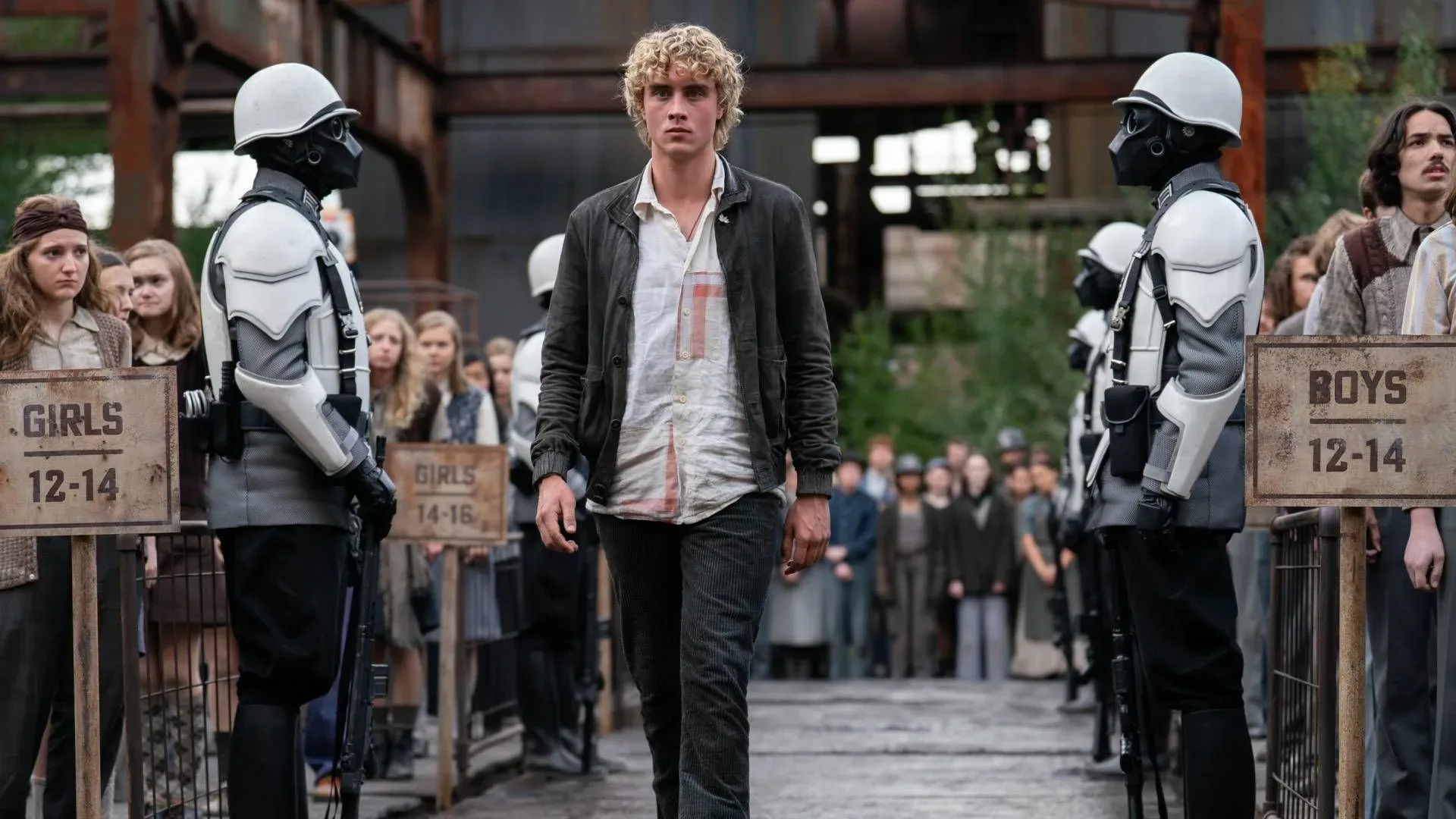
Joseph Zada plays Haymitch as a 16-year-old from District 12, long before the character becomes the alcoholic mentor played by Woody Harrelson in the original films. Panem remains a post-nuclear nation organised into districts and ruled by the affluent, overbearing Capitol. The annual Hunger Games are the regime’s central display of control, forcing districts to provide young contestants for a televised death match. For the 50th anniversary, the Capitol escalates the punishment by requiring four young people from every district rather than two.
Haymitch is drawn into the contest after another would-be contestant is shot. From there, the narrative sends him through a route that will be instantly legible to franchise viewers: the ceremonies surrounding the Games, the makeovers and parades, a growing resistance-minded plan against Panem’s rulers, and entry into the arena with a strategy intended to disrupt its design.
There is real dramatic value in watching an authoritarian system turn procedure into spectacle. The public-facing glamour is not separate from the violence; it is part of the violence. The film’s premise keeps that connection clear, presenting the Capitol’s showmanship as an instrument of humiliation and political suppression. Its focus on teenagers compelled to perform for a deadly broadcast preserves the franchise’s most corrosive idea: that state power can package cruelty as mass entertainment.
But the same structure that makes the film immediately accessible also exposes its limitations. Haymitch’s path closely resembles Katniss Everdeen’s, from the grooming of a tribute into a public figure to a challenge against the rules of the arena and the government behind it. Familiarity is not inherently a problem for a prequel; repetition can reveal how a system reproduces its abuses. Here, though, the parallel too often reads as a retread rather than a purposeful variation. The story supplies another version of established Hunger Games beats without finding enough new dramatic shape between them.
The arena supplies the film’s fiercest energy
Where Sunrise on the Reaping most clearly distinguishes itself is in its appetite for grotesque invention. The arena deaths are designed with a darkly playful nastiness, including a lethal chariot incident and attacks involving rampaging robot squirrels. Those details underline the Capitol’s malicious imagination: even the mechanisms of death must be made into memorable programming.
The tone has an intentionally storybook-meets-nightmare quality. Its cruelty toward children is so exaggerated that it can feel almost gleefully macabre, but the exaggeration serves a point. Panem’s leadership does not simply accept the suffering of the young; it curates that suffering. The more inventive eliminations give the film a jolt of character because they make the regime’s sensibility palpable—ornate, childish, and monstrously indifferent.
That energy also sharpens the viewing experience. The arena material is not described as restrained realism, and it should not be mistaken for one. Its heightened violence is closer to political grotesquerie, using absurdly elaborate threats to emphasise the obscene distance between the Capitol’s entertainment values and the contestants’ humanity. When the film leans into this grim theatricality, it finds a nasty pulse that a more routine franchise replay lacks.
Still, strong individual set pieces cannot entirely solve the broader sense of déjà vu. The contest remains the franchise’s most reliable dramatic engine, but its presence also invites comparison with earlier arenas and earlier rebellions. The film’s best sequences demonstrate that there are fresh variations available within Panem’s machinery; the larger narrative does not always build enough on those variations.
Glenn Close gives the Capitol a memorable face
Among the supporting cast, Glenn Close stands out as Drusilla Sickle, a figure positioned as a predecessor to Effie Trinket. The character’s design and manner are pointedly excessive: part ominous child-snatcher, part warning about cosmetic self-invention taken to grotesque extremes. Close brings a welcome specificity to a film that can otherwise feel bound to familiar franchise functions.
Drusilla embodies one of the series’ most effective tonal contrasts. The Capitol’s officials can be funny in their artifice, yet that artifice never neutralises their role in the system. It makes them more unsettling. A character like Drusilla turns bureaucratic participation in atrocity into a flamboyant performance, which is precisely why she registers. The role gives the film a burst of eccentric, unpleasant life without losing sight of the institutional cruelty beneath the costume.
Zada’s Haymitch carries the central task of making a known future character feel immediate in his earlier years. The film gives him a clear circumstance—a District 12 teenager forced into the expanded anniversary Games—and a familiar arc of resistance. However, the reviewable limitation lies less in the premise of a younger Haymitch than in how tightly his journey echoes what audiences have seen before. The character’s story is framed by information viewers already possess, and the screenplay’s reliance on parallel beats can make this chapter feel like explanatory backfill rather than a fully independent dramatic necessity.
Jennifer Lawrence appears briefly as Katniss. Her return has obvious franchise significance, but the appearance is too short to materially change the film’s centre of gravity. It functions as a connection to the earlier films rather than a major new strand of the story.
Confident craft, constrained novelty
Francis Lawrence, who has directed every entry in the series apart from the first film, handles Panem with assurance. The world-building and cast management are dependable strengths. That continuity matters in a setting built on contrasts between deprived districts and the Capitol’s aristocratic excess; the film evidently understands the visual and tonal language that makes those contrasts legible.
Yet confidence in execution is not the same as renewal. The film knows how to stage the franchise’s signature apparatus, but it has difficulty finding a sufficiently different purpose for it. The parades, transformations, political plotting and arena gambits all work as components of a Hunger Games story. Their cumulative effect is less persuasive because they so closely resemble the components that worked more powerfully in the original run.
That makes Sunrise on the Reaping a reasonable choice for viewers who want more Panem and are receptive to a return to its established rhythms. The cruelty has bite, the Capitol gets a vivid new supporting presence in Drusilla Sickle, and the filmmaking keeps the world coherent. Viewers seeking a prequel that radically reorients their understanding of the franchise, however, may find its strongest ideas and dramatic movements overly familiar.
For related franchise coverage, see Whitney Peak on Lenore Dove’s connection to Lucy Gray.
Final take
The Hunger Games: Sunrise on the Reaping is a solid, watchable return to a world still capable of conjuring unsettling images of power disguised as pageantry. Its most memorable material is the nastily imaginative arena carnage and Glenn Close’s sharply stylised Capitol operator. But Haymitch’s story is pulled through too many recognisable franchise stations, leaving the film caught between effective repetition and the need to justify why this particular return had to happen. It offers enough menace and personality for committed fans, while stopping short of recapturing the fresh impact of the earlier films it repeatedly recalls.