For a game that asks players to spend plenty of time crossing open ground, World of Warcraft: Forever has given tauren a wonderfully on-brand answer to the question of how to get somewhere faster: put your head down and keep running.
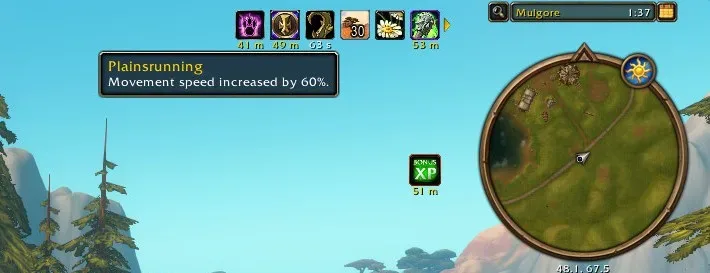
Plainsrunning, the long-dormant tauren racial ability, has returned in Forever with a substantial movement-speed payoff. A tauren can begin using it at level 1 and, if they continue moving without stopping or entering combat, gradually build toward a 60% movement-speed increase. That is the same increase associated here with an apprentice-level mount, normally not obtained until level 40.
The important word is gradually. Plainsrunning is not a button that turns a tauren into an immediate blur. It builds in stacks over uninterrupted travel: one stack arrives every few seconds, each stack contributes 2% movement speed, and the cap is 30 stacks. The full bonus therefore requires a sustained run through safe terrain. Stop to gather a Peacebloom, get into a fight, or otherwise break that rhythm, and the appeal of the ability is no longer an instant shortcut.
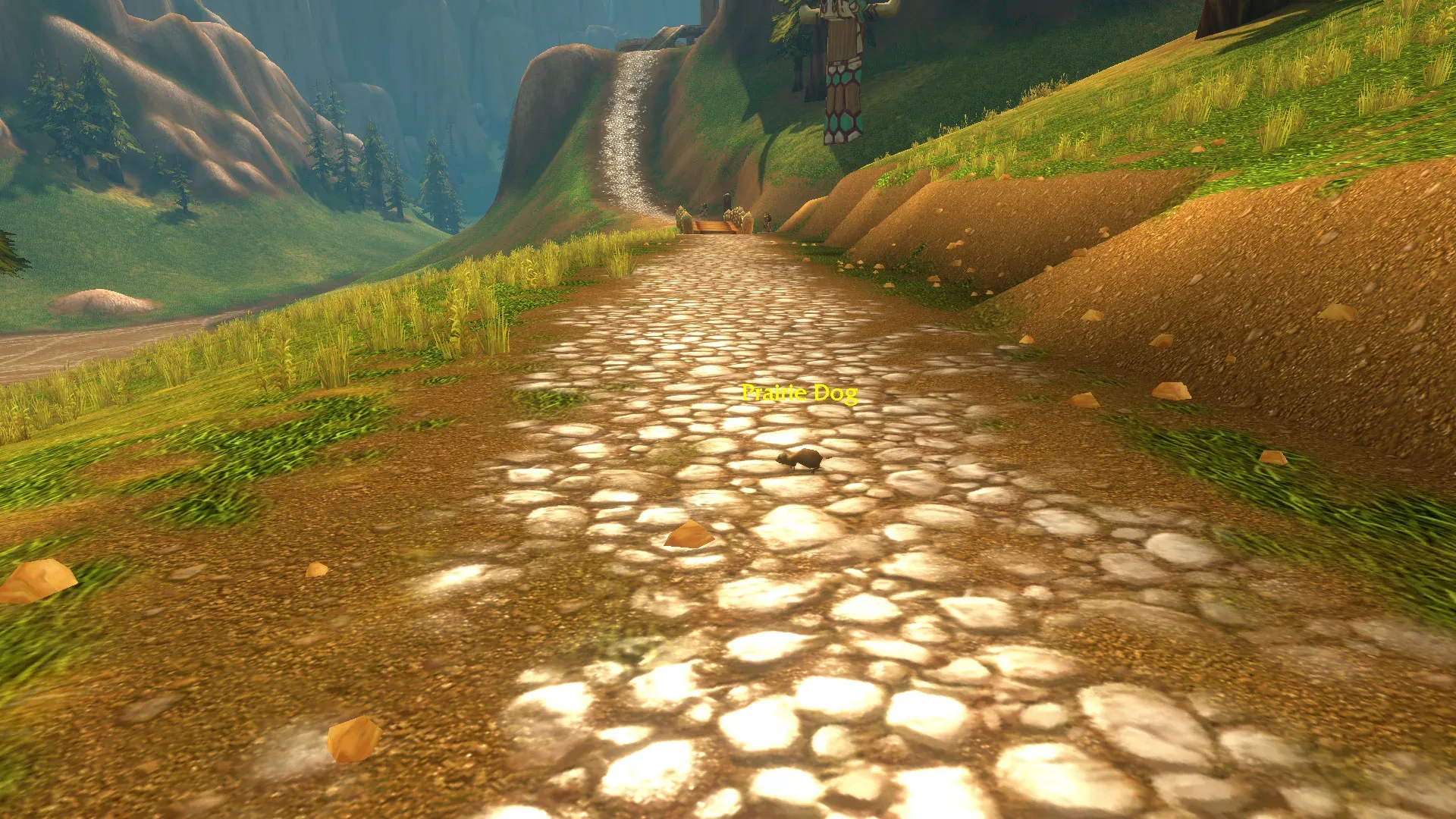
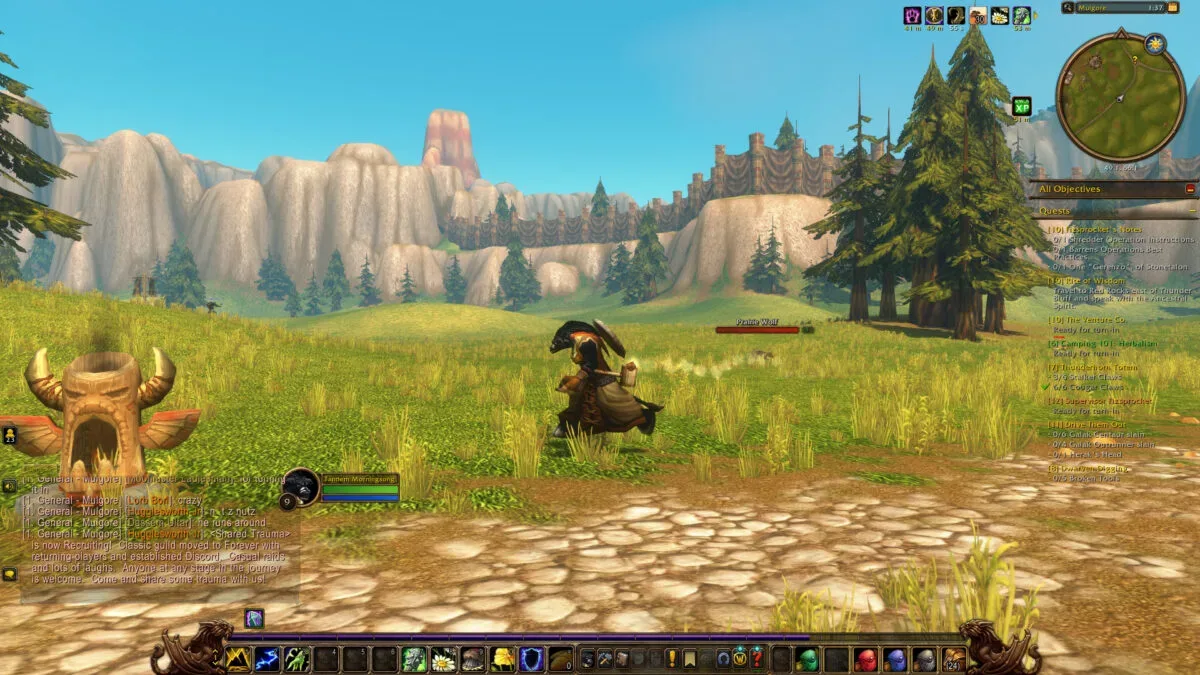
That limitation is exactly why the design is more interesting than a flat, always-on racial movement advantage. Plainsrunning rewards the kind of long overland travel that defines the early experience, particularly across broad spaces such as Mulgore, while doing little for quick bursts between nearby objectives. It is a travel tool with a cowbell, rather than a universal combat power wearing a travel hat.
A strange old racial ability gets a second life
Tauren are the humanoid, cow-like people of World of Warcraft, and race-specific abilities have long been part of how characters distinguish themselves. Those racial kits have changed as the game has been rebalanced, but Plainsrunning occupies an unusual place in the game’s history because it once represented an alternative to the ordinary mount system.
In the original beta, tauren were the lone race without a level-40 mount. Instead, they had a quest that taught Plainsrunning, allowing them to travel at a mount-equivalent pace. The apparent practical issue was easy to imagine: tauren are large, bulky characters, not a clean fit for the standard horse setup. Eventually the concept was removed and tauren received kodos to ride. Plainsrunning then faded into the kind of early-development curiosity players remember more as trivia than as a living part of a character’s tool kit.
Forever first brought it back during its beta, but in a revised form. Rather than simply functioning as an equivalent replacement for riding, the new version ramped up speed as the tauren stayed in motion and out of combat. That framework creates a meaningful distinction between a short run and an extended trek. It also gives the ability a natural counterweight: the player has to protect the run.
After the beta ended and before launch, the cap was raised to 60%. That number changes the conversation. At maximum stacks, Plainsrunning is no longer merely a flavorful nod to an abandoned beta idea. It is a genuine early-level mobility advantage for the situations in which it can be maintained.
How the 60% bonus works
“Movement speed” is a straightforward term, but its practical meaning can get muddled when an ability builds over time. In this case, Plainsrunning is best understood as a stacking travel effect, not a permanent 60% racial bonus.
- Availability: Tauren can use it from level 1.
- Stack value: Each Plainsrunning stack grants 2% additional movement speed.
- Maximum stacks: The effect reaches 30 stacks.
- Maximum bonus: 30 stacks multiplied by 2% equals 60% movement speed.
- Condition: The tauren must keep moving and avoid combat.
- Practical consequence: It is strongest on long, quiet routes rather than during active questing stops or combat-heavy travel.
The stacking model matters because it prevents a simplistic comparison of “tauren at level 1” versus “everyone else before level 40.” A new tauren does not leave the starting area already traveling at the full 60% bonus. They earn it over distance. But older-style World of Warcraft travel contains exactly the kind of extended stretches that can make a gradual ramp feel valuable.
That is especially true when a route is mostly open and the next target is far away. A player can set a direction, keep the character moving, and let the stacks accumulate. By contrast, a densely packed area filled with enemies, gathering nodes, and frequent course corrections is likely to deny the ability its ideal conditions. This is not an answer to every trip. It is an answer to the long road.
A boost that preserves the journey’s pace
There is an enjoyable tension in the revival. Older versions of World of Warcraft are often valued for a slower rhythm, including the time spent physically moving through zones and across continents. Travel is part of the texture: it gives land scale, makes distant places feel distant, and turns a trip into something more than a loading-screen transition.
A full-speed movement option at level 1 could have threatened that feeling if it arrived instantly and worked everywhere. Plainsrunning’s ramp instead makes speed feel like a reward for committing to a route. The tauren still has to cover the ground. They still have to avoid interruptions. They just become more efficient as the journey settles in.
That is a notably elegant fit for the race’s identity. A kodo is the obvious visual expression of tauren travel, but the old Plainsrunning concept was always stranger and arguably more memorable: no mount, no borrowed animal, just a very large person with hooves making impressive progress through the grass. The modern version retains that joke and gives it a clear gameplay purpose.
It also avoids making the racial ability feel mandatory in every moment. In combat, Plainsrunning is not the deciding factor described here. During repeated stops, it cannot reach or hold its ideal value. Its niche is specific enough that the bonus reads as flavor with real utility, rather than an all-purpose advantage that would reshape every encounter.
What it changes for early tauren characters
The most immediate implication is simple: a tauren player has an unusual incentive to think about route planning from the beginning. If several objectives lie in the same direction, it may be worth arranging them into one uninterrupted run instead of bouncing back and forth. If a destination is across an open, low-risk stretch, remaining on course becomes more valuable as stacks build.
That does not mean players should ignore nearby herbs, enemies, or objectives solely to preserve Plainsrunning. The effect’s conditions make it a bonus to capitalize on when the road is already clear, not a command to play against one’s goals. Gathering a Peacebloom or engaging an enemy can break the run, and that is simply part of the intended tradeoff. The ability rewards focus; the world supplies reasons to lose it.
For players choosing a race, the appeal is less about declaring tauren objectively best and more about recognizing a distinctive travel pattern. Someone who enjoys sustained overland movement now has a race-specific mechanic tailored to it. Someone who expects every few seconds to involve combat, gathering, looting, or detours may see much less value. The headline number is large, but the context is larger.
Forever also includes new fast-travel additions, yet long-distance running remains part of its world. That coexistence is important. Fast travel handles some journeys, while Plainsrunning makes the journeys that remain more playful for one particular race. It is not trying to replace travel systems wholesale; it makes the unavoidable hoofing it feel like a perk.
The best kind of historical callback
Game-history callbacks can be empty museum pieces: a familiar name, a superficial visual reference, and not much reason for players to care after the first smile. Plainsrunning has the better outcome. Its return draws from an unusual piece of World of Warcraft’s early design, but it has been adjusted into a system that works on its own terms.
The shift from a mount substitute to a stacking movement mechanic is the crucial decision. It respects the original oddity while recognizing that the present setup includes kodos and a broader travel ecosystem. Tauren do not have to be excluded from mounts to preserve the fantasy that they can cover ground under their own power. Now they can have both.
And, frankly, 60% is an excellent number for selling the fantasy. It is high enough that reaching the cap should feel dramatic, yet the need for sustained, uninterrupted movement keeps it from being the default state of ordinary play. A taurens’ best run is something that happens because the terrain, the route, and the moment line up.
In a PC landscape where even release pipelines can become a major discussion point, as seen in ongoing debate about Steam review capacity, it is refreshing to see an old-school MMO detail generate excitement through a small mechanical change rather than a complicated new layer. Plainsrunning does not need a grand system around it to land. It needs open land, a tauren, and enough uninterrupted distance to let those stacks do their work.
For anyone entering Mulgore as a tauren in World of Warcraft: Forever, the advice is therefore beautifully uncomplicated: pick a faraway point, start running, and try not to get distracted. The faster cow is not an immediate cow. But given a long enough road, it may be very difficult to catch.