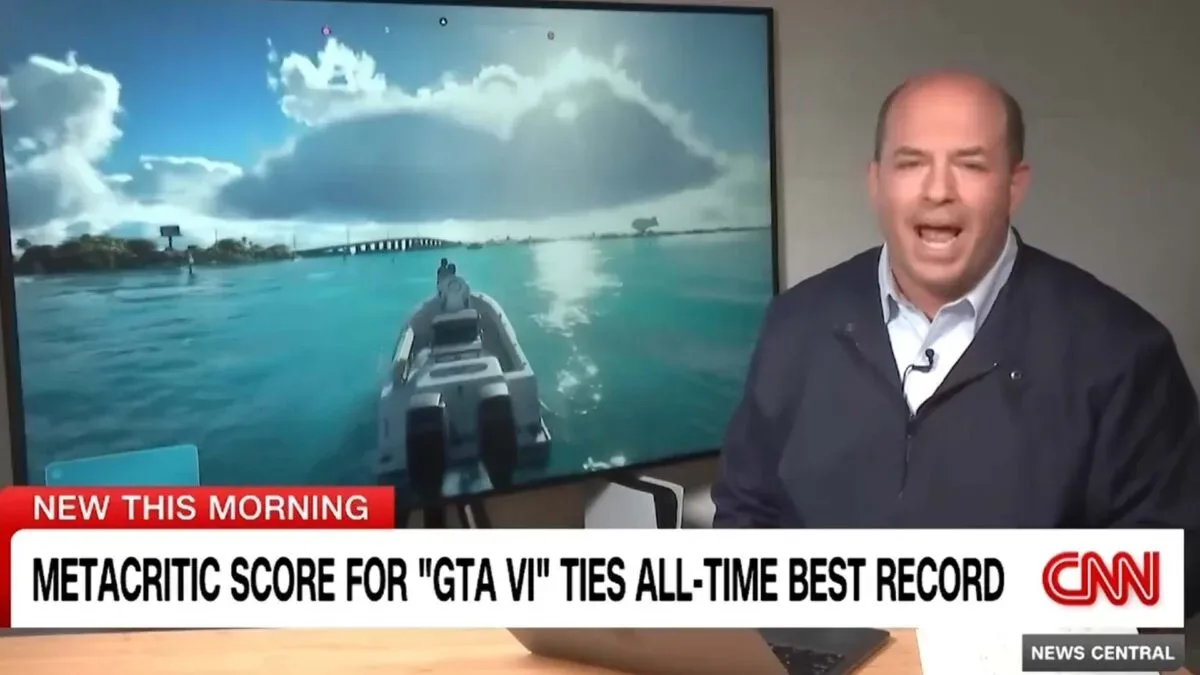
A televised discussion of Grand Theft Auto 6 has drawn ridicule after one speaker tried to introduce the game to non-players by calling it “the most intense version of Pac-Man,” with lifelike graphics and both chasing and being chased involved.
It is an attention-grabbing comparison, certainly. It is also a remarkably poor description of what makes a modern Grand Theft Auto game legible to anyone who has even a loose awareness of the series. Pac-Man is an arcade maze game built around movement, routes, pursuit and evasion. Grand Theft Auto is broadly understood as a large-scale crime-action series associated with stealing vehicles, moving through a city, confronting police, and deciding what to do next inside a simulated urban setting. Those are not interchangeable ideas merely because pursuit occurs in both.
The clip’s reaction is not really about demanding that every television host become a genre specialist. It is about the difference between a useful analogy and one that reduces the subject so aggressively that it stops informing the audience.
What the Pac-Man comparison gets technically right
At its most charitable, the line identifies one extremely basic game-design commonality: pursuit. Pac-Man asks players to navigate spaces while enemies hunt them. The player can also temporarily reverse that power relationship. Grand Theft Auto games can include pursuits too, particularly when a player is escaping law enforcement or chasing another character or vehicle.
That is the whole bridge. It is a small one.
Plenty of games involve chasing, fleeing, navigation, timing and avoiding threats. Those are mechanical verbs, not a meaningful account of a game’s identity. Describing GTA 6 primarily through that shared verb is like describing a crime film as an intense version of hide-and-seek because someone tries not to get caught. It may be technically defensible in a narrow sense, but it tells a newcomer almost nothing useful about tone, structure, player activity or why the work has cultural attention.
“Lifelike graphics” adds little clarity, either. Visual fidelity refers to how closely a game’s image, animation, lighting, characters or environments appear to resemble a real-world counterpart. It can matter, but it does not explain the play experience. A more realistic-looking maze would still be a maze. Realism is not a substitute for explaining what people actually do in the game.
Why GTA is a particularly strange series to explain this way
Grand Theft Auto is not obscure. Even people who do not play games often recognize its basic cultural shorthand: cars, city streets, crime, chaos and police chases. That shorthand is incomplete, and it may not capture every part of a particular entry, but it gets a listener much closer to the series than an arcade reference from a vastly different style of game.
That distinction matters because genre is more than a label on a store shelf. It is a compact way of communicating expectations. An arcade maze game emphasizes immediate repeated play within a confined ruleset. A large, city-focused action game implies a broader environment and a collection of activities that may involve driving, exploration, missions and conflict. One description prepares a viewer for a closed chase loop; the other prepares them for a sprawling game world where a chase can be one event among many.
Calling GTA 6 an especially intense Pac-Man may therefore create a false picture for the exact audience it intends to help. A non-player might reasonably infer a narrow, score-driven chase game with upgraded visuals. That listener would not have been given the central context that Grand Theft Auto’s appeal has long involved the freedom and spectacle of navigating a crime-fiction city.
There is another issue: Pac-Man is so universally familiar that it can be tempting to use as a catch-all reference point for games. But familiarity does not make an analogy precise. It simply makes it easy to say. Explaining games through the same decades-old mascot every time risks treating the medium as though its vast range of structures, themes and audiences has not changed since the arcade era.
A better plain-English explanation does not require expert jargon
The notable thing about this misfire is that it would have been easy to avoid without burying a general audience in terminology. A concise explanation could say that GTA 6 is a major open-city action game in which players take part in a crime story, drive vehicles, move around a detailed setting and can become involved in police pursuits. That is not exhaustive, but it is intelligible and meaningfully connected to the series.
Open-world, when used in games, generally means that the player is allowed to move through a broad environment with some degree of freedom instead of progressing only through a fixed sequence of enclosed levels. The term alone may need a quick explanation for a totally unfamiliar viewer, but it is still far more useful than anchoring the conversation to Pac-Man.
A responsible short description should answer a few basic questions:
- What is the player’s role? In broad terms, they are participating in a crime-focused action game, not piloting a yellow character around a maze.
- What is the setting like? A city environment is foundational to how the series is commonly understood.
- What do players do? Driving, action and police chases are clearer examples than abstract “chasing and being chased.”
- Why is the game notable? Its scale of public interest and the stature of the Grand Theft Auto name are relevant context.
None of that requires claiming that a speaker has played the game or has reviewed it. It merely requires using language that describes the subject rather than reaching for a nostalgic comparison that mainly signals distance from it.
The larger problem with legacy-media game shorthand
The reaction to the clip also reflects a frustration games audiences have experienced for years: the sense that games are often treated as a novelty whenever they enter a broader entertainment or news conversation. The supplied discussion notes that games are a massively popular and influential medium, and points to television adaptations of The Last of Us and Fallout as recent evidence that game properties sit comfortably within mainstream culture.
That does not mean every reporter, anchor or commentator must share the hobby. No one expects the same person to master every sport, film genre, software platform and music scene they may have to cover. But a lack of personal expertise should lead to careful framing, not a lazy analogy.
There is a practical editorial lesson here. If a game is important enough to warrant coverage, it is important enough to identify accurately. That might mean a short briefing before a segment, a guest who knows the subject, or a script that plainly acknowledges complexity rather than pretending an old arcade touchstone will do the work.
Games are especially vulnerable to this kind of reduction because their interactive nature is harder to summarize than a movie’s premise or a song’s genre. But that is a reason to choose concrete verbs and setting details, not to collapse everything into “it is like Pac-Man, but intense.”
Why the joke traveled
The line spread because it combines a massive modern release with one of the most famous symbols of early video games. The contrast is inherently comic. Pac-Man remains a useful cultural reference, but it is a reference point from a different era and design tradition. Putting it forward as the main explanation for GTA 6 makes the speaker appear to be reaching for the first game they can name.
It also invites an endless escalation gag. If a present-day Grand Theft Auto is “intense Pac-Man,” then future sequels can apparently only be framed as increasingly intense Pac-Man. That is funny precisely because it refuses to acknowledge the medium’s variety.
For readers looking beyond the meme, there is already a separate question around the critical-statistics conversation surrounding the release: what a 99 Metacritic score can—and cannot—mean. Scores, cultural buzz and television-friendly comparisons all simplify games in different ways. The useful question is whether the simplification preserves the essentials.
In this case, it does not. A chase is part of many games. It is not an explanation of Grand Theft Auto 6. For a general audience, “a major crime-action game set around vehicles, a city and police trouble” is not perfect, but it is honest, relevant and immediately more informative than turning one of gaming’s largest series into an overcaffeinated arcade maze.