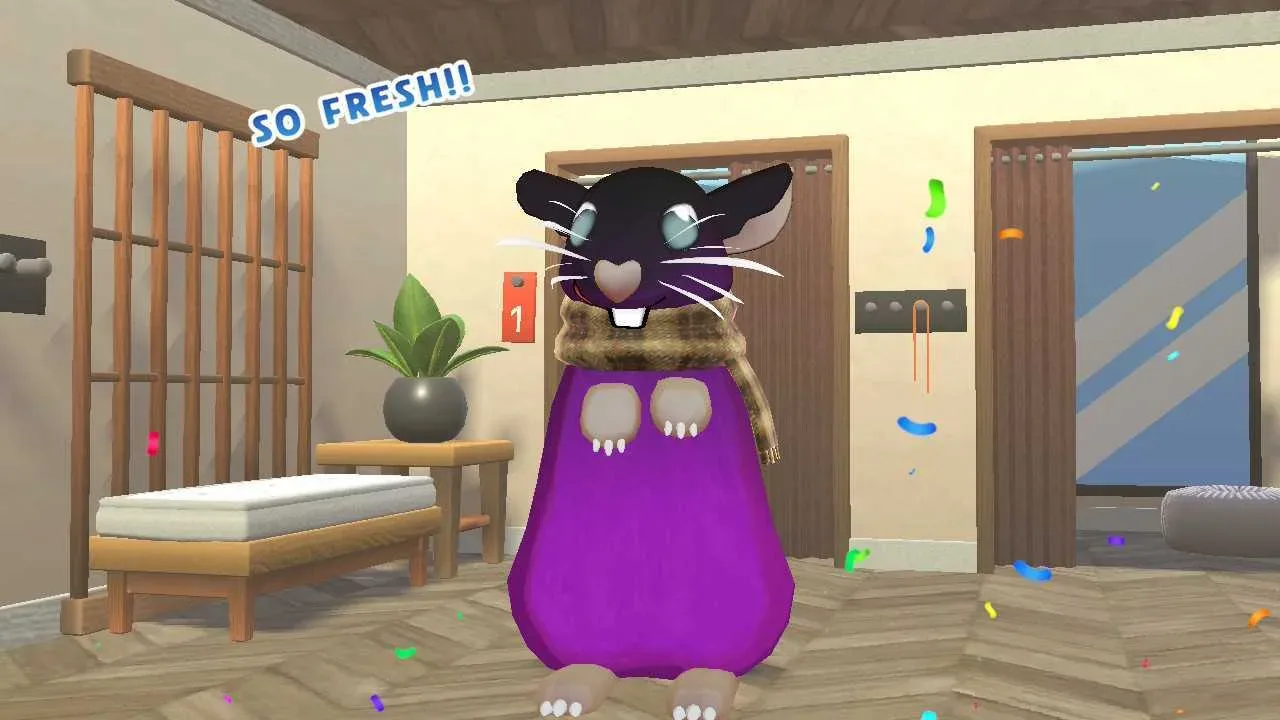
Some games ask players to save nations, settle ancient grudges or shoot an unreasonable number of aliens. Squeakross: Home Squeak Home asks for something both smaller and, arguably, more urgent: furnish a mouse-sized home one logic puzzle at a time.
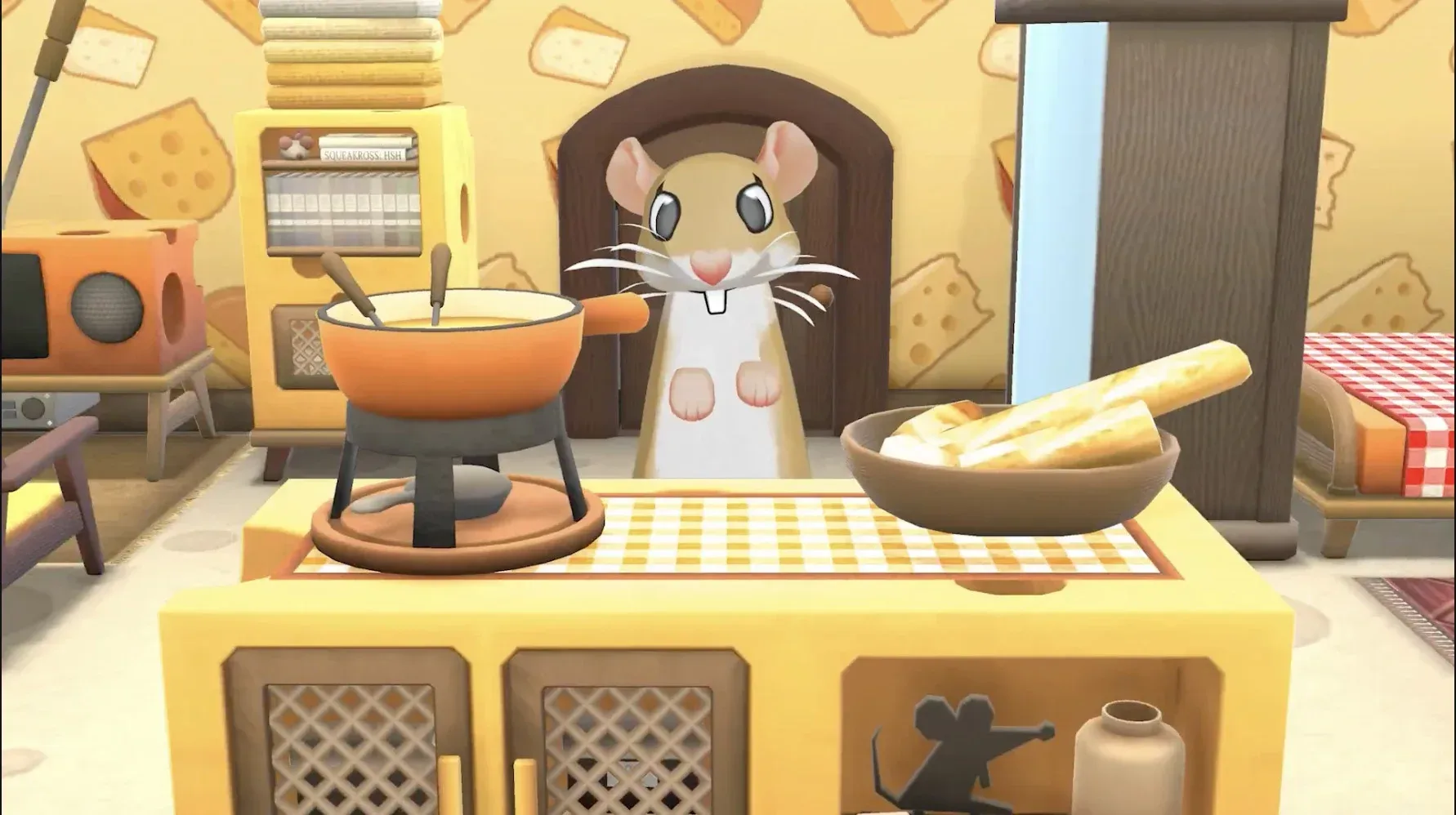
Its core idea is wonderfully direct. Players take the role of a mouse with a newly purchased house and very little inside it. Beds, tables, chairs and decorative items are not simply handed over through a shop menu. They are earned by completing nonograms, better known to many players as Picross-style puzzles. The resulting loop turns a familiar puzzle format into a steady home-building project: solve a grid, receive an item, then decide where that item belongs in the house.
That structure gives the game a particularly cozy purpose. A puzzle is no longer only an abstract image to reveal; it is part of the practical business of turning an empty home into a lived-in one. It also means a player can sensibly prioritize necessities before getting carried away with decorative clutter. A bed and a nightstand may feel more pressing than wall art, at least until the urge to create an absurdly stylish rodent apartment takes over.
What a nonogram actually asks you to do
A nonogram is a grid-based logic puzzle in which numbered clues tell the player how many connected squares to fill in on each row and column. If a row’s clue says “5,” for example, that row contains one unbroken run of five filled cells. Multiple numbers indicate separate runs, with at least one blank cell between them. By comparing row clues against column clues, players gradually determine which cells must be filled and which must remain empty.
The completed pattern ordinarily creates a small pixel-like picture. In Squeakross, the filled squares are rendered as blocks of cheese, a thematic choice that does not solve every interior-design problem but certainly commits to the bit. The game’s furniture-shaped grids may use unusual dimensions rather than standard square boards, reflecting the shapes of the items players are trying to make. That variation is important: it gives each object a silhouette before the puzzle is even fully understood.
Not every solution will be immediately legible while it is being built. Some item patterns communicate their subject clearly, while others may look more like a tiny encrypted symbol than a microwave, chair or other household object. That is part of nonograms’ peculiar charm. The logic can be perfectly sound even when the emerging picture has not yet made a convincing case for itself.
Helpful features without removing the puzzle
Squeakross includes a few quality-of-life tools that should matter to both newcomers and people who have spent years arguing about whether the word is pronounced “pee-cross” or “pie-cross.” Visual indicators can show when a line is completed and flag mistakes. These are useful distinctions. A completed-line indicator confirms that the current row or column has been resolved, reducing the need to keep recounting clues. Error feedback, meanwhile, identifies an incorrect move rather than letting a bad assumption quietly contaminate the entire grid.
There is also a night mode that darkens the puzzle field. That may sound minor, but puzzle games are often played in long, concentrated sessions; an alternate visual setting can make the game better suited to evening play or simply a player’s preferred screen brightness. Players who hit a wall can ask their mouse avatar for help as well, adding a built-in route forward when a deduction refuses to reveal itself.
Related coverage includes Squeakross: Home Squeak Home Turns Nonogram Puzzles Into Mouse-Sized Interior Design.
Those features suggest an experience designed around continued momentum rather than making every mistake feel punitive. The challenge remains in interpreting the clues and managing the grid, but the game appears willing to keep players from being stranded by one unfortunate row of cheese.
A puzzle game with a furnishing economy
The most interesting progression detail is that completing a puzzle opens a tougher version of the same puzzle. Solving that harder variation unlocks extra flexibility for the associated furniture item: players can change its color or place multiples of it.
That creates a clean distinction between acquisition and customization. Completing the first version gives the household its basic object. Completing the harder version turns that object into a more useful decorating tool. A player may only need one bed, but several tables, chairs or decorative pieces can make a room feel intentional rather than like a warehouse that happens to have walls.
It is a clever way to make increased puzzle difficulty meaningful without relying on a separate currency or a conventional store. The reward has a clear relationship to the challenge. Want more design options? Return to the logic board. Want a more coordinated color scheme? There is another grid waiting.
The house itself can be arranged in an Animal Crossing-like fashion, with furniture and decorations placed by the player. The comparison is about the freeform domestic decorating appeal, not a claim that the two games share the same wider structure. In Squeakross, the decorating is attached directly to puzzle completion, so every room can act as a visual record of what has been solved.
Players can also customize the mouse protagonist with accessories. Among the early clothing unlocks is a scarf, which is almost aggressively well suited to the game’s small-scale autumnal appeal. The effect is not just that the house changes; its resident does, too.
More than 800 reasons to keep arranging things
The Nintendo Switch store page lists more than 800 puzzles. That is a substantial number for a game whose basic activity is individual nonogram solving, especially because the puzzles are tied to furnishings and décor rather than presented as a disconnected sequence of boards.
Quantity alone does not determine whether a puzzle catalog stays engaging, but the furnishing system gives the total some practical texture. Different furniture outlines can alter the shape and rhythm of a puzzle, while the harder follow-up boards add a second layer of goals for players who want greater control over their homes. The broad count also makes it reasonable to approach the game as a long-term comfort routine rather than a brief novelty.
That appeal sits within a growing appetite for games that make a modest task feel satisfying. The overlap between gentle management, customization and a low-stakes daily ritual is also visible in other cozy releases, including a recent boutique-focused game finding an audience through its own cozy energy. Squeakross takes a much more narrowly focused route: less running a business, more filling squares until a mouse finally has a respectable kitchen.
The odd little details doing the real work
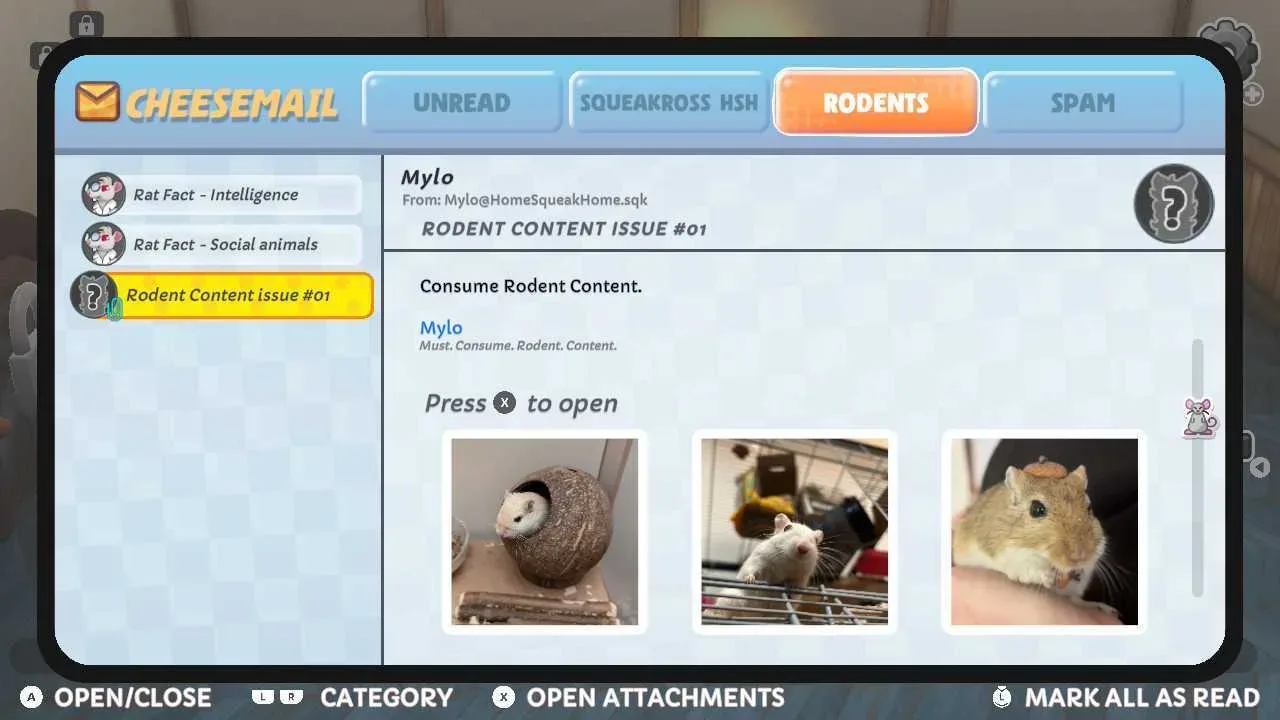
Squeakross does not restrict its charm to furniture rewards. As players advance, they may receive in-game emails celebrating puzzle milestones or offering rat facts. Some messages can include real rodent photographs. It is an unexpectedly specific choice, but a fitting one for a game whose entire premise depends on treating a tiny mouse home as something worth taking seriously.
These small touches matter because cozy games rarely succeed on mechanics alone. Nonograms already offer an intrinsically satisfying cadence: examine clues, make a deduction, confirm a line, watch an image take shape. Squeakross adds context to that cadence. The mouse needs furniture. The home needs personality. The player gets to decide whether the result is sparse and functional, packed with tchotchkes, color-coordinated, or aesthetically indefensible in the way only a tiny virtual room can be.
For players who enjoy Picross-style logic but want each solved board to feed into a visible larger project, that is the central pitch. The puzzles are still puzzles, including the occasionally baffling kind where the final image requires a leap of faith. But the reward is more tangible than a completion checkmark. It is a chair, a lamp, a picture or a better-colored version of something already in the room.
And when the puzzle session ends, the mouse is still there, perhaps wearing a scarf, standing in a house made from hundreds of small deductions. That is a remarkably efficient definition of cozy.