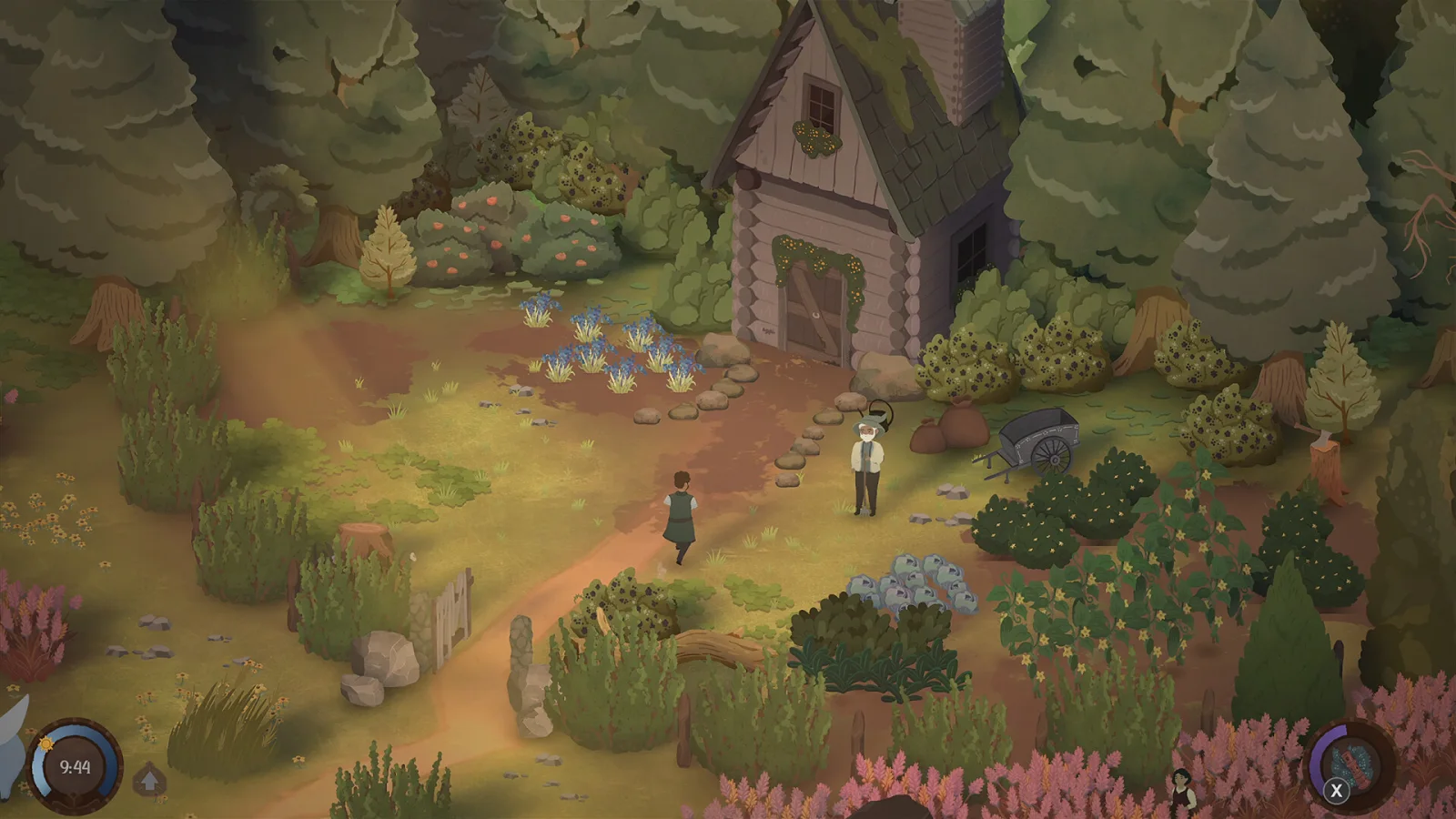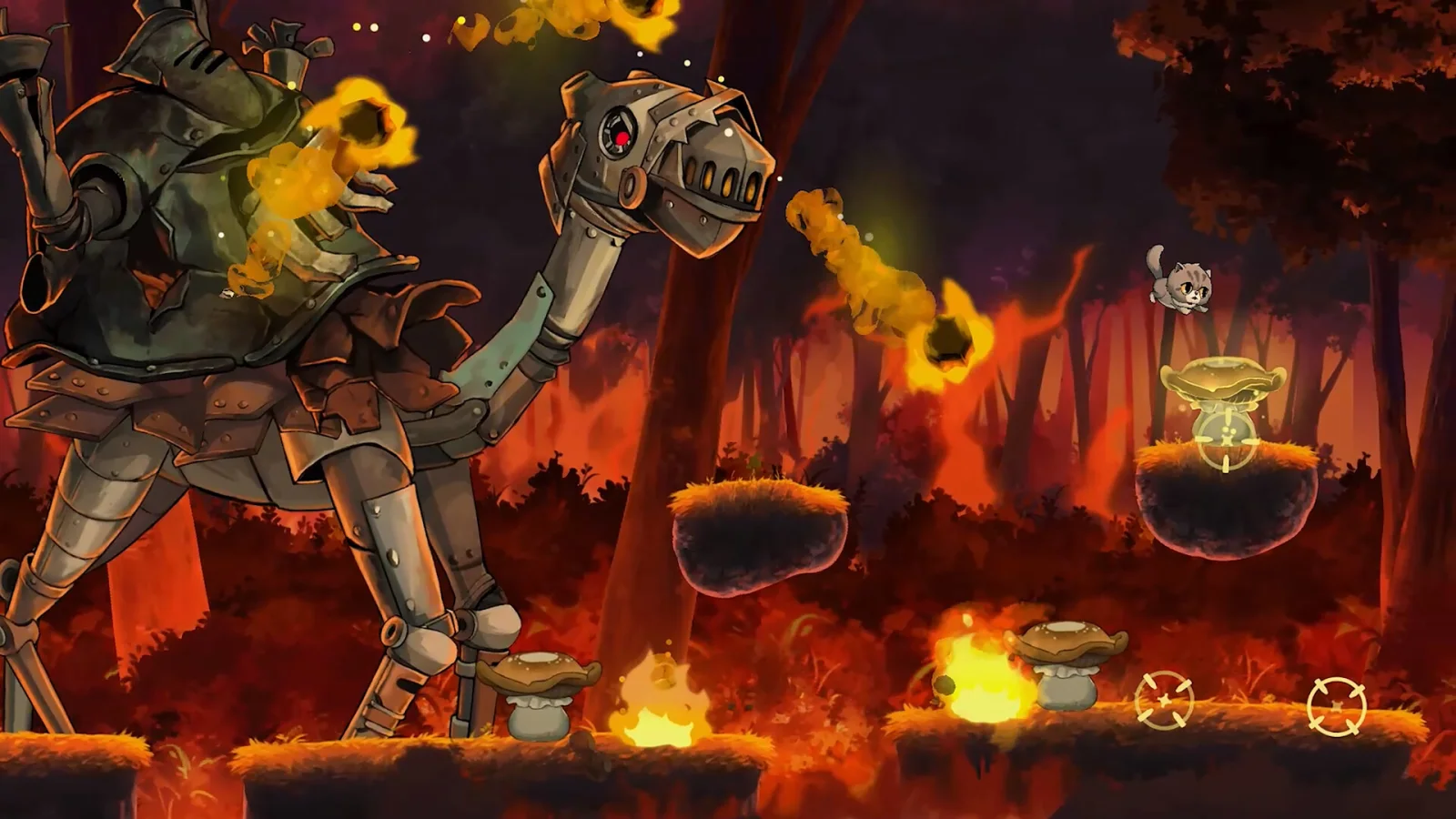
Princess of the Water Lilies was released for Windows on November 20, 2025. Why Knot Studio and Red Dunes Games are credited as its developers, with Red Dunes Games as publisher. It is a hand-painted side-scrolling adventure with environmental puzzles, boss encounters, and a story told without dialogue. The Princess's purr is central to the premise: the official description says it can make plants bloom, make machines crumble, and heal animals changed by a forgotten laboratory. The official description therefore gives one action three distinct reactions in the world.
The game also contains a tension that a glance at its artwork might not convey. Its illustrated environments and the ability to heal animals sit alongside encounters described as requiring timing and precision. Published accounts mention chases, forced-scrolling stretches, and one-hit risk. The contrast between exploration and more urgent movement is part of the documented structure.
What the Princess can do
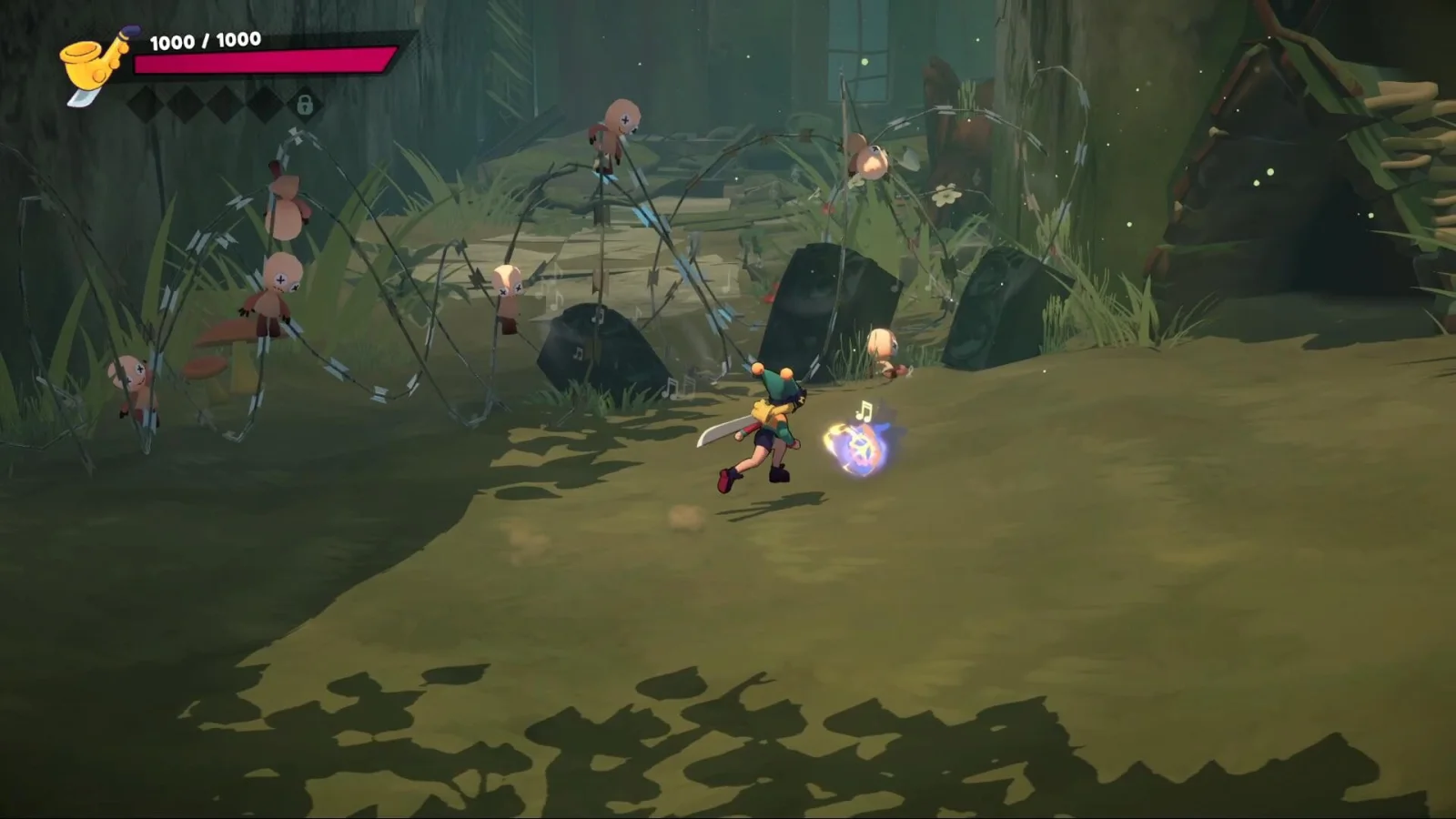
Descriptions of the controls identify movement, jumping, crawling, paw swipes, and purring. Purring is also described as a way to stun a threat. The list is short enough to make the role of each action easy to distinguish on paper: movement and jumping carry the Princess across space, crawling changes which openings can be used, paw swipes supply a direct physical response, and the purr interacts with parts of the world. Whether those actions are needed in a particular scene depends on its layout, not on an ever-expanding set of controls.
The purr's documented effects are notably different from one another. Making a plant bloom is a constructive change, while bringing down a machine removes something. Healing an altered animal connects the mechanic to the laboratory plot. A stun adds a defensive use in a dangerous encounter. This range creates a practical question for the player: what kind of object or creature is nearby, and what response should follow from using the same ability there? The documented responses range from a square moved through tunnels to changes affecting plants, machines, and animals.
Environmental puzzles beyond a single trick
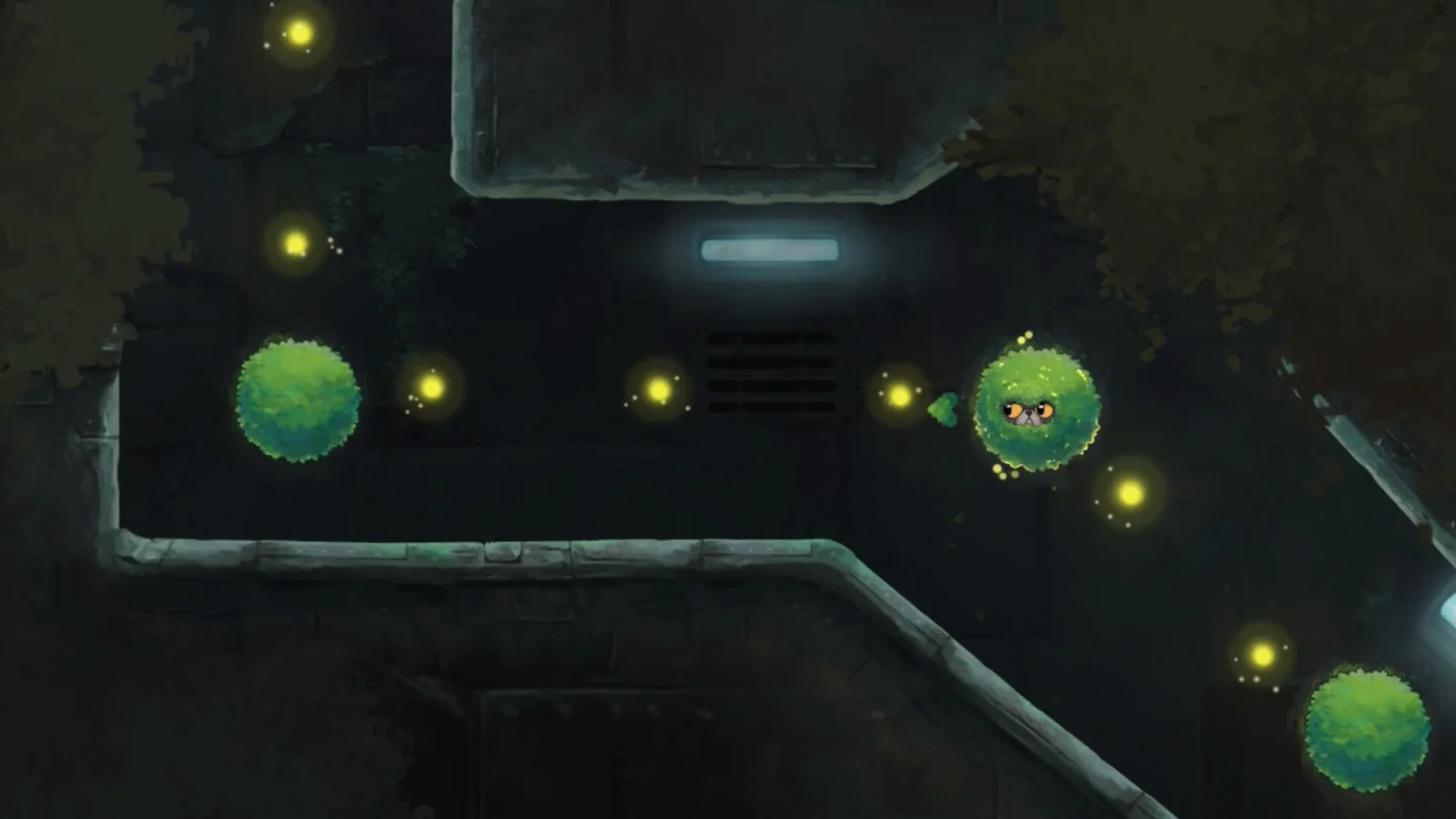
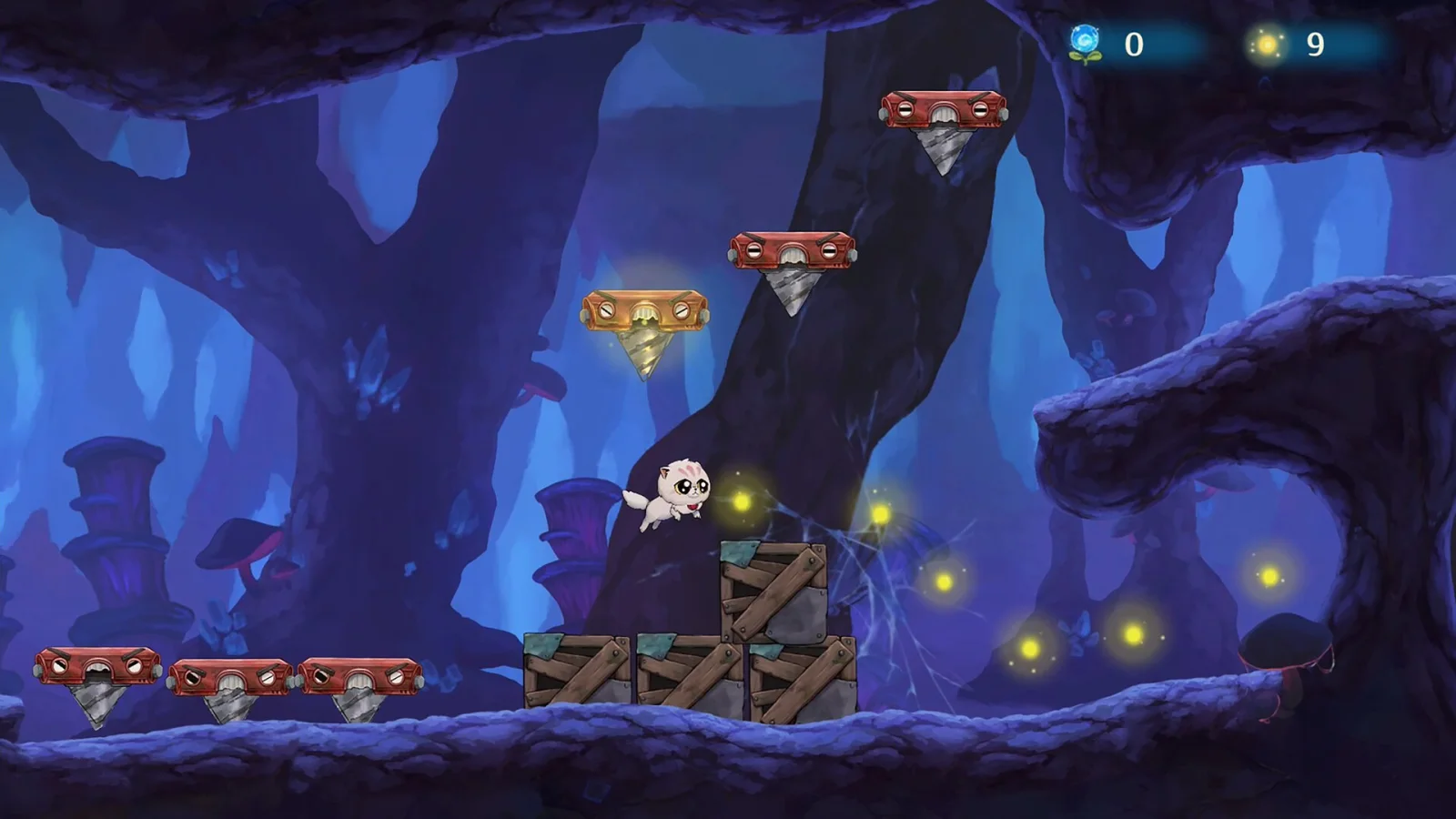
One published puzzle example involves moving a square through tunnels by purring. It illustrates that the ability is not limited to scenery that grows or enemies that react; it can also affect an object used for spatial reasoning. Other described puzzle ingredients include portals, moving platforms, bouncy mushrooms, wind, and water. These do not all ask the same thing of the player. A tunnel can be about positioning an object, a platform about timing a jump, and wind or water about reading the direction of movement. Combining familiar movement with a world-changing action is the core design opportunity.
These ingredients also create different ways to make progress visible. A shifted square gives a position to track. A portal establishes an entry and exit. A platform shows a moving target. Environmental forces change how a route is crossed. Because the story does not rely on spoken explanation, those relationships need to be conveyed through the space itself. The puzzle types give the player several kinds of movement and object behavior to distinguish.
A story without dialogue
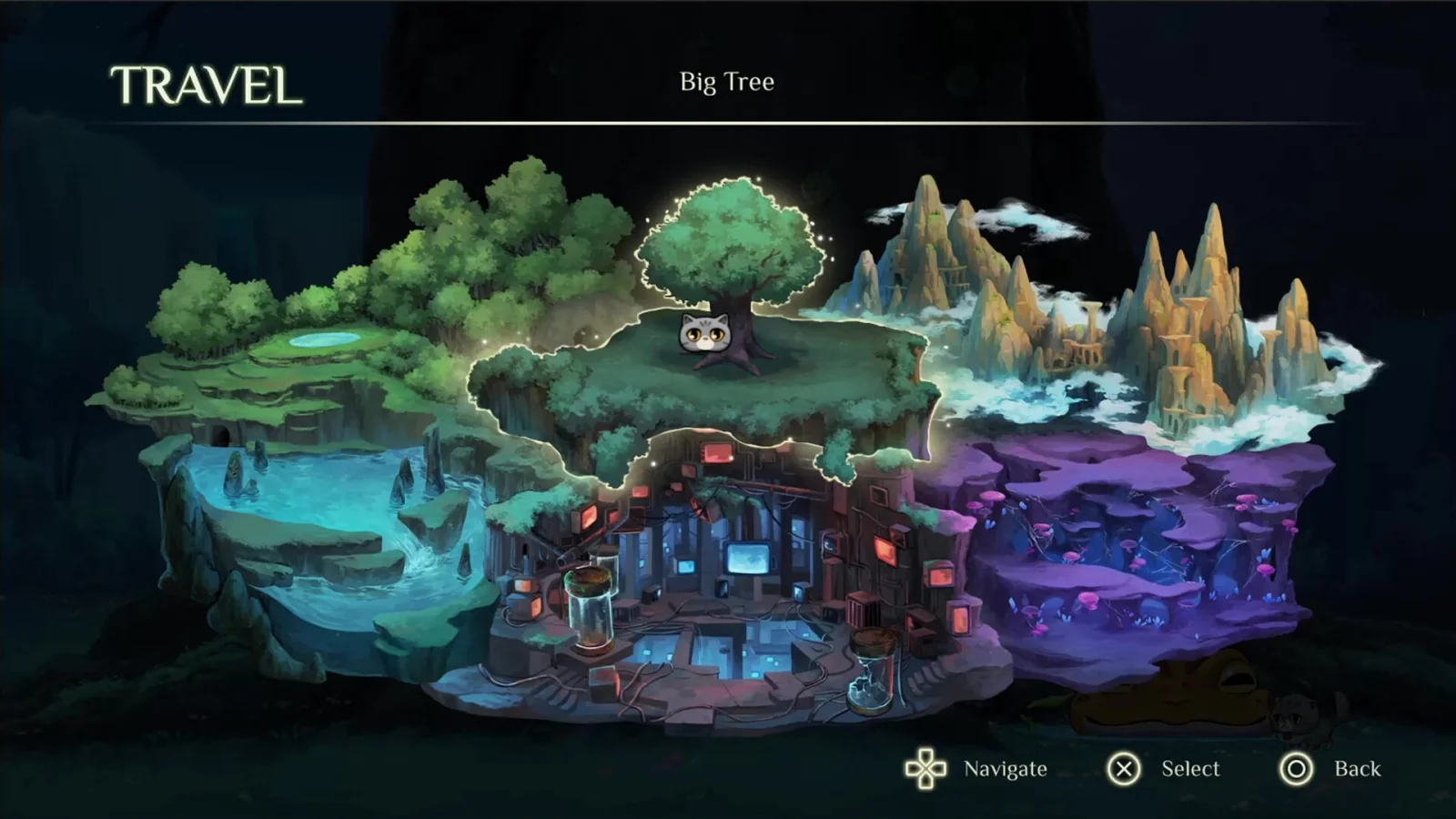
The official description places forests, caverns, machinery, and a hidden laboratory within the game, without establishing a fixed order for every visit. The laboratory is connected to animals that have been reshaped, while the Princess's purr can heal them. That gives the journey a concrete narrative thread even when no character speaks: something has happened to the living world, and the protagonist can reverse at least some of its effects. Plants and mechanisms provide visible forms of change as well as obstacles.
A wordless format places more narrative work on the environment. The condition of a creature, the state of a machine, or the presence of a blocked route can communicate a problem before it is solved. A changed scene can then show that an action mattered. The actions of the Princess and the resulting changes in the scene provide a way to connect the laboratory premise to the places and creatures encountered outside it. The hand-painted visual style is part of that presentation, but visual style and clear communication are separate qualities; one does not automatically guarantee the other.
Reasons to look away from the direct path
Published accounts mention locked cages, hungry animals, and returns to earlier areas. Those details give exploration a purpose distinct from simply finding the next exit. A cage marks an unresolved situation. An animal in need offers a reason to examine a place more closely. Returning to a previously visited area can put an earlier observation in a new context. Together, these details show how optional discoveries can draw attention to inhabitants and spaces away from the direct path.
That exploration fits the premise of restoration. If an obstacle is only a gate, opening it is mainly a navigation result. If it is tied to a living creature, the same action can also move the story forward. Published accounts also mention backtracking, which brings earlier spaces into the exploration loop. The cages and hungry animals give that exploration concrete subjects beyond the principal puzzle sequence.
When observation gives way to speed
The developer characterizes boss encounters as tests of timing and precision. Independent published accounts add specific examples of chases, forced-scrolling sequences, one-hit deaths, and demanding later encounters. Together, they identify a change in pace. In an environmental puzzle, the player may have time to inspect what can react to the purr. A chase or scrolling sequence can reduce that time and make movement decisions more immediate.
The same short list of controls has to serve both situations. Jumping and crawling are useful for reaching places, but an urgent encounter may ask for them under tighter timing. The purr-based stun offers a possible response to danger rather than only an environmental effect. Where a hit can end an attempt, the distinction between a learnable hazard and an unseen one matters. A short attempt can make the next movement decision more consequential. The game offers Kitten and Cat difficulty modes, giving players two named challenge settings; their separate names make the presence of a challenge choice clear.
Art and music in a text-free adventure
The game is presented with hand-painted environments and a partly live-recorded orchestral score. Neither detail explains a puzzle on its own, yet both shape how a wordless adventure is received. Painted scenes can establish the difference between natural and mechanical places, while music can support shifts in mood or pace without spoken dialogue. The partly live-recorded score adds another component to a presentation that already relies heavily on its visual world.
The combination of a visual story, a restorative central ability, and precision-focused hazards gives Princess of the Water Lilies a recognizable set of design elements. The Windows release is already available, and its documented puzzle examples show that the purr is used for more than one kind of interaction. For someone looking into the game, the useful questions are how its environmental puzzles use that ability, what its optional discoveries add to the journey, and how its faster encounters sit beside its quieter exploration. Those three elements provide a useful way to understand the adventure structure without reducing it to its painted appearance alone.
For another puzzle-platformer with a different central mechanic, see our Echo Weaver coverage.