The Martial World of Phantom Blade Zero
Phantom Blade Zero arrives as a dark wuxia action RPG, but that label only establishes its starting point. S-Game’s project combines martial-arts spectacle with supernatural threats, industrial machinery, mechanical prosthetics and a deliberately punk visual attitude. The studio calls this mixture Kungfupunk, its own art-direction term rather than an established genre category. In practical terms, the game is built around close-range combat, boss encounters, weapon experimentation and handcrafted areas rather than the endless sprawl of a conventional open-world RPG. Its identity is therefore less about choosing between familiar labels than about making several action-game traditions occupy the same space without allowing any one of them to define the whole experience.
This feature examines the game through its published design material, official launch information and original developer interviews. It is a researched analysis rather than a hands-on review; performance claims and practical outcomes remain tied to the evidence available for the relevant platform. The discussion stays close to the opening premise and avoids revealing the investigation’s conclusion.
At the center is Soul, an elite assassin of the Order who is blamed for killing its patriarch or master, depending on the wording of the particular official page. He is hunted, gravely wounded and kept alive by a temporary cure that gives him 66 days. That premise supplies urgency without, by itself, turning the game into a time-management simulation. It frames the character’s investigation and the wider Wulin, the martial world through which the story moves. Official descriptions also point toward a connected Phantom World and mysteries involving memory, supernatural forces and places whose meanings are best left for the game to reveal. The important launch-level identity is the pressure of a doomed assassin navigating a world where institutional loyalty has already failed.
That premise also explains why Phantom Blade Zero is difficult to classify as a straightforward Soulslike or a conventional character-action game. S-Game has explicitly positioned it between fast action titles associated with elaborate chains and slower action games that emphasize patience, observation and strategic commitment. The comparison describes an intended design balance, not a final verdict on how successfully the finished game achieves it. The announced combat vocabulary includes ordinary and stronger attacks, blocking, parrying and dodging, while the broader structure adds weapon switching, limited-use secondary tools and progression tied closely to combat. Those ingredients suggest a game concerned with rhythm and decision-making, but they do not authorize claims about responsiveness, balance or difficulty based solely on promotional footage.
So the central launch question is not whether Phantom Blade Zero resembles a particular famous action game. It is whether its parts reinforce one another: whether a doomed assassin’s urgency gives purpose to the Wulin’s handcrafted detours; whether boss-earned weapons feel like extensions of the opponents who carried them; and whether Kungfupunk is more than an attractive collision of adjectives. At release, the game presents itself as a focused, single-player action RPG with a substantial weapon-driven combat framework, semi-open exploration and an unusually specific cultural-artistic vocabulary. That is a clear identity, even before anyone decides how well its ambitions survive sustained play.
From Rainblood to S-Game’s Global Ambition
Phantom Blade Zero’s history begins before Phantom Blade had become a global-facing name. Soulframe Liang identifies Rainblood: Town of Death as the starting point, an RPG Maker project he made in 2010. That origin matters because the new game is not presented as a conventional remaster of an old release. S-Game describes it as a spiritual rebirth: a return to the franchise’s identity through a much larger production, a different technology base and an audience beyond the market that first sustained it. The chronology is therefore less a straight remake story than a series of expansions, each adding scale while attempting to preserve a recognizable center.
After Rainblood, Liang returned to China and founded S-Game. The project grew into a wider Rainblood franchise, and later entries adopted the Phantom Blade name. Most of those earlier Phantom Blade games were smartphone titles that did not release outside China, according to Liang’s account. The studio says the series accumulated a fan base of more than 20 million, though that number is a company-reported promotional figure rather than an independently audited measure. More important for understanding Zero is the market transition: S-Game spent years making mobile games for China before treating this project as its first major console production and its deliberate push into the global market.
The public turning point arrived at the PlayStation Showcase on May 24, 2023. The reveal established the broad identity that later materials continued to refine: a dark wuxia action RPG built around an assassin, a conspiracy and a martial world where supernatural forces and industrial machinery coexist. The game was already being framed as a new beginning rather than a restoration of an inaccessible mobile lineage. That positioning placed pressure on S-Game from the outset. It had to make the setting legible to players unfamiliar with Rainblood while ensuring that the project did not dissolve into a generic international action game.
The technology change made that pressure visible. Liang describes the move from RPG Maker to Unreal Engine 5 while arguing that the series’ core identity could survive the transition. This is not simply a technical upgrade from small-scale tools to modern production software. It represents a change in what the studio could attempt: more elaborate environments, cinematic character presentation, authored combat animation and a console-scale presentation. Yet a new engine cannot automatically carry over tone, rhythm or cultural specificity. Those had to be rebuilt deliberately, which is why the development story is as much about translation as technology.
Liang’s architectural studies in Beijing and New Haven form part of that development story. His original account places Rainblood within his student years, while a later October 2026 interview report connects his architectural background to thinking about the game’s world design. That connection is most useful at the level of spatial organization: an action environment must accommodate movement, sightlines, encounter staging and routes that become meaningful on a return visit. It does not mean every building or visual motif can be traced to a particular school of architecture, or that education alone explains the finished art direction.
The scope was also constrained by choice. S-Game rejected the idea of one seamless open world in favor of multiple reasonably sized, handcrafted maps populated with activities. Later descriptions call the setting semi-open, but that should not be confused with a continuous landscape. This structure can support a more authored action game: spaces can be arranged around encounters, shortcuts, secrets and dramatic transitions rather than stretched to satisfy a map-size expectation. It also acknowledges production reality. A studio moving from mobile development into a major console project could pursue visual and systemic ambition without committing to the enormous content burden of an uninterrupted open world.
The creators attached to the project reinforce its emphasis on authored action. Kenji Tanigaki was identified as action director in the 2023 reveal, with Liang citing his work on classic kung-fu fight scenes as a major influence. The announced workflow involved Tanigaki demonstrating designed movements for a camera matrix, after which the animation team used that material as reference. Liang also stressed that motion capture alone could not represent the combat adequately, requiring handcrafted animation. Later materials credit motion capture more broadly, including Donnie Yen’s facial and performance capture as Mó Yuan and his role as creative consultant from 2023. Taken together, the evidence supports a hybrid process: movement is captured or demonstrated, then selected, corrected, heightened and integrated by animators.
That distinction matters because Phantom Blade Zero’s ambition is not merely to contain many attacks. It is trying to make a combat system carry the visual authority of wuxia performance while remaining usable through a controller. S-Game’s mobile background informed a stated preference for simplifying inputs so players could perform elaborate chains with limited button presses. Its console project then had to reconcile approachability with the timing, spacing and defensive reading associated with more demanding action games. The result is a design problem rather than a proven verdict: spectacle must be made readable, and accessibility must not flatten the differences between weapons or encounters.
The global strategy is visible in the influences S-Game has named. Liang has cited Louis Cha’s wuxia stories, Bruce Lee, Michelle Yeoh’s work in Everything Everywhere All at Once and Donnie Yen’s appearance in John Wick: Chapter 4. A later developer interview names The Valiant Ones, The One-Armed Swordsman and Once Upon a Time in China as specific film touchstones. These references do not establish a single authoritative version of wuxia, nor do they make the game culturally representative of China as a whole. They show an attempt to communicate through familiar martial-arts cinema while combining it with contemporary pop-cultural forms. The studio’s Kungfupunk label condenses that strategy into a marketable identity: traditional kung fu, punk attitude, steampunk and cyberpunk machinery, anime and manga influence, and a deliberately hybrid visual world.
Full-scale development began in 2022, according to Liang’s December 2025 interview, although the concept and franchise lineage are older. S-Game’s route from a 2010 solo-origin project to a UE5 console release was therefore neither instantaneous nor purely technological. It involved rebuilding a mostly China-focused mobile property for a global audience, limiting the world’s physical sprawl while expanding its systems, and combining captured performance with hand-authored action. Phantom Blade Zero’s architecture follows from those decisions in the practical sense: contained handcrafted maps can support dense authored encounters, weapon-led progression and gated revisits without requiring a continent of filler. Its central gamble is that a constrained structure can make a newly global game feel more intentional, not smaller.
Soul, the Order and a Life Measured in Sixty-Six Days
Phantom Blade Zero begins with a premise built to make trust unstable. Soul is an elite assassin serving the Order, a martial organization whose patriarch is murdered. Soul is blamed for the crime, hunted, and left gravely wounded. A makeshift cure keeps him alive for only 66 days, giving his search for the truth an explicit limit. That is the verified starting frame, not a summary of the game’s later revelations. The identities behind the framing, the final consequences and the shape of the ending remain outside this chapter’s spoiler boundary.
The useful tension is that Soul’s emergency is personal while the Order’s authority is institutional. He is not simply pursuing a target because a mission marker says so; he is trying to understand why the organization that gave him purpose has turned its machinery against him. The premise therefore makes every official explanation suspect. A faction can offer rules, discipline and belonging while also controlling the account of what happened. The game’s conspiracy setup works best when read as a conflict between inherited duty and the need to investigate the institution that defined Soul’s life.
That does not mean the Order should be treated as a confirmed caricature of corruption. The available premise establishes Soul’s framing and the resulting manhunt, but it does not authorize a complete moral verdict on every member, branch or tradition within the organization. Calling the institutions unreliable is an interpretive description of the setup: the player receives a world in which the dominant authority cannot be accepted at face value. It is not a claim that every statement made by the Order is false, nor a license to fill in missing conspirators or hidden motives.
The 66-day figure gives the story a clean dramatic measure. It converts Soul’s injury into more than background tragedy: time itself becomes evidence that the cure is temporary and that delay has a cost. A long investigation would normally invite patience, detours and accumulation. Here, the premise insists that those choices happen under pressure. The number also makes Soul’s condition legible without requiring the player to know the full medical or supernatural logic behind it. The countdown is a narrative constraint first, a promise of urgency before it becomes a question about systems.
That distinction matters because the story’s 66 days and the named Sixty-Six Days difficulty mode are not automatically the same thing. The official difficulty announcement lists Sixty-Six Days alongside Wayfarer and Hellwalker, presenting it as an especially severe option tied thematically to Soul’s lifespan. That is a mode selection, not proof that the ordinary campaign is a real-time 66-day simulation. Nor does the existence of the mode establish its complete fail-state rules from the official description alone. The title creates a thematic echo; it does not turn the narrative premise into a publicly documented timer mechanic.
This separation protects the story from being reduced to a menu gimmick. If the 66-day premise only mattered because one mode used it as a punishment, then Soul’s crisis would become a difficulty modifier. Its more important function is motivational. Soul must act before the cure fails, while the player must decide how much uncertainty to tolerate before pursuing the next lead. The game can present that urgency through dialogue, wounded-character framing, pursuit and the escalating implications of the conspiracy without requiring the player to watch a clock drain during every playable moment.
The announced side-quest structure complicates that pressure in a productive way. Side quests can deepen understanding of the Wulin and may open new story paths, while exploration can advance existing quests or reveal new ones. That means the player’s desire to understand the world is not necessarily opposed to the main investigation. Curiosity can be part of the narrative architecture. At the same time, the sources do not establish a complete branch map, a fixed number of endings or the precise consequences of every optional decision. It is more accurate to say that optional content can affect the route through the story than to promise a particular outcome.
Soul’s unreliable position also changes how the Order’s language should be read. An organization built around hierarchy can make obedience seem like moral clarity, while exile turns the same rules into possible evidence of manipulation. The player is asked to navigate that uncertainty through a protagonist whose identity was formed inside the system he now has to question. The danger is not merely that a villain lies; it is that institutional certainty can survive long enough to shape Soul’s choices before the truth is known. The premise gains texture from that gap between belonging and belief.
By launch, then, the 66-day idea operates on several distinct levels. It is Soul’s stated survival limit, the dramatic reason his investigation cannot be postponed indefinitely, and the name of an announced high-pressure difficulty mode. Treating those levels as interchangeable would misrepresent both the story and the mechanics. Treating them as unrelated would miss the design conversation between them. Phantom Blade Zero uses the same phrase to connect character vulnerability with player challenge, while leaving room for the ordinary campaign to breathe as an action RPG rather than a permanently ticking survival exercise. That unresolved pressure is the premise’s most useful question: how much truth can Soul recover before urgency stops being a story condition and becomes a limit on action itself?
Understanding Wuxia and the Machinery of Kungfupunk
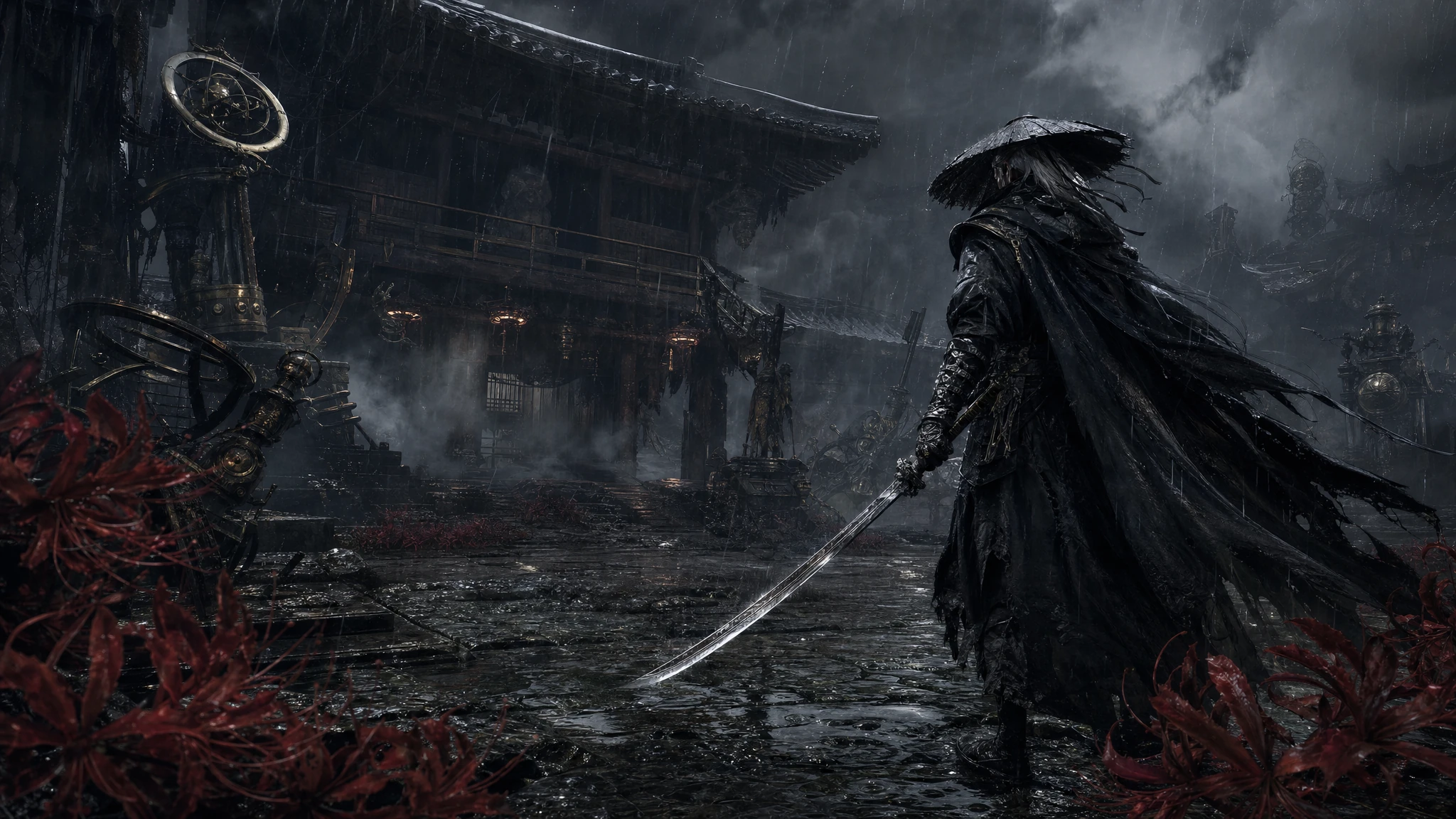
Phantom Blade Zero’s most useful creative label is one S-Game coined itself: Kungfupunk. It is not a recognized historical category or a universal description of Chinese culture. It is the studio’s shorthand for placing Chinese martial-arts fantasy beside punk attitude, industrial machinery and contemporary pop-cultural design. The distinction matters because the game is not presenting a single, supposedly definitive China. It is building a stylized Wulin, a fictional martial world in which recognizable wuxia ideas can coexist with mechanical prosthetics, occult forces and engineered weapons.
Wuxia, broadly understood, is a tradition of Chinese martial-arts fiction centered on wandering fighters, personal codes, rival schools, loyalty, injustice and extraordinary skill. Those ingredients do not require a literal historical setting, and Phantom Blade Zero does not appear to pursue period reconstruction. Its influences are selective and openly cinematic. Soulframe Liang has identified Louis Cha’s stories, Bruce Lee’s films, Michelle Yeoh’s work and Donnie Yen’s appearance in John Wick: Chapter 4 among the project’s touchstones. The Epic Games Store interview further names The Valiant Ones, The One-Armed Swordsman and Once Upon a Time in China, giving the game a more specific lineage than a generic appeal to martial-arts imagery.
The visual contrast begins with the Wulin’s darkness. Liang has described the bleak tone as deliberate, using danger and visual severity to make sympathetic characters stand out. That rationale gives the machinery a useful dramatic role. Mechanical limbs, industrial ruins and engineered weapons are not merely bright ornaments placed over a historical backdrop. They make the world feel damaged, improvised and morally unstable. A sword can belong to a martial tradition while its setting suggests factories, prosthetics and accumulated technological violence. The contrast turns old ideals into something tested by modern-looking systems of control.
Occult material pushes the setting in another direction. Official descriptions place the martial Wulin alongside a Phantom World, with Memory Flowers, the Lady of the Veil, Inanis’ Dreamscape and other mysteries occupying the game’s supernatural horizon. These terms establish a mood without proving a single coherent religious system, and they should not be treated as a survey of Chinese spiritual belief. Phantom Blade Zero is using the occult as fantasy machinery: a way to make memory, death, identity and place visible. Its supernatural elements seem designed to sit beside blades and mechanisms rather than replace them.
That coexistence is where Kungfupunk becomes more than a list of influences. A mechanical prosthetic can suggest repair, punishment or adaptation; an occult apparition can suggest memory made physical; a martial technique can communicate character without exposition. In the studio’s stated creative model, kung fu is a form of communication as much as a fighting style. Liang has compared that goal with Bruce Lee’s ability to carry personality and philosophy through movement for audiences who may not share the performer’s cultural background. The ambition is cultural translation, not a claim that one game can summarize Chinese martial arts or Chinese history.
The machines also provide a deliberate counterpoint to wuxia’s romance of individual cultivation. Traditional martial-arts fiction often gives a skilled person agency against corrupt institutions, rival factions or abusive power. Phantom Blade Zero places that kind of figure inside a world where bodies can be altered and violence can be industrialized. Soul’s identity as an assassin already complicates the wandering-hero image: he is not simply outside the system, but shaped by one. The game’s machinery therefore reinforces its narrative tension. Technical power may expand what a fighter can do while narrowing the space in which a person can remain free.
The same contrast appears in the game’s weapon conception. S-Game has described weapons as differing in movement and core mechanics, not only in damage or appearance. Official examples include the White Serpent and Crimson Viper as dual-wielded swords with separate combos that can be mixed, while the Scarlet Wraithblade summons spider lilies that slow enemies and control space. These details are concrete demonstrations of the design direction, not evidence that every weapon behaves as dramatically. They show a studio treating an arsenal as a collection of fighting identities, each capable of carrying a visual and thematic idea into play.
Boss weapons intensify that relationship between spectacle and meaning. The October 28 PlayStation feature states that most weapons are claimed from defeated bosses, allowing players to observe a weapon’s capabilities before using them. Soulframe Liang has described this as carrying something of a defeated boss’s spirit into the player’s own combat, an interpretive design explanation rather than a literal transfer of powers. The structure gives the Wulin’s antagonists a lasting presence. Their techniques do not end when the encounter ends; they become part of Soul’s expanding vocabulary, turning victory into appropriation as well as progression.
The punk component is less about a single musical or fashion code than about collision and refusal. S-Game’s own explanations connect traditional Chinese kung fu with steampunk, cyberpunk, anime, manga and modern pop culture. That mixture resists the museum-like treatment of wuxia, but it can also create friction. Contemporary references may make the setting legible to a global audience, while risking a flattened idea of tradition if used without specificity. The documented film influences help counter that risk because they point to particular works and performers rather than presenting an abstract, export-ready image of Chinese culture.
Mood is consequently as important as lore. A dark industrial environment beside an elegant martial performance can make beauty feel precarious. A supernatural flower that reveals the past can turn exploration into an encounter with memory rather than a hunt for generic collectibles. A prosthetic or unusual weapon can look excessive until its movement establishes a practical purpose. These are editorial readings of the announced material, not findings from a complete playthrough. Still, they describe the central promise of the blend: Kungfupunk works when every collision of styles changes how the player understands a person, a place or a fight.
Phantom Blade Zero therefore should not be judged by whether it reproduces an imagined pure form of wuxia. There is no single visual template that stands for all Chinese martial-arts fiction, and the supplied sources do not justify universal claims about how China views tradition, technology or spirituality. The more precise question is whether S-Game’s selected elements reinforce one another. Its documented influences, performed movement, handcrafted animation, occult atmosphere, mechanical bodies and boss-defined arsenal point toward a coherent experiment: a wuxia action game whose past is not preserved behind glass, but forced into contact with machinery, trauma and pop-cultural reinvention. Kungfupunk is most convincing when that contact produces tension rather than merely decoration.
How the Martial-Arts Performance Becomes Readable Combat
Phantom Blade Zero’s martial-arts identity is not only a matter of costume, weapon shape or cinematic flourish. It depends on whether a player can understand what a body is doing quickly enough to respond. A spectacular kick that reads as a blur in a trailer has a different design burden when it becomes an attack that must be blocked, parried or avoided. The available production accounts suggest that S-Game treats this problem as a collaboration between martial-arts performance, animation, camera direction and input design. The result is intended to look authored rather than merely recorded, while still leaving the player responsible for interpreting danger.
Kenji Tanigaki’s role is central to that ambition. The 2023 reveal identified him as Phantom Blade Zero’s action director and described a workflow in which he demonstrated designed movements before a camera matrix recorded them as reference for the animation team. That detail matters because it places choreography before capture. The team was not simply asking performers to improvise attractive attacks and then turning the resulting footage into gameplay. It was establishing a vocabulary of movements first, with the capture process supplying material that artists could reshape for a controllable action game.
That distinction also explains why the game’s animation cannot be described accurately as either pure motion capture or entirely hand-drawn performance. Soulframe Liang said the combat could not be represented adequately by motion capture alone and required handcrafted animation. Later official material credits motion capture in the broader production, including Donnie Yen’s facial and movement performance as Mó Yuan, Soul’s father. The most defensible reading is a hybrid pipeline: demonstrated martial-arts movement provides physical reference, captured performance contributes timing and character, and animators correct, compress or heighten the material so it functions inside a game.
The Epic Games Store developer interview adds an important practical complication. Captured movement is not automatically clean mechanical data. Markers or suits can shift, and animators must decide whether to correct the movement, preserve an accidental irregularity or exaggerate it. That choice is artistic as well as technical. A perfectly smoothed strike may be easier to classify but less distinctive; an uncorrected stumble may communicate weight but confuse the player. Readability therefore does not mean removing every human imperfection. It means deciding which irregularities belong to a character and which would obscure the attack’s intended message.
Donnie Yen occupies a different but connected position in this system. S-Game identifies him as a creative consultant who has been involved since 2023, while also crediting him as the facial and motion-capture performer for Mó Yuan. Those are performance and advisory responsibilities, not evidence that he choreographed every fight or served as a general producer. His contribution can nevertheless be understood as a bridge between the game’s martial-arts language and the screen tradition that informs it. A consultant can help preserve posture, rhythm and intention; a performer can give one character a specific physical identity. Neither role eliminates the work of the action director, animators or gameplay designers.
The team’s stated process reportedly begins with a fighter’s backstory, goals and purpose before those elements become combat design. That approach gives choreography a dramatic function. A move is not valuable only because it is difficult to perform or visually impressive; it can establish temperament, status or a relationship to a weapon. A boss who attacks with deliberate economy should communicate something different from one who overwhelms the arena with theatrical momentum. For the player, this creates a useful possibility: animation can carry information about an opponent’s personality while also preparing the next mechanical decision.
Yet choreography and controls cannot be identical. Film choreography is designed for a camera, an editor and a known sequence of reactions. A game animation must survive interruption, repetition and player error. It may need to begin from several possible states, allow a defensive response and return cleanly to a neutral position. S-Game’s mobile-game background is relevant here because Liang has described a philosophy of simplifying inputs so players can perform elaborate chains with limited button presses. The apparent ease of an attack therefore should not be mistaken for a small design. Fewer inputs can require more careful animation timing, transition logic and priority rules behind the scenes.
The announced control structure suggests that the player reads performance through a compact set of decisions. Basic Square attacks and stronger Triangle attacks are paired with blocking, parrying and dodging, while switching between two equipped main weapons quickly restores Soul’s Sha-Chi. That arrangement gives choreography a job beyond showing damage. A strike sequence must tell the player whether aggression is still safe, whether a defensive response is arriving, and whether changing weapons would preserve the exchange. The weapon switch is especially revealing: because it is both a visual flourish and a resource action, the animation must remain legible as an invitation to continue the rhythm rather than merely a stylish interruption.
Defensive feedback also depends on differentiation. Perfect parries, successful dodges and landed attacks reduce an opponent’s Sha-Chi, while blocking consumes Soul’s own supply and can leave him staggered when it is exhausted. These systems make the player watch bodies, not just health bars. A readable combat pose should indicate whether an enemy is beginning an attack, exposing a defense or completing a sequence. The official descriptions do not provide frame timings, damage values or guaranteed reactions, so no claim about exact responsiveness follows from them. The design implication is clearer: when several defensive answers exist, visual telegraphing must distinguish a commitment from a feint without turning every encounter into a set of obvious flashing prompts.
Camera direction is where martial-arts spectacle and combat information can most directly conflict. A close camera can make a sword pass feel heavy and personal, but it may hide the attacker’s shoulder or the line of a second weapon. A wider view exposes spacing and surrounding threats, yet risks reducing a carefully performed movement to a small figure in a busy arena. Rapid cuts can clarify a cinematic beat while disrupting the player’s sense of position. The announced emphasis on handcrafted maps, bosses and weapon-specific encounters makes this balance especially important: the camera has to sell the setting without stealing the spatial information needed to act.
This is why Phantom Blade Zero’s martial-arts performance should be judged as a translation problem rather than a simple authenticity test. The source material may be physically credible, but the game must translate it into signals that remain understandable through repetition, camera movement, enemy interference and player-controlled interruption. The production evidence supports a layered method: action direction establishes the vocabulary, performers supply physical and character detail, capture preserves useful motion, animators reshape it, and controls give the player a place inside the choreography. Whether that balance succeeds consistently is a matter for direct play, not marketing footage. What can be established now is the design challenge: every beautiful movement must also explain what the player can do next.
Sha-Chi, Defense and the Rhythm of Changing Weapons
Phantom Blade Zero’s combat is built around a conversation between pressure and restraint. The basic vocabulary is familiar: Square attacks are lighter, Triangle attacks are stronger, and Soul can block, parry or dodge. The distinctive part is how those actions are organized by Sha-Chi, a combat resource that makes defense an active commitment rather than an unlimited safety net. The result, at least in the systems S-Game has officially described, is not a loop of attacking until an enemy falls and then reacting to whatever remains. It is a cycle of creating openings, spending protection, recovering that protection through decisive action and choosing when to change weapons.
Sha-Chi is Soul’s defensive meter. Blocking consumes it, and if the meter is emptied, Soul can be staggered and left exposed. That rule gives the guard button a cost without making it irrelevant. A block can absorb danger, but holding it indefinitely is presented as a losing approach. This distinction matters because a player who treats every incoming attack as something to be held through will gradually spend the resource that keeps them safe. Defense therefore has to be selective: block when absorbing a hit is preferable to risking a mistimed response, but do not confuse temporary security with a sustainable plan.
Parries and dodges occupy a different place in that plan. The official launch feature says that perfect parries and successful dodges reduce the opponent’s Sha-Chi, while landed attacks do the same. In other words, defensive success is also offensive progress. A parry is not merely a way to avoid damage before returning to neutral; it helps cut through the enemy’s defenses. A dodge can serve a similar purpose when blocking would consume too much of Soul’s own meter or when the incoming attack is better avoided than received. The system consequently rewards reading an attack and answering it with purpose, rather than asking the player to use one universal defense against everything.
The important distinction is between Sha-Chi and Sha-Chi Essence. They sound related because both are resources attached to combat, but they perform different jobs. Sha-Chi governs the sustainability of Soul’s defensive actions and is threatened by blocking. Sha-Chi Essence is earned by landing attacks and fills a separate gauge for Power Surge. When that gauge is full, Power Surge can be activated with L2 to overpower an opponent, interrupt attacks and deal heavy damage. The available information does not establish numerical charge requirements, damage values or interruption guarantees, so Power Surge should be understood as a described tactical release, not as a button that has been proven to solve every dangerous situation.
That separation produces a useful tension. If Soul spends too much time behind his guard, he risks exhausting Sha-Chi and loses the defensive reserve he needs. If he refuses to engage, he also denies himself the attacks that build Sha-Chi Essence. Aggression is therefore not simply a way to end an encounter faster; it is part of maintaining access to the system’s stronger responses. The sensible conceptual rhythm is to attack when an opening appears, use a parry or dodge to keep pressure on an opponent’s defenses, and reserve Power Surge for a moment where interruption or a heavy burst changes the shape of the exchange. This describes the intended relationship among the systems, not a claim that every enemy must be handled identically.
Weapon switching is the bridge between those two meters. Soul can equip two main weapons, and the October 28 feature states that switching between them quickly refills his Sha-Chi. The source does not provide a cooldown, animation length or exact refill amount, so the practical significance is more important than any imagined timing advantage: changing weapons is a defensive reset tied to offensive momentum. S-Game specifically describes a loop in which players attack with both main weapons, switch at the end of a strike sequence, and then return to defense. The swap is not presented as a menu interruption between fights. It is part of the exchange itself.
Consider the conceptual difference between continuing a familiar attack string and changing weapons after it has done its work. Continuing may build Essence and keep the opponent under pressure, but it also leaves Soul committed to the same tool and eventually asks him to defend with whatever Sha-Chi remains. Switching offers a reason to stop repeating that pattern. It refreshes defensive capacity and introduces the second weapon’s movement and mechanics. The choice is not automatically correct every time: an attack may still be creating a valuable opening, while a swap made without regard to the enemy’s position could surrender pressure. The system’s promise lies in making that decision meaningful, not in making weapon changes universally optimal.
That variety is supported by the weapons themselves. Liang has said that weapons can differ in movement and core mechanics, rather than merely changing damage or appearance. The Drunken Sword is one named example, with a different tempo and range and an intoxication-related behavior that becomes stronger as drunkenness increases. The White Serpent and Crimson Viper are described as dual-wielded swords with separate combos that can also be mixed. These examples suggest that a swap is not just a meter-management trick. It can change how Soul approaches distance, rhythm and the kind of opening he wants. Exact superiority cannot be inferred from those descriptions, and there is no basis for naming a best weapon or a guaranteed counter.
The same principle applies to defense. An axe is given as one possible answer to shield-bearing enemies, but Liang stresses that alternative solutions remain available. That example is useful because it frames the arsenal as a set of tools for solving problems rather than a strict sequence of mandatory keys. A weapon may make an encounter’s central obstacle easier to read or attack, while another may preserve a preferred tempo. The player’s task is not necessarily to identify the one correct answer. It is to recognize what the enemy is asking for and decide whether a different weapon, a safer defensive response or a more aggressive Essence-building exchange addresses it better.
Phantom Edges add another layer without replacing the main loop. They are secondary weapons with powerful effects and limited uses, and official examples include ranged attacks, summons and traversal abilities. Ranged effects and summons expand the meaning of aggression: the goal may be to create space, alter an opponent’s priorities or shape an encounter before returning to ordinary strikes. The distinction between a main weapon and a Phantom Edge remains important; an unusual main-weapon combo effect does not turn that weapon into a secondary tool. Because the sources do not define a universal charge model or complete list of Edge effects, these should not be treated as an unlimited set of emergency answers. Their limited-use nature makes selection part of preparation.
The broader combat loop is best understood as controlled alternation. Attack to pressure defenses and build Essence. Respond to danger with a parry, dodge or measured block rather than treating the guard as a permanent shelter. Change weapons when the current sequence has reached its useful endpoint, using the swap to restore Sha-Chi and alter the next exchange. Spend Power Surge when its stated interruption and heavy-damage functions suit the situation. Then reassess instead of repeating the same action because it worked once. Nothing in the published material supplies frame data, exact damage, guaranteed stun behavior or universal matchup rules, so the value of this loop is structural: it asks the player to manage momentum, defense and variety at the same time.
That structure also explains why the advertised arsenal should not be reduced to a collection checklist. S-Game says players can theoretically complete the game with one weapon, including the childhood wooden sword as a challenge concept, while also presenting more than 30 main weapons and 25 Phantom Edges in its August deep dive. Variety is encouraged, not declared mandatory. The combat’s central question is consequently not how quickly a player can unlock every option, but whether they can recognize when their current rhythm is becoming wasteful. Sha-Chi gives defense a limit, Essence rewards engagement and switching offers a way to reset the balance. Together, those systems make changing weapons a combat decision rather than a pause between combat decisions.
An Arsenal That Changes Your Approach
Phantom Blade Zero’s arsenal is designed less as a ladder of increasingly powerful replacements than as a set of different answers to combat problems. The August 2026 State of Play described more than 30 main weapons and 25 secondary weapons called Phantom Edges. The current PlayStation product page uses the broader phrasing of a 30-plus primary arsenal and more than 20 Phantom Edges, so the exact advertised totals should not be artificially reconciled. The dependable point is scale: Soul’s equipment choices are meant to change how he solves encounters, not merely alter the decoration of an otherwise fixed moveset.
The terminology matters because the two categories do different jobs. Liang described a loadout containing two main weapons, two secondary weapons, two potions and two accessories. The main weapons form the core of Soul’s close-combat identity, while Phantom Edges provide more specialized effects and, in some cases, traversal or environmental functions. That division makes the arsenal readable even before considering individual weapon names. A player is not choosing between dozens of interchangeable swords at once; they are selecting a pair of primary approaches and supporting them with limited-use tools.
The main weapons are also presented as mechanically distinct rather than as damage skins. Liang has said that weapons can change movement and core mechanics, and the Drunken Sword was offered as a concrete example of a different tempo, range and intoxication-related behavior. The childhood wooden sword illustrates the opposite end of the design: a deliberately humble weapon that can theoretically carry a player through the game. These examples establish possibility, not a universal recommendation. They suggest that the arsenal accommodates both expressive experimentation and commitment to a familiar tool.
That distinction is useful when reading the game’s boss rewards. Most weapons are claimed from defeated bosses rather than primarily discovered in chests or purchased from merchants. The reward therefore has a double function: it records what the player has overcome and hands over a version of the opponent’s combat idea. The official explanation is that players can first observe a weapon’s capabilities in the boss encounter and then bring those capabilities into their own fights. A boss reward consequently feels less like an unrelated prize and more like a lesson translated into equipment.
Hua, the optional boss known as Deadly Betrothed, supplies one of the clearest announced examples. Defeating her awards the Scarlet Wraithblade, whose combos summon spider lilies that slow enemies and help control the battlefield. That makes its appeal legible without declaring it the best weapon: it is oriented toward shaping space and managing enemy movement. The White Serpent and Crimson Viper demonstrate another kind of identity. Their dual-wielded swords have separate combos that can also be mixed, presenting variation through combination rather than through a single extraordinary effect.
Phantom Edges extend that role-based thinking beyond the main weapons. The official materials describe them as powerful but limited-use tools, meaning their value depends on when the player spends them rather than on constant rotation through an unlimited catalogue of attacks. Ranged attacks and summons are the broad secondary-tool examples identified in the developer’s presentation. The Scarlet Wraithblade’s slowing flowers belong to its main-weapon combos and should be understood separately. Across the wider arsenal, other described effects include bleeding enemies or siphoning life; those descriptions do not establish that every such effect belongs to a Phantom Edge. The sources do not establish a complete catalogue, shared charge system or numerical comparison, so the sensible interpretation is functional: an Edge can be selected because it solves a particular pressure, not because it occupies a universal ranking.
Some Phantom Edges also operate as keys to the world. The October launch feature describes barriers that can be smashed and distant locations that can be reached with grappling functions. Liang has discussed a broader lock-and-key structure in which a later weapon, such as a hammer, can open a secret in an earlier area. This turns equipment collection into a reason to revisit handcrafted maps. A weapon may matter after its first combat demonstration because it changes what the player can physically access, not simply because its damage profile remains attractive.
That is where customization becomes more consequential than a conventional upgrade menu. Weapons can be upgraded and paired with accessories, and the announced examples include ranged attacks and summons as possible build directions. Liang also described weapon upgrade and evolution systems capable of granting new skills and movements. The available information does not specify tiers, costs or numerical effects, so it would be misleading to construct a definitive build chart. What can be said is that customization reaches into behavior: the question is not only how much a weapon improves, but what new action it permits.
Reforging provides an important safety valve for that experimentation. When an upgraded weapon is reforged, its materials can be returned and reinvested in another weapon. This does not make every choice consequence-free; time, discovery and familiarity still shape a player’s decisions. It does mean the system is not built around permanently punishing curiosity. A player can commit to a weapon to understand its movement, then redirect resources when a later boss reward better matches their preferred role. That flexibility supports comparison through use rather than through speculation.
The most practical way to choose is therefore by role. A player who struggles to hold a battlefield together might favor an effect that slows or controls enemies. Someone who wants sustained pressure could look toward a weapon or Edge associated with bleeding or life siphoning, while a player who values distance may investigate the announced ranged options. A shield-bearing enemy may invite an axe, according to Liang’s example, but the point was that alternative answers remain available. These are situational approaches, not claims that one weapon dominates the rest of the arsenal.
This also explains why a single best-build ranking would miss the point. A tool that looks less attractive in a neutral comparison may become valuable when its movement, control effect or environmental function answers a specific encounter. The announced design even allows a player to use one weapon from beginning to end, with the wooden sword cited as a theoretical challenge option. Variety is encouraged, not imposed. The arsenal’s success will therefore depend on whether its distinctions remain meaningful while players move between bosses, side paths and revisited areas, rather than on whether one combination produces the largest numbers.
The two-main-weapon loadout creates room for a stable foundation alongside an experimental choice. A dependable close-range option can sit beside something that changes tempo, range or utility, with Phantom Edges answering more specialized pressures. Reforging makes that relationship flexible as new options arrive: familiarity has value without becoming a permanent investment trap. This does not establish an optimal launch build. It describes the design role of the arsenal as Phantom Blade Zero presents it: a catalogue of martial answers, boss-earned lessons and exploration keys that asks what kind of problem Soul needs to solve next.
Bosses, Difficulty and Learning Without False Promises
Phantom Blade Zero’s difficulty design is easiest to understand as a question of adaptation rather than a simple ladder of enemy health. The announced modes are Wayfarer, Hellwalker and Sixty-Six Days, while a hands-on report identifies Pathbreaker as the default setting. The official descriptions are deliberately broad: Wayfarer is intended for players who want to focus on the story, Hellwalker adds more advanced and adaptive enemy intelligence, and Sixty-Six Days is framed as an especially severe challenge tied to Soul’s limited lifespan. Those names communicate different relationships with the combat system, but they do not establish exact damage multipliers, reaction windows or death counts. Such details should not be invented from the labels alone.
Wayfarer’s importance is not that it makes the game consequence-free. Its stated purpose suggests a lower barrier to learning the game’s basic language: attacks, blocks, parries, dodges, weapon switching and the management of Sha-Chi. That is a useful distinction from a mode that merely inflates Soul’s survivability. The official material does not promise that every boss becomes passive or that all mistakes are harmless. Instead, the mode appears designed to let players spend more attention on the Wulin’s story and spectacle while still engaging with the same advertised combat framework. Whether that balance feels generous or merely less severe remains something only direct play can establish.
Hellwalker is the most revealing announced difficulty option because its defining feature is enemy behavior, not just numerical punishment. PlayStation describes its opponents as possessing more advanced and adaptive intelligence, while the Epic hands-on report says the mode can read player habits and change attack patterns in real time. That is a meaningful design ambition. A player who repeatedly answers a threat with one defensive response might be encouraged to vary timing, distance or weapon choice rather than repeat a memorized solution. But adaptive intelligence is not automatically the same as better encounter design. Its value depends on whether changes remain legible, whether the game communicates why an enemy has altered its approach, and whether adaptation creates strategic pressure instead of arbitrary surprise.
Sixty-Six Days carries a different kind of pressure because its name links difficulty to the narrative premise that Soul has only 66 days to live. The official announcement confirms the mode but does not fully define its fail state. A preview report describes it as limiting the number of deaths before the game ends, and that description should remain attributed to the preview rather than treated as a complete launch specification. The important design implication is clear enough: this mode asks the player to treat failure as a resource. It could transform familiar encounters into route-planning and risk management, but it could also make experimentation expensive. Without verified rules for saves, retries, progression or the exact consequence of exhausting that allowance, no responsible guide can promise what kind of run it produces.
The boss structure gives that learning process a concrete reward. Hua, also identified as Deadly Betrothed, is an early optional boss whose defeat awards the Scarlet Wraithblade. The weapon is not an unrelated trophy: its combos summon spider lilies that slow enemies and help control the battlefield. This creates a productive loop in principle. A boss demonstrates a distinctive combat idea, and victory can place a version of that idea in Soul’s arsenal. The reward therefore changes the player’s future vocabulary rather than simply increasing a damage number. It also makes optional encounters strategically attractive, especially for players who would rather gain a new solution than grind a conventional level.
The most honest expectation is that Phantom Blade Zero wants players to learn through repeated interpretation, but the available evidence cannot guarantee how gracefully every encounter delivers that lesson. The modes promise different pressures, Hellwalker specifically promises adaptive enemies, and the weapon system promises several ways to answer a problem. None of those claims proves that the finished balance will be fair, that adaptive behavior will always be readable, or that Sixty-Six Days will suit every kind of challenge-seeker. The practical approach is to treat each boss as information: observe its attack language, protect Sha-Chi without surrendering initiative, switch weapons for a reason, and regard rewards as new questions rather than automatic upgrades. That is a grounded method for approaching the game without pretending to have tested outcomes the evidence does not provide.
Exploration, Memory and the Cost of Curiosity
Phantom Blade Zero’s world is semi-open by design, not a single uninterrupted landscape waiting to be crossed from one edge to another. S-Game describes a collection of reasonably sized, handcrafted maps, each dense enough to support side paths, activities and concealed routes without requiring the game to become a conventional open-world checklist. That distinction matters. Exploration is framed less as distance travelled and more as a conversation between what Soul can currently do and what the environment is quietly asking him to remember, revisit or overcome.
A first pass through an area therefore should not be treated as a final sweep. Official material describes routes that can remain blocked until Soul obtains a necessary item or weapon, including barriers that can be broken and distant points reached through grappling traversal. Later developer discussion expands that idea into an approximate network of locks and keys: a weapon obtained further into the adventure may open a secret in a location visited earlier. The structure encourages recognition rather than exhaustive searching. A suspicious wall, a gap beyond a ledge or an unreachable object can be recorded mentally without turning the first visit into a frustrating attempt to solve every omission immediately.
Phantom Edges are particularly important to this rhythm. These secondary weapons are not only combat tools with powerful but limited-use effects; some also function as traversal instruments. The official examples refer to smashing through environmental obstacles and grappling to distant locations, while preview material describes visual clues such as anchor points, sword-scarred surfaces and elevated objects that appear to invite a particular solution. The useful planning principle is to notice the language of a space before demanding an answer from it. If an obstacle looks deliberately staged rather than naturally impassable, it may be communicating a future requirement rather than denying access permanently.
That does not make every locked route a promise of a major reward, and the available information does not justify treating the maps as a complete catalogue of secret rooms. The better expectation is selective backtracking. Return when a new weapon or Phantom Edge changes what Soul can interact with, but do not assume that every previously noticed obstruction must be solved at the earliest opportunity. Because the game’s progression is curated rather than built around a conventional character-level ladder, the meaningful upgrade may be a new movement possibility, a weapon evolution or an environmental answer rather than a numerical increase that makes an old area irrelevant.
This arrangement gives curiosity a practical cost. Revisiting consumes attention, and an area that once felt straightforward can become a web of possible detours after new tools enter the arsenal. The game’s compact handcrafted maps should make that reconsideration more manageable than a giant open-world search, but the tradeoff remains: thorough players will need to remember visual landmarks and unfinished possibilities, while players focused only on the critical route may leave narrative and progression value behind. Since no complete map or gate list is supplied, the sensible habit is to note distinctive barriers and return during natural transitions rather than repeatedly combing every corridor after each acquisition.
Side quests give that return loop a human and narrative purpose. S-Game says exploration can advance existing side quests and reveal new ones, with some potentially opening different story paths. That wording establishes meaningful consequences without confirming a complete branch structure, a fixed number of endings or a universal checklist of decisions. The important distinction is between a side activity that merely adds combat and one that changes how the Wulin is understood. Players who ignore optional content may still follow Soul’s central investigation, but they should not assume that the main route contains every relevant explanation of the world or its people.
Planning around side quests consequently means resisting the urge to postpone everything until the end. If a quest points back toward a previously visited map, its value may be tied to the state of that location, the weapon now available or the character context surrounding it. At the same time, spoiler-sensitive players should avoid treating every optional path as a required branch of the main plot. The official descriptions promise additional story routes in some cases, not a guarantee that every detour rewrites the conclusion. A good approach is to pursue quests when they naturally intersect with the current region, then leave unexplained markers for later instead of forcing completion through a guide-like sweep.
Blue Memory Flowers provide the clearest connection between physical exploration and personal history. Finding one gives a glimpse of the past and unlocks a story connected to the place where it appears. These are not presented merely as decorative collectibles or a second currency. Their function makes location part of the memory: the act of finding a flower ties a fragment of history to the environment that preserves it, allowing the world to carry narrative information without requiring every detail to arrive through the main path.
The reward also gives curiosity a measurable cost and benefit. Completing all the Blue Memory Flowers associated with a particular story increases Soul’s health, according to the official launch material. The sources do not specify the number of flowers in each set, the size of the increase or their exact locations, so there is no responsible route-by-route collection plan to offer. The practical implication is still clear: memory hunting is not wholly separate from survival. Players who want the strongest possible health progression have a reason to explore thoroughly, while players avoiding spoilers can treat the flowers as optional story fragments whose mechanical value will reveal itself gradually.
This creates a productive tension in the map design. The flowers reward patience, but their narrative purpose makes blind collection less attractive than attentive discovery. Reading a location’s mood, checking a side path and noticing an object placed away from the obvious route become forms of interpretation rather than simple completionism. That is especially appropriate for a game whose setting joins martial-world traditions with occult and mechanical imagery. Exploration is not just the movement between fights; it is how the Wulin acquires a past, and how the player decides which parts of that past deserve time.
The result is a map structure built around delayed understanding. A blocked passage may be a future traversal puzzle, a side quest may become significant only after a return visit, and a Blue Memory Flower may turn an anonymous corner into part of Soul’s history. The most useful plan is therefore neither to rush the critical path nor to demand total completion immediately: explore the current map carefully, mark what appears deliberately inaccessible, pursue side stories when they intersect naturally, and revisit old spaces when a new weapon changes the rules. Phantom Blade Zero makes curiosity valuable, but not free. It asks for attention, memory and occasional backtracking, then pays those costs with access to more of its world rather than merely more distance across it.
Platforms, Launch Decisions and the Game’s Place in Action RPGs
Phantom Blade Zero’s native launch platforms are PlayStation 5 and Windows PC, with the PC version distributed through Steam and the Epic Games Store. PlayStation’s product page also lists PS5 and PS Portal cloud streaming with a PlayStation Plus Premium subscription; streaming access is distinct from a separate native handheld release. No Xbox, Nintendo or PlayStation 4 release is confirmed in the official material reviewed here. Regional timing places the American release on October 28, 2026, while October 29 is the broader international date. Checking a local storefront resolves that calendar difference more reliably than treating every regional listing as a separate launch.
On PlayStation, this is a PS5-only release and is marked PS5 Pro Enhanced. The US Standard Edition costs $59.99, while the Digital Deluxe Edition costs $69.99, with regional pricing subject to change. Both editions contain the full game. Deluxe adds the Wulin Legend and Blood-Steel Form outfits, a digital artbook, and a digital soundtrack. A separate upgrade is available on the storefronts reviewed, so choosing Standard does not permanently close off those extras. The pre-order Treasure Basin accessory and Legacy outfit are also described as early unlocks rather than permanently unavailable content, and S-Game says they can be earned through progression.
The PC storefronts add their own conditions. Steam lists Steam Achievements, Steam Cloud, Family Sharing, and a third-party Denuvo requirement, alongside a linked EULA. Epic lists achievements, cloud saves, controller support, and single-player functionality. Epic purchasers also receive Fortnite cosmetics connected to the transaction, which is separate from Phantom Blade Zero’s own Deluxe package. These details do not establish that one PC storefront is technically superior. They establish different ownership ecosystems, account obligations, and extras that readers should weigh before buying, particularly if controller support, cloud saves, or platform-specific promotions affect where they keep a single-player library.
The official PC requirements provide a useful starting point but not a performance verdict. Minimum specifications call for 16 GB of RAM, DirectX 12, an Intel Core i7-8700K or AMD Ryzen 5 3600, and a GTX 1660 6 GB or RX 5500 XT 8 GB. Recommended specifications raise the processor to an Intel Core i5-10600K or AMD Ryzen 5 5600X and the graphics card to an RTX 3060 Ti 8 GB or RX 6700 XT 12 GB, while retaining 16 GB of RAM and Windows 10 or 11 64-bit. Steam additionally describes an SSD as required. Those are official configuration thresholds, not evidence that every listed system delivers the same image quality or responsiveness.
Steam’s storefront further attaches a 1080p/30 FPS target with upscaling to its minimum specification and a 1440p/60 FPS target with upscaling to its recommended one. The wording should be read as a target, not a benchmark. No verified testing here establishes the graphics preset, upscaler, frame-time consistency, CPU or GPU utilization, or how those targets behave in demanding areas. The PlayStation storefront does not provide measured resolution modes, frame-rate modes, VRR behavior or sustained performance. In an October developer interview, Liang separately described PS5 Pro lighting and ray-tracing enhancements. That statement supplies design intent, while leaving the precise shipping modes and their measured behavior for platform testing. Calling the game a 60 FPS action experience on console would therefore exceed the available evidence, even if the hardware labels make that outcome seem plausible.
Support information is similarly concrete in some places and limited in others. PlayStation lists DualSense vibration and adaptive trigger effects, PS5 Pro enhancement, manual saving, offline pausing, control reminders, tutorial reminders, adjustable difficulty, individual volume controls, 3D audio, and fully subtitled spoken dialogue. Steam separately lists adjustable text size, subtitle options, custom volume controls, and stereo sound. These are declared platform features, not a usability audit. The listings do not tell us how extensive the text-size adjustment is, whether every tutorial can be revisited in the same way, or how consistently the options apply across cinematics, menus, and combat.
The launch decision itself also carries development context. S-Game moved the date from September 9 to October 29, 2026, attributing the delay to further refinement including upgraded character models and reworked environments. That explanation documents the studio’s stated rationale, but it does not prove that every promised improvement arrived in a measurable form. More importantly, the decision places a first major console project from a studio historically associated with mobile games for China directly in the international action-RPG conversation. Phantom Blade Zero is not merely being exported as an existing mobile product; it is S-Game’s deliberate attempt to establish a console-scale global identity.
That identity is easiest to understand through comparison, provided the comparisons remain functional rather than classificatory. S-Game has positioned the game between fast character-action traditions associated with Devil May Cry and Ninja Gaiden and more deliberate action games associated with Soulslikes and Monster Hunter. The comparison describes a design problem: how to preserve spectacular martial-arts chains while making defense, weapon choice, and enemy pressure meaningful. It does not make Phantom Blade Zero a Devil May Cry clone, a Soulslike by default, or a new genre simply because its marketing uses the term Kungfupunk.
Phantom Blade Zero therefore occupies a promising but specific place in the action-RPG field. Its point of difference is not simply Chinese-inspired presentation, a large weapon list, or a choice between forgiving and punishing modes. It is the attempt to make martial-arts spectacle, boss-earned equipment, semi-open exploration, and resource-conscious defense serve one another. The launch buyer should approach it as a single-player action RPG built around authored encounters and replayable mastery, not as a benchmarked technical showcase or a conventional loot treadmill. Choose the platform according to verified support, storefront priorities, and hardware rather than assumed performance. Choose the edition for its documented extras, not imagined gameplay advantages. And judge the game’s broader ambition by whether its many systems actually reinforce the same martial rhythm—something the available launch facts can frame, but only a properly verified play experience can finally settle.