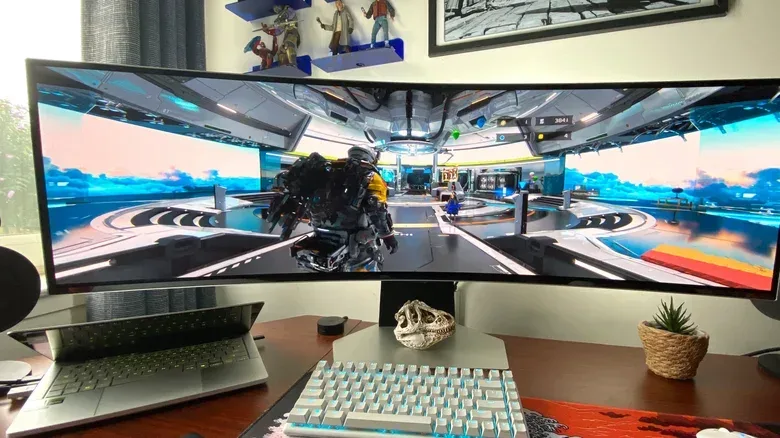

There is an easy mistake to make when looking at a major esports stage: if the professionals are sitting in front of LCD monitors, LCD must be the better competitive technology. That conclusion does not really hold up. The display choice at a tournament is shaped by standardized event hardware, sponsor relationships, familiar formats and the unusually persistent popularity of compact 24-inch, 1080p screens—not a sweeping verdict that OLED cannot keep up.
For people buying a monitor for their own desk, the question is far more personal. It is not “what happens to be installed on stage?” It is whether the room is bright, how much the display costs, how static the daily workload is, which screen size feels comfortable, and whether rich HDR games, dark scenes and fast motion matter most. OLED has major advantages in that equation, alongside a few caveats that deserve a clear-eyed look.
Why tournament monitors are usually LCD
Competitive events generally provide the monitors rather than having every competitor bring a preferred display. That makes uniformity valuable: everyone plays on the same model, with the same size, resolution and basic behavior. Sponsors also influence the hardware selection. Neither point says anything inherently negative about OLED image quality; they explain why a familiar class of LCD monitor remains entrenched.
The established tournament template is often a 24-inch, 1080p display. The compact format is valued because players can take in the whole image quickly without moving their eyes across a larger panel. It is also a well-populated part of the LCD market. OLED monitor options in 2026 commonly begin at 27 inches, so the physical dimensions alone make OLED a less natural fit for an event built around the 24-inch standard.
Refresh rate matters, too. Refresh rate, expressed in hertz (Hz), describes how many times a screen can update per second. A 480Hz monitor can refresh up to 480 times each second. OLED has reached that territory: Sony developed its 480Hz M10S OLED for the Apex Legends Global Series Year 4 in early 2025. Still, some IPS LCD displays exceed 600Hz, giving organizers and players who prioritize the highest available refresh-rate figures another reason to remain with LCD.
That does not turn OLED into a weak option for competitive games. It simply means the pro-event market rewards a particular package: very high-Hz options, established availability at 24 inches, and standardized equipment arrangements. Those conditions are more specific than the broad claim that “pros do not use OLED.”
Fast motion is an OLED strength, not a liability
OLED’s case in fast-paced games starts with pixel response. A pixel response is the time a pixel takes to change from one state or color to another. Slower changes can leave a faint trailing artifact behind moving objects, commonly called ghosting. OLED pixels can change extremely quickly, which helps preserve motion clarity in high-speed first-person shooters and other games where targets, camera movement and visual effects are constantly in motion.
This is separate from refresh rate, though the two are often discussed together. Refresh rate is about how often the panel receives an opportunity to show a new frame. Pixel response is about how cleanly it can make the transition when that update occurs. A high refresh rate is useful, but a display also needs good motion behavior to keep the image from looking smeared or trailed. OLED’s near-instant response is therefore a meaningful competitive asset.
There are practical reasons not to treat a professional player’s event setup as a universal shopping recommendation. Event competitors may train on a particular size and resolution for speed and consistency. A home player may want a monitor for single-player games, multiplayer games, movies, work and shared viewing. A 27-inch screen can be a drawback in one tightly controlled competitive scenario while being a more appealing everyday canvas everywhere else.
The black-level advantage changes more than dark rooms
The core technical distinction is illumination. OLED is a self-emissive display technology: individual pixels produce their own light and color. When a pixel must display black, it can switch off. LCD panels need a backlight, so they cannot shut off illumination on a pixel-by-pixel basis in the same way.
That is why OLED is associated with perfect black levels and effectively infinite contrast. In a dark game scene, black areas can remain truly dark while bright interface elements, flashes of light and colorful effects stand apart sharply. It is not merely an impressive specification on a product page. It affects the sense of depth, atmosphere and separation between light and shadow in normal use.
Contrast is the range between the brightest and darkest parts of an image. Strong contrast helps an image look dimensional and impactful. OLED also brings wide viewing angles, so the image is less compromised when viewed away from the center, and it can offer high-level color reproduction and HDR performance. HDR, or high dynamic range, is content designed to represent a broader brightness and color range. OLED’s ability to render true blacks gives HDR material an especially strong foundation.
Design can be an additional, if less important, benefit. OLED monitors often have slim bezels, which can reduce the visible framing around a game world. That does not decide whether a monitor is good, but it can improve the feeling of immersion in a desktop setup.
OLED imperfections are real, but so are LCD’s compromises
It would be misleading to present OLED as flawless. Burn-in, sometimes discussed as persistent image retention, remains a consideration. It refers to lasting traces left by static elements after prolonged exposure. Modern OLED panels use measures such as pixel shifting to reduce the risk, and the issue is less severe than it was for earlier generations, but it has not vanished. Buyers who display fixed desktop elements for long periods or spend extensive time with persistent interface layouts should account for it.
OLED can also show vertical banding in near-black material. This may appear as faint vertical lines during a dark panning shot. It is an image-uniformity limitation worth knowing, especially for people who are sensitive to dark-scene artifacts.
LCD has its own image-quality pitfalls. One is Dirty Screen Effect, or DSE: uneven backlighting can create blotchy-looking patches on the panel. The problem can stand out on broad, uniform areas of color and is particularly noticeable in sports viewing. Since LCD backlights cannot illuminate every part of the panel perfectly evenly, this is a familiar concern across the category.
Neither technology should be judged by pretending its drawbacks do not exist. The more useful comparison is about which drawbacks affect the intended setup. OLED’s headline risk is static-image retention, while LCD’s strengths include lower prices, higher brightness in many models and much lower susceptibility to retention. OLED’s big image advantages are black level, contrast, motion clarity and uniformity, with exceptionally wide viewing angles as another notable bonus.
Brightness, budget and room conditions still favor LCD for some buyers
LCD remains the sensible choice in several straightforward cases. First, it is often substantially cheaper. OLED pricing has become more approachable, and 27-inch OLED gaming monitors can sometimes be found below $500 during major sales, but comparable LCD options are frequently less expensive. A tight budget can outweigh any technical preference.
Second, many LCD displays are brighter than OLED alternatives. In a bright room, extra brightness can be a practical advantage for both gaming and work. A great dark-room image loses some of its charm if daylight or strong room lighting dominates the screen. Shoppers should think about the actual place the monitor will live rather than only a dark, controlled demo environment.
Third, an LCD can offer more peace of mind for long stretches of static content. That can matter for a monitor used as much for work as games. OLED’s protective technology helps, but it does not change the basic fact that the panel type deserves more care around persistent elements.
That broader setup thinking applies to the rest of a PC, too. A display purchase is one part of a system rather than an isolated trophy component; routine maintenance issues can also affect the desk experience. For another practical example, see what to watch for with PC liquid coolant replacement.
A practical way to choose between OLED and LCD
Start by ignoring the prestige of the esports desk. A tournament monitor is purpose-built around organizational needs and a specialized competitive format. Your own monitor should match the games, space and non-gaming use you actually have.
- Choose OLED when: deep blacks, contrast, HDR, color, wide viewing angles and clean fast motion are high priorities; a 27-inch-or-larger screen suits the desk; and you can accommodate the premium and manage static-content concerns.
- Choose LCD when: price is the overriding concern; the monitor will operate in a very bright room; persistent static imagery is a major part of daily use; or a compact 24-inch, 1080p competitive format is specifically desired.
- Consider refresh rate in context: exceptionally high-Hz IPS displays remain relevant for players pursuing the highest available refresh-rate numbers, while a high-refresh OLED can still provide superb motion due to its fast pixel response.
- Match the screen to your field of view: do not assume larger is automatically better for competitive play. The event preference for 24 inches reflects a real ergonomic priority, even if it is not the only valid preference.
The useful takeaway is not that OLED has displaced LCD everywhere, nor that esports has somehow exposed OLED as unsuitable. OLED and LCD solve different practical problems. Tournament stages continue to lean on LCD because of sponsorship, standardization, compact 24-inch availability and extremely high refresh-rate choices. At home, OLED’s self-emissive pixels, true blacks and rapid response can make it an outstanding gaming display—provided its cost, brightness limitations and residual burn-in risk fit the buyer’s circumstances.