GTA 6 may be absorbing a remarkable amount of gaming conversation, but the people not playing it are not short on things to do. A recent wave of player responses sketches out a notably wide alternative playlist: subterranean curiosity in Queen’s Domain, an extended stay in Fire Emblem: Fortune’s Weave, familiar frustration at the Water Temple in an Ocarina of Time remake, several flavors of Warhammer, and quiet indie pursuits such as Milki Delivery, Tanuki: Pon’s Summer, and Dressmaker.
That variety is the useful part of the discussion. A game dominating attention does not turn gaming into a one-game hobby. Some players may lack the right platform or the money for the biggest release; others simply want a different pace, genre, aesthetic, or commitment. The result is not a single anti-GTA consensus. It is a reminder that, even during a blockbuster moment, people play for very different reasons.
For readers trying to separate the volume of conversation from the meaning of review aggregates, see our explainer on what a 99 Metacritic score for GTA VI actually means. A score can describe critical reception; it cannot decide what kind of evening, game loop, or community a particular player wants.
Queen’s Domain and the appeal of the suspicious hole
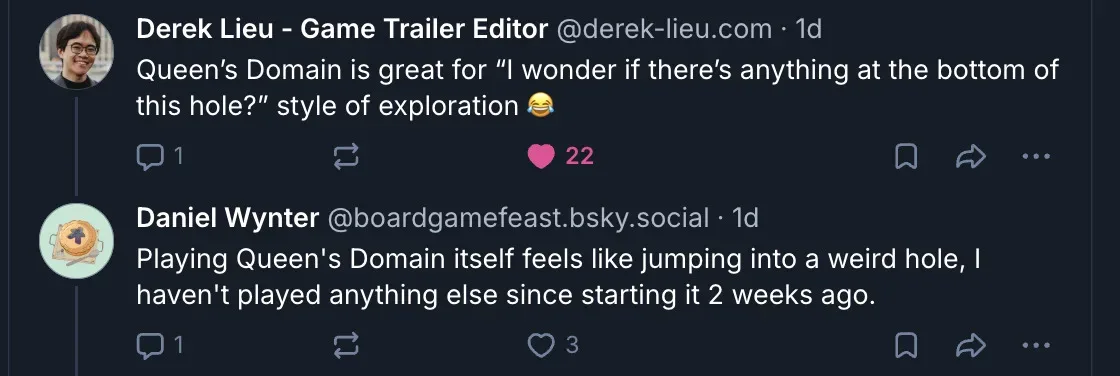
Among the games repeatedly raised as an alternative, Queen’s Domain stood out. The clearest description offered by players is wonderfully specific: it is built around the impulse to look into a hole and wonder whether something is waiting at the bottom.
That phrase points to a particular kind of exploration game. Rather than treating movement through a world as a straight line between mission markers, it makes a question itself compelling. Is the drop safe? Is it a shortcut? Is there a secret, a route onward, or merely an unpleasant surprise? The pleasure is in investigating the possibility.
Exploration, in this sense, does not just mean having a big map. It means being given spaces that prompt curiosity and allow the player to act on it. A cavern, side path, pit, locked door, or strange landmark can become memorable when it carries the suggestion that the obvious route may not be the only route. The available player comments do not establish every system or feature in Queen’s Domain, but they do identify its appeal with unusual precision: people are enjoying the urge to find out what is down there.
That is a strong counterpoint to the idea that one enormous release needs to satisfy every possible gaming appetite. Some players want a vast, high-profile open-world spectacle. Others are quite happy to spend their time following the ancient gamer instinct that says, “There is definitely loot—or trouble—at the bottom of that hole.”
Long games are still being played one chapter at a time
Fire Emblem: Fortune’s Weave was another point of recognition, particularly for players who are still in its first part. That is less a complaint than an acknowledgment of how players actually live with long-form games. A lengthy campaign does not have to be treated as a race to the credits, nor does being early in the story mean someone is “behind.”
Related coverage includes What Players Are Choosing Instead of GTA 6.
There is a practical contrast here between a major release that drives immediate, collective conversation and a game that can occupy someone for an extended stretch. New releases often generate pressure to keep up: avoid spoilers, join the discussion, complete it before attention moves elsewhere. A long-running game offers another rhythm. Progress can be measured in a finished chapter, a completed battle, or simply an evening spent returning to a familiar save file.
That slower relationship with a game matters when every large release is framed as an event. Gaming is also a backlog, a hobby built around partial progress, and sometimes a promise to oneself to finally continue the game already in progress. “Still in part one” can be a status update, a joke, and an entirely valid way to play.
The Water Temple remains a water problem
The Ocarina of Time remake also surfaced in the responses, along with a particularly enduring obstacle: the Water Temple. Even with the understanding that its challenge has been reduced relative to the original version, the temple still managed to stop a player in their tracks.
That anecdote is a compact explanation of why a remake can remain interesting. A remake is a new version of an earlier game, but it does not necessarily erase the original’s identity—or every form of friction players remember. Changes may make certain tasks less punishing or more manageable, while the broader mental challenge remains: keeping track of a complex space, interpreting how its mechanisms relate to one another, and noticing the next route forward.
The Water Temple’s continued reputation is also a reminder that difficulty is not one thing. Reflex challenges ask for timing and execution. Navigation challenges ask players to build a mental map. Puzzle challenges ask them to understand a system. A section can be less difficult in one respect and still be demanding in another. For anyone choosing what to play instead of the cultural headliner, revisiting an old adventure—and discovering that an infamous dungeon can still cause problems—has its own charm.
Warhammer offers more than one kind of game
The responses also made room for a broad spread of Warhammer games, including Warhammer Survivors, Rogue Trader, and Space Marine 2. The significant point is not simply that Warhammer has a dedicated audience. It is that the setting can serve players looking for markedly different genres.
Genre is the basic category describing how a game is played: the rules, viewpoint, goals, and skills it emphasizes. Players referenced a mix that includes survival-focused action, role-playing, and combat action. One fictional universe can therefore become a route into several distinct kinds of play rather than a single experience with a single audience.
Strategy is the remaining Warhammer lane highlighted in the conversation, with Dawn of War IV set to arrive November 30. Strategy games generally center decisions about positioning, units, resources, and larger plans. The appeal expressed by one player was admirably direct: moving soldiers around a map remains a pure form of gaming. That is an argument for the satisfaction of making a plan and watching it succeed—or having to rebuild one when it fails.
It also demonstrates why “what are you playing?” is more revealing than “what is the biggest game?” One player may want character-building and role-playing decisions; another may want immediate action; another may want the focused, deliberate work of tactical command. They can all find something within Warhammer, while still having little reason to switch to the industry’s most-discussed release.
Cozy games make room for a different kind of attention
Cozy indie games formed another clear cluster, with Milki Delivery, Tanuki: Pon’s Summer, and Dressmaker receiving mentions. “Cozy” is not a strict technical genre in the way strategy or role-playing game can be. It is better understood as a description of tone and player expectation: a game associated with lower-pressure enjoyment, comforting routines, gentler stakes, or a warmly crafted setting.
That label is useful precisely because it says something a platform, budget, or visual scale does not. Players can be looking for a game that lets them settle in rather than gear up. They may want a smaller experience between larger games, or they may prefer that intimate scale outright. The games mentioned here should not be assumed to play alike just because they are grouped as cozy; the shared thread is the kind of mood players are seeking.
Dressmaker has an especially intriguing upcoming appearance: it is slated to be featured during AGDQ 2027. AGDQ is a speedrunning event, and speedrunning means completing a game as quickly as possible, usually through deep knowledge of its systems, routing, and execution. A dressmaking game appearing in that setting is a neat illustration of how speedrunning can turn almost any focused activity into a technical challenge. It does not require a game to be built around combat or spectacle for players to investigate its fastest possible path.
The practical case for playing something else
The most grounded takeaway from these responses is not that anyone needs to reject GTA 6. It is that gaming attention can become so concentrated around one release that opting out feels like missing the whole conversation. In practice, players opt out for ordinary and sensible reasons: the needed platform may not be available, the cost may not fit, or the game may simply not be to their taste.
For players feeling shut out by a blockbuster-heavy news cycle, the practical response is simple: identify the kind of play you actually want rather than the title everyone is discussing. Want discovery? The enthusiasm around Queen’s Domain suggests an exploration-led detour. Want a lengthy campaign that accepts incremental progress? Fortune’s Weave remains there. Want to test your spatial memory against a famous dungeon? The Ocarina of Time remake has a Water Temple waiting. Want an established universe with multiple gameplay styles? The cited Warhammer games provide several directions. Want a softer pace? The cozy indie group is a useful starting point.
None of that diminishes the scale of GTA 6’s moment. It just makes room for the far more durable truth: no game, however enormous, is the only game being played. While one audience is talking about Vice City, someone else is mapping a dungeon, commanding troops, sewing under speedrun pressure, or jumping into a hole because curiosity got there first.