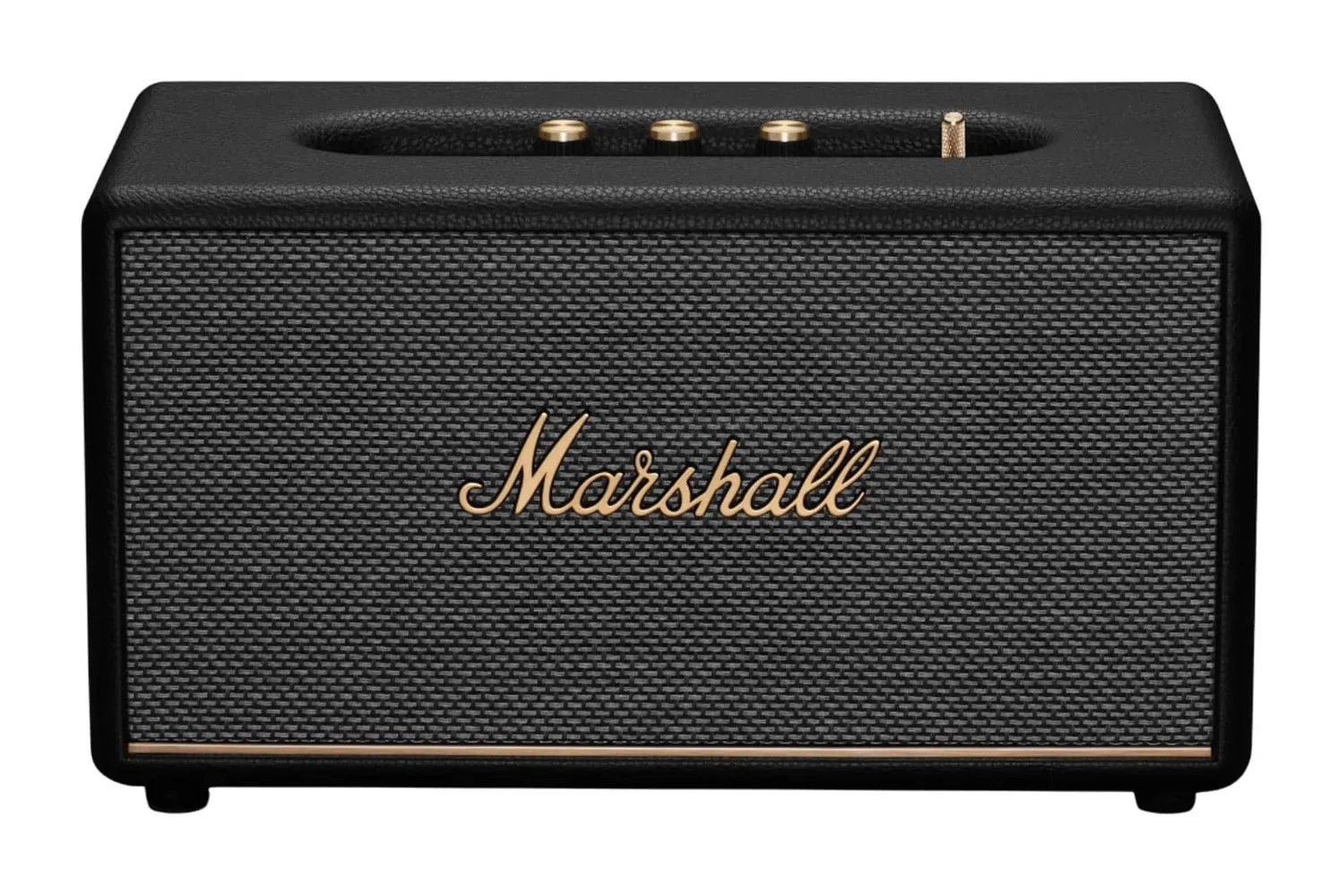
The Marshall Stanmore III Bluetooth Home Speaker is listed at $250, a $150 reduction from its stated $400 regular price. That is a 38% discount on a mid-size home speaker built around a distinctly guitar-amp-inspired look, but the more useful reason to consider it is its mix of straightforward physical controls and flexible connections.
Marshall rates the Stanmore III at 80 watts of Class D amplification. Its cabinet contains a 50-watt woofer for the lower frequencies and two 15-watt tweeters for higher-frequency detail. Bluetooth 5.2 handles wireless playback, while RCA and 3.5mm analog inputs offer options for equipment that should not—or simply cannot—connect over Bluetooth.
For a living-room, shelf, desk-side or game-room music setup, that combination matters more than headline wattage alone. It means the speaker can be used as a single all-in-one unit for a phone or computer, then remain useful if the setup expands to include a CD player or a turntable with its own phono stage. It also provides knobs for volume, bass and treble, avoiding the need to reach for an app every time a track needs a small adjustment.
What the $250 Stanmore III deal includes
The Stanmore III is intended for placement on furniture such as a shelf, sideboard or bookcase. It is a two-way speaker: in simple terms, it divides the job of reproducing sound between a larger woofer and smaller tweeters. The woofer handles much of the low and mid-range output, while the tweeters reproduce the higher frequencies.
Each driver has its own Class D amplifier. Class D is an amplifier design commonly used in compact powered speakers because it can deliver substantial output without requiring the bulk associated with some other amplifier approaches. In this case, the combined amplifier rating is 80 watts: 50 watts for the woofer and 15 watts for each of the two tweeters.
The two tweeters angle outward rather than firing only directly ahead. Marshall’s stated goal is a broader dispersion of sound around a room. Practically, that is relevant when listeners are not positioned in one fixed sweet spot—for example, while moving between a sofa, desk and kitchen area. It is not a replacement for a multi-speaker surround system, but it is a design choice aimed at making one speaker sound less narrowly focused.
A rear-facing bass reflex port supports low-frequency reproduction down to 45Hz. A bass reflex port is an opening in the cabinet that uses the air inside the enclosure to reinforce part of the bass response. Its placement at the rear is worth noting when choosing a spot: the Stanmore III includes a software setting specifically designed to account for reflections from nearby walls and surfaces.
Controls that work without the app
One of the Stanmore III’s clearest differentiators is its top-mounted analog control set. Physical knobs adjust volume, bass and treble through a twisting motion that deliberately echoes an amplifier control panel. That is useful for people who prefer an immediate change rather than navigating a phone interface just to make a tonal adjustment.
The bass and treble controls are basic tone controls. Raising bass emphasizes the lower end; raising treble emphasizes higher-frequency content. Neither is a universal “better sound” dial. A small bass increase may help at low volume or in a thin-sounding room, while too much can muddy voices and instruments. Additional treble can add presence, but excessive adjustment may make a recording sound sharp. The point of having direct controls is not that every track needs intervention, but that room acoustics and listening level can call for quick, personal changes.
The Marshall Bluetooth app adds functions beyond those three knobs. It provides equalizer adjustment, source selection and over-the-air firmware updates. An equalizer, or EQ, changes selected portions of the frequency range more specifically than broad bass and treble adjustment. Firmware updates are software updates for the speaker itself, delivered wirelessly.
The app also houses Placement Compensation. The feature is intended to address near-field reflections, meaning sound that quickly bounces off close walls or similar surfaces before reaching the listener. A speaker placed close to a wall may sound different from one sitting farther into a room; this setting is designed to help tailor the presentation to that placement. It is a practical feature for the Stanmore III’s intended shelf and sideboard use, where free space behind a speaker is not always available.
Dynamic Loudness is another included processing feature. It adjusts tonal balance based on volume so music is intended to retain a fuller character whether played softly or loudly. That is particularly pertinent for low-volume listening, when the perceived balance of bass and treble can change compared with louder playback.
Bluetooth, Auracast and the wired connections
Bluetooth 5.2 provides the Stanmore III’s primary wireless connection, with a stated range of about 30 feet. Real-world range can vary with walls and other obstacles, but the specification establishes the speaker as a conventional room-scale Bluetooth option rather than a device tied to a short cable run.
The speaker supports Bluetooth Low Energy Audio and Auracast. Bluetooth Low Energy Audio is a newer Bluetooth audio framework designed around lower-energy operation. Auracast is the relevant practical term here: it can allow multiple compatible speakers to play the same music at the same time. Compatibility is the key qualification. This feature depends on the other participating audio devices supporting the necessary technology; it should not be assumed that every Bluetooth speaker can join such a setup.
For wired gear, the Stanmore III has an RCA input and a 3.5mm analog input. RCA is the familiar pair of left-and-right analog connectors commonly found on home audio equipment. Marshall positions it for CD players and turntables with built-in phono stages. That last detail is important: the supplied information identifies turntables with built-in phono stages, not all turntables.
A phono stage boosts and equalizes the unusually low-level signal produced by a traditional turntable cartridge so it can be used by normal line-level audio equipment. If a turntable lacks that built-in stage, the described RCA connection alone does not establish that it can connect directly without additional hardware. Buyers planning a vinyl setup should verify what their turntable outputs before treating the Stanmore III as a one-cable solution.
The 3.5mm analog input provides a simpler wired route for older mobile devices and other equipment using that connector. It also gives users an alternative where they would rather use a cable than wireless pairing. Between Bluetooth, RCA and 3.5mm, the Stanmore III covers several generations of common playback hardware without presenting itself as a complicated receiver or a component-speaker system.
Design is part of the product proposition
The Stanmore III is unmistakably styled after Marshall guitar amplifiers, with a script logo on the grille and brass-colored accents surrounding the controls. That visual identity is central to its appeal, particularly for a setup where the speaker will remain visible rather than disappear behind a television or under a desk.
It comes in Black, Brown and Cream. The finish choices are a practical consideration for a speaker intended to occupy furniture space in a living room or listening area. Someone building a visible entertainment corner may value that flexibility as much as the familiar Marshall branding. For a broader look at a lower-cost display option for a game-room setup, see our coverage of the Insignia 50-inch F50 4K Fire TV deal.
Marshall also says the Stanmore III contains no PVC and that 70% of the plastics it uses are recycled, alongside vegan materials. Those material choices do not answer every sustainability question around an electronic speaker, but they are defined design details for shoppers who weigh materials alongside connectivity and appearance.
Who this speaker makes the most sense for
At $250, the Stanmore III is most compelling for someone who wants a single powered home speaker that can bridge current wireless listening and legacy analog equipment. The key attraction is not one specification in isolation. It is the cumulative package: 80 watts of Class D amplification, a woofer-and-two-tweeter arrangement, physical tone controls, app-based room and EQ settings, and both RCA and 3.5mm inputs.
It is especially suited to listeners who want their speaker to be a visible piece of furniture and who appreciate immediate controls. The angled tweeters, Dynamic Loudness and Placement Compensation are all intended to make the unit more accommodating in ordinary rooms, where placement and listener position are rarely perfect.
There are also clear boundaries to keep in mind. The product is one home speaker, not a specified surround package. Auracast’s multi-speaker function requires compatible devices. And vinyl users should confirm that a turntable includes a phono stage before expecting a direct RCA connection. Those caveats do not lessen the appeal of the discount; they simply define the setup the Stanmore III is designed to serve.
The current listing brings the Marshall Stanmore III down from $400 to $250. For buyers looking for a shelf-friendly speaker with wireless convenience, analog inputs and amp-like physical controls, that $150 reduction materially changes the value conversation.
Shop the products
Check current price, model and availability at the retailer.