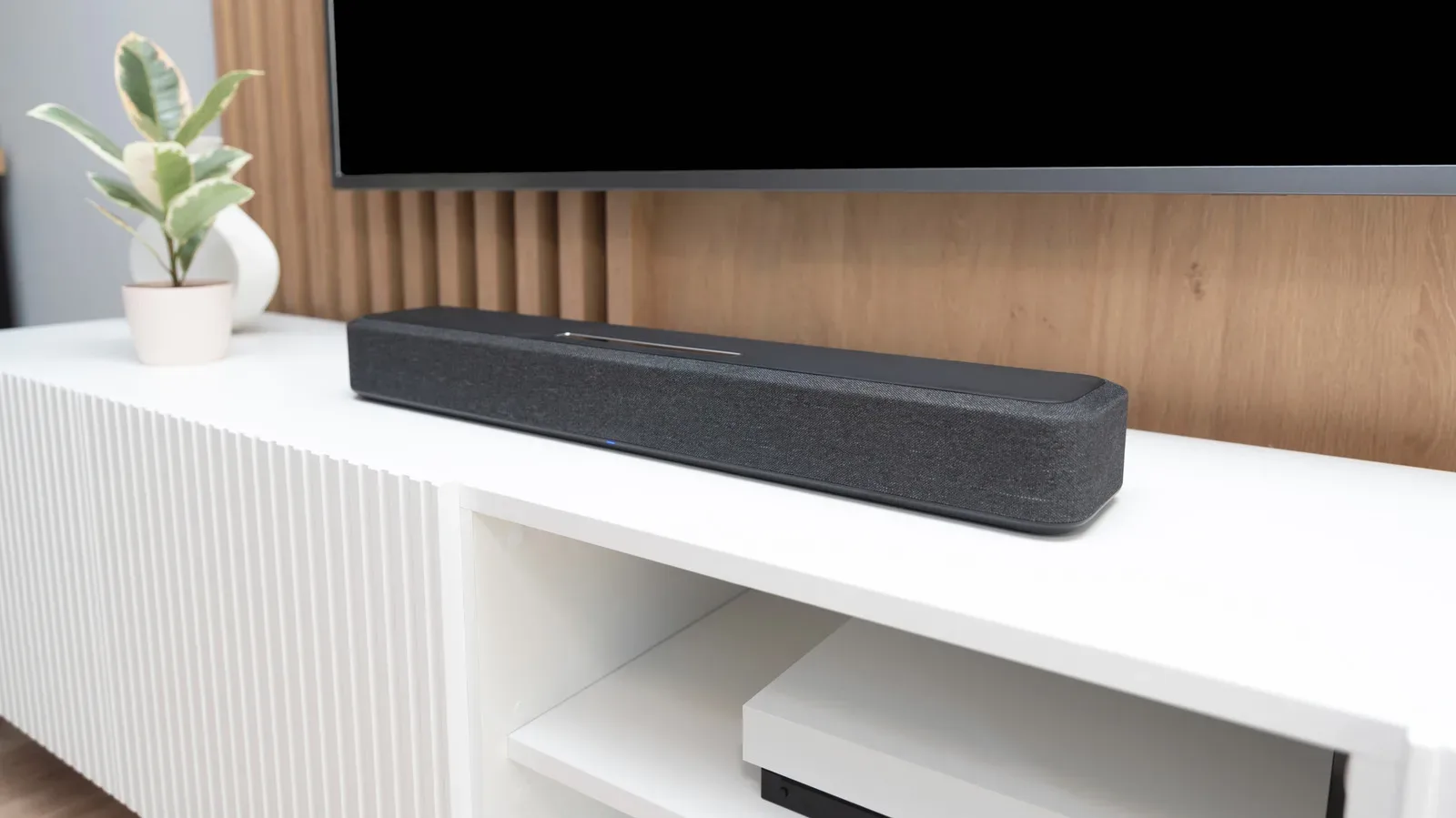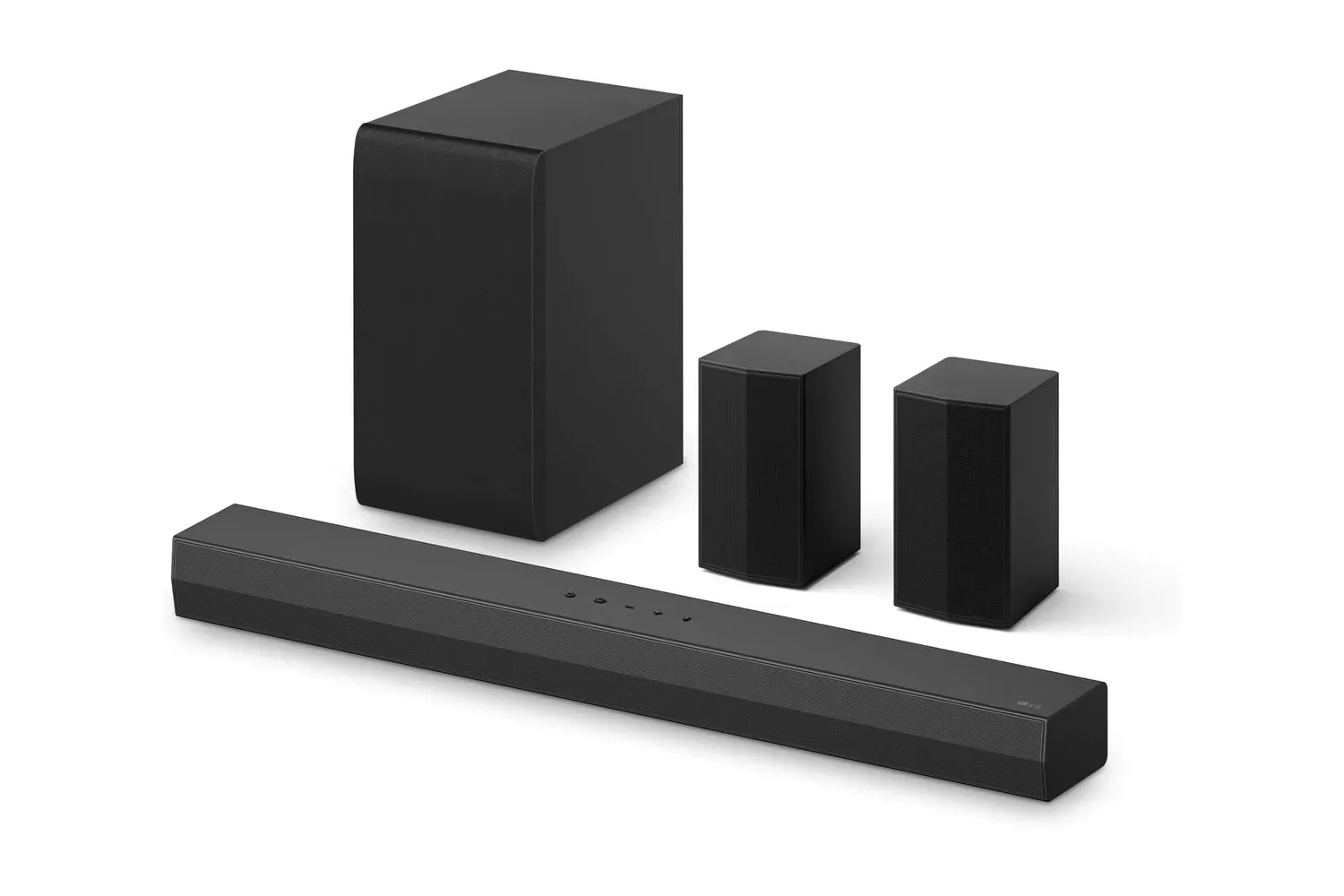
TV speakers can handle the basics, but they are often the weak link in a gaming setup built around a large display, a current console, or a capable PC. LG’s S40TR 4.1-channel home-theater soundbar is currently listed at $200, down $50 from a stated $250 regular price. The notable part is not simply the discount: this is a package with a main soundbar, a wireless subwoofer and two rear speakers rather than a bar-only solution.
For players who want a broader, more positional presentation without assembling a traditional receiver-and-speaker system, that configuration is the central appeal. The S40TR supplies 400 watts of total power, with 200 watts attributed to its wireless subwoofer, and supports Dolby Digital and DTS. It also includes Bluetooth 5.3, HDMI ARC and optical inputs, a three-band equalizer, dialogue-focused processing, and automatic sound adjustment.
That is a substantial list at the listed price, but it is important to frame it correctly. A 4.1-channel system adds real rear speakers, which can give games and films more activity behind the listener. It is not the same thing as a system with dedicated height channels, and prospective buyers should make sure the physical realities of their room suit rear-speaker placement before treating the package as an automatic upgrade.
What “4.1-channel” means for games
The first number in a speaker-channel label refers to the main speakers; the number after the decimal identifies subwoofers. In this case, 4.1 means four primary channels and one subwoofer. The S40TR’s soundbar covers the front of the room while its two included speakers are intended to sit behind the seating position. The subwoofer is responsible for low-frequency effects.
In practical terms, rear speakers can make environmental effects feel less confined to the front wall. A game’s ambient weather, vehicles passing through a scene, enemy movement, or effects approaching from behind have more room to register around the player. The same layout can make a sports broadcast feel more enveloping when crowd noise fills the room.
That benefit depends on game audio design and speaker positioning, rather than a promise that every sound will be pin-point accurate. Still, the important distinction here is hardware: a soundbar that merely simulates surround sound does not put speakers behind the couch, while this package does. Buyers moving up from TV audio, or from a basic bar without satellites, are getting an actual rear sound field to work with.
The subwoofer has an equally straightforward job. Explosions, engines and bass-heavy musical passages are the kinds of sounds it is meant to carry. LG rates the included wireless subwoofer at 200 watts. “Wireless” in this context means it does not need an audio cable run from the soundbar across the room; it still needs power. It can be moved to seek the bass response that works best in a particular room, although no placement is universally ideal.
The setup detail worth checking before buying
The system reduces one common surround-sound headache but does not eliminate every wire. The rear speakers do not require a cable run back to the soundbar. However, they are connected to one another by a wire, and one rear speaker plugs into a power outlet. That is a more manageable arrangement for many living rooms, but it still asks for a plausible route behind the sofa and access to electricity.
That caveat matters more than headline wattage. Someone with a couch against a wall, usable outlets nearby and enough space behind their seating is in a much better position to benefit from the included rears. Someone who cannot place speakers behind or beside the seating area may end up paying for a key feature they cannot sensibly use.
The front end is more conventional. The S40TR can connect to a television through HDMI ARC or optical. ARC, short for Audio Return Channel, allows a compatible TV to send audio back through an HDMI connection to the soundbar. It can simplify control because the television remote may handle the soundbar’s volume. Optical is an alternative digital audio connection for televisions that lack ARC or for setups where that is the preferred available option.
LG says setup consists of connecting the TV by HDMI ARC or optical, turning on the soundbar, and powering the subwoofer and rear speakers, which pair automatically. That should make the product less intimidating than a component system, though buyers should still verify which outputs their TV has and plan cable lengths around their furniture.
Dialogue processing and sound modes explained
The S40TR has two features aimed at reducing routine fiddling. Clear Voice Plus is designed to bring dialogue forward, helping speech stand out when music, effects or busy mixes threaten to swamp it. For games, that could be useful in story-heavy scenes, mission briefings, multiplayer chatter routed through the TV, or any title where subtitles are not a player’s preferred fallback.
AI Sound Pro, meanwhile, analyzes the content being played and automatically adjusts the overall sound. The basic promise is convenience: fewer manual jumps between preset modes when moving from a game to a show, a film, or music. Automatic processing is a preference-sensitive feature, though. Some people appreciate a system making sensible adjustments in the background, while others prefer a stable manual setting.
The three-band equalizer provides a middle path. It separates tone adjustment into bass, mids and treble. Bass changes the low-end weight associated with the subwoofer’s rumble and music’s deeper notes. Mids are especially relevant to the body of voices and many effects. Treble affects higher-frequency detail, such as the sharp edge of certain effects. It is a basic set of controls rather than an invitation to overcomplicate a living-room system, but it gives owners a way to respond if a room sounds boomy, dull, or overly bright.
LG TV owners have extra options
Owners of compatible LG televisions may have two additional integration features. WOW Orchestra combines the television’s built-in speakers with the soundbar, intended to create more depth than the bar alone. WOW Interface places soundbar controls within the television’s menu.
These extras should be considered a compatibility benefit, not a reason to assume every television will offer them. The S40TR can still connect via HDMI ARC or optical without a compatible LG TV. But buyers who already use one of the supported sets may find the unified control and combined speaker behavior appealing.
Who this $200 package suits
At its listed $200 price, the S40TR makes the most sense for someone seeking a comparatively uncomplicated move beyond television speakers and who specifically has room for rear channels. It provides a complete set of hardware for front, rear and low-frequency sound rather than asking the buyer to add a subwoofer or satellites later.
- Good fit: TV or console players with seating that allows rear-speaker placement, an available power outlet behind the seating area, and a television with HDMI ARC or optical output.
- Potentially useful: Households that regularly switch between games, movies, sports and Bluetooth music, since the system includes automatic sound processing and a manual equalizer.
- Think twice: Buyers with no sensible place for rear speakers, or those looking specifically for height-channel audio, should not confuse this 4.1 setup with a more elaborate surround arrangement.
It is also worth separating audio improvement from competitive advantage. Rear effects can make an action game more involving and can supply a more convincing sense of activity behind the player. They do not replace in-game awareness, a good display setup, or personal preference. The value is in a richer shared-screen and living-room experience, particularly for games with active surround mixes.
For shoppers refining the rest of a console setup, our look at the Xbox Elite Series 2’s feature-to-fit question makes a similar point: premium-sounding hardware only pays off when it suits how and where it will actually be used.
The practical takeaway
The discount reduces LG’s S40TR from $250 to $200, or 20% off, while retaining the package’s key proposition: a soundbar paired with a wireless subwoofer and two rear speakers. Its HDMI ARC and optical connectivity cover two common TV hookup paths, Bluetooth 5.3 adds phone music streaming, and Clear Voice Plus and AI Sound Pro aim to limit constant setting changes.
For gaming, the rear speakers are the feature to evaluate first. If a room can accommodate them, the system’s 4.1 arrangement offers something TV speakers and many entry-level bars cannot: physical sound coming from behind the listener. If the room cannot, a buyer should give that limitation as much weight as the sale price.
Shop the products
Check current price, model and availability at the retailer.