A portable battery is not glamorous equipment, but it can be the difference between a dead phone at the worst possible moment and a device that gets through a long commute, event day or travel stretch. The black version of INIU’s 10,000mAh power bank is currently listed at $22, reduced from $24 in a limited-time deal. That is a 10% discount, modest in cash terms but enough to make this a potentially useful low-cost addition for people who need compact USB-C charging away from a wall outlet.
The deal specifically gives the black model the lowest stated price. Beige, blue, green and red versions are also discounted, though their prices can differ. As with any time-limited storefront promotion, the $22 figure and color availability may change, so it is worth checking the live listing before treating it as a fixed price.
The headline specs: 10,000mAh capacity and up to 45W output
INIU’s battery pairs a 10,000mAh capacity with output rated up to 45W. Those numbers describe different, equally important parts of a power bank’s job.
mAh, short for milliamp-hours, is a battery-capacity measurement. In practical terms, a larger mAh number generally means more stored charge. It should not be read as a literal, universal count of device refills, however. A phone’s battery, the power bank’s conversion process and charging conditions all affect the result. INIU says this model can provide nearly two full smartphone charges, but that should be understood as a brand claim rather than a guarantee for every handset and every situation.
Wattage, or watts, concerns the potential rate of power delivery. A 45W-rated output can matter when the connected device supports a suitably fast charging profile. It is not an instruction that forces 45W into every product: the device and charger negotiate an appropriate level. That distinction is useful for shoppers with a mixture of phones, tablets and gaming-adjacent accessories. The ceiling gives compatible equipment room to charge rapidly, while lower-power devices take only what they support.
For a player carrying a phone for companion apps, voice chat, maps, two-factor sign-ins or mobile games, the combination is straightforward: capacity is the reserve, while wattage is the potential recovery speed. The same applies to a tablet used for streaming, guides or remote-play sessions. The power bank is a backup energy source, not a replacement for knowing the charging requirements of each device.
What INIU claims for charging speed
INIU advertises several 30-minute examples when devices begin at roughly 20% charge: an iPhone 17 Pro Max reaching 76%, a Galaxy S25 Ultra reaching 84%, and an iPad Pro reaching 60%. These examples point to the intended use case—getting a meaningful percentage back during a relatively short break rather than waiting for a full overnight recharge.
They are still examples, not universal results. Charging speed naturally varies with device model, battery condition, temperature, the cable being used and how actively the device is being used while plugged in. A phone running a demanding game, navigation or a video stream may gain charge differently from an idle handset. Likewise, the 45W maximum is only useful where the connected device can accept a compatible fast-charge rate.
That does not undermine the practical appeal of the specification; it simply sets the right expectation. Fast charging is most useful as a way to regain usable time quickly. For many people, turning a low battery into a comfortably usable one before leaving the house—or during a meal, airport wait or convention queue—is more valuable than chasing a perfect 100% every time.
A compact format with a built-in cable option
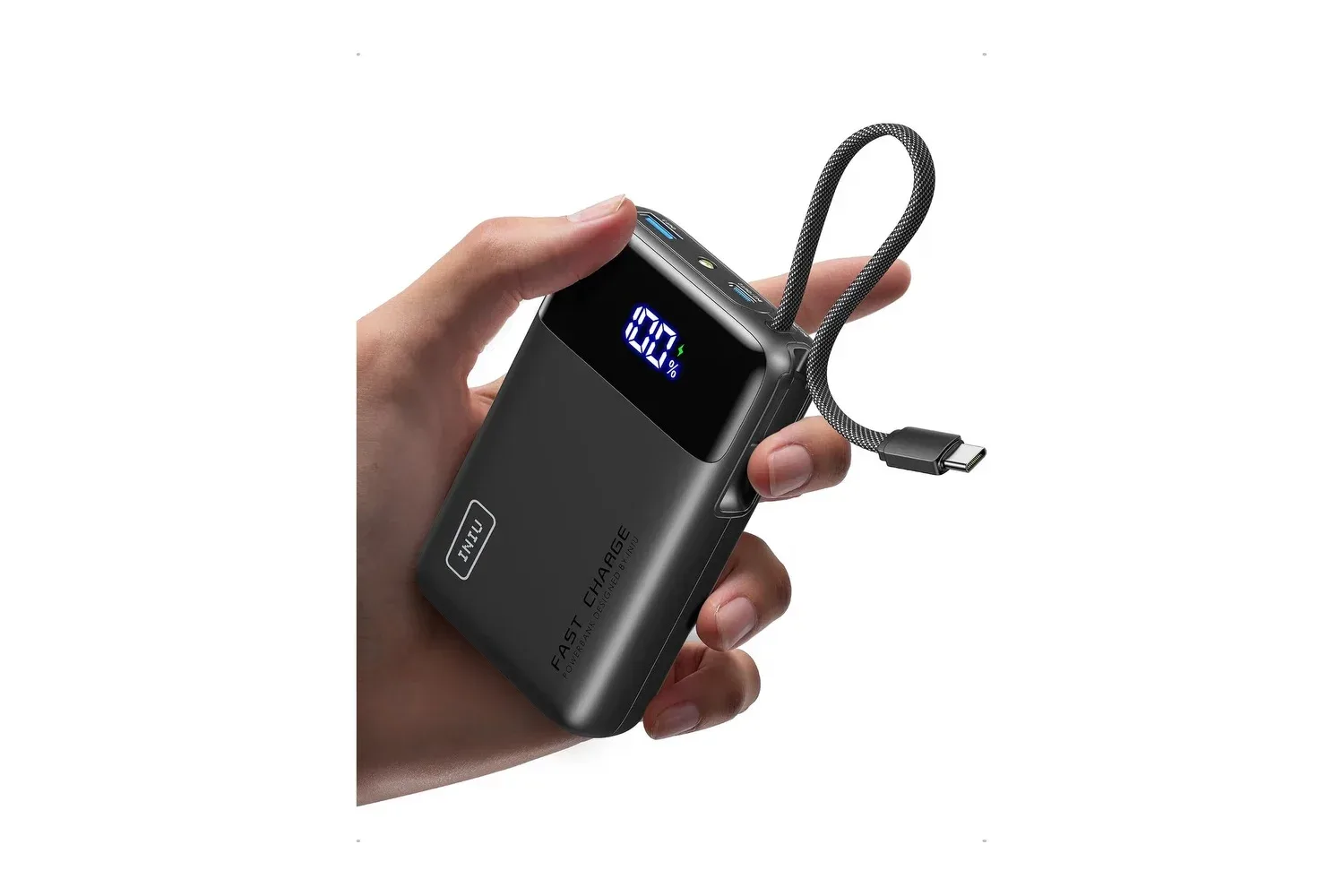
INIU describes this power bank as about 40% smaller and 36% lighter than many alternatives in its category. Those are comparative brand figures rather than standardized measurements against a named set of products, but the intended benefit is clear: the unit is designed to be easy to carry rather than a large reserve battery meant to live in a backpack.
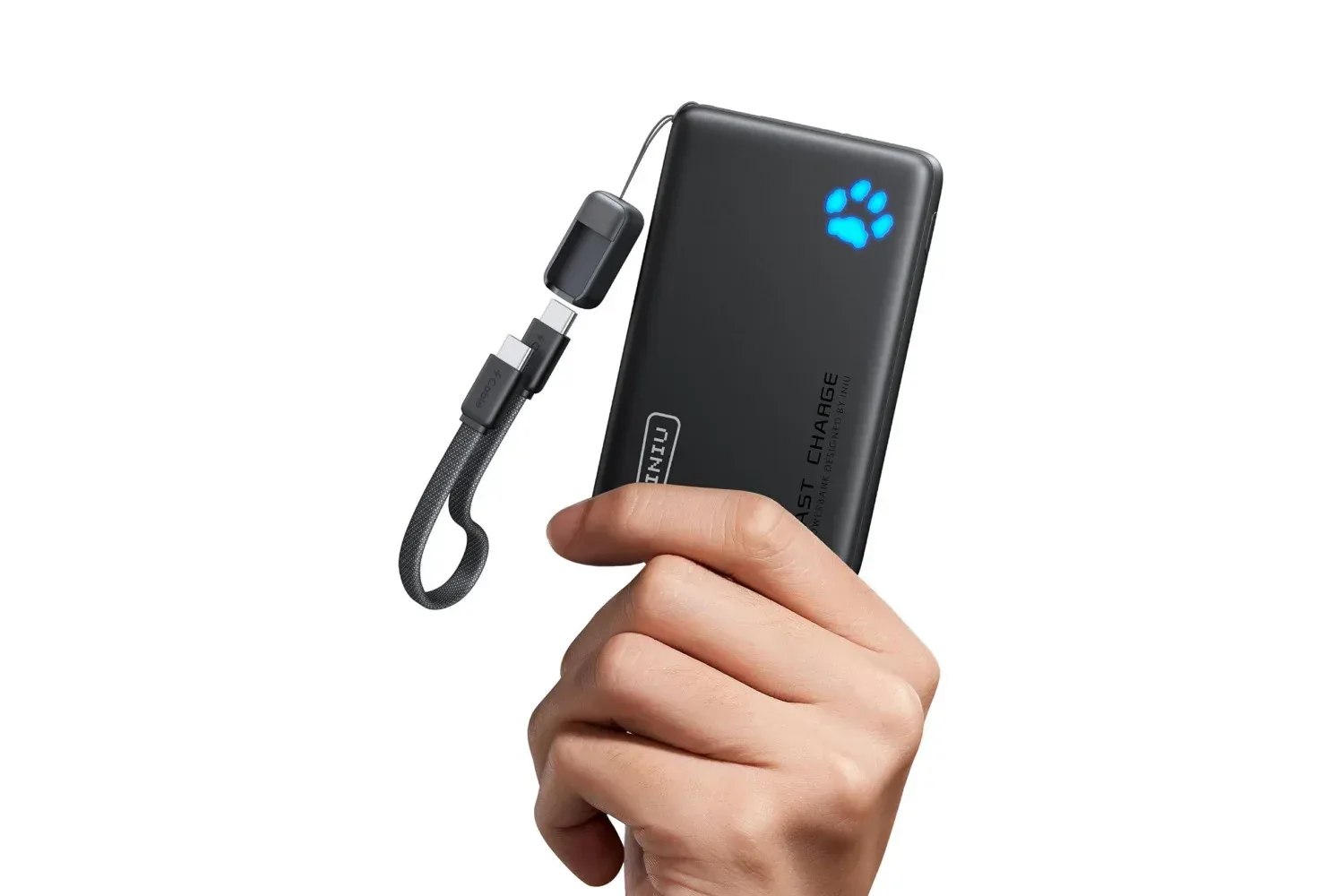
Its included 0.4-foot braided USB-C cable is detachable. That is a small feature with practical consequences. A short cable can keep a pocket, bag or desk setup tidier when the battery is sitting close to the device. Detachability also means it is not a permanent single point of failure: if a longer lead is needed, or the included cable is misplaced, users can swap in another compatible USB-C cable.
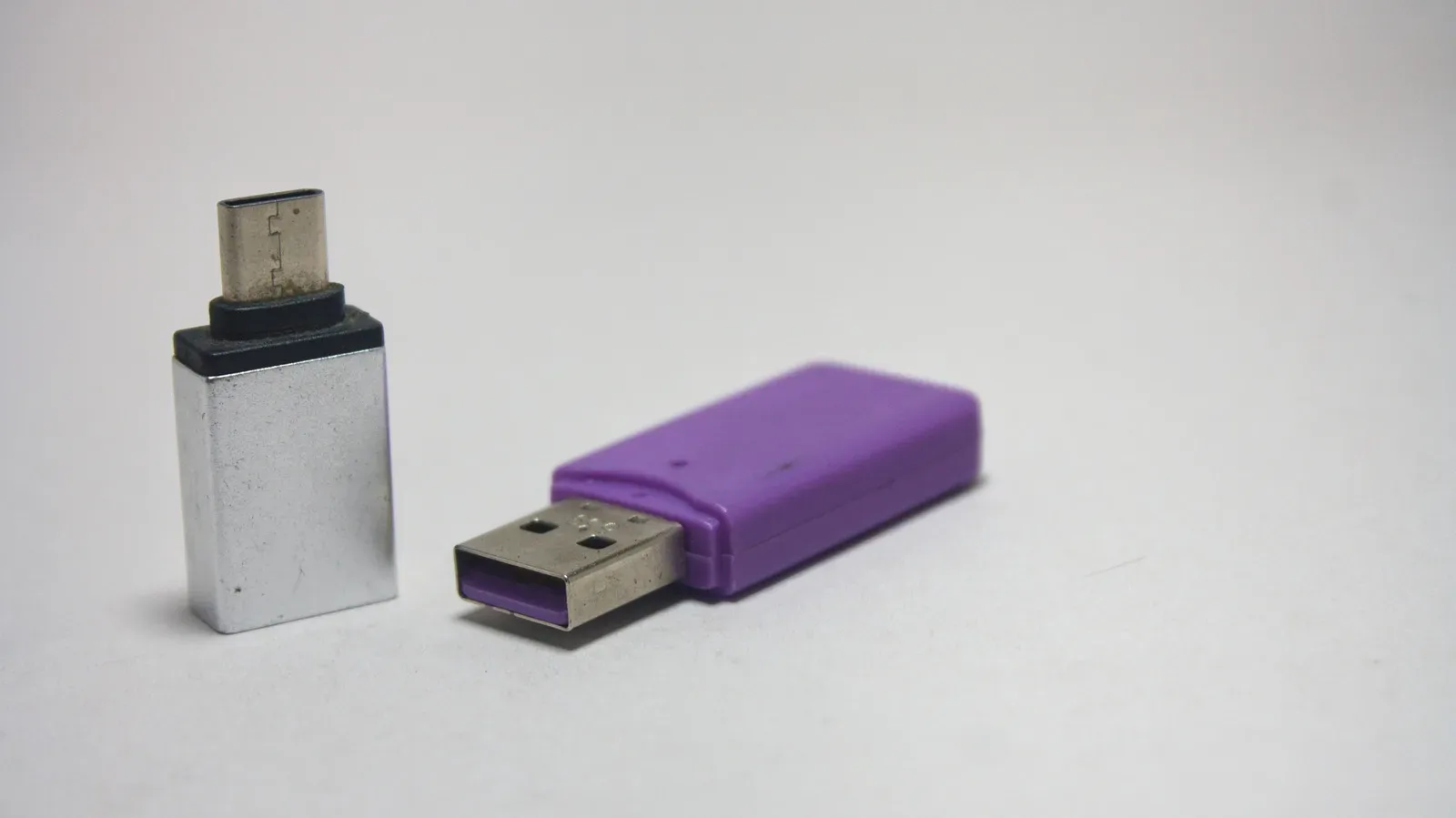
That flexibility is particularly helpful for setups with more than one kind of gear. A short lead may be convenient for a phone and power bank held together, while a longer one can be preferable when charging a tablet from a bag or a device resting on a nearby surface. Anyone buying a separate replacement cable should check its charging capability rather than assuming every USB-C cable performs identically; cable support can affect what a fast-charging device can do. For more on that broader connector question, see our guide to what gamers should check with USB-A-to-USB-C adapters.
Who this $22 battery makes sense for
At the current stated price, this looks best suited to someone who wants a portable day-to-day reserve rather than the largest possible battery. The 10,000mAh rating is positioned by INIU as enough for nearly two smartphone charges, while the 45W output is aimed at reducing the time required to get compatible hardware back into service.
- Phone-first users: A compact power bank can provide a buffer during long days without access to an outlet.
- Tablet users: INIU’s iPad Pro example suggests the unit can deliver a significant partial refill, though a tablet’s larger battery means expectations should be different from those for a phone.
- Travelers: The battery is described as flight-approved for carry-on packing, which gives it an obvious role for trips.
- People who value cable flexibility: The detachable short USB-C cable can be retained for close-range charging or replaced with a longer option.
The package includes the power bank, a USB-C cable, a user manual and three years of INIU care coverage. Prime members are also stated to receive free shipping on the purchase.
Before buying: match the power bank to the device
The most useful shopping question is not simply whether 45W sounds fast. It is whether the device—or combination of devices—you carry can use the connections and charging level on offer. A power bank can be technically capable of a higher rate while a particular phone, handheld accessory or cable works below that maximum. The output rating is headroom, not a promise that every item will charge at 45W.
It is also worth separating portability from endurance. A compact 10,000mAh model is easier to take everywhere, but it is not meant to offer the same reserve as a substantially larger battery. For short-to-medium stretches away from power, that trade-off can be sensible. For extended use where several large devices must be charged repeatedly, shoppers should consider whether a smaller physical footprint is more important than extra stored energy.
Finally, a $2 reduction should be viewed in proportion. The appeal here is not an enormous price collapse. It is that a 10,000mAh, 45W-rated battery with a detachable USB-C lead is listed at $22 rather than $24, with the black color receiving the strongest stated discount. If those specifications already fit the equipment in your bag, the limited-time offer is a reasonable opportunity to save a little. If they do not, the deal alone is not a reason to buy a battery that does not match your charging needs.
Shop the products
Check current price, model and availability at the retailer.